A town reached by a changing army
The operation to recover Tassar ran from March 8 to May 19, 1231. Its setting was eastern Aldren, where Lathorne's Allied grouping confronted Rusk's Teran defense after years of advances, reverses and rebuilding. The town's principal junction had been lost on June 9, 1227. Recovering it therefore carried a powerful symbolic charge. Yet the army of 1231 and the community it hoped to reach were not preserved versions of those present four years earlier. A satisfactory account has to explain those changes rather than treat the operation as a return to a paused moment.
Lathorne's 7th retained institutional experience through surviving leaders, training and staff practice. Many of the people who had learned the earlier lessons directly were no longer serving with it. The same was true of Rusk's 87th. Replacements and reorganization kept the corps active but changed its composition. The familiar contest between the two formation names can hide the work that reproduced their competence. The March battle was fought by organizations carrying experience across repeated personnel losses, not by intact bodies of veterans immune to the passage of the war.
The immediate Allied purpose was to regain the outer ground lost in the September 1230 counterstroke and then reach the central junction. Aldren participation and pressure from other Allied commands restricted the Terans' reinforcement choices. Lathorne led his grouping rather than every Allied formation on the continent. The recovery resulted from a local operation embedded in a wider coalition war. Recognizing that setting gives neighboring commands their causal importance without inventing a unified personal command for a general whose responsibilities were already extensive.
The map no longer described ordinary life
By 1231, Tassar was a damaged collection of positions, surviving civilian spaces and improvised connections. Buildings shown on maps had disappeared. Routes crossed old properties because the original streets could no longer perform their former functions. Shelter systems brought together people once living in separate neighborhoods. These changes affected both combat and relief. Troops needed to establish what a mapped place actually contained; returning residents needed to discover whether the institution or household associated with its name had survived elsewhere.
The central repair district was particularly important because it joined local resistance to the question of usable movement. The battle for connected groups of buildings could not be reduced to counting structures occupied. A group gained in isolation might be lost when its access failed. A less conspicuous position could sustain the supply relationship needed to keep a neighboring gain. The plan's success depended on establishing a workable arrangement inside a damaged town rather than treating its principal junction as an object whose capture would automatically solve every supporting problem.
The Teran defense had also adapted since the previous year. Rusk could not assume the Allies would repeat the same weaknesses, and Lathorne could not assume enemy positions matched earlier reconnaissance. Both organizations operated with a history that was useful only when combined with current information. Wrecks and familiar landmarks reminded veterans where earlier units had fought, but they did not establish which approaches were now secure. The value of accumulated experience lay partly in recognizing that the next battle could differ from the battle remembered.
March 8–31: Ground repeatedly contested
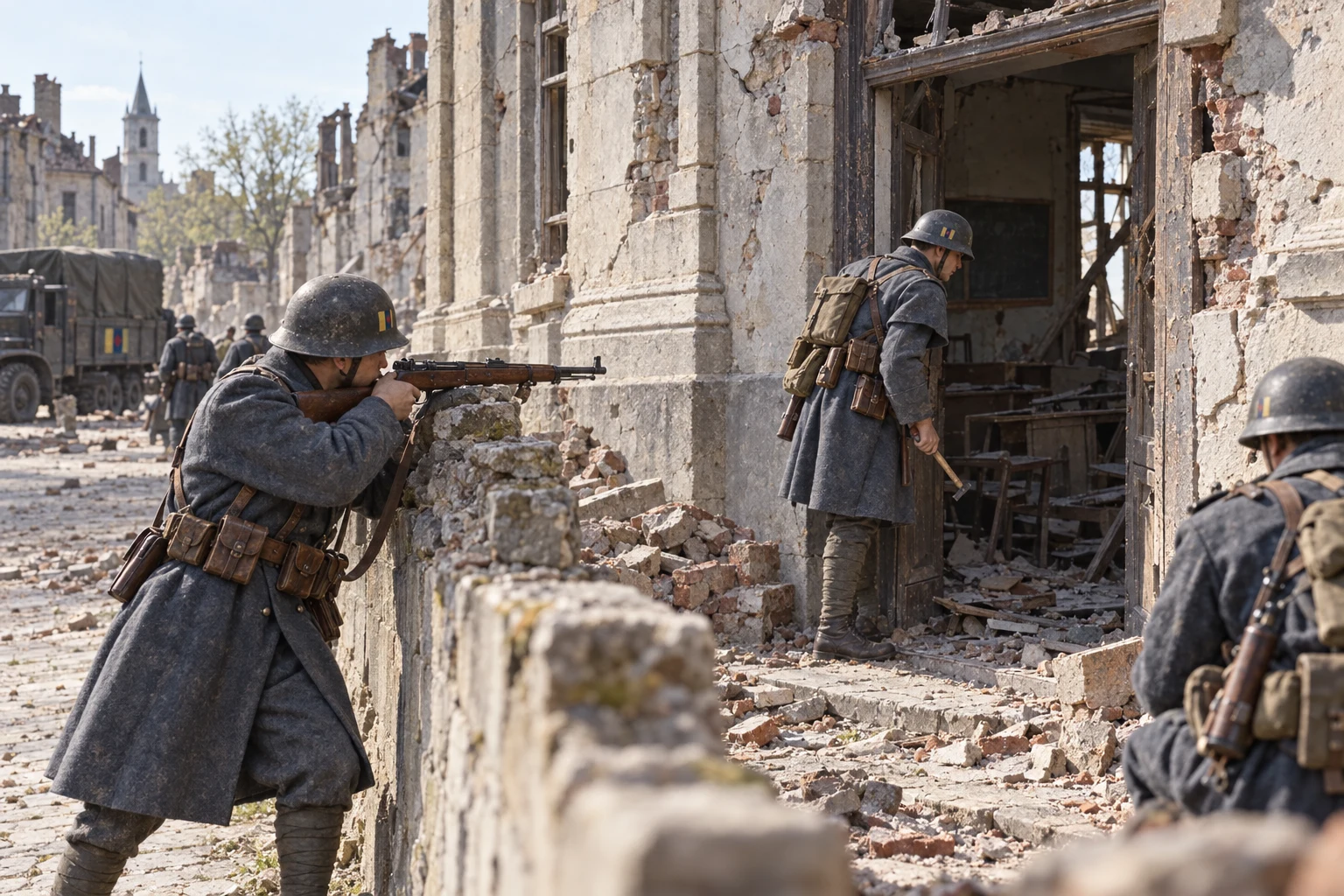
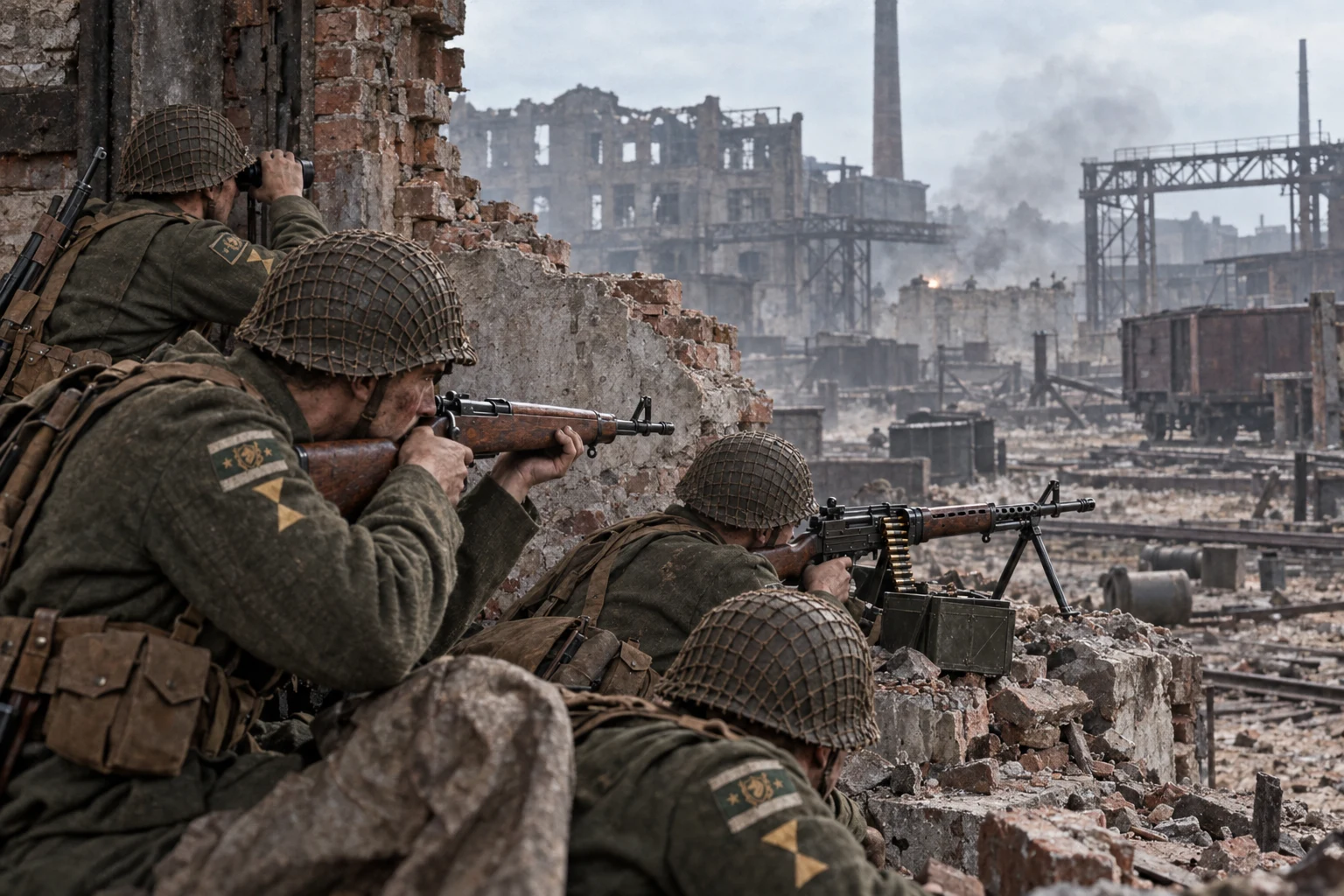
The offensive opened on March 8 with hard fighting in the outer district. Vale's formation advanced among material left from previous battles. Such wrecks were military obstacles and personal reminders. Their presence made the earlier reverses physically immediate without making them an accurate guide to present enemy strength. Allied forces recovered positions that had been improved during the intervening months. The progress was real, but its pace reflected resistance by a functioning corps rather than a simple occupation of ground that the Terans had decided to abandon.
Rusk counterattacked where a local recovery could preserve the defense's coherence. Those efforts imposed losses and delayed the Allied schedule. The difference from earlier campaigns lay in the shrinking ability to restore every threatened part of the front. A reserve committed to one problem became unavailable for another. Teran reports increasingly separated the value of the present line from the value of preserving the force for a later one. That distinction acknowledged a deteriorating situation while retaining the possibility of organized action beyond Tassar.
The repair district's approaches changed hands in parts. Allied troops secured a connected group, lost some of it, and recovered the ground when neighboring positions improved. The sequence is important because it shows support making a repeated effort possible without turning reverses into evidence that the whole campaign had failed. Wounded and replacements moved through an organization able to absorb interruptions. A route closure still had consequences, but it no longer automatically severed the battle from the means needed to continue it. The offensive gained resilience before it gained its final objective.
April: The cost of restoring the defense
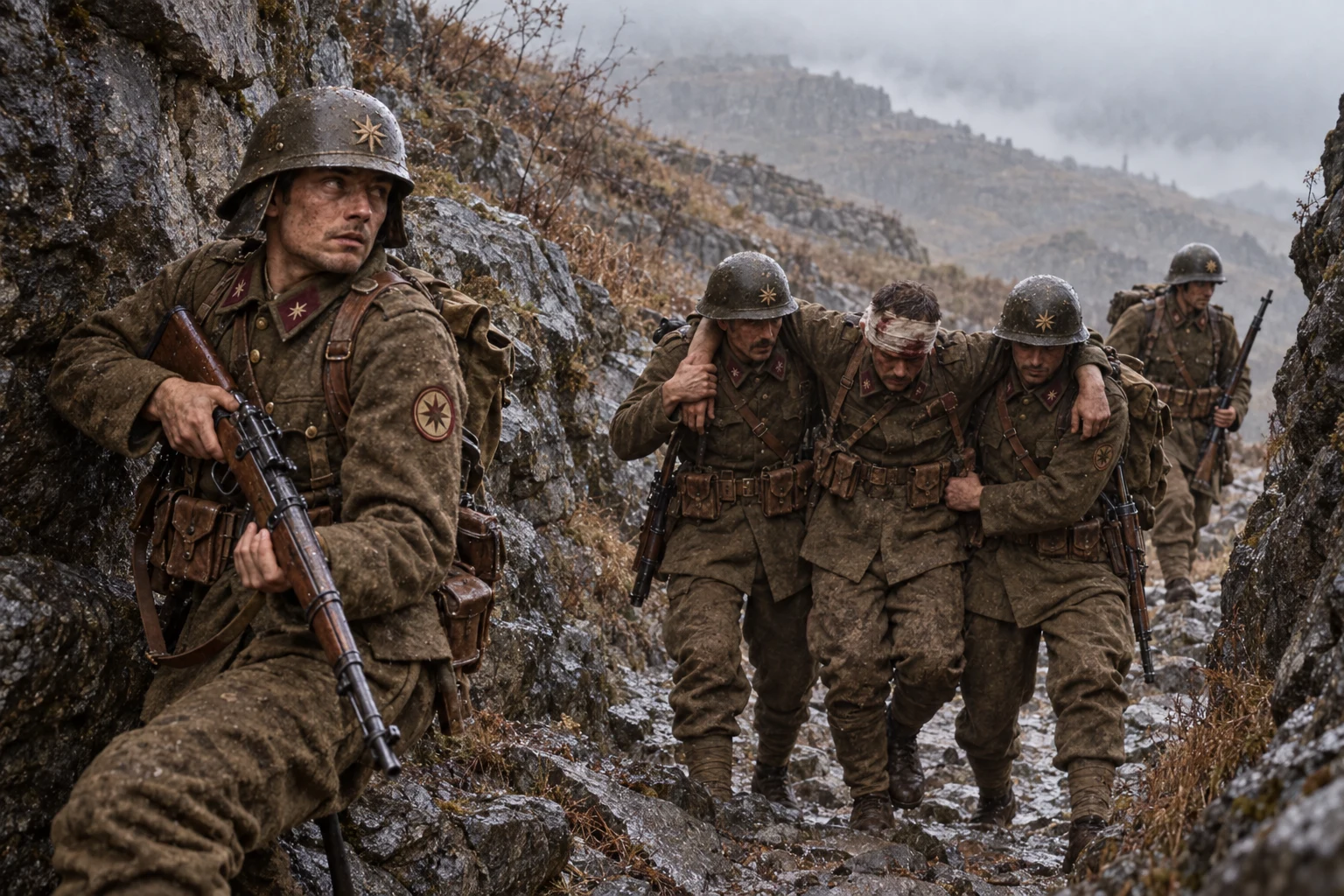
Allied pressure progressively reduced the space available to Rusk's reserves. The 87th remained effective, but moving to repair a threatened position became harder when other necessary movements occupied the same shelters and routes. Drel's unit encountered an intended resting place already filled with wounded and a displaced headquarters. That episode captures contraction as a lived condition. The shortage was not merely of ground on a map. It was of practical room in which fighting units, patients and command functions could coexist without displacing one another.
The corps' predicament cannot be explained by its commander lacking professional ability. Rusk still distinguished between formations able to resist and those needing restoration. The problem was that professional choices were being made within a system providing fewer alternatives. Each intervention could preserve a local connection while increasing demands elsewhere. This is how a competent defense loses depth: it retains the capacity to answer particular threats while losing the capacity to answer enough of them over time. The eventual withdrawal followed that accumulation rather than an abrupt disappearance of discipline.
Lathorne continued requiring evidence that supporting units could follow before authorizing larger movement. Reconnaissance and prisoner information contradicted premature claims that the enemy was broken. His restraint could surrender immediate opportunities, yet it protected the relationship between the advancing force and the organization sustaining it. The account does not establish that every cautious decision was optimal. It establishes that the headquarters had learned the danger of treating a local withdrawal as proof that the next district could be entered without encountering renewed organized resistance.
Residents inside the military picture
People emerged from newly reached areas with information about shelters and missing neighbors. Their testimony also corrected military assumptions. A building thought empty might contain families beneath its ruins. A store bearing a civilian identity might have been used by occupation forces. The same place could possess several histories, only one of which appeared in the army's immediate report. Aldren officials and recovery personnel helped separate the urgent needs of residents from the collection of useful operational information, giving civilian testimony a purpose beyond its value to the advancing force.
That separation mattered because residents faced unequal power and an uncertain future. They could provide local knowledge without being responsible for deciding whether nearby Teran soldiers had surrendered. They could seek treatment without knowing the military significance of a route or building. Relief had to be organized around needs that did not map neatly onto combat categories. The town's liberation brought the army into contact with people whose survival strategies had developed under occupation and bombardment, rather than with a single undifferentiated group waiting for instructions.
The surviving spaces within Tassar also carried evidence of community adaptation. New shelter relationships and displaced records showed that life had continued changing during the Allied absence. Recovery could not mean restoring a list of households as if no one had moved or been born, joined the community, died, or disappeared. The military victory opened access to those changes. It required civil inquiry capable of distinguishing them, particularly when family expectations were formed from information carried out during the loss of the town four years before.
May 1–19: A result short of annihilation
By May, the Teran position was increasingly difficult to sustain. Rusk requested authority to withdraw units most likely to be consumed in a final defense. Higher command eventually accepted the loss of Tassar to preserve a corps still useful farther west. That decision placed the institution's continuing military value above the holding of a celebrated objective. It did not erase responsibility for the occupation or for the decision to continue a war whose costs fell on residents as well as soldiers. Tactical judgment and political accountability remain different questions.
The phased retreat produced mixed outcomes. Some units disengaged coherently. Others lost contact, abandoned equipment or surrendered after becoming isolated. Allied pursuit gained ground and prisoners without destroying the entire Teran organization. Vale's troops entered the central district under instructions to secure it, support recovery and maintain contact before acting on reports beyond their immediate area. This combination of pressure and consolidation helped prevent the victory from becoming another unsupported penetration that an intact enemy reserve could reverse.
On May 19, the principal junction and central district were secured. The recovery was decisive for this campaign, but Rusk's 87th withdrew in diminished yet coherent form. The junction itself remained damaged. Possession allowed repair work to begin; it did not make transport instantly available at its prewar capacity. Tassar therefore changed from a contested military objective into a problem of restoration as the battle ended. The operational value of victory would be realized through subsequent work rather than fully embodied in the final day's movement.
May 27: A different standard of safety
The school inspection on May 27 makes the transition concrete. Mela Orsen returned with an Aldren building inspector and local residents. A military assessment had treated the partly surviving roof as evidence that the building could serve a purpose. The inspector found hidden damage and prohibited use of the upper floor. Temporary cover for troops and safe daily occupation by children required different judgments. Neither assessment can simply be substituted for the other, because the question asked of the structure had changed as the area passed from combat into civil recovery.
Former caretaker Arin Vell had preserved school records in a cupboard and described the location in a letter reaching relatives. The letter made the recovery specific rather than speculative. Vell was later found at a civilian reception station and could explain the records' history. This is victim and survivor agency in documentary form: a resident protected information while lacking control over the battlefield, and that act shaped what could be recovered when the military situation changed. The records did not survive merely because an army eventually reached them.
Mela retained both original records and those reconstructed during occupation, recording their different origins. Dismissing the later material as automatically worthless would have erased children who had arrived after her evacuation. Accepting it without distinction would have concealed uncertainty. The combined record allowed a more responsible account of a school population whose history had continued during displacement. Some children had grown older elsewhere; some remained missing. Liberation restored the ability to ask about them in their own town without guaranteeing a complete answer.
Tassar in the longer war
The school inquiry offers a useful parallel to the army's own reconstruction. Both depended on retaining original affiliation while recording changes that had occurred during absence. A child entering the neighborhood after evacuation was not an error in the recovered list. A soldier serving through a replacement or temporary attachment was not proof that the formation's earlier history had vanished. Institutional continuity required records capable of describing change. The comparison explains why liberation cannot be measured solely through the restoration of an old name to a place on the map.
The recovery linked improved Allied support to the shrinking depth of the Teran defense. It also ended one phase of the struggle without ending the 87th's service. The corps later fought in western Tera, where its final campaign unfolded in 1234. A history that labels Tassar its destruction would make that continuation impossible. A history that focuses only on the corps' preservation would understate the Allied accomplishment and the loss of a major position. The battle's significance requires the outcome and its limits together.
For Aldren, the junction's recovery mattered through the routes it might restore and the community it made accessible. For Silvia, the result belonged to an army sustaining institutional experience despite repeated losses. For Tera, it exposed the growing difference between retaining a competent unit and retaining the strategic conditions that allowed competence to produce victories. Those perspectives do not carry equal responsibility for the occupation. They explain why the same result was a military achievement, a civil opening, and a contraction of future choices for the defending command.
This authored synthesis rests on the inherited Tassar narrative and interprets its sequence through formation continuity, support and civil restoration. It adds no invented casualty totals or fabricated quotations. Its links to Meren, the September 1230 reverse and the 87th's last campaign allow readers to follow recurring people without treating them as unchanged representatives of entire nations. The May victory recovered a place. The school records show why recovering the history of the people who belonged to it remained a separate, demanding task.