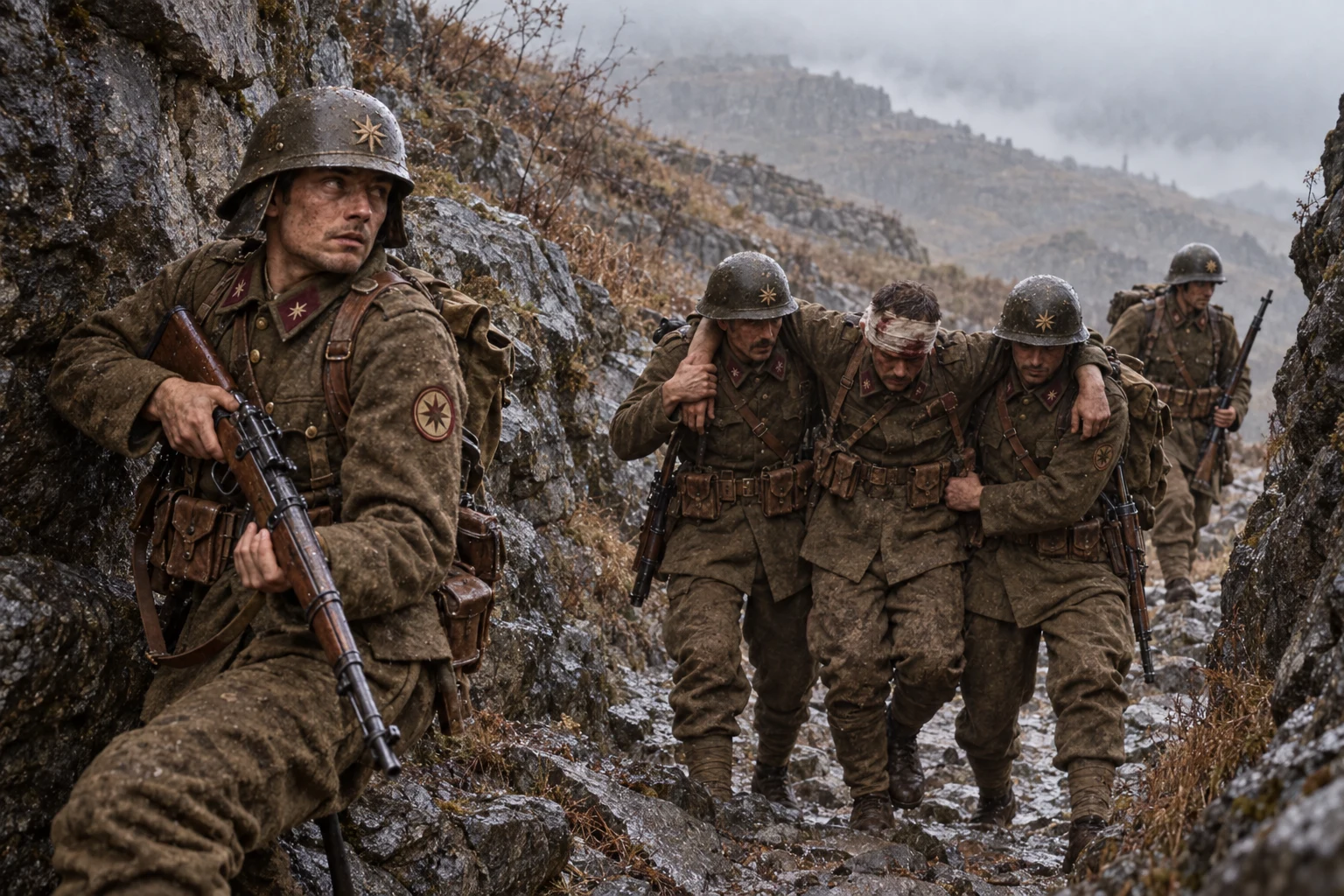
Meren Ridge recovered
October 10–November 4, 1229 · Eastern Aldren, Volara · Allied forces under Lathorne against Rusk's Teran defense
The third approach to the same ground
The October campaign began from the position secured around Darsel and sustained through the summer. That preparation changed the battle without making its outcome inevitable. Lathorne's army had better access, more coherent support, and experience of the enemy's responses. Rusk's corps had adjusted in turn, repairing positions and preparing to yield selected ground while preserving its principal defense.
Meren had acquired meaning beyond its immediate military value. Silvian troops knew it as the objective of repeated costly failure. Aldren residents knew the occupied settlements around it by names attached to homes and farms. Teran communiqués treated the ridge as evidence of the 87th's endurance. Those expectations increased the pressure on commanders to interpret possession as a statement about their armies' worth.
Lathorne's plan sought to keep that pressure from dictating every local decision. Orders distinguished essential objectives from opportunities requiring further authorization. Supporting arrangements accounted for the possibility that damaged ground would delay progress. The plan could still fail, but it was less dependent on the assumption that the enemy's first withdrawal would continue beyond the next position.
October 10–17: The lower defenses
The attack began on October 10 and met strong resistance. Allied troops recovered parts of the lower district while losing men and equipment in positions the Terans had prepared carefully. Vale's formation advanced through ground it had approached during earlier campaigns. Familiarity helped identify landmarks and also created danger when soldiers assumed a previously known route remained usable after further bombardment and reconstruction.
At West Quarry, the scene of fighting in 1228, the Allies encountered a changed defensive arrangement. Some old positions had been abandoned, others strengthened, and several recognizable buildings no longer stood. Vale warned his officers against using memory as a substitute for current reports. The force progressed slowly, checking its connections rather than rushing toward places whose names were familiar.
Rusk committed reserves to prevent the lower losses from separating the defense. The 87th's reaction imposed delays and casualties, but the Allies maintained more consistent support than in the previous year. Units that gained ground could remain there without immediately consuming the formations intended for the next phase. This difference accumulated gradually rather than appearing as a sudden collapse of Teran resistance.
October 18–29: The ridge positions
The central battle moved among damaged agricultural ground, local rises, and positions whose boundaries had become difficult to recognize. The term “ridge” suggested a single crest, while the actual campaign involved multiple connected features. Capturing one did not automatically remove the defenders from the others. Lathorne's headquarters reported progress by function and contact, not simply by assigning the entire ridge to whichever side had reached a prominent point.
Savin Drel's Teran unit received replacements during the fighting. Veterans distributed them among surviving groups and explained immediate responsibilities. Some men learned quickly; others were lost before they understood the sector. Drel had begun to acquire the judgment of a survivor and found himself passing it to soldiers who treated his few months of experience as authority. The corps preserved effectiveness through a process that continually depleted those teaching it.
Allied pressure increasingly threatened the coherence of Rusk's arrangement. He requested permission to withdraw portions of the defense toward Tassar rather than expend the corps in a rigid hold. Higher command hesitated because abandoning Meren would contradict repeated claims of its permanence. Rusk's reports emphasized the formation's continuing value on another line, converting a military argument into terms his superiors might accept.
Equipment left at Meren
Rusk's withdrawal order included a list of equipment that could be abandoned without delaying the movement of depleted units. The list was controversial because several items had been recovered and repaired through months of effort. Savin Drel's section had helped move one weapon into its position and regarded leaving it as a personal defeat. Their officer explained that the corps needed the surviving men more urgently than a piece whose transport would slow the group.
Drel helped carry its wounded crew instead. He remembered the order because it contradicted lectures in which loss of equipment had been treated as evidence of weak discipline. The difference lay in authority and circumstances, but that explanation offered little comfort while men watched positions disappear behind them. Rusk's staff later documented the authorized losses to prevent retreating units being punished for obeying the withdrawal plan.
Allied recovery parties found the abandoned equipment after securing the ridge. Some was repairable, some salvageable, and some dangerous to approach until specialists inspected it. Reports counted the pieces without distinguishing those conditions. Lathorne required a corrected inventory before treating captured material as additional army capacity. The two records together show the same objects changing meaning: a burden to the retreating corps, a symbol of Allied victory, and only later an assessed resource with a use or disposal requirement.
October 30–November 4: The withdrawal
The Teran retreat began in stages amid continued fighting. Some positions disengaged successfully; others were overtaken or isolated. The Allies captured prisoners and equipment without destroying the 87th as a coherent organization. Vale's troops entered positions containing abandoned stores, wounded, and signs of hasty departure. Their immediate tasks included securing the area and arranging medical care rather than simply continuing pursuit.
On November 4, the Allies secured Meren Ridge. The result was substantial: a position that had defeated repeated offensives was recovered, and the Teran defense withdrew toward Tassar. Lathorne resisted declaring the corps broken because reports showed organized resistance farther back. His army needed restoration after the battle, and the terrain it had gained required work before supporting another major effort.
For displaced Aldren residents, recovery opened questions about return. Mela Orsen helped families compare lists of recovered localities with information about destroyed houses and missing people. Military possession did not establish that a settlement was safe or habitable. Some families returned to inspect homes and left again with what could be recovered.
Meren's capture mattered because the Allies had finally converted preparation, sustained support, and battlefield pressure into a retained operational result. It did not make the preceding failures inevitable steps in a flawless plan. The dead of those campaigns remained lost, the 87th remained active, and Tassar lay ahead. Lathorne's army had changed the front and inherited the responsibility of making its next decision without assuming that one hard-won victory had made the enemy incapable of another costly defense.
Original illustrations for this source record
Original archive artwork and captions are preserved. Dates, labels and claims printed within inherited images belong to the previous edition; the revised text governs the current history.