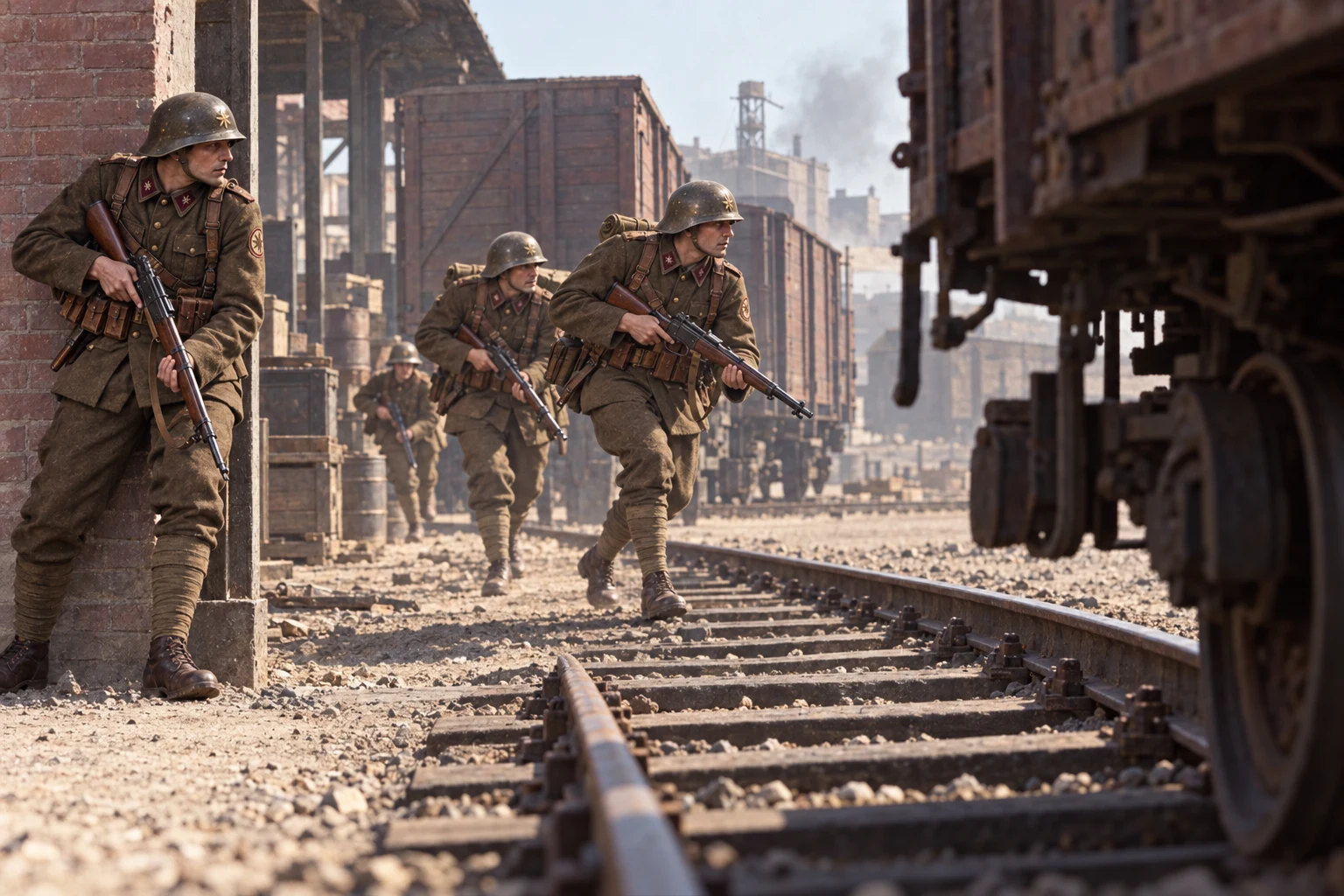
An expeditionary army enters a continental war
High General Hujo Lathorne’s Silvian 7th Army assumed its eastern Aldren sector on March 14, 1227. Substantial experience accompanied it, but concentration remained incomplete. Fighting formations and supporting services did not all become available together. The transition from island operations involved different distances, movements and coalition connections. Previous competence helped the army adapt without proving that adaptation was already complete. Treating the army as fully established from the date it assumed the sector would obscure the opportunity its opponents exploited.
The Teran western-command offensive began on May 18. General Cevan Rusk’s 87th Elite Battle Corps was a principal striking formation, supported by neighboring units and the wider theater. It was not the sole force attacking an entire Allied army. Rusk sought to disrupt the Silvian concentration and obtain useful ground before Lathorne could choose the next campaign’s timing. His success depended on identifying a local advantage within the larger war rather than possessing unlimited strength or control over all Teran fronts.
The distinction between army arrival and operational readiness also shaped the first Allied responses. Lathorne could commit troops already present while their support remained uneven. A unit’s complete establishment described capabilities expected under normal conditions, not necessarily those available at the point where a rupture demanded immediate action. The resulting problem was not that Silvia had no experienced soldiers. It was that experience and material strength had not yet been connected across the new front in the arrangement the crisis required.
Tassar’s importance beyond the railway symbol
Tassar’s railway facilities made it a valuable military objective. The district also contained housing, schools and workshops already affected by crowded military movement. A railway town was a community and an operational connection at the same time. Aldren officers understood that losing its facilities would change both supply and civilian survival. Local authorities prepared evacuation while hoping defense would make it unnecessary. The preparatory work belonged to the battle’s consequences before the enemy reached the yards.
Teacher Mela Orsen identified pupils whose families lacked transport. Her school register became more than a record of attendance. Under evacuation it helped establish which children were present, which were with relatives and where separated people had last been seen. Those distinctions would matter after departure because absence from one assembly point did not establish disappearance into occupation. Preserving an account of changed destinations could give reception authorities information a simple list of passengers lacked.
The registry’s separate engagement at the Tassar Service Road began on May 17 and continued to May 22. It describes a distinct Allied probe defeated by Rusk’s reserve and supporting artillery, rather than the inherited major Tassar offensive itself. Its context reinforces the corps’ attention to supporting approaches, but its chronology and result should not be merged into the town’s capture. Linking it here allows readers to examine a smaller neighboring action without treating two records as interchangeable versions of the same event.
May 18–31: Rupture and containment begin together
The opening attack created a dangerous breach. Some Aldren formations withdrew coherently; others lost contact and reappeared under neighboring commands. Reports of withdrawal thus did not describe one uniform condition. Lathorne sent available Silvian units to stabilize the situation, with different levels of support accompanying their arrival. The army had to determine immediate tasks according to current capacity rather than presume that a formation’s name meant every service normally attached to it was present.
Rusk maintained pressure through local reverses. His leading troops met resistance near village structures and railway approaches while supporting elements struggled to follow changing directions. The 87th’s elite standing brought priority and expectations that could themselves increase strain. Officers warned about losses among experienced personnel. Higher command nevertheless judged the opportunity important enough to continue. Its choice demonstrates that professional reputation did not remove attrition or automatically resolve the balance between exploiting success and preserving a formation.
Eran Vale’s formation entered Lathorne’s containment effort. The country was more open than the island terrain familiar from Lethan, but scattered reporting could still conceal the actual front. Ground could seem deserted because defenders had moved behind cover. Vale delayed one movement when patrol reports contradicted the map at headquarters. The supposed opening proved defended. His decision carried earlier experience into a new setting by insisting that an apparent location be tested against current evidence.
That continuity should not imply that island fighting had given Vale a complete understanding of continental war. He still relied on local observation and partner knowledge. The useful transferred habit was preserving uncertainty until information justified the next movement. The campaign therefore distinguishes adaptable experience from an assumption that veteran status answered every new problem. Tassar’s defenders learned under attack, while their enemy tried to prevent the time and cohesion required for that learning.
June 1–9: A town’s facilities change function
Fighting reached Tassar’s approaches in early June while the railway organization still attempted to move stores and evacuees. Mela’s assembly point changed twice. A departure plan could remain valid in intent and fail in location as the front and access shifted. Records needed to preserve those changes because later readers would otherwise treat the last clean manifest as if it described every stage of movement. The evacuation history was a sequence of redirection, not a single train removing an already complete group.
Teran troops reached the outer yards while Allied defenders held workshops and streets. Damaged tracks and routes changed the tactical significance of buildings. A signal structure became an observation point; a repair shed housed wounded after machinery had left. Maps kept the old names, making it easy to assume that facilities still performed their original functions. This mattered to military decisions because holding a railway building did not necessarily retain usable railway capacity.
Lathorne authorized withdrawals where isolation threatened the force needed to contain the wider advance. Aldren officers accepted necessity unevenly because their own communities occupied the ground being relinquished. Their reaction was not evidence that local knowledge obstructed professional judgment. It exposed a genuine difference in the stakes borne by coalition partners. A withdrawal that preserved an expeditionary formation could leave one ally’s residents behind the enemy line, making the same operational decision a different personal event.
Some rear guards remained longer to protect civilian departure. Their resistance helped people leave and increased the risk that the soldiers would not escape. This tradeoff belonged in the battle’s assessment. It cannot be resolved by claiming that civilian protection always improved the army’s immediate position. Nor should preserving military capacity be treated as the only consequence that mattered. Tassar’s loss involved decisions among legitimate responsibilities under conditions that prevented satisfying all of them without cost.
Teran forces secured the principal railway facilities and most of the town on June 9. Mela’s group had left, while several families remained separated. The capture gave Rusk a major success and established ground the Allies would struggle to recover for years. It did not give his corps unlimited endurance for further advance. The distinction between securing a valuable objective and breaking the whole theater would become clearer during the rest of June.
The platform allocation that joined two accounts
One evacuation train left without two pupils on its preliminary manifest. One child had joined an aunt on an earlier departure; the other remained with a sick brother at the assembly point. Mela refused to erase these differences beneath a general mark of absence. The amended register retained last known locations. Its later use allowed reception staff to distinguish separation during movement from a disappearance under enemy occupation. The record’s value came from preserving what remained uncertain as well as what was confirmed.
Major Vale’s transport officer sought priority for ammunition wagons waiting behind civilian loading. Aldren railway superintendent Oran Tesk explained that moving them first would obstruct the platform required by immobile patients. Vale accepted another sequence. His formation received only part of its expected load before additional damage closed the route. The patients reached care beyond the threatened town. The military and medical consequences were connected by one allocation decision and then appeared in different institutions’ records.
This sequence should remain costly in the narrative. Respecting the medical movement did not produce a sudden compensating tactical benefit that removed Vale’s shortage. His men fought with tighter allowances. The decision was defensible because it protected people and considered the actual use of the platform, not because every legitimate choice secretly served all purposes at once. Preserving that cost makes civilian consequence part of operational causality rather than a reassuring anecdote attached after the fighting.
Lathorne’s review included the incident because better intentions alone could not have eliminated the conflict. The platform, time and route were finite. Understanding the sequence required the railway account, civilian manifest and ammunition return together. The result explains why a battle archive benefits from cross-links among witnesses and institutions. No one document necessarily possessed the entire consequence of a decision whose effects were distributed across military supply and human evacuation.
June 10–26: A defeat stops short of collapse
The 7th Army and its partners formed a more stable defense beyond Tassar. Reinforcements arrived into a situation better understood than the opening breach, and support increasingly matched the units using it. Teran pressure continued against an opponent less dispersed than before. Rusk’s own formations carried accumulated losses and needed replenishment. The offensive’s changing pace came from adjustments and depletion on both sides rather than a simple transition from one army’s superiority to the other’s effortless victory.
By June 26 the offensive had lost its early momentum. Tassar and the stronger Meren positions remained Teran, while the Allies prevented a wider rupture. Lathorne’s first major continental result was containment following defeat. Calling containment a complete victory would erase the town’s capture and the burden left for future operations. Calling the whole defense a total collapse would erase the coalition’s preservation of a field force and front from which it could continue the war.
Rusk gained useful territory and retained an effective corps without breaking the theater. His achievement was substantial within those limits. The 87th’s continuing defensive strength around Meren and Tassar would shape Allied choices in 1228 and afterward. Its success required artillery, engineers, reserves and neighboring formations as well as veteran personnel. The retained account provides no basis for presenting the corps as either invulnerable or independently responsible for every Teran action in eastern Aldren.
The political weight of the new front
Silvia expected a veteran army to relieve exhausted allies. Aldren expected recovery of its communities. Teran authorities announced the security of the new positions. These expectations placed pressure on later command decisions. A future Allied offensive would have to meet the desire to recover valuable ground without assuming that desire supplied the necessary conditions. Tassar’s defeat thus changed more than the map; it created a political burden that could encourage premature efforts to reverse an acknowledged loss.
Soldiers on both sides repaired and strengthened the positions where the advance stopped. Mela resumed teaching west of the front in a borrowed classroom. The pupils’ uncertainty about return connected subsequent campaigns to the original displacement. The archive need not invent later answers for every child to show that consequence. Their waiting places the town’s capture within a continuing civilian history while the military chronology records another planned attack and another change in the front.
Exact national strength figures should not be used as an undated explanation of the battle. Silvia’s later eighteen million under arms in 1232 did not stand behind Lathorne at every moment in May 1227. Likewise, the existence of the 87th across a career range does not locate all its personnel in each supporting engagement. This synthesis uses the documented concentration, support mismatch and role of the corps without adding numerical precision absent from the inherited account.
Tassar’s importance finally lies in the connection between a capable enemy exploiting an incomplete concentration and an Allied response that preserved survival without recovering the objective. Its losses and containment supplied distinct lessons for later operations. Rusk’s victory must remain real, Lathorne’s responsibility must remain visible, and the civilian departure must retain its costs and unfinished separations. Those elements together explain why a railway town became a long-running burden rather than one more place briefly colored differently on a campaign map.
The ending also separates three dates that later summaries can compress. The sector’s assumption on March 14 began an administrative and operational responsibility. The town’s capture on June 9 fixed a major change in control. The offensive’s loss of momentum by June 26 established the limits of that change. None of those moments made the other two irrelevant. Keeping them distinct explains how an army could already be responsible for a front while still concentrating, and how losing a valuable objective could be followed by a successful effort to prevent a greater defeat.
The later recovery of Tassar belongs to another battle and another set of conditions. It should not be used to imply that the June withdrawal was merely a temporary maneuver already certain to succeed in the long term. Families and soldiers waiting through the intervening campaigns did not possess that certainty. Reading the loss alongside the later recovery clarifies what changed in support, planning and enemy position while preserving the original defeat as the event that created those years of difficult work.