Improvement did not mean an unchanged enemy
The second Allied attempt on Meren Ridge began on March 4, 1228, after winter reconstruction of Lathorne’s 7th Army. The previous autumn’s attempt had failed, leaving the ridge in Teran hands. Better local experience, revised planning and improved support made another offensive plausible. Those changes mattered and should not be erased merely because the second operation also failed. They nevertheless described the Allies’ preparation, not a guarantee that the enemy’s condition remained the one they had last encountered.
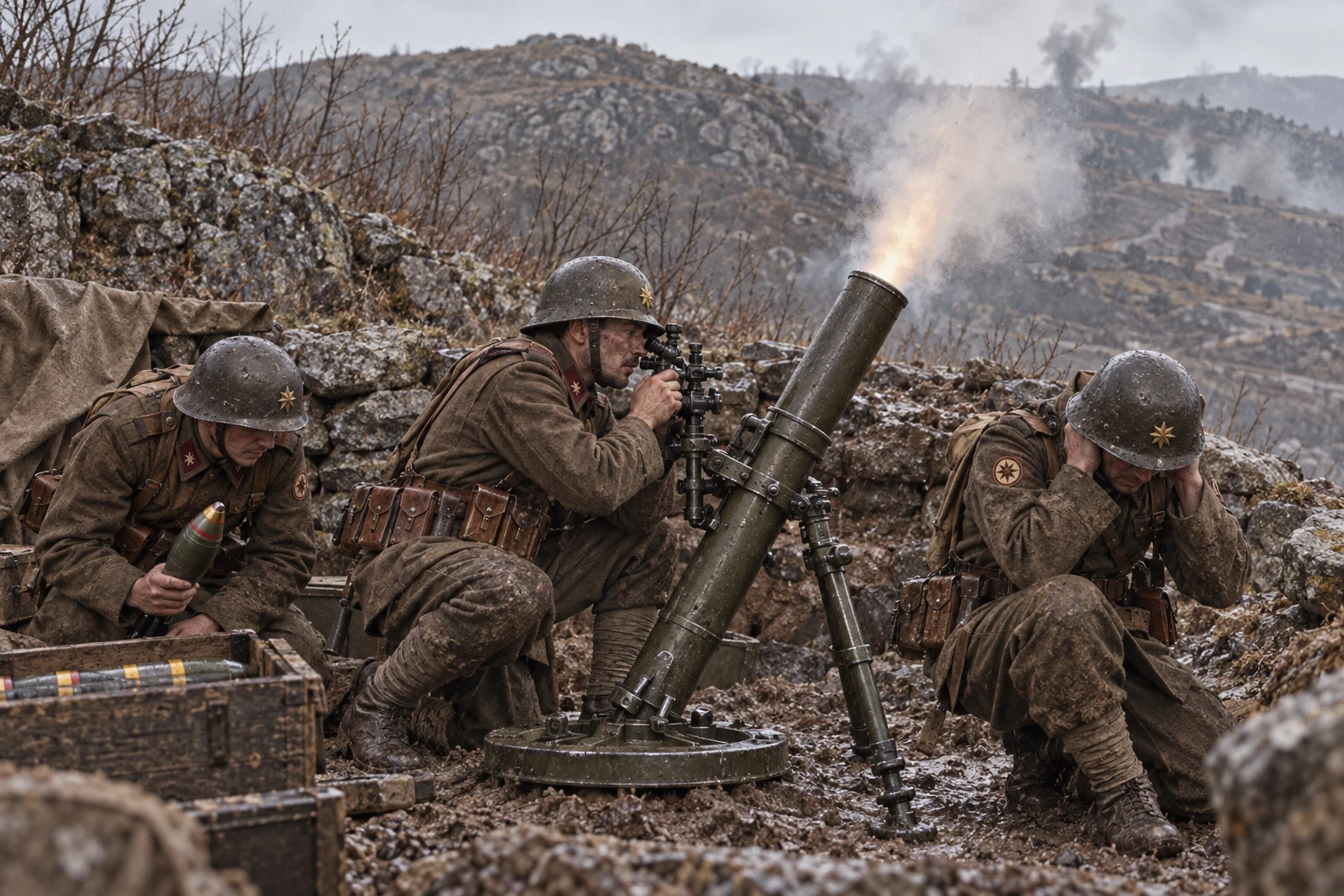
General Cevan Rusk reorganized the 87th Elite Battle Corps, received replacements and adjusted its positions. Some forward ground existed principally to delay attackers and expose their intentions; other positions sustained the defense’s essential connections. Neighboring formations and theater resources remained part of the system. The corps’ reputation did not substitute for them. An explanation based entirely on elite courage would omit the support and selective choices that made prolonged resistance possible.
The offensive’s central difficulty was therefore comparative. Lathorne could recognize real improvement in his army and still overestimate how that improvement changed the balance. Rusk could lose personnel and ground while retaining sufficient organization to deny the principal objective. The decision to begin the campaign and the later decision to continue it require separate assessment. Preparation supported the first; subsequent evidence would have to support each additional commitment.
The nearby registry engagement at the Lower Terrace, fought February 18–24, provides context for the lower-ridge struggle without being the March offensive itself. Rusk’s force severed a newly occupied Allied terrace from heavier weapons, while Allied troops resisted long enough to remove wounded and observers. Its source explicitly distinguishes the engagement and rejects the mass-capture implication of early Teran reports. Linking it to this synthesis preserves the sequence of smaller counterstrokes around Meren without merging their dates into the major battle’s chronology.
West Quarry as an intermediate objective
West Quarry contained worked ground, service buildings and irregular faces that complicated observation. The Allied plan identified it as a stage on the way to the ridge. Calling it intermediate did not make its capture inexpensive or its occupation easy to sustain. The operation had to obtain a position from which the next stage could proceed. If the quarry consumed the formations and support intended to exploit progress, apparent advancement could diminish the army’s ability to achieve the larger objective.
The opening attacks gained lower approaches. Some Teran positions were overrun; others were abandoned after delaying the advance. Reports used the same general description of withdrawal for both. These events had different implications for the defense’s remaining capacity. Forced loss might indicate a weakness the attacker could exploit. Planned retirement might move the contest toward positions more important to the defensive system. Treating both as equivalent progress encouraged confidence unsupported by a clear distinction between what the enemy had lost and what it had chosen to leave.
Lathorne ordered continuation on the belief that improved preparation had created an opportunity beyond the preceding army’s capacity. This was not wholly wishful thinking: initial gains and improved Allied organization supplied real grounds for optimism. The question is how command tested those grounds as resistance developed. A promising beginning did not establish that the conditions favoring further movement persisted when support, casualty evacuation and reserves became increasingly strained around the quarry.
March 4–12: Occupied buildings and uncertain intervals
Silvian troops reached quarry service buildings and faced resistance beyond their immediate view. Supporting units arrived through damaged approaches and struggled to connect across the irregular ground. Vale’s formation joined two groups whose headquarters had each assumed the other covered the interval between them. The correction prevented local isolation while delaying the next movement. It was necessary work produced by the mismatch between a coherent map and the actual arrangement of troops.
The episode connects Vale’s earlier experience to this continental battle. An objective label could conceal dispersed people and uncertain contact, much as reported locations had done at Orava. The remedy required checking responsibility on the ground. It did not imply that the quarry resembled the island in every tactical respect. The recurring problem was organizational: neighboring commands could each make a reasonable local assumption while their combined assumptions left a gap nobody had actually covered.
Rusk counterattacked the quarry’s edges without necessarily recovering its center. His purpose was to prevent Allied occupation becoming a dependable base. The Allies could therefore report possession of named buildings while lacking regular passage for supplies and wounded. Their claim was not necessarily false; it answered the wrong question if interpreted as proof that the next offensive stage was ready. The major battle’s apparent progress diverged from the functioning capacity produced by that progress.
This distinction is important to the opposing perspective. Teran defenders did not need to recover every structure to undermine the Allied plan. Denying reliable movement could oblige the attackers to expend further force where they expected to be preparing exploitation. A defensive result thus appeared in the attacker’s changing requirements even when it did not produce a dramatic reversal of possession. Following those requirements helps explain why additional attacks became necessary before the original timetable could resume.
March 13–31: The reserve changes purpose
Lathorne committed further strength and narrowed some local objectives. Coordination improved without eliminating the defenses ahead. Each success exposed another position that had to be reduced. Units intended to exploit a breach instead relieved exhausted troops or retook ground lost under counterattack. The uncommitted reserve shrank while the map continued to show forward movement. This was a critical divergence between the operation’s visible progress and the capacity left to complete its purpose.
For the command, more limited objectives could be a sensible adaptation. They could also extend commitment without demonstrating a route to the original goal. Assessing them required asking whether the limited gain restored a useful opportunity or mainly postponed acknowledgment that the principal objective had become unattainable at an acceptable cost. The source’s later review concentrated on that continuing judgment rather than claiming that the winter’s whole reconstruction had been worthless.
The 87th also paid for its defense. Replacement groups included personnel without shared service, and veteran leaders were distributed to sustain cohesion. Rusk’s staff requested relief and support. Higher authority provided enough to continue resisting while expecting results consistent with the corps’ reputation. Its continued success did not mean its people remained unchanged or its reserves inexhaustible. The defensive organization managed attrition while benefiting from resources outside the corps itself.
Vale’s soldiers experienced repeated changes of purpose: preparation to advance, holding during another formation’s reorganization, then moving wounded from lost ground. Each could be completed competently while the ridge remained beyond reach. This gap between effective individual action and an unsuccessful overall campaign is essential to frontline experience. It prevents the history from assigning responsibility for failure simply to the troops whose immediate orders did not yield visible strategic progress.
April 1–22: Evidence and the hope of exhaustion
By early April, subordinates questioned whether the remaining prospects justified the cost. Lathorne authorized further limited attacks because he believed Teran resistance might approach exhaustion. Enemy losses were real. The uncertain step was inferring that those losses placed the defenders closer to a decisive threshold than the attackers. Allied intelligence had not fully assessed the support sustaining the 87th, so visible attrition could not establish the whole defensive system’s remaining capacity.
Medical and replacement records challenged optimistic accounts of Allied condition. Personnel listed as returned to duty had not all regained assault endurance. New soldiers filled vacancies while depending on a declining number of experienced leaders. The distinction was not whether the army could fight at all. It concerned whether continued fighting in this setting could still produce the objective. An institution can preserve substantial general military capacity while lacking the particular combination needed for one further attack.
The source provides no exact return allowing this question to be resolved through an invented numerical ratio. The recorded condition, changing use of reserves and continuing Teran resistance establish the problem more reliably than manufactured precision would. The major-battle synthesis follows those indicators because they shaped decisions. It does not assign a hypothetical day on which one side would inevitably have collapsed had Lathorne continued beyond the battle’s actual end.
Soll’s observation and the confidence added to it
Captain Iren Soll’s testimony later exposed a specific intelligence error. He reported reduced enemy movement visible from his observation position. Staff interpreted the reduction as evidence of declining strength. Smoke, relocation and concealment could also explain the observation. Soll had not assessed the corps’ reserves. A limited report about visible activity acquired a broader meaning as it moved into the command assessment, turning uncertainty into apparent support for continuing the offensive.
Its placement beside other reports of Teran loss made the inference seem reinforced. The review traced statements to viewpoints that did not all address the same question. Several observations could be individually correct without collectively proving that resistance neared exhaustion. This is an important causal distinction: the problem was not necessarily inaccurate observers. It was the relationship command constructed among different kinds of evidence, and the conclusion attributed to them without retaining their limits.
Revised assessment forms separated observed activity from inferred condition and identified the area covered. This correction did not supply perfect intelligence or remove the need for judgment. It made the grounds of judgment more visible. A commander could still choose to act under uncertainty, but the choice would be less likely to rest on an observation silently enlarged into knowledge of the entire enemy formation. The reform addressed a specific failure in the circulation of evidence.
Soll’s testimony also did not absolve Lathorne. The High General authorized continuation and remained responsible for weighing the reports available. An individual reporting ambiguity mattered because it interacted with that decision, not because identifying it transferred the whole campaign’s failure to the observer. The review’s value lay in connecting personal responsibility and institutional correction instead of choosing between punishment of one subordinate and a claim that no one could have done anything differently.
An end that did not erase the work already done
Lathorne stopped the offensive on April 22. The Allies retained some gains and failed to recover Meren Ridge. That is the battle’s result. Retained lower ground does not convert the principal failure into success, while failure does not establish that every local action or winter improvement was useless. The important question afterward was which capacity remained and what could be learned about the decisions that spent it without securing the ridge.
Wodro retained Lathorne in May while requiring clearer objectives and assessments. Continued appointment was not validation of the campaign as a necessary victory. It left the commander responsible for rebuilding and showing that future decisions used the evidence of failure. The political choice also preserved continuity in leadership, with the possibility that lessons could be carried forward by the person accountable for the earlier judgment. Whether that continuity produced improvement had to be tested in subsequent operations.
Soll later supported the successful Meren campaign. His recurring service links the defeated army’s inquiry to later practice without implying that one corrected reporting form caused victory by itself. The Darsel operation in 1229 would first seek a sustainable position useful for another campaign. Reading these Chronicles together shows a developing distinction between obtaining ground, preserving it under counterpressure and possessing the conditions for the larger attack.
Consequences beyond the command review
Meren’s continued occupation left the surrounding communities and displaced people dependent on a front that had not delivered the expected recovery. The source does not establish a new civilian casualty total for this offensive. This synthesis therefore preserves the consequential delay in liberation and medical strain without inventing named households or unsupported atrocities within the quarry. Civilian experience remains connected through the earlier Tassar displacement and the campaigns of recovery, rather than disappearing whenever the immediate source focuses on military decisions.
The opposing force’s continued effectiveness also belongs to the revised war’s chronology. Tera inflicted serious defeats through coordinated defense, support and counterpressure. Recognizing those achievements explains why Allied numerical growth did not automatically produce immediate recovery. It does not validate imperial aggression or confuse Rusk’s corps command with national sovereignty. Valther IV remained emperor; Rusk’s important decisions operated within a larger military and political system.
The second failure at Meren consequently offers a distinct analysis of continuation after a plausible opening. Orava concerned the failure to align an expedition’s components. Tassar concerned an enemy exploiting incomplete concentration. Here an improved army made gains but increasingly lacked a supported path from those gains to its principal objective. The review showed how narrowed observations and genuine enemy losses could be combined into excessive confidence. Preserving that mechanism, the enemy’s agency and the unresolved civilian consequences gives the battle meaning beyond another account of courageous troops stopped by a formidable ridge.