Supporting battles below the major narrative
The [lower-ridge counterstrokes](campaign-the-lower-ridge-counterstrokes) of 1228, [river-support battles](campaign-the-river-support-battles) of 1229 and [railway-town supporting war](campaign-the-railway-town-supporting-war) of 1230 concern the infrastructure beneath larger offensives. They cover Meren’s lower districts, the Darsel–Meren supporting sectors and Tassar’s outer yards. These twelve engagements supplement retained main battles. Their Teran victories cannot be used to change the wider Darsel campaign’s outcome, substitute a farm fight for the second Meren offensive or erase Tassar’s later recovery. Their purpose at Chronicle scale is to explain why coalition progress required repeated reorganization even when a foothold or an eventual major victory remained possible.
General Cevan Rusk’s 87th Elite Battle Corps appears in the lower-ridge and railway-yard groups, while General Vessa Dalk’s 14th Field Army appears in the river-support group. Colonel Dema Orven contributes fire to the Ravine Relay entry without becoming the sole commander of all three campaign groups. These relationships matter because the veteran corps did not absorb the field army or supply itself without neighboring support. Rusk’s reserve, artillery coordination and engineers produced formidable local results. Their recurrence provides a history of a working formation, while its repeated reconstruction and finite replacements prevent the name 87th from being treated as a permanently unchanged force outside the material conditions of the war.
Holding the lower ridge in 1228
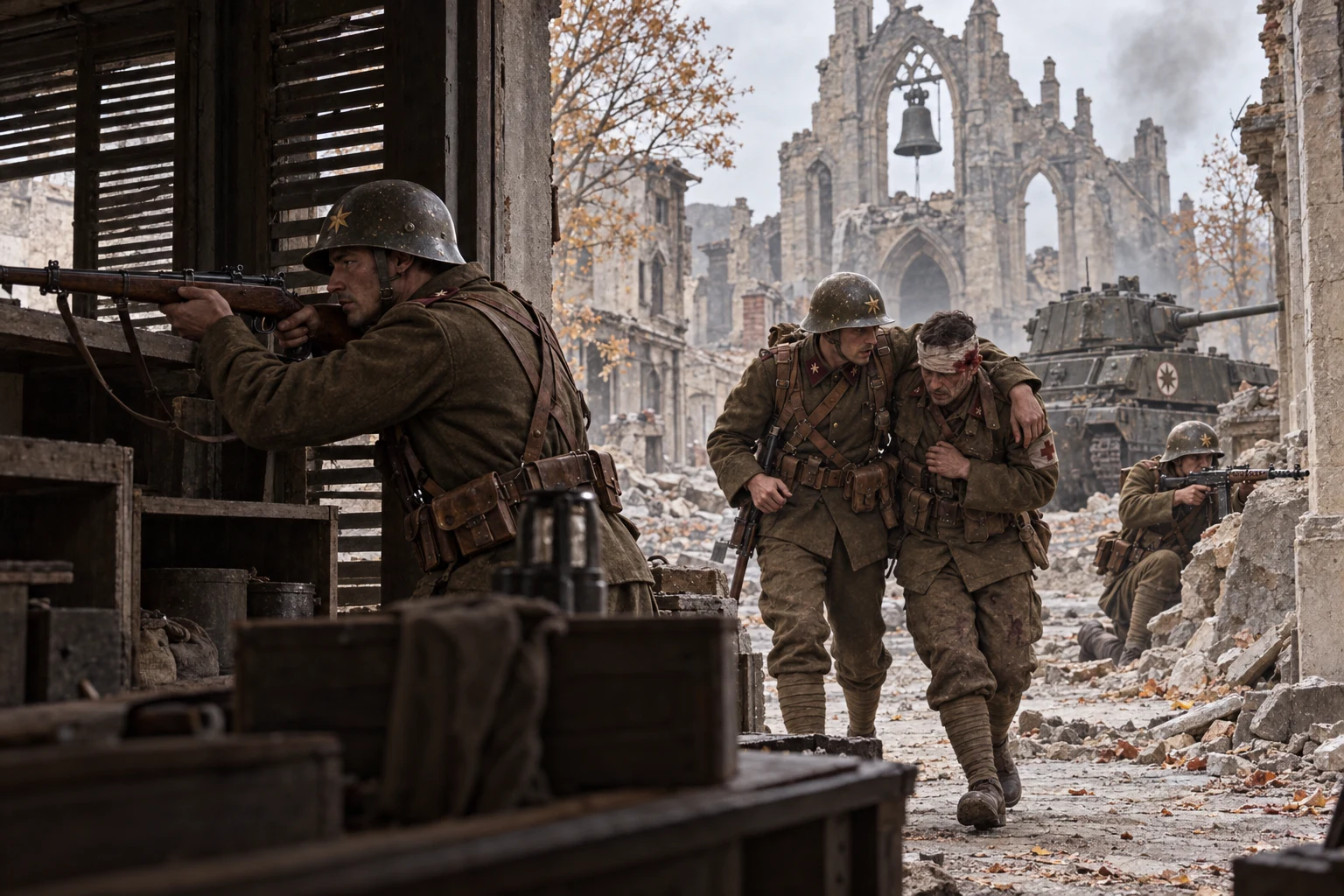
The February [Lower Terrace](new-battle-301) began with an Allied gain. Infantry intended to bring guns onto the terrace before the ridge defenders could respond. Rusk attacked the narrow supply climb while supporting fire held the crest approaches and engineers restored a sheltered lateral route. Allied troops stayed long enough to evacuate wounded and observers, denying the mass capture suggested by first Teran reports. The local result was a recovered terrace, but the mechanism was failure to connect the newly won ground to heavier weapons. The entry therefore records the limits of both an Allied territorial success and a Teran claim about the people captured during its reversal.
May’s [Cold Store Position](new-battle-302) supplied several camps and sheltered assembly in poor weather. Tracing food wagons revealed the concentration; a limited attack cut the service road and forced movement before an expected offensive. Allied logisticians redistributed supplies over smaller routes. Endurance survived while concentration on the original timetable failed. This differs from the terrace’s interrupted climb because the troops did not all depend on one newly captured elevation. Their shared preparation depended on a central supply and assembly function. Dispersing that function helped preserve consumption at the cost of assembling a common attack, showing how an adaptation could solve one operational problem while conceding another.
At [The Ravine Relay](new-battle-303) in August, a protected passage carried both telephone lines and ammunition. Infantry attacked its entrance while Orven’s guns isolated the upper exit. A Silvian signals team carried radio equipment along an exposed side path and warned headquarters, saving a neighboring unit from isolation. The captured ravine position itself could not be rescued. November’s [Stone Farm Counterattack](new-battle-304) addressed walls that survived bombardment. Rusk waited for reconnaissance to identify the ammunition entrance, then supported an engineer and infantry assault on it. The garrison fought out through the orchard with many wounded. The costly local restoration remained separate from the inherited second Meren offensive; intact walls had lost the connection sustaining their defense.
Dalk’s river-support operations
The [Darsel Cable Ferry](new-battle-305), February 1229, was a secondary route within a wider river campaign. Dalk’s engineers found the sheltered anchorage and infantry seized it before a supporting armored column crossed. Fire isolated troops already beyond the river, while Allied boats recovered a portion of them. Losing the ferry reduced flexibility without annulling every inherited campaign gain. The distinction is central to the synthesis: a secondary route can determine the outcome of a local supporting engagement while the army retains other crossings, positions and accumulated knowledge. Treating one defeated route as proof of complete river failure would exaggerate the battle and overwrite the evidence it is intended to enrich.
The May [Ridge Ammunition Stair](new-battle-306) sustained a recently gained post through rough steps. Teran infantry took a lateral shelf overlooking the route, and engineers protected their approach from the opposite slope. Carriers kept trying as supplies dwindled. Allied troops withdrew under another ridge’s covering fire, retaining a broader foothold. Here the lost connection did not require a bridge or vehicles: men carrying ammunition were the support system. Their determined work could postpone exhaustion without defeating the observation and fire that made delivery increasingly inadequate. The retained foothold then limited the strategic significance of Tera’s recovery of this one post and provided a basis for later operations.
At [The Reeds Battalion](new-battle-307) in August, dispersal sheltered a battalion waiting for bridging equipment. Reconnaissance identified its radio position, and converging movements against the banks prevented assembly at the planned crossing. Soldiers escaped in small groups, leaving heavy weapons in the reeds. The defeat’s cost therefore exceeded a prisoner total. November’s [Outer Bridge Depot](new-battle-308) contained stores for the next river phase. Dalk attacked the protected road exit during a guard change. Allied engineers destroyed selected components and evacuated specialists before equipment fell. Tera won a depot without receiving an immediately usable bridge system. Both engagements show the difference between retaining trained people and retaining the material needed for the planned next step.
The railway town’s outer struggle
In February 1230, [The Eastern Coal Ramp](new-battle-309) offered an Allied approach outside Tassar’s main station frontage. Rusk occupied its sheltered rear entrance and counterattacked as the detachment reached the exposed upper level. Supporting fire isolated the road; a service passage let the detachment save observers. The Teran success remained distinct from the inherited main assaults and outer-yards counterstroke. Its local terrain mattered because a route that concealed approach did not necessarily protect the point of arrival. Preserving observers reduced the longer damage of the reverse while conceding the ramp, ensuring the next attempt could draw on experience gained at real cost.
The [Signal Box Annex](new-battle-310) in May began with another Allied capture lacking a completed connection. Infantry fixed the annex while Teran engineers followed a freight maintenance ditch into its rear. Recovering the signaling link delayed Allied control of the railway but did not prevent later wider recovery of Tassar. Soldiers escaped through a damaged loading shed. The original capture was a useful foothold whose vulnerability lay in the unsecured freight line beyond it. The counterattack’s success required familiarity with maintenance access and supporting pressure, rather than an assumption that possession of a veteran corps automatically invalidated every Allied maneuver in the yards.
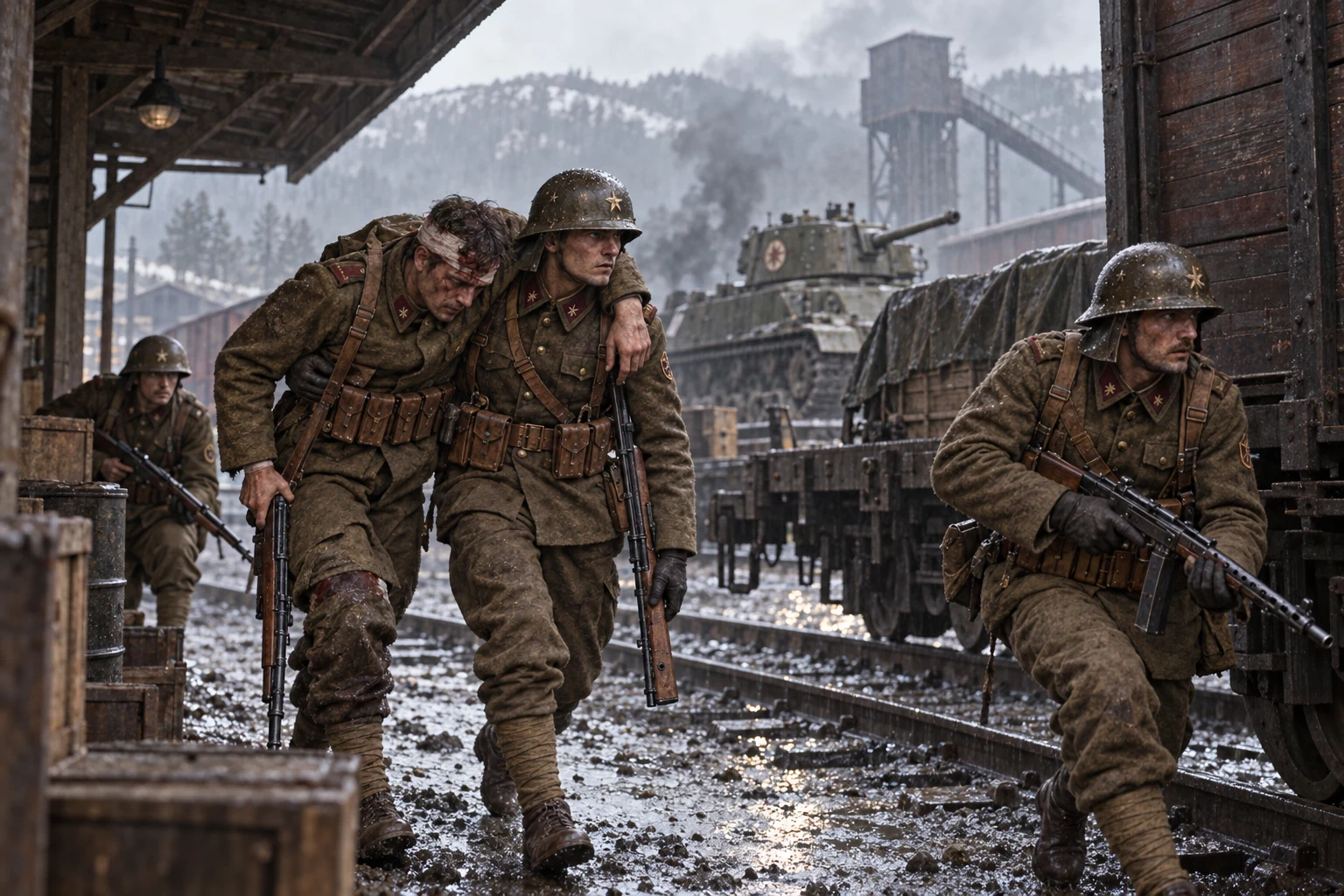
In August’s [Wagon Repair Row](new-battle-311), returning vehicles revealed a repair establishment sustaining transport through the town’s approaches. Rusk struck its road junction with limited forces and separated mechanics from protection. Tools and drivable vehicles escaped, preserving a cadre whose rebuilding site now had to be farther back. November’s [North Yard Footbridge](new-battle-312) involved infantry expecting support across the same narrow connection it had used to enter. Teran engineers isolated the approach and a reserve emerged from freight sheds. The Allies fought back across the bridge under covering fire. Rusk restored the local line but could not pursue outside the yards without exposing the corps’ flanks, making the victory’s boundary part of the recorded outcome.
What local success could and could not decide
The four lower-ridge engagements deprived the Allies of immediate support or assembly while leaving evacuated people and redistributed food. The river group removed flexibility, a post, weapons and bridging stores while leaving a broader foothold and specialists. The yard group restored local railway positions or damaged transport readiness while leaving observers and mechanics able to inform later work. These are different outcomes beneath the common Teran victory classification. The campaign does not need to deny the victories to preserve the Allies’ strategic recovery. It needs to explain exactly which task failed, what survived and how the larger command could reorganize around the surviving assets.
Lathorne’s broader operations belong to that higher scale, not to an invented personal role in every supporting detachment. The verified battles name their particular actors and mechanisms. Rusk remained the recurring commander of the 87th, Dalk directed the field-army river work, and Orven’s supporting fire appears where specifically recorded. A corps history can link these people through cooperation without making one officer omnipresent or retrospectively attributing every decision to a single master plan. The difference is especially important in interpreting Tassar, where separate supporting victories took place inside a war whose larger outcome could still become Allied recovery.
Geography, civilians and support burdens
Meren’s lower slopes, rough ammunition steps, the Darsel ferry and Tassar’s rail installations are tactical sectors attached to established regional context. They do not create new ancient cities or move the inherited atlas. Crosslinks to [Aldren](nation-aldren) and [Volara](volara) locate the campaign; the individual entries describe the sector functions at finer scale. The connection between those levels prevents a reader from mistaking a coal ramp for the whole railway town or a minor ferry for every river crossing. It also keeps the consequences in inhabited places, where a damaged footbridge, interrupted cold store or repair row could affect movement and distribution beyond the immediate military task.
The local sources provide some rescues and withdrawals in detail while leaving civilian losses unquantified. Their evidence supports the fact that wounded people were evacuated from the terrace and farm, carriers risked exposed movement, and specialist tools left threatened establishments. It does not establish a comprehensive account of every household near these sites. The synthesis therefore avoids inventing a uniform civilian response. What can be established is how military control changed access to structures and routes communities depended on. Repeated combat and occupation imposed disruptions even when a major map showed little change. The small geographic scale of a supporting engagement does not make its inhabitants’ losses proportionally insignificant.
Reading the campaign beside the major battles
The [1228](year-1228), [1229](year-1229) and [1230](year-1230) annual records supply the chronology surrounding the supporting war. The major syntheses on [the Darsel crossings](chron-major-029), [Meren Ridge’s recovery](chron-major-030) and [Tassar’s recovery](chron-major-032) address the retained decisive events at their own scale. This article’s twelve linked entries explain friction beneath those events without duplicating their narrative purpose. No battle strength has been constructed from the national headcounts, and no cumulative local loss total has been invented. Teran defeats of specific Allied formations can coexist with growing coalition ability to coordinate new crossings, replacement support and sustained pressure.
These groups reveal why the route from tactical gain to operational endurance was repeatedly contested. A terrace needed a climb, a post needed carriers, a yard needed signaling and repair, and a detachment needed observers and a protected exit. Teran commands recognized those dependencies and attacked them with professional effectiveness. The Allies preserved enough people, knowledge and wider positions to continue altering the campaign around each setback. The resulting history makes both the empire’s formidable victories and its limits visible. It leads to [the frontier and final counterblows](chron-campaign-14), where that same capacity for local success would persist as Teran strategic options contracted toward national capitulation.