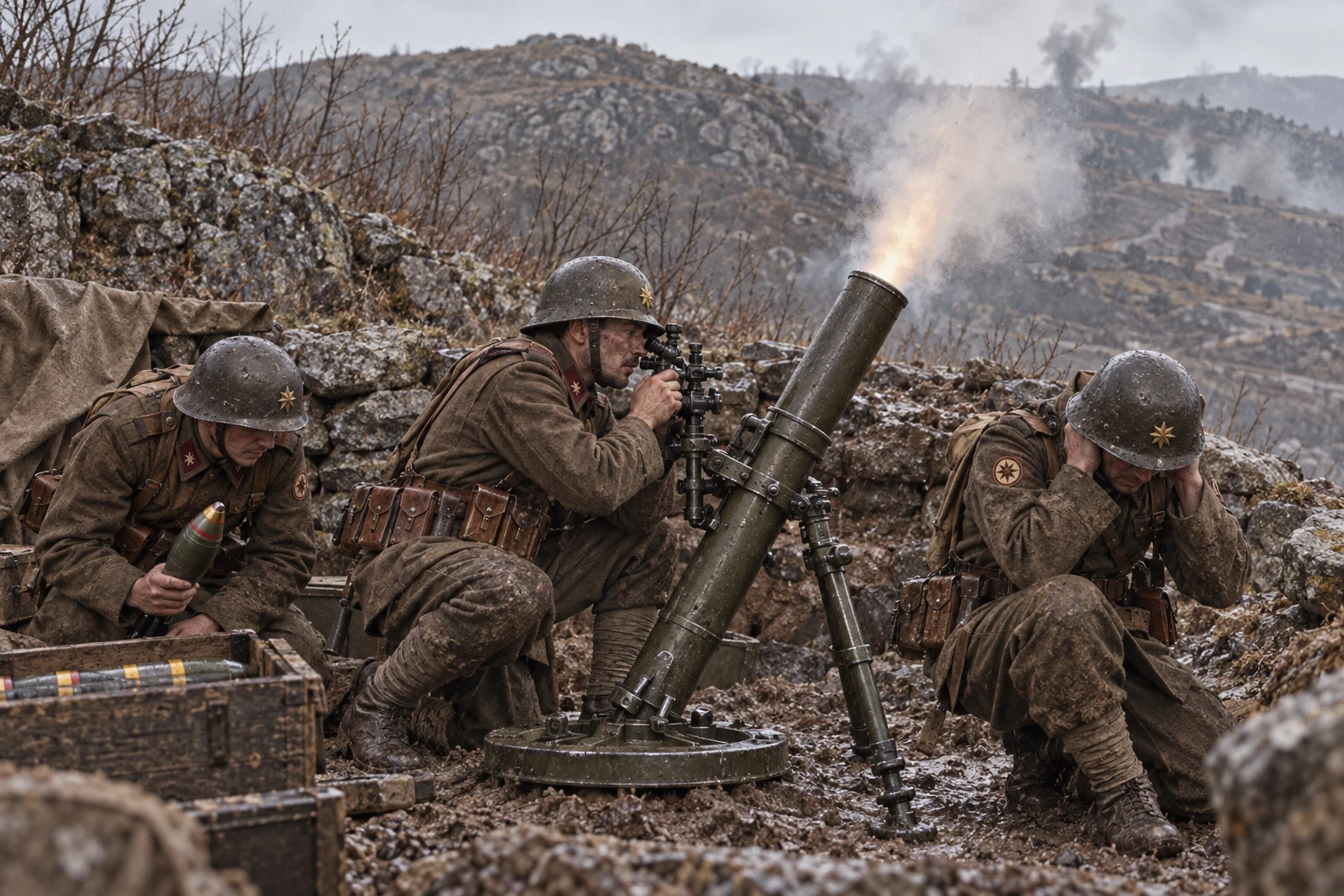
The second failure at Meren
March 4–April 22, 1228 · Eastern Aldren, Volara · Lathorne's 7th Army and Aldren forces against Rusk's 87th and supporting Teran formations
A familiar objective, a reconstructed army
Meren Ridge remained in Teran hands after the Allied attempt of autumn 1227. During the winter, Lathorne rebuilt depleted formations and revised the plan for another offensive. The army possessed more experience of the district, better support, and a clearer understanding of the 87th's defensive habits. Those improvements made the next attempt plausible. They did not establish that the enemy had remained unchanged while the Allies prepared.
Rusk had reorganized his corps, received replacements, and adjusted positions according to the preceding battle. Some forward ground was retained chiefly to delay and reveal Allied intentions; other positions supported the defense's essential connections. The system depended on neighboring Teran formations and theater resources as well as the corps itself. Its strength lay in the combination, not in an elite title capable of substituting for support.
The West Quarry position became one of the campaign's most contested local features. It included worked ground, service buildings, and irregular faces that distorted observation. Allied plans identified it as an intermediate objective. Soldiers assigned to take it soon discovered that an intermediate objective could consume as much effort as the ridge beyond it.
March 4–12: The quarry
The offensive opened on March 4 with gains in the lower approaches. Some Teran positions were overrun; others were evacuated after delaying the attackers. Reports of both reached headquarters under the same description of enemy withdrawal. Lathorne ordered continuation, believing the improved preparation had created an opportunity that the previous year's exhausted force could not exploit.
At West Quarry, leading Silvian troops occupied service buildings and found themselves exposed to resistance from ground beyond their immediate view. Supporting units arrived through damaged approaches and had difficulty establishing contact across the irregular terrain. Vale's formation helped connect two groups whose headquarters had each assumed the other was covering an interval between them. The work prevented a local isolation and delayed further movement.
Teran counterattacks contested the quarry's edges without necessarily recovering its center. Rusk sought to prevent the Allies from turning occupation into a dependable base for the next phase. The Silvians could report possession of named buildings while still being unable to move supplies or wounded through the district consistently. That distinction complicated the offensive's apparent progress from its first week.
March 13–31: The advance that keeps requiring another attack
Lathorne committed additional force and narrowed some local objectives. The changes improved coordination but did not remove the defense ahead. Each success revealed another position that had to be taken before the original timetable could resume. Units intended to exploit a breach instead relieved tired troops or recovered ground lost during counterattacks. The army's uncommitted strength diminished while the map still showed an offensive moving forward.
Within the 87th, resistance also became more expensive. Replacement drafts included men who had not served together, and veteran leaders were distributed among them to maintain cohesion. Rusk's staff requested relief and additional support rather than simply declaring the corps invulnerable. Higher command provided enough to sustain the defense and continued expecting results associated with the formation's reputation.
Vale's troops experienced the battle through repeated changes of immediate purpose. One day they prepared to advance; the next they held while another unit reorganized; later they moved wounded from a position another formation had lost. The sequence made individual courage difficult to connect with visible progress. Soldiers could complete the task directly before them and still end the week facing the same ridge.
April 1–22: The decision delayed
By early April, several subordinates argued that the offensive's remaining chances no longer justified its cost. Lathorne believed Teran resistance might be approaching exhaustion and authorized further limited attacks. His judgment rested partly on real evidence of enemy losses and partly on the hope that those losses were closer to a decisive threshold than his own. The 87th continued resisting with support that Allied intelligence had not fully assessed.
Medical and replacement reports increasingly contradicted optimistic interpretations of the army's strength. Men counted as returned to duty had not all recovered the endurance required for another assault. New soldiers filled vacancies but relied heavily on a shrinking body of experienced leaders. The army could continue fighting; the question was whether continued fighting could still achieve this objective under these conditions.
What Soll had actually observed
The command review included testimony from artillery observer Captain Iren Soll, whose reports had repeatedly used the phrase “enemy movement reduced.” Lathorne's staff read it as evidence of declining strength. Soll explained that it meant less movement visible from his observation position; smoke, relocation, and deliberate concealment could produce the same appearance. He had not intended a judgment about the corps' reserves.
The misunderstanding was consequential because the phrase appeared beside other reports of Teran losses, making several limited observations seem mutually confirming. The review traced them to separate viewpoints that did not cover the same questions. Staff officers revised the assessment format to separate observed activity from inferred condition and to identify the area each observation actually covered.
Soll remained in service and later supported the successful Meren campaign. His account did not absolve Lathorne, who had authorized continuation, or imply that perfect intelligence was available if only someone had used different wording. It identified a correctable habit in the way uncertainty disappeared while information moved upward. The next campaign would still require judgment under incomplete knowledge. Its staff could, however, avoid presenting a reduced field of observation as if it were direct evidence that the enemy's capacity to resist had been reduced by the same amount.
Lathorne ended the offensive on April 22. The Allies retained some gains but failed to recover Meren Ridge. The subsequent review examined the preparation honestly and focused on the decision to continue after the evidence had weakened. Wodro retained Lathorne in May while demanding clearer objectives and assessments. The High General's survival in command did not convert the campaign into a necessary success. It left him responsible for rebuilding the army and demonstrating that the next decision would use what this defeat had revealed.
Original illustrations for this source record
Original archive artwork and captions are preserved. Dates, labels and claims printed within inherited images belong to the previous edition; the revised text governs the current history.