A harbor attacked before the diplomatic question closed
The Selen harbor battle in the western Grand Isles lasted from February 9 to February 28, 1210. The Kelonese attack began before Naviri's authorities had resolved whether the latest demands constituted an ultimatum or another round of bargaining. Ordinary departures were still being arranged when warnings interrupted work. Ships responded according to their immediate condition: some could move, while others had crews ashore or machinery awaiting attention. This starting point makes readiness a concrete matter of people and equipment rather than a list of available hulls. A vessel could belong to the harbor's fleet and be incapable of leaving at the necessary hour. The opening attack thus met a commercial and naval system caught between routine operation and a sudden coercive campaign, not a uniformly prepared force already executing a single wartime movement plan.
The retained annual account situates Kelonese intervention within a debate over using naval preparations to impose a new order in the western islands. Advocates treated possible future hostile use of neighboring ports as a reason for present coercion. Admiral Taren Seko favored a limited campaign aimed at seizing useful approaches and compelling submission. The harbor battle tests the gap between that expectation and the obligations created by occupying damaged facilities. A limited political intention did not guarantee a short military effort. Once Naviri resisted, the attackers needed to secure and use a foothold whose opening bombardment had impaired. The Chronicle's analysis follows that causal relationship without adding diplomatic documents, secret orders or new claims about what individual commanders knew before the attack. The inherited accounts provide the stated strategic expectation and the subsequent material difficulties.
Namin’s priorities: vessels able to leave
Initial attacks damaged storage and communications without destroying the entire harbor. Smoke obscured approaches and led local naval command to believe briefly that its main repair facility had been lost. A civilian messenger reported that the workshops remained usable despite a failed power supply. That correction altered the range of possible responses. Repair crews improvised before the military picture had become clear, demonstrating that the harbor's surviving capability could not be inferred simply from the number of visible fires. Different cargoes, facilities and connections failed in different ways. A working building without power still presented a problem, but not the same problem as a destroyed workshop. Civilian observation corrected an operational conclusion and helped preserve choices at a moment when incomplete reports encouraged a more comprehensive assessment of ruin.
Commander Lera Namin directed the local naval defense and ordered repairs prioritized for departures instead of completing every scheduled job. Her vessels included patrol craft, ships under repair and auxiliaries with civilian crews not organized for combat. The order matched the task to the immediate need: getting a ship out could matter more than making it appear fully restored at its berth. Several vessels departed with unfinished work and technicians aboard. The account does not state that they subsequently operated without further difficulty, so their survival should not be converted into a claim of full readiness. Namin preserved the possibility of continued service elsewhere while accepting incomplete maintenance. Her choice joined naval operations to workshop labor and challenged a fleet comparison based only on formally serviceable categories. The harbor retained strength through decisions about what to finish, what to postpone and where remaining work might continue.
Naviri enters the war and improvises a land defense
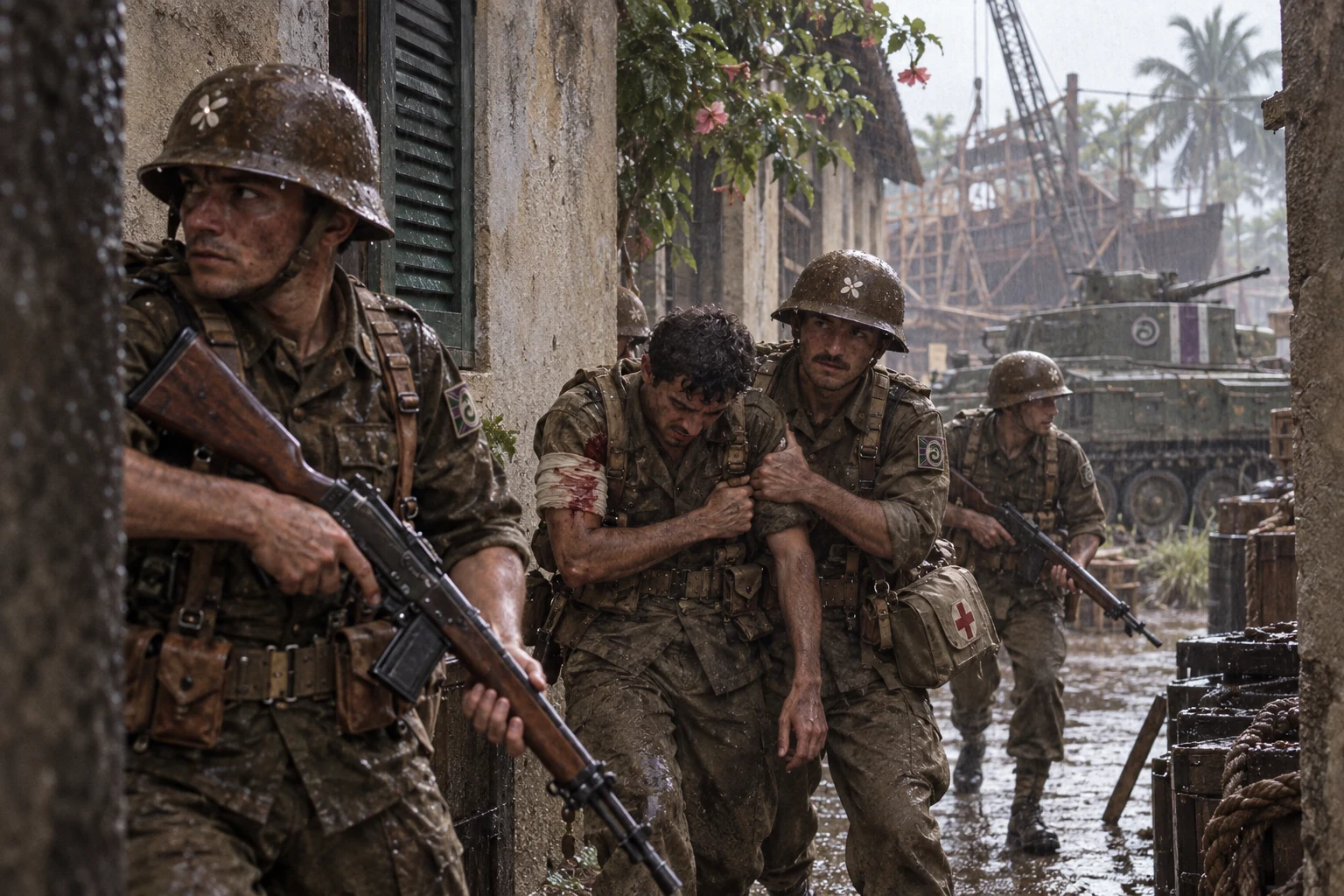
Naviri declared on February 10. The declaration clarified political status but did not create trained personnel or additional weapons. Regular troops and locally mobilized forces defended the harbor's landward approaches. Captain Tovan Eri's assignment in the warehouse quarter illustrates the importance of commercial geography. Military plans presented buildings as solid blocks, whereas workers knew the shared courtyards, alleys and internal passages connecting them. Their guidance could turn an apparently closed space into a movement route or expose an assumed opening as misleading. Some workers remained until relatives could be located. The source therefore describes participation shaped by local obligations, not an effortless transfer of civilian labor into military service. The workers contributed necessary knowledge while also pursuing the survival of their households. Both purposes belonged to the harbor's defense.
Kelonese forces obtained coastal positions and pressed the district from their footholds. Their commanders expected interruption of port activity to force withdrawal, but Naviri dispersed handling among surviving facilities. This reduced throughput and increased labor requirements while keeping supplies moving. Vessels unloaded at awkward points and carts passed through residential streets. Municipal officials sought protected intervals for distributing civilian food. The adaptation was effective within limits: it sustained resistance but did not restore normal port capacity or remove competing needs. The harbor remained a civilian provision system as well as a military installation. Describing the improvised traffic solely as military ingenuity would leave out the people who bore the congestion and the officials trying to preserve food distribution. Describing it solely as disorder would miss the organized work that kept the defense supplied despite the damage.
The customs compound as observation point and public institution
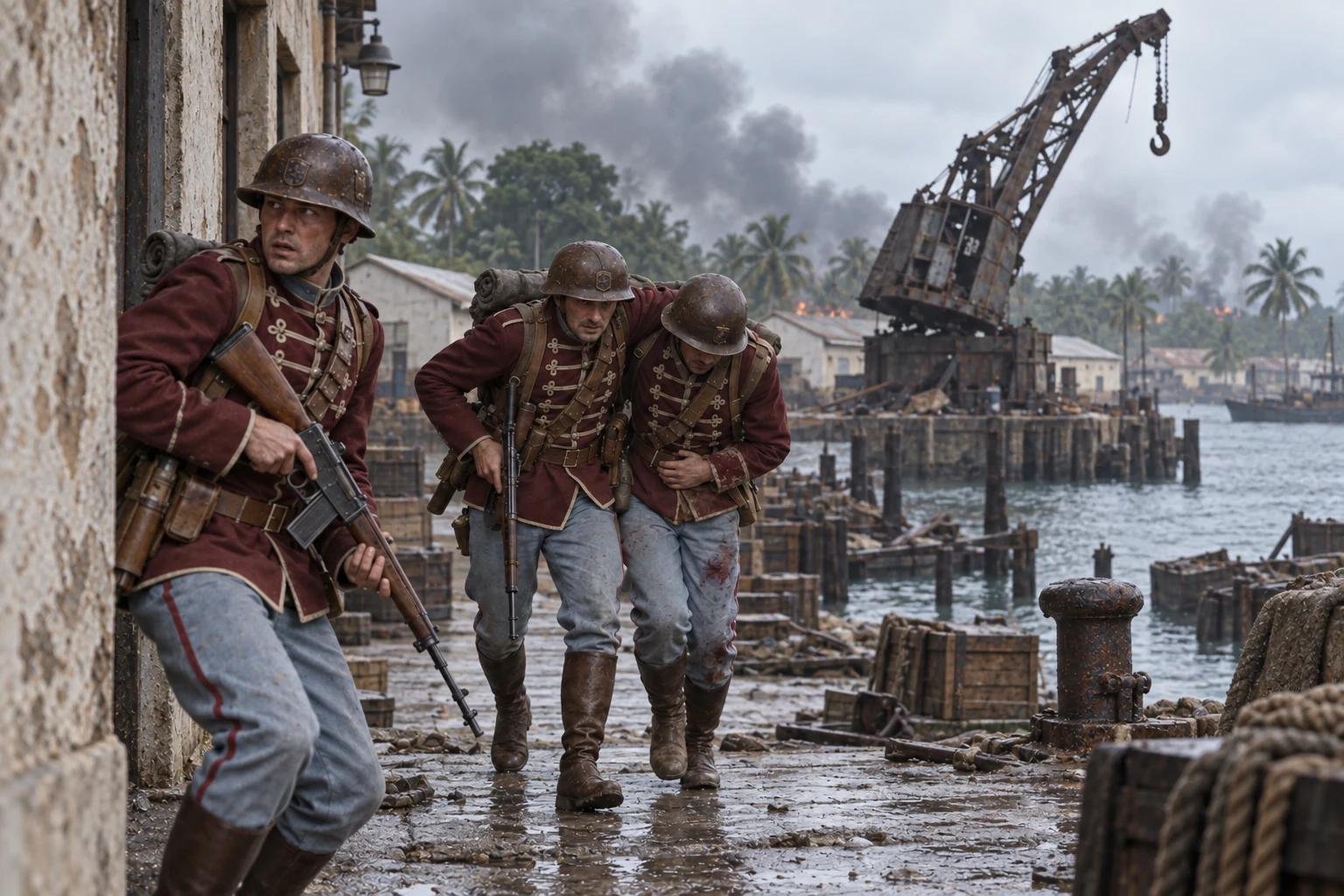
Fighting reached a customs compound on February 13. Kelonese possession would improve observation of the harbor and endanger remaining traffic. Eri's mixed force held the main office while losing adjoining sheds, and the damaged walls divided its understanding of nearby movement. The compound did not function as one indivisible objective. Different rooms and entrances were held or crossed at different moments, with neither side necessarily seeing the whole arrangement. During a night relief, fresh troops entered incorrectly and required redirection by a customs clerk. The incident identifies the difference between a unit's nominal assignment to a location and its actual arrival at the useful position within that location. Local knowledge mattered because a misplaced relief could consume the limited interval in which exhausted defenders needed replacement.
The struggle also placed the compound's civilian records at risk. By February 20, Eri's force had retired from the main office while retaining buildings inland. Soldiers removed the customs register after a clerk insisted that it recorded claims belonging to households and businesses. Later it helped identify displaced workers and dependents. The register's preservation did not change the military outcome, yet it formed part of what the withdrawal carried forward. Its importance makes sense within the larger pattern of Ravessa's survey plans and payroll, where civilian documents similarly served continuity after territorial loss. The comparison does not establish common orders or coordinated archival policy. It shows that people inside different battles recognized records as tools for maintaining relationships and obligations. Military retreat could preserve some public functions when individuals resisted the assumption that paper mattered less than every immediate tactical burden.
Kelonese reinforcement and the unloading problem
Between February 15 and 22, additional Kelonese infantry sought to enlarge the foothold. Naval support damaged Naviri positions while also wrecking facilities intended for the attackers' use. A crane fell across a quay needed to unload occupation stores. Clearing it required equipment aboard vessels still waiting offshore. This sequence created a practical circularity: the foothold needed unloading capacity in order to receive the means to improve that capacity. Seko's wider headquarters received reports of coastline captured together with demands for labor, machinery and protected time. The coast's military possession therefore represented an incomplete operational gain. It gave the attackers locations from which to continue but not an automatically functioning base. Recognizing that limit does not deny Kelonese success; it identifies the work required to convert success into the coercive leverage expected at the campaign's outset.
Naviri's surviving vessels performed transfer, communication and evacuation work under growing danger. These duties were less conspicuous than a major naval action but connected damaged parts of the harbor that roads no longer joined. An auxiliary grounded while trying to reach an unfamiliar unloading point. Recovering its cargo over successive tides absorbed men expected to reinforce the land defense. This was not a separate accident irrelevant to the battle's course. It reduced immediately usable labor through the same dispersed arrangement that otherwise kept supplies moving. Improvisation could preserve endurance and create fresh demands at once. The source establishes the grounding and recovery burden without attributing blame to a named officer. The operational interpretation should remain similarly specific: unfamiliar access and physical damage multiplied tasks, and those tasks competed for the personnel on whom the defense depended.
The Amaret and the misleading boundary of a fleet list
The training cutter Amaret was initially marginal to the harbor's main movements. Lieutenant Des Nori commanded a crew partly made up of trainees. Namin assigned the shallow-draft vessel to local transfers because its familiar crew made it useful amid damaged facilities. Nori protested that the cadets had expected operational duty. Their later work carrying wounded under attack exposed how little that expectation's distinction protected them from combat danger. A training vessel could become operationally important through suitability to a local task without being reclassified instantly as a major fighting unit. The cutter's story therefore supports a critique of conventional fleet comparisons: formal categories obscured the contributions of small craft, technicians and trainees whose work preserved the functioning of a naval establishment after its principal facilities were disrupted.
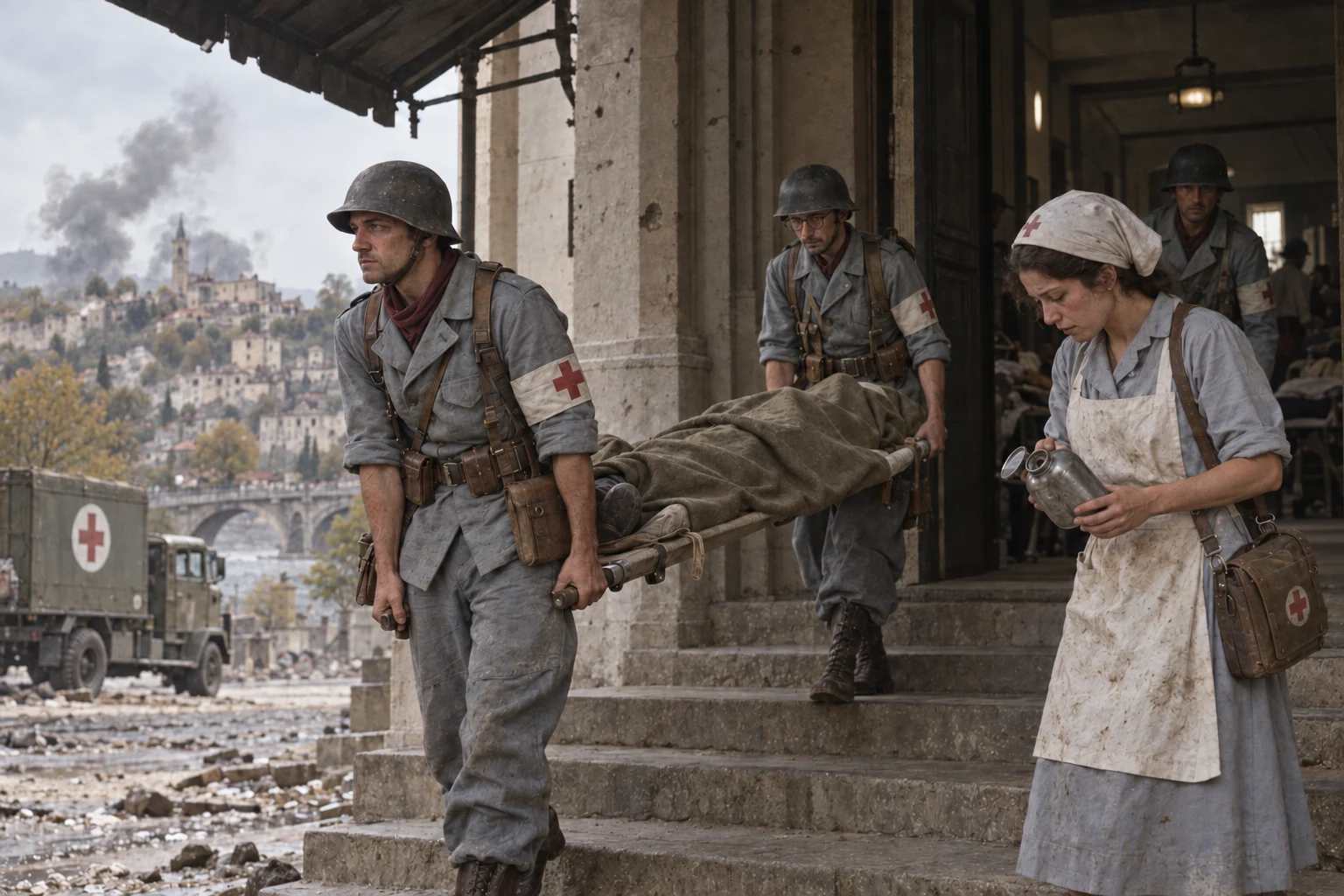
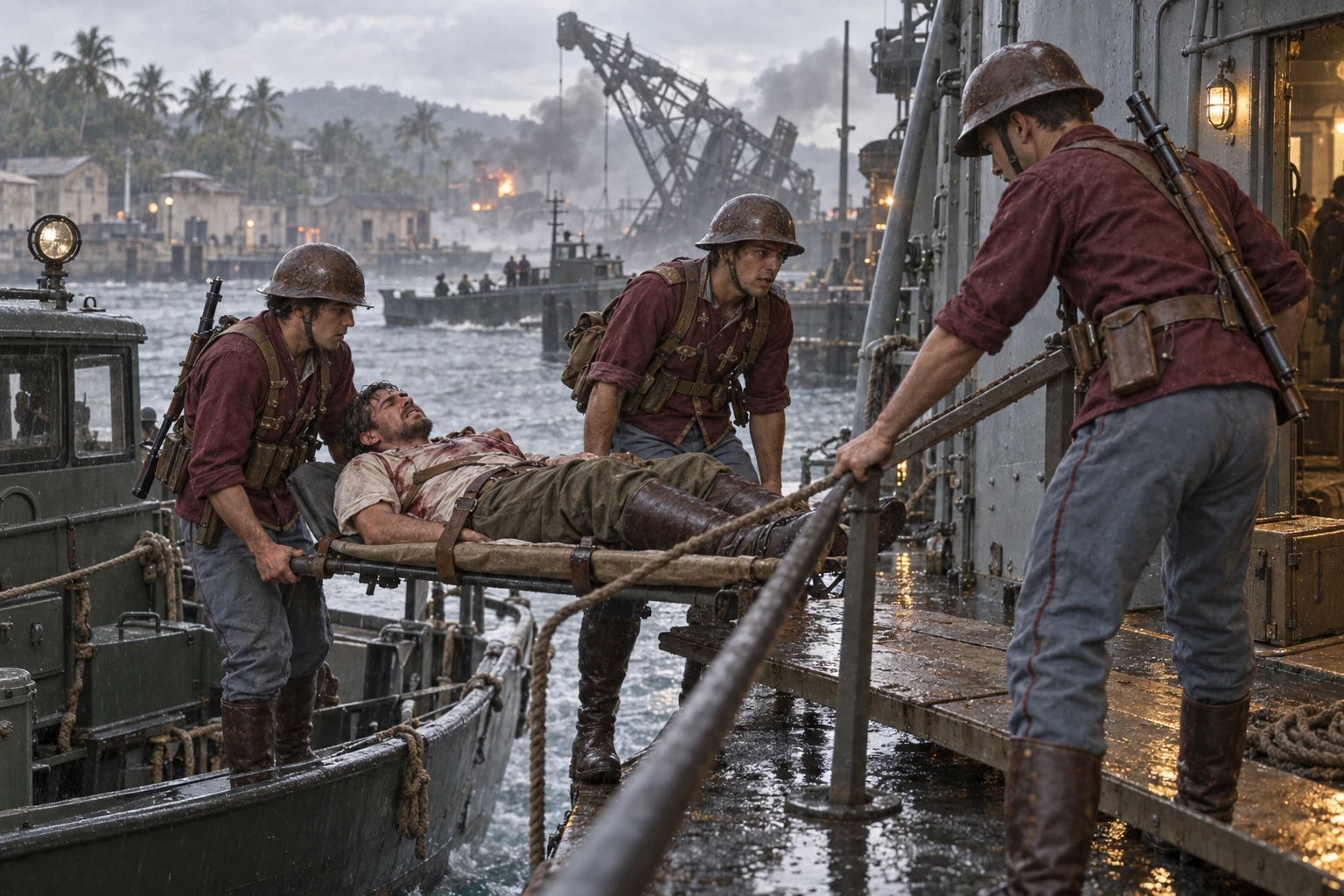
The cutter moved injured dockworkers from an isolated quay to a surviving medical landing. A loose crane cable complicated access, and some injured people required help to board. Nori put a party ashore between trips. Two transfers were completed before damage took the cutter out of service, and the shore party returned aboard another vessel after its own command had reported it missing. The episode links damaged infrastructure, medical need and the difficulty of accounting for personnel temporarily detached from their parent vessel. The eventual return is recorded, but it should not be expanded into invented details about its route or timing. Nor does the successful transfer demonstrate that the harbor's evacuation problem had been solved. It establishes a bounded action in which a small vessel and a shore party preserved lives while accepting danger and disruption to their own availability.
A repaired vessel and a public memory of service
The Amaret survived the campaign and resumed harbor training after extensive repair. Its casualty list included instructors and trainees. Those losses made the overlap between educational and fighting establishments visible to Naviri's public. Namin named the vessel in her report because its contribution challenged the lists planners used to compare fleets. Her recognition belongs to the source's account of institutional learning, but it does not permit a claim that all later planning changed. The report demonstrates an effort to preserve a lesson: a major facility's survival could depend on craft outside the apparent core of the battle fleet. That lesson arose from the vessel's specific suitability and the work assigned to it, not from a romantic assumption that smaller ships were always more useful or less vulnerable than larger ones.
The cutter's service also highlights civilians as people with claims to rescue rather than as an anonymous labor reserve. The injured were dockworkers whose knowledge and work had helped sustain harbor functions. Once wounded, their needs became part of naval movement priorities. This relationship resists a narrow narrative in which civilians appear only when they enable soldiers to continue fighting. The harbor's defense depended on their labor, and its medical transfers acknowledged their vulnerability. The source cannot establish the outcome for every dockworker or household, and the Chronicle should not imply universal protection. It can identify the principle visible in the action: local transfer work carried human obligations across damaged connections. The material record of a vessel's sorties thus has meaning beyond the tonnage delivered or the direct combat power it contributed.
Different records of the same coastal possession
A captured-coast report, a workshop schedule, a customs register and a cutter's casualty list described different outcomes of the harbor struggle. The first established Kelonese territorial gain; the second revealed whether ships could move again; the third preserved claims of displaced civilians; the fourth showed which people paid for the transfer work sustaining resistance. No one record could substitute for the others. This is why Selen can be both a local Kelonese victory and evidence of Naviri's continuing organized endurance. The categories answer different questions. The source does not authorize a combined numerical score balancing them, and the Chronicle makes none. It instead follows how occupation, repair, recognition and movement interacted. The harbor's fate emerged from those relationships over the remainder of February and into the later evacuation arrangements, rather than from a single moment in which a captured quay settled the country's capacity to remain at war.
A coastal victory short of national defeat
During February 23 to 28, Naviri abandoned its most exposed harbor positions to preserve the remaining force. This military movement did not evacuate the surrounding population in full. Some residents stayed in shelter because travel had become more dangerous, while authorities registered those reaching safer areas. The later April evacuation developed from these arrangements and their failures. Staying behind should not be read automatically as acceptance of occupation or refusal of assistance. The source describes constrained choices within a changing danger. An organized force could withdraw more readily than households whose members, property and means of movement differed. The final defense therefore produced an enduring asymmetry: it preserved organized resistance while leaving civilians in a district now partly controlled by the attacker. The limited evacuation must accompany any account celebrating the survival of Naviri's institutions.
By February 28, Kelonese forces possessed important coastal positions and had disrupted a valuable port. Naviri had not surrendered nationally. Its surviving forces remained organized, repairs continued elsewhere, and further Allied island participation would widen the war. The captured facilities required substantial work before consistent use. These outcomes explain why the attack failed to produce the quick political submission anticipated by its advocates despite a real local victory. For Naviri, dispersed handling and civilian cooperation supported endurance; for Kelonese commanders, occupation carried obligations made harder by the bombardment that helped obtain it. The Chronicle derives that interpretation from retained fictional battle and annual accounts. It supplies no invented naval strengths or evacuation totals and does not equate continued resistance with civilian safety. Selen mattered because it showed that a harbor could be gravely impaired and partly lost while the country drawing upon its surviving people and institutions remained in the war.