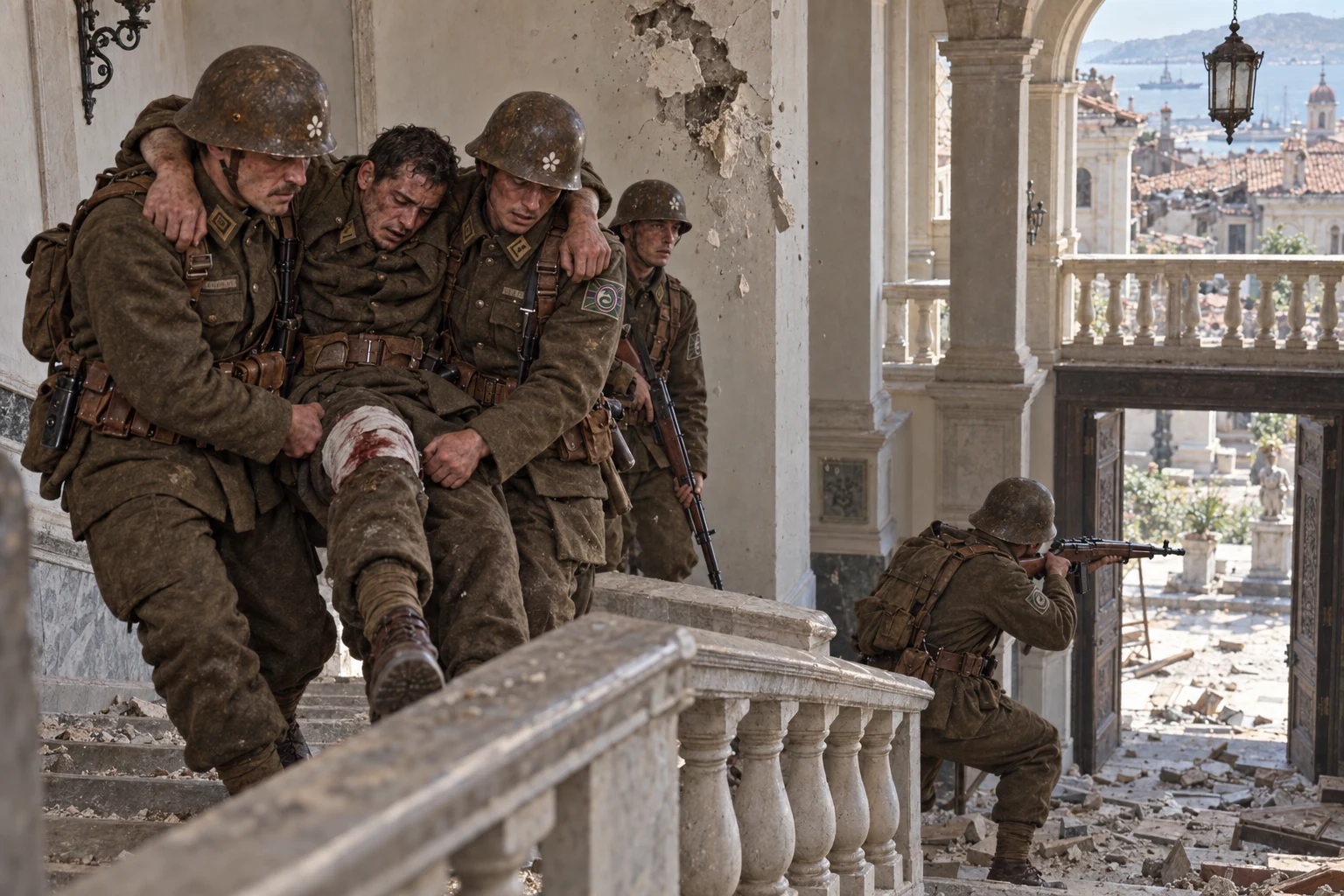
The final state belligerency
The capital campaign ran from November 1 to November 21, 1235, in Kaisora, the Kelonese capital in the Grand Isles. It followed a homeland campaign begun on July 16 after the empire's outer support system had been lost. The September 30 position left Kelonese as the sole national belligerent: the other 106 Axis national commands were bound by capitulation or cessation arrangements. That status gave the capital operation world significance, while not implying that every isolated armed group elsewhere had already implemented the end of its own resistance.
Silvian marines, army formations, naval forces and Allied partners contributed to the advance. The palace was a position within that larger campaign, not a battlefield on which every participant physically converged. Major General Mara Isen's 2nd Marine Division operated in the inner district with Brigadier Alen Corv's 4th Marine Brigade. Sergeant Tavin Orrel and Corporal Eda Sorn served in the 2nd Battalion's C Company. Their retained service places a local flag party within an identifiable organization rather than making two individuals stand in for the entire coalition's final operation.
The Palace of the Dawn Court stood above Procession Avenue in the inner administrative district. Its political meaning exceeded the immediate military value of the buildings, but that meaning did not grant the local marine command authority to end a national war. The fighting for the position, the negotiations binding remaining national forces and the later ceremony were separate processes. They converged over the final two days without becoming interchangeable. This distinction is central to explaining how the world's last state belligerency ended through an implemented capitulation rather than simply through the occupation of a famous site.
An experienced force that had changed
Orrel and Sorn served among marines whose formation had been reorganized and replenished after earlier campaigns. Some were veterans of several landings; others knew those actions through instructors and companions. The unit's competence arose from collective habits and continuing training, not from every person carrying the same length of experience. Its history therefore cannot be represented by an unchanged roster traveling intact from one operation to the next. The capital campaign was another stage in the work of maintaining an institution through losses and replacements.
Urban conditions complicated the relationship between maps and actual use. A building's official function did not establish whether it now held defenders, records, shelters or people requiring care. The force had to establish present conditions rather than treat an imperial label as a complete military description. Earlier campaigns had taught the value of such distinctions, but teaching did not remove uncertainty. The marines still encountered incomplete information in the final weeks, when the temptation to assume that the last enemy would collapse under the weight of the war's apparent conclusion was especially strong.
The Allied support arrangement remained necessary despite the empire's isolation. Defenders could delay movement and impose losses locally even when their national prospects were poor. Relief personnel and reserves could not be dismissed as unnecessary because every other Axis state command had stopped fighting. A unit entering the capital needed the same ability to sustain and interpret its gains that had mattered in earlier invasions. The finality of the campaign concerned the national sequence, not immunity from the dangers confronting the troops and civilians within the remaining battlefield.
November 1–10: an uneven outer defense
The advance met varied resistance. Some Kelonese formations withdrew under orders; others held after neighbors moved; some surrendered locally. A single white flag could not establish the status of every nearby position. An empty street likewise did not prove the whole district safe. Orrel's company moved through areas where residents remained in basements and service buildings. The force needed to distinguish local signals from wider command decisions while preserving contact with civilians whose presence was easy to miss beneath the damaged surface of an apparently abandoned neighborhood.
A municipal complex became a sustained point of fighting. Administrative offices adjoined medical rooms and shelters, so different uses occupied the same immediate geography. Marines secured parts while medical personnel continued their work nearby. The situation did not reduce to a choice between a wholly military building and a wholly civilian one. It demanded an account of which functions and people were present in each part. Sorn directed residents toward a collection point only after a route was confirmed usable, rather than acting on the rumor that an open street existed somewhere beyond the complex.
That confirmation mattered because civilians moved differently from an assault formation. Families could include people unable to travel quickly or understand military signals. Their knowledge of home might no longer correspond to routes altered by destruction. Directing them into danger on the basis of an incomplete report would use military authority without establishing the conditions needed for safe movement. The record identifies Sorn's decision as part of the campaign's civil consequence. It illustrates agency exercised in a supporting task, rather than reserving all historical importance for those closest to the palace position.
November 11–19: authority and actual use diverge
As the fighting approached the imperial center, official buildings served as positions, shelters or abandoned spaces according to local circumstances. Orrel's men entered an office expecting a command post and found records, civilian staff and a smaller defensive group than reported. The result corrected their immediate understanding but did not invalidate every earlier report about the building. Conditions could change, and sources might describe different times or parts. The unit had to act on what it now established while retaining enough context to understand how its initial expectation had been formed.
Capturing an administrative place immediately created several responsibilities. Documents needed protection, wounded required movement and civilians had to be distinguished from prisoners. Sorn's group guarded a temporary collection area while other marines continued forward. That task placed them away from the most visible fighting but helped prevent the rear from becoming disordered as the front moved inward. A capital offensive cannot be sustained solely by taking successive buildings. It also requires controlled relationships among people and material left inside the growing area for which the attacking force now bears responsibility.
The documents could later support inquiry into the empire's governance, occupation and crimes, but their immediate presence did not provide an instant complete explanation. Preserving them safeguarded the possibility of such work. Responsible interpretation would still require attention to authorship, date, purpose and the relationship between an order and its implementation. The campaign's record supports the protection of evidence; this synthesis does not invent a specific discovery or verdict in those offices. The distinction keeps accountability substantive without manufacturing a convenient revelation to conclude the military narrative.
The national negotiations had their own authority
Authorized representatives considered terms binding the Kelonese Empire's remaining forces separately from the fight for the palace. A marine company could secure an area but could not substitute that local outcome for the national agreement. Nor could an individual civilian gesture in the district certify the decisions of military commands elsewhere. These distinctions explain why the end of local resistance and the national cessation have separate dates. They also show why transmission and implementation remained necessary after representatives agreed, particularly for forces not directly connected to the capital's immediate events.
The negotiations did not make the preceding days harmless. Troops and civilians continued to face danger while positions were contested and routes uncertain. The knowledge that a national end was approaching could influence expectations, but it did not establish what a local defender had been ordered to do. Allied units therefore continued verifying conditions rather than treating political possibility as a confirmed military status. A history written with the final capitulation in view should preserve that uncertainty instead of imagining all participants already acting inside a peace that had not yet taken effect.
The Kelonese state's responsibility for occupation, prisoner abuse and genocidal persecution remains part of the setting of its defeat. An account of the final capital fighting cannot treat that responsibility as a decorative description of an enemy. It explains why protection of people and records carried consequences beyond immediate victory. At the same time, the source does not authorize inventing a particular camp, witness or criminal finding inside the palace. The military chronology and the work of accountability should connect through evidence and institutional responsibility, without using an unsupported atrocity episode to supply dramatic closure.
November 20: the palace position stops resisting
The palace's local resistance ended on November 20. Marines secured the relevant buildings and grounds while medical work, searches and prisoner arrangements continued. Occupation of the site did not make every room safe or every person's status clear. Damage and incomplete knowledge persisted. Personnel checked where movement was possible and where restrictions remained necessary. The local result was substantial because it transferred a central imperial position into Allied control. It did not itself give the marines authority over every remaining national force, nor did it replace the settlement still governing the next day's national end.
The site was thus already undergoing a practical transition before the later ceremony. People under custody, wounded in need of treatment and civilian staff remaining in the complex did not disappear from its history when the firing ended. The force's obligations expanded as its control became firmer. A palace might be remembered chiefly through a flag above its facade, yet the implementation of victory took place through less visible rooms, collection areas and communications. Those tasks established the conditions in which the ceremony could mark an event rather than pretend to create it.
Local cessation also did not automatically deliver perfect information to every party elsewhere in the city. Confirmation and continuing checks remained necessary. A route could have been cleared at one point and still require current authorization before a group used it. That requirement explains the flag party's later wait for confirmation without implying renewed palace resistance or moving the surrender date. Security after a battle is a process of establishing usable control, and the timing of that process must remain distinct from the time an opposing position agreed to stop fighting.
November 21 at noon: the war's national end
The national capitulation took effect at noon on November 21. The settlement required the remaining Kelonese forces to end resistance. As the companion lore establishes, Admiral Taren Seko accepted that general order; he and surviving senior personnel then entered custody. The agreement ended the final state belligerency of the world war. Orders still had to reach formations that had not witnessed the capital's events. The end was nationally binding without producing instant simultaneous knowledge in every isolated group around the world.
This is the date of final Allied victory in the retained canon. It followed Hukular's April 12, 1234 capitulation and Tera's July 1234 national end, rather than occurring in the same year as those continental defeats. The interval preserves the continuing importance of the Grand Isles campaign after the principal Volaran Axis powers stopped fighting. The world war had many fronts, and its conclusion could not be declared merely because the dominant earlier aggressor had fallen. The final national decision belonged to the state that remained belligerent through November 1235.
The noon settlement also preceded the flag raising by three hours and forty minutes. The ceremony would mark the concluded national event at its most recognizable site; it was not the act that legally ended the war. This relationship matters because memorable images tend to replace the preceding institutional process in public recollection. Here the sequence preserves both: representatives made a binding national agreement, commands began implementing it, and marines later represented that conclusion through a flag above a position already surrendered locally the previous evening.
The ensign reaches its destination
The standard naval ensign had been issued at Motari on July 5, eleven days before the homeland campaign began. Its recorded identity linked the final ceremony to the force's longer movement through the Grand Isles. The design was familiar aboard the ships carrying the marines: white, green and white fields, a gold wolf-and-shield emblem, foliage and two flanking stars. The source provides this specific history of the cloth. It does not require an invented prophecy or private speech to explain why its destination now mattered to the surviving troops assigned to carry it.
Before proceeding to the Dawn Terrace, the party gathered in the West Service Quadrangle. The ensign was intact, but Sorn's inspection of its waxed canvas sleeve revealed a torn fastening. The detail situates the ceremony in practical preparation rather than effortless symbolism. The party still had to carry, handle and raise an object at a site whose access had required checking. Other marines continued security duties. The flag's symbolic purpose did not suspend responsibility toward prisoners, patients or staff elsewhere in the newly controlled complex.
At 15:32, Orrel received confirmation that the terrace route was clear. The party then reached the central flagstaff at the recorded municipal survey point E2.40/N3.10 above the frontage facing Procession Avenue. This local coordinate is retained from the account and does not redefine the world atlas or create a new ancient city. At 15:40, the raising began. Nearby personnel paused where duties allowed, while medical parties moved patients and headquarters continued transmitting the national order. The moment was shared through different tasks, not through every participant physically standing beside the flagstaff.
What the flag concludes and what continues
Orrel and Sorn's action belonged both to the small party present and to the coalition sustaining it. Sailors, soldiers, aviators, workers, civil officials and Allied nations had contributed across decades of war. Recognizing that wider effort does not erase the local people who handled the ensign, nor does focusing on them make their unit the sole author of victory. The palace provides a recognizable point at which those scales meet. The national war ended through a settlement, while its public image came through people carrying out an ordinary task under extraordinary historical circumstances.
The aftermath remained full of separate histories. Wounded still needed treatment. Families required information. Captives had to be identified and held under recorded arrangements. Communities harmed by occupation and persecution faced questions the ceremony could not answer. The finality of Allied victory therefore should remain exact without becoming a claim that every consequence was resolved on November 21. The archive can record a war's conclusion while continuing to follow survivors, missing people and accountability beyond it. Those subjects are consequences of the event, not evidence that the national chronology lacks a definite end.
This authored synthesis retains the inherited capital dates, named formations, officers, local surrender, noon settlement and 15:40 ceremony. It adds no new in-world quotation or invented criminal finding. Its analysis distinguishes authority, implementation and public memory so that the palace's fall can remain both meaningful and precise. The endpoint is clear: the Silvian flag rose above the imperial palace after the final national capitulation had taken effect. The people continuing medical, custody and relief work below it demonstrate why ending a world war and repairing its world were connected achievements with profoundly different durations.