The sea fight inside the land campaign
The western chains campaign lasted from March 6 to April 28, 1226, across the western Grand Isles and adjoining Nagasaki waters. Its significance lay in the relationship between a continuing land commitment and a navy challenged while sustaining it. The troops could not consider arrival ashore the end of their dependence on the fleet. The naval command could not evaluate its battle solely by enemy ships damaged if its own losses severed the connection on which Allied positions depended.
General Mira Dalen commanded army formations containing veterans and replacements shaped by the expedition’s previous failures and successes. Admiral Oren Vask coordinated support within wider Allied arrangements. Their cooperation had improved since Orava without eliminating disagreement. Dalen needed predictable help for troops already committed. Vask needed to preserve vessels, aircraft and crews capable of providing that help after another encounter. The problem was an ongoing allocation of endurance rather than a contest between commanders who did or did not care about the people ashore.
The objectives belonged to the established western island theater. The operation did not require new national borders or access through neutral Korai or Savaio. Allied island personnel remained important to terrain knowledge and civilian arrangements. Recognizing those bounds keeps a maritime campaign from turning every nearby coast into available Allied space. It also preserves the distinction between a larger expedition’s growing capabilities and the local institutions without which those capabilities could be directed toward the wrong needs.
March 6–19: A foothold must become a commitment
The opening landings met organized resistance and secured usable positions. Some arrivals remained out of sequence, demonstrating that experience had reduced disorder without abolishing it. Shore commands identified gaps earlier. A formation missing communications equipment was not described as fully ready simply because most infantry had landed. That correction slowed some movement. Its military value lay in preventing an order based on capabilities the troops did not yet possess.
The difference from earlier operations concerned the use made of bad news. Accurate reporting could lead headquarters to postpone or alter an attack before missing support produced isolation. It did not necessarily produce a more impressive initial progress report. A developing institution accepted that less optimistic information could support more durable action. The campaign’s improved competence therefore cannot be measured only by speed of advance or the number of early objectives reported taken.
Kelonese defenders contested inland approaches and vulnerable connections. The Allies lost exposed positions before forming a more coherent arrangement. Dalen accepted local withdrawals when they preserved the principal objectives’ support. This was not a general policy of conceding ground at the first difficulty. It was a judgment about which possessions could be sustained and which imposed demands greater than their contribution to the operation. Retaining every opening gain would have confused the extent of occupation with the ability to continue fighting usefully.
Offshore, damaged vessels entered repair and replacement arrangements. Withdrawal reduced immediate available strength while preserving future service. Vask refused to keep every ship continuously on station regardless of its condition. Infantry officers sometimes waited longer for support than they considered acceptable. Openly revising schedules did not remove the cost of those gaps. It made the conflict visible, allowing army decisions to reflect the naval force actually available rather than promises maintained after their practical basis had changed.
March 20–24: A carrier force under uncertainty
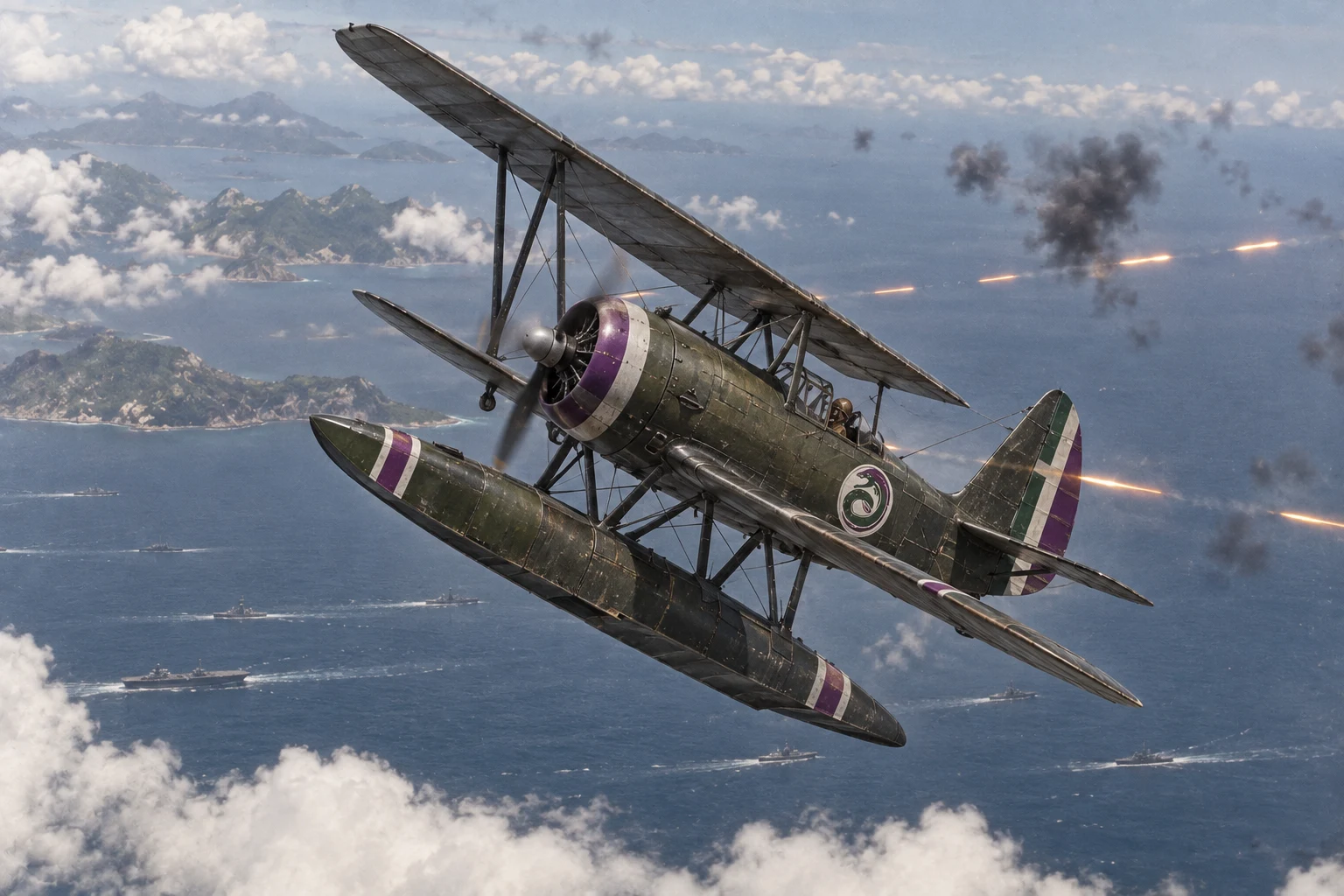
Kelonese forces challenged the support system during the third week of March. Reconnaissance and weather gave both commands incomplete pictures. Reports of enemy activity did not always locate the force responsible or establish its condition. Returning Silvian aircrews supplied accounts that differed about ships seen. A synthesis should not transform those reports into a single complete view possessed by every headquarters during the action. Their differences shaped the decisions commanders could make before later evidence clarified the battle.
The naval encounter threatened more than the destruction of individual hulls. Carrier activity required flight facilities, returning crews, fuel, maintenance and a schedule compatible with neighboring ships. Damage to one part could redistribute tasks across the force. This interdependence explains why a surviving carrier could become unavailable for its assigned role and why other vessels could remain intact yet lose time for their own missions while receiving diverted aircraft.
An attack damaged a Silvian carrier’s flight facilities while aircraft remained away from it. Command had to decide where those crews could land before fuel made delay impossible. Other carriers had recovery schedules and operating demands already in progress. Redistribution and suspension of some planned activity preserved people and aircraft at a cost to the force’s immediate program. The resulting survival was an organized response to a changed condition, not proof that the damage had been militarily insignificant.
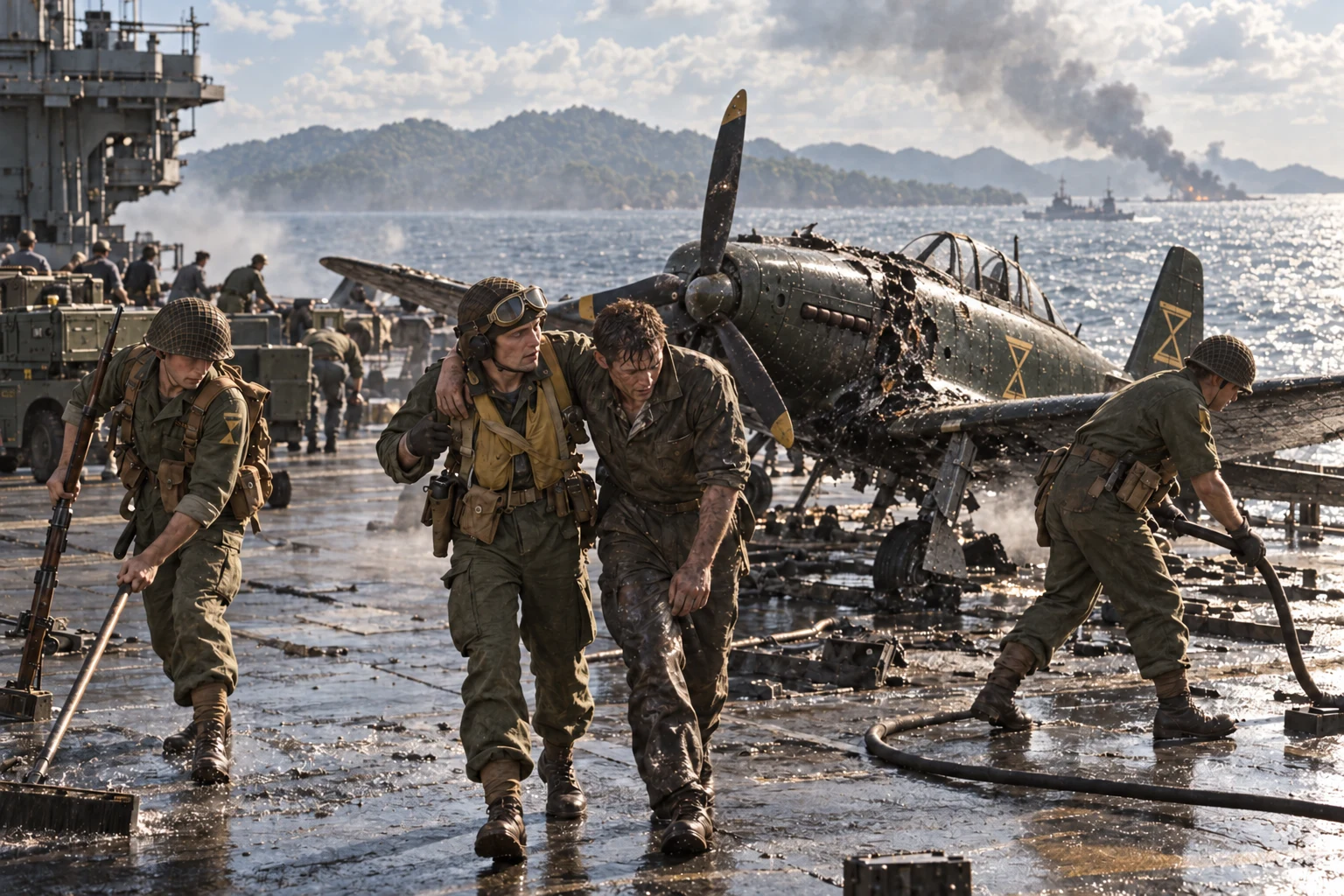
Repair and medical teams worked beneath the damaged facilities while smoke disrupted access. Reports changed as parties entered spaces previously unreachable. The captain kept enough control to withdraw with escort. The ship survived but could no longer fulfill its assigned role. Early claims counting only sunk vessels could therefore exaggerate the continuing strength of a force. To understand the support available ashore, the account must follow condition and absence as well as survival.
Resolute Horizon and the redistributed air groups
The damaged carrier was Resolute Horizon, flagship of Rear Admiral Jesan Tor. At 14:12 on March 22, Captain Mera Dast reported that the damaged flight facilities could not accommodate the group's scheduled return. Vask’s staff reassigned recoveries among other ships. This sequence connects a specific technical condition to the operational redistribution that followed. It does not require inventing additional maneuvers or assigning the entire encounter to the flagship’s perspective.
Landing elsewhere saved aircraft and crews while separating them from established maintenance relationships. Personnel receiving unfamiliar aircraft lacked immediate individual histories, delaying inspection and renewed employment. A machine could be physically present yet unavailable until its condition was established. This problem resembled the shore command’s distinction between equipment unloaded and equipment delivered to its user. In both settings, transfer preserved an asset without automatically restoring the relationships that made the asset useful.
Lieutenant Sela Renn returned carrying a wounded observer whose squadron had been entered incorrectly. Medical staff treated him before reconciling affiliation. His original unit searched urgently until the receiving carrier sent a complete hospital return. The episode demonstrates why survival and accountability followed different paths. The observer was safe enough to receive care while remaining absent from the institution trying to locate him. Correct records reconnected those paths without delaying treatment until every administrative uncertainty was settled.
The search also illustrates how a force could temporarily lose an operational team while preserving its component people and aircraft. Aircrew identity, unit affiliation, machine condition and maintenance information had to be brought together again after diversion. This work consumed time and personnel. Describing redistributed aircraft simply as available elsewhere would omit the effort required to restore their useful employment. The campaign’s endurance depended on performing that work repeatedly as disruption altered familiar arrangements.
Resolute Horizon withdrew and returned to combat service in August. Its air groups did not remain uniformly intact in the interval. Some transferred, retrained or rejoined later. The ship’s continuity was therefore the continuity of a hull and command institution rather than an unchanged gathering of identical people. That distinction helps readers understand how a large navy could retain experience while continually reorganizing around damage, personnel loss and the unequal timing of repairs.
What the opposing force achieved
Kelonese forces suffered aircraft losses and ship damage of their own. They did not secure the interruption necessary to isolate the Allied landing force. Neither navy destroyed the opposing fleet completely. The encounter ended through separation, recovery and management of damaged formations rather than a final exchange clearly visible to all participants. Preserving this qualified outcome is essential: the Allies maintained their land commitment, but the sea battle was costly and did not remove future naval threats.
For the Kelonese command, a meaningful local result would have involved making the Allied shore positions unsustainable. Damage that forced schedule changes but left supplies arriving fell short of that purpose. The account should still credit the disruption inflicted. Resolute Horizon’s absence and redistributed groups constrained Vask’s choices afterward. The opposing fleet changed the support system even though it failed to sever it, and its continued existence meant the Allied command could not assume the next maritime movement would be uncontested.
The retained source supplies no complete order of battle or definitive ship-by-ship total for this encounter. This synthesis consequently avoids inventing one. The documented carrier episode and continuation of the shore campaign establish the relevant causal sequence. Additional numerical precision would require evidence beyond those details. An explanatory account can identify what the action changed without fabricating a strength comparison to make its conclusion appear more authoritative.
March 25–April 28: The shore learns the result
Troops ashore experienced the naval action through delayed stores, changed air support and unfamiliar ship names in messages. Supply continuing did not make the fleet battle irrelevant. It demonstrated that the support system had enough depth to absorb a major interruption without abandoning the land commitment immediately. From a position inland, that institutional achievement could be less visible than a missed delivery. A major-battle synthesis must connect the delay experienced locally with the repair and redistribution that prevented a larger failure.
Dalen’s formations continued the land campaign under adjusted support. Their principal limited objectives were secured by April 28. Kelonese resistance remained elsewhere and the Nagasaki naval war continued. The result was a retained campaign achievement rather than unrestricted control of the entire island theater. The distinction allows the operation’s success to remain substantial while preserving the requirements that subsequent campaigns would still have to meet.
The land result depended partly on avoiding a false choice between naval preservation and shore support. Keeping damaged ships on station could diminish later capacity; withdrawing them without substitute arrangements could endanger troops already committed. Vask’s organization managed the interval through redistribution and revised schedules. The solution imposed inconvenience and delay rather than removing scarcity. It succeeded because those costs remained compatible with sustaining the army’s essential connections.
Institutions grow at different dates
The later 1226 establishment of fifty-two operational Silvian carrier battle fleets belongs to a later census. It does not establish that all fifty-two participated in the March carrier action. Importing that figure backward would distort both the operation’s available strength and the scale of its command problem. The campaign provides evidence about demands such a larger navy would face repeatedly, not a license to treat the eventual national establishment as present in every preceding battle.
Silvia’s volunteer-only system also remains part of the wider institutional setting. Expansion required recruitment, training and support rather than a compulsory draft. When personnel transferred or retrained after Resolute Horizon’s damage, they were participating in an organization whose continuing availability involved more than first enrollment. Volunteers remained people with specialized experience, medical needs and changing assignments. National totals alone could not show whether the combination needed by a particular ship or squadron had been restored.
The recurring Dalen–Vask relationship connects Orava, Red Mangrove and the western chains without making these battles interchangeable. Orava exposed a failure to align landing components. Red Mangrove retained a narrower foothold under pressure. The western chains tested successive land objectives while the fleet itself sustained a major interruption. The growing competence was real because it met different problems through related practices, rather than repeating the same lesson in a larger word count.
Civilian consequences within bounded evidence
Allied island personnel supported terrain interpretation and civil arrangements. Their role preserves the people of the theater within a campaign often described primarily through ships and expeditionary soldiers. The retained account does not supply an exhaustive civilian register for the western objectives. This synthesis therefore does not invent casualty totals, named households or a complete restoration sequence. It identifies the supported civil arrangements and continuing resistance as limits on what military success alone can establish.
The campaign also depended on repair facilities, medical movement and the work of people whose contribution did not appear as offensive combat. Crew reconciliation and treatment were not peripheral to military endurance. A navy could survive a strike and still fail to support the army if its surviving people and machines remained separated from functioning institutions. Restoration of those institutions provided a practical connection between care for individuals and preservation of future capacity, without implying that care was justified only by combat usefulness.
The western chains consequently stand as a success built through managed disruption. The enemy remained formidable, the fleet suffered real damage and the troops encountered continuing resistance. The Allies retained their limited objectives because command adjusted the relation between ashore and afloat instead of assuming that either force would remain unchanged. Resolute Horizon’s later return offers continuity, while the immediate campaign shows what had to happen during its absence. Both belong in the history of a navy and army becoming capable of sustaining a global war.
The distinction between a hull, an air group and a complete operating relationship also helps explain the campaign’s historical evidence. A ship’s repair record establishes its absence and return. A hospital return establishes where a wounded observer received care. Squadron and maintenance records establish when people and aircraft could be employed together again. These sources answer related questions without allowing one answer to substitute automatically for another. Resolute Horizon could return as a ship while some former personnel continued elsewhere; a diverted pilot could survive the battle before her former unit regained knowledge of her destination.
Following those different continuities prevents the familiar mistake of making an institution’s name imply an unchanged membership. It also gives the wider naval expansion a concrete basis. More ships increased potential capacity, but turning that capacity into support required routines capable of managing separation, repair and replacement. The western chains demonstrated part of that work under enemy pressure, with a limited land result preserved while the fleet’s internal relationships were being reconstructed.