An objective whose apparent simplicity misled
Orava was a local island objective in the established Taluman approaches, within the Grand Isles theater. It offered an anchorage, an apparently limited area to occupy and the prospect of early expeditionary momentum. Those qualities encouraged Silvia’s new force to treat the operation as a bounded problem. A limited geographic objective, however, was not necessarily a limited organizational demand. The army still had to move from ships into a defended environment, identify its actual positions and establish connections that could survive pressure after the first landing.
General Mira Dalen’s staff expected the strongest resistance near the shore and more rapid progress inland. Taluman officers warned that broken ground, vegetation and existing defenses made this separation unreliable. The warning reached the briefing but did not substantially alter its underlying confidence. The distinction matters to responsibility. Local knowledge was not entirely absent. Its practical effect depended on whether the plan changed its assumptions in response, rather than merely recording that experienced allies had been consulted.
Admiral Oren Vask’s naval staff identified another set of constraints. Boats, unloading parties, communications and infantry would have to remain aligned after contact. The fleet could carry the force and provide support without being able to guarantee that every component landed beside the people who needed it. Rehearsals exposed delays and led to timing revisions. Dalen judged the main difficulties resolved; Vask considered them reduced. Their disagreement concerned how much uncertainty remained after preparation, not whether preparation had taken place at all.
The February 12–19 campaign consequently tested an organization whose confidence exceeded its ability to verify its own condition ashore. That gap was not the same as cowardice among the landing troops or inactivity offshore. Many participants performed immediate tasks effectively. Their separate achievements failed to combine into a sustained operation. Orava must remain a serious Kelonese defensive victory and a Silvian defeat if its subsequent institutional consequences are to retain meaning.
The first landing and the first misleading picture
Substantial numbers reached the island on February 12. Kelonese defenders gave up some exposed ground while retaining positions farther inland. From the fleet and higher headquarters, this initial progress could appear to confirm expectations about where resistance would be strongest. From the shore, the same movement left troops mixed with equipment and personnel intended for other tasks. The presence of men did not guarantee that their radios, medical loads or appropriate ammunition had reached them.
A report that the beachhead was established therefore described less than the command assumed. Establishment required more than the ability to put troops ashore without their immediate destruction. It required dependable movement among the landed units and between them and the fleet. The distinction became operationally decisive because later orders relied on an image of a coherent force. Units sent farther inland were expected to draw support through a connection that had not yet demonstrated it could perform that work under resistance.
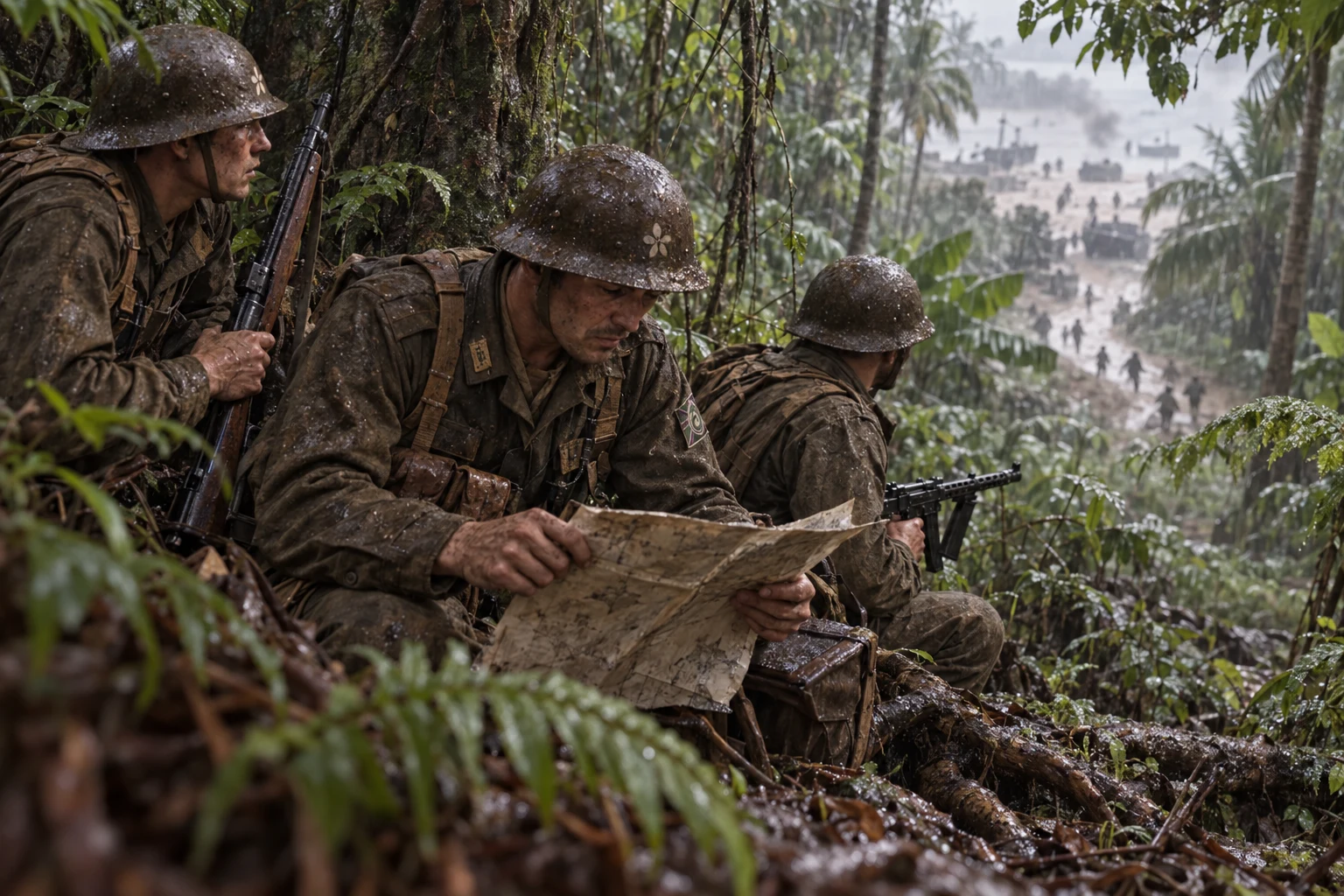
Lieutenant Eran Vale’s element carried sketches showing an inland path and a plantation building as a reference point. The roof had changed since the sketch’s preparation, and several paths resembled the one depicted. His men knew their immediate task more clearly than they knew the island’s current arrangement. Even before the first serious encounter, identifying the point from which their next movement should begin was uncertain. The map was a guide requiring confirmation rather than a substitute for observation.
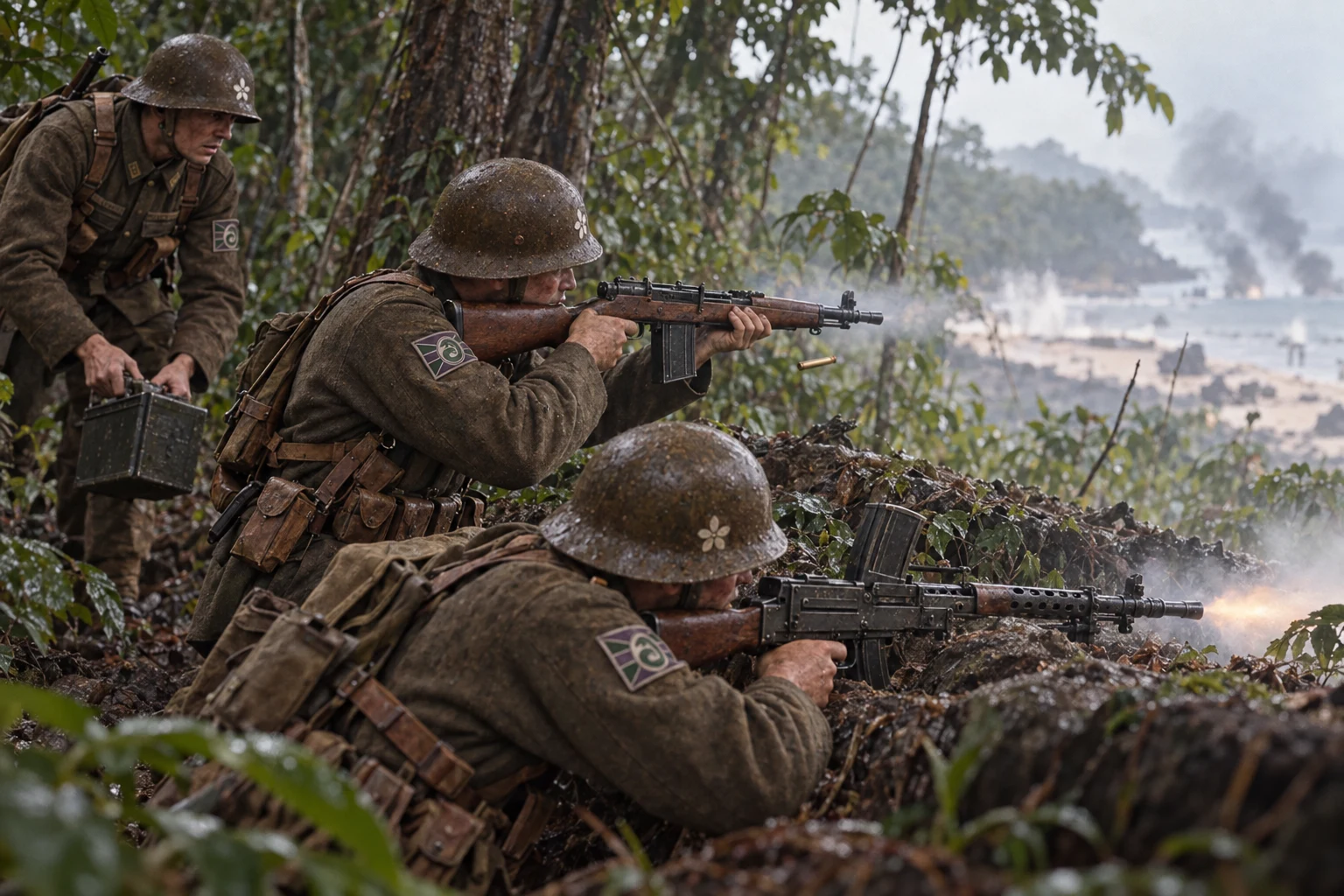
Vale’s group encountered fire along what seemed the assigned route. Men took cover among roots and damaged vegetation while those behind heard fighting without seeing its extent. A patrol’s arrival at the plantation building entered reporting as progress toward the objective. Higher headquarters then gave that report a stronger meaning than it possessed. A recognizable place on a sketch became evidence of a unit’s established location, though the unit remained scattered and its connection back to the beach was contested.
Support existed beyond the reach of useful messages
Naval support was available but difficult to apply when shore messages described locations through inconsistent landmarks. A request could identify a real enemy position without allowing the ships to distinguish it safely from friendly groups nearby. Officers delayed messages they could not reconcile rather than risk harming their own troops. This hesitation was costly to infantry waiting under pressure. It nonetheless arose from the operation’s inadequate common picture, and cannot fairly be described as the fleet simply refusing to assist.
The infantry and naval perspectives were both partial. Men under fire experienced delay as abandonment because they could see their danger and could not see the fleet’s informational problem. Offshore staff saw confused references and could not necessarily appreciate how rapidly a delay changed the defenders’ position. Command had to connect these perspectives before support could become reliable. The necessary work involved shared descriptions and corrections, not merely insistence from either side that the other should act with greater urgency.
The original plan’s confidence encouraged headquarters to interpret uncertainty as an interruption of progress rather than evidence about the plan itself. If the beachhead was already secure and a company already at its objective, another order to advance seemed plausible. If those statements concealed missing equipment and dispersed groups, the same order could increase isolation. The loss of qualifications from reports thus had physical consequences. Information did not merely describe the battle after events; it directed further commitments while events remained unresolved.
February 13–15: The disconnected operation
The battle inland consisted of separated positions, uncertain intervals and contested routes rather than a continuous front moving through trees. Kelonese defenders exploited these conditions by interrupting communication and movement between Silvian groups. The defense did not need to occupy every space uniformly. It could preserve resistance in positions whose effects reached the connections the landing force required. Its success is best explained through that relationship between local fighting and the invader’s incomplete organization.
Vale lost company-headquarters contact for part of February 13. He assembled men around a damaged plantation outbuilding and used the few confirmed routes to send reports. The position offered some shelter and no assurance of continued support. Wounded accumulated under a leaking roof, and water parties returned too tired to contribute fully to the next movement. These were operational demands consuming the same personnel counted for combat. Their presence explains why a formation could possess ammunition and still lack the capacity assumed by its orders.
The types and quantities of ammunition also mattered. Stocks somewhere in the landing area did not necessarily match weapons functioning inland. Aggregated supply figures could conceal a shortage among the troops actually under attack. Similarly, a boat’s arrival did not establish that its contents had passed through unloading, sorting and movement to the correct user. Orava made those stages visible by their failure to connect. A force’s numerical and material presence could be impressive while its practical availability remained fragmented.
Dalen committed reserves to restore momentum. Some reached the beach before the routes needed for their employment were usable. They added demand for handling, space and movement without immediately increasing effective strength farther inland. Observers could reasonably ask why men visible near the shore were absent from the threatened positions. The answer was not simply a shortage of courage or an excess of caution. The reserve faced the same disconnected system already preventing supplies and reports from reaching the units it was supposed to reinforce.
This difficulty placed command at risk of spending additional strength on a diagnosis it had not corrected. A temporary lack of combat power can sometimes be solved by reinforcement. A broken relationship between the beach and inland units may be made worse by landing more people before the relationship works. The retained account does not justify a claim that every reserve commitment was useless. It does justify asking whether commitment restored the operation’s essential functions or primarily increased the number of people dependent on them.
The report that changed as it traveled
Vale’s company report passed through two relays before reaching Dalen’s staff. Its original form distinguished three conditions: a patrol had reached the plantation, the company remained dispersed behind it, and the route was contested. The version plotted at headquarters preserved the first condition while losing the others. Comparing the three versions later established the transformation. The apparent position of an organized company was created through reduction of a qualified statement about a small party’s movement.
Signaller Eda Nerin preserved the original while leaving the shore. Her action supplied evidence for the inquiry rather than merely another recollection competing with the headquarters account. The different versions did not demonstrate intentional deceit. Operators working under pressure shortened messages without recognizing which clauses altered the conclusion. That mechanism matters because its correction had to address composition and relay practice. Punishing an imagined dishonest author would not have solved the loss of meaning produced by the reporting chain.
Dalen directed the communications school to use the example. The intended lesson extended beyond preserving longer messages for their own sake. The key requirement was retaining the distinction between observed progress and the conditions that limited its significance. A patrol’s location, a company’s disposition and a route’s usability answered different questions. Compressing them into one successful objective mark gave command an apparent clarity at the cost of the information required to judge its next movement.
Nerin also found an error in the evacuation roll. Two soldiers listed together had boarded different boats after redirection. A loading party copied a preliminary list as if it were a final embarkation record. Both survived, but one was sought initially in the wrong hospital. The error came from the same general problem in a different setting: a simplified account made movement administratively manageable while obscuring the changes that actually occurred. Preserving corrections and cancelled destinations allowed later staff to reconstruct those changes.
The communications and evacuation examples connect command knowledge to individual consequences. One shortened message helped authorize further inland movement; one uncorrected loading list separated a survivor from his unit’s search. Neither consequence can be reduced to harmless paperwork. At the same time, these records place limits on the synthesis. They establish particular failures and institutional responses without proving that flawless messages would have guaranteed victory against the island’s defenders and terrain.
February 16–18: The decision to withdraw
By February 16 the cost no longer fitted the original objective. Vask warned that sustaining the exposed commitment would require naval support and shipping needed elsewhere. His assessment concerned the wider force’s endurance as well as the immediate shore crisis. Dalen first sought another limited effort to stabilize the troops before deciding. Reports showed that stabilization itself demanded more than the operation could sustain. Withdrawal became a choice to preserve surviving capacity after the planned result had ceased to justify its expenditure.
The disagreement should not be rewritten as one commander possessing perfect foresight from the beginning. Vask had recognized unresolved difficulty but still participated in the operation. Dalen had accepted timing changes but gave them more certainty than they warranted. Their later decision occurred after evidence of failure accumulated. Evaluating responsibility means following how that evidence changed their choices, while retaining the planning assumptions each had accepted before the landing.
Departure required troops to disengage and find collection points through the same uncertain ground that had impeded the advance. Wounded needed movement while Kelonese pressure continued. Vale’s group abandoned equipment it could not carry and searched for men last reported elsewhere. Some were with other units; others remained missing. The difference became clear only later. A withdrawal order therefore did not instantly turn all survivors into a single body ready for embarkation.
Rear guards helped preserve routes while naval and medical personnel managed boats and casualties. Craft sometimes arrived before the intended party was ready, then returned to find more people than expected. Orders sought to prevent able-bodied men displacing immobile patients. Danger and confusion prevented complete control. Recording that imperfection preserves the burden borne by rescuers and the people awaiting them without inventing a perfectly orderly evacuation to soften the defeat.
The enemy’s continued pressure also belonged to the outcome. Kelonese defenders had retained the capacity to interfere with withdrawal after denying the original objective. Silvia’s departure did not mean the island had become irrelevant or the defenders had been exhausted into an equivalent loss. Orava ended with the local position in Kelonese hands. Its importance to later Allied learning arose from confronting that result, not from redefining retreat as an unacknowledged operational success.
February 19 and the inquiry’s responsibility
The evacuation ended on February 19 with the objective unachieved. Survivors carried different experiences: effective local fighting, prolonged waiting, failed movement and orders describing positions they had never reached. These experiences were not mutually exclusive. They described an operation whose components did not work together consistently. The inquiry needed to understand their relationship instead of selecting the most heroic or most critical account as if it represented everyone ashore.
Planning, local advice, communications, unloading, medical movement and command relations all entered that examination. Vale’s testimony emphasized the distance between a reported location and a position truly held. Nerin’s preserved copies made one mechanism of distortion testable. Dalen remained important in the expedition’s subsequent development, but her continuing role did not erase responsibility for the initial confidence or later reserve commitments. Leadership continuity mattered because it could carry correction forward, provided defeat remained honestly named.
Orava’s lessons should not be described as wisdom automatically purchased through suffering. Severe loss can leave an institution depleted without making it more competent. Here the retained record identifies actual changes in training, message handling and organizational practice. Their effects would have to be tested in later operations. The disaster became formative because people preserved evidence, investigated causes and altered behavior. The dead and missing did not cause those improvements merely by becoming part of the casualty record.
The island and the people beyond the landing force
The archive gives Taluman personnel a consequential role in warning about terrain and defenses. Their contribution prevents the narrative from treating a local theater as empty ground on which Silvia learned warfare alone. Their knowledge had limits and still deserved influence over planning. Consulting it without changing assumptions was an incomplete form of cooperation. Later cooperation required the larger expedition to recognize that material weight and local understanding answered different questions.
The plantation buildings and paths also belonged to a landscape shaped before the landing. Their use as tactical references did not create new national borders or turn a local objective into a sovereign island state. Nor does the retained account authorize invented civilian casualty totals for Orava. The defensible civilian consequence in this synthesis is the continued Kelonese control of a theater whose local allies remained involved in its liberation. Further claims about particular residents would require additional source evidence.
Casualty movement linked sailors, medical personnel and infantry in ways the battle’s combat summary might conceal. A man’s recovery could depend on a boat redirected offshore, a record carried from a collection point or an attendant recognizing a wrong hospital destination. These relationships explain why the subsequent reforms involved institutions beyond the attacking units. The expedition had to improve how it knew where its people were, not simply how many it could land.
From Orava to a more limited kind of success
Red Mangrove later tested a foothold selected for endurance rather than a rapid assumption of inland progress. The relationship is causal without being automatic. At Orava, reserves, reports and support failed to form a dependable operation. At Red Mangrove, cautious reporting, clearer supply stages and explicit conditions for continuation helped preserve a result. Neither comparison guarantees that later battles would repeat the same circumstances. It shows the particular practices through which the expedition attempted to address the defeat’s revealed mechanisms.
Vale’s continuing service gives the chronology a human connection without making him representative of every participant. His experience at the plantation affected how he reported partial occupation later. Dalen and Vask’s continued cooperation connects command responsibility to institutional change. Nerin’s record connects an individual decision to preserve evidence with a training response. These recurring people belong in a major-battle synthesis because they show how knowledge moved from one event into the next.
Orava’s final significance therefore remains double. The defenders won a serious local victory and Silvia failed to achieve its objective. The expedition also recovered enough people, evidence and institutional continuity to examine that failure and change. Allied ultimate victory did not undo the February defeat. Understanding it as a defeat is necessary to explain why later victories required more than additional soldiers and a determination to try again.