A different question after Orava
Red Mangrove opened on July 9, 1224, with a narrower ambition than the failed February landing at Orava. The Allied force sought a coastal foothold it could retain and use. It did not assume that reaching the shore would permit rapid movement across the surrounding island system. This change gave the operation a different measure of success. Ground had to remain connected to support, medical movement and neighboring units after the first encounter, rather than merely appear as a completed objective in the opening reports.
General Mira Dalen and Admiral Oren Vask agreed more explicit conditions for continuing the advance. Their relationship remained capable of disagreement, but they now had a shared means of assessing reports before committing further strength. That institutional change was important because Orava had shown the danger of army and navy acting from different understandings of the same landing. Red Mangrove did not remove uncertainty. It made the decision to proceed depend more clearly on what the force could demonstrate about its actual situation.
The name described an operation in the western Grand Isles, not a uniform landscape. Mangrove margins, firmer areas and tracks serving inland settlements created different local conditions. Allied island personnel distinguished features compressed together in Silvian map symbols. Some testimony came from visits preceding years of occupation, so it required qualification. Using local knowledge responsibly meant preserving both its value and its limits, rather than alternating between ignoring it and assuming it supplied perfect intelligence.
Veterans, replacements and the meaning of readiness
Eran Vale’s formation combined earlier survivors with replacements taught revised procedures. The veterans’ attention to meeting places, casualties and withdrawal instructions could seem excessive to men who had not experienced Orava’s separations. These habits were not decorations attached to a veteran reputation. They concerned recurrent points at which a force’s parts could cease to work together. A formation needed to preserve such knowledge as people were lost, transferred or replaced, because experience held only in a dwindling group could not sustain the growing expedition indefinitely.
Readiness therefore involved agreement on what ordinary instructions meant under pressure. Where would parties meet if an expected point became inaccessible? What did a report of partial occupation establish? Who needed to know when wounded moved? The retained narrative identifies these concerns without providing an exhaustive training manual. Their importance lies in reducing the gap between the force imagined at headquarters and the force operating in the vegetation. Accurate expectations could prevent additional troops being committed to tasks the landed formation was not yet able to support.
The arrival of replacements also complicates claims that the same veteran army emerged unchanged from every battle. Survivors carried knowledge forward, while new personnel enlarged the force and required integration. The organization’s competence depended on turning previous experience into practices people could learn. Red Mangrove consequently offers evidence of institutional maturation rather than a story in which surviving exposure to danger automatically made each participant proficient at every later task.
July 9–12: A shore organization that admits its gaps
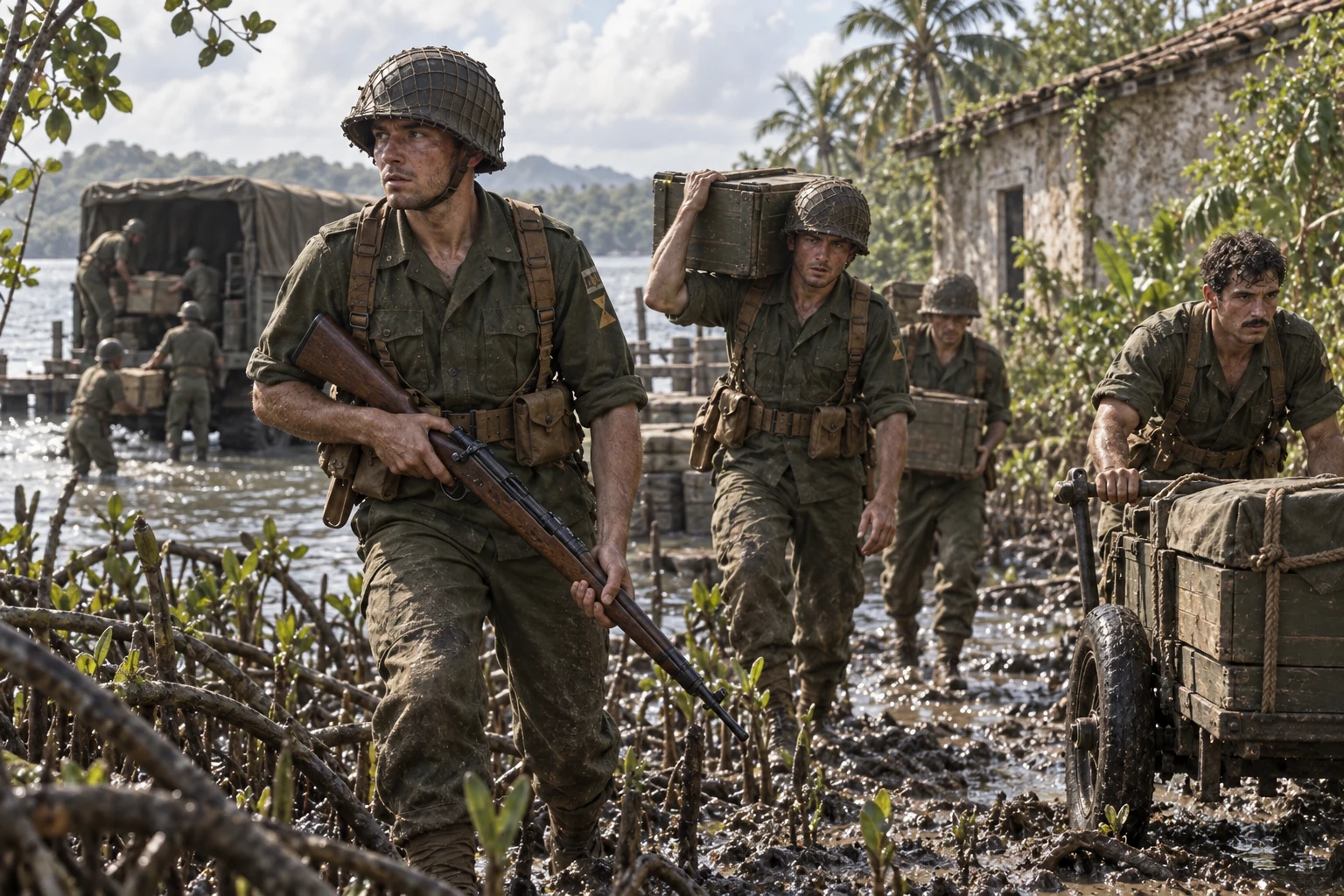
The landing met resistance and confusion, but its handling was more coherent than at Orava. Loads were tracked toward intended users. Reports distinguished cargo on the shore from cargo delivered to troops. The difference could make the early situation look less successful, because material plainly visible at the beach might still be unavailable inland. It also allowed headquarters to recognize a missing function before that missing function became another unit’s unsupported movement.
Vale’s company approached firm ground beside an abandoned agricultural building. Leading elements met Kelonese fire before the entire company reached the intended area. Rather than equate a patrol’s entry with possession by the whole unit, Vale reported partial occupation and asked for time to reconnect his groups. This was a direct response to the distorted reporting exposed after Orava. More cautious information slowed expectations while allowing support to address the company’s actual need.
Such reporting did not eliminate danger or imply that every higher commander welcomed delay. It altered the grounds on which delay could be judged. A company seeking time to establish contact was not necessarily reluctant to advance. It might be preserving the conditions needed to make the next advance useful. The battle’s causal distinction is between restraint linked to a specific functional deficiency and hesitation with no assessment of what would permit renewed action.
The first night remained difficult. Movement and sound through vegetation and water could be misidentified by tired soldiers. Officers and experienced noncommissioned personnel worked to prevent every noise becoming an uncontrolled reaction. A local guide corrected a track identification that helped a supply party reach the company. These activities contributed to survival without appearing as major changes on the operational map. They kept people and material connected in a setting where a mistaken route could reproduce the previous campaign’s separations.
July 13–22: The enemy contests the connections
Kelonese commanders understood the foothold’s threat to their local system. Their counterattacks aimed to disrupt its connections before those became dependable. The defense’s competence should remain visible here: it challenged the relationship between the Allied positions, not merely the forward boundary drawn around them. Some exposed ground changed hands, and the Allies did not retain every place they first reached. This uneven result was compatible with the survival of the operation’s essential functions.
Dalen’s headquarters asked what a local withdrawal had changed. Had it broken supply, made medical movement impossible or isolated a neighboring unit? Those questions provided a more useful assessment than assuming that every lost building proved general collapse. They also prevented every small defensive success becoming a demand for an expensive counterattack merely to restore a neat map. The foothold’s integrity depended on a set of usable relationships rather than possession of all initially occupied ground.
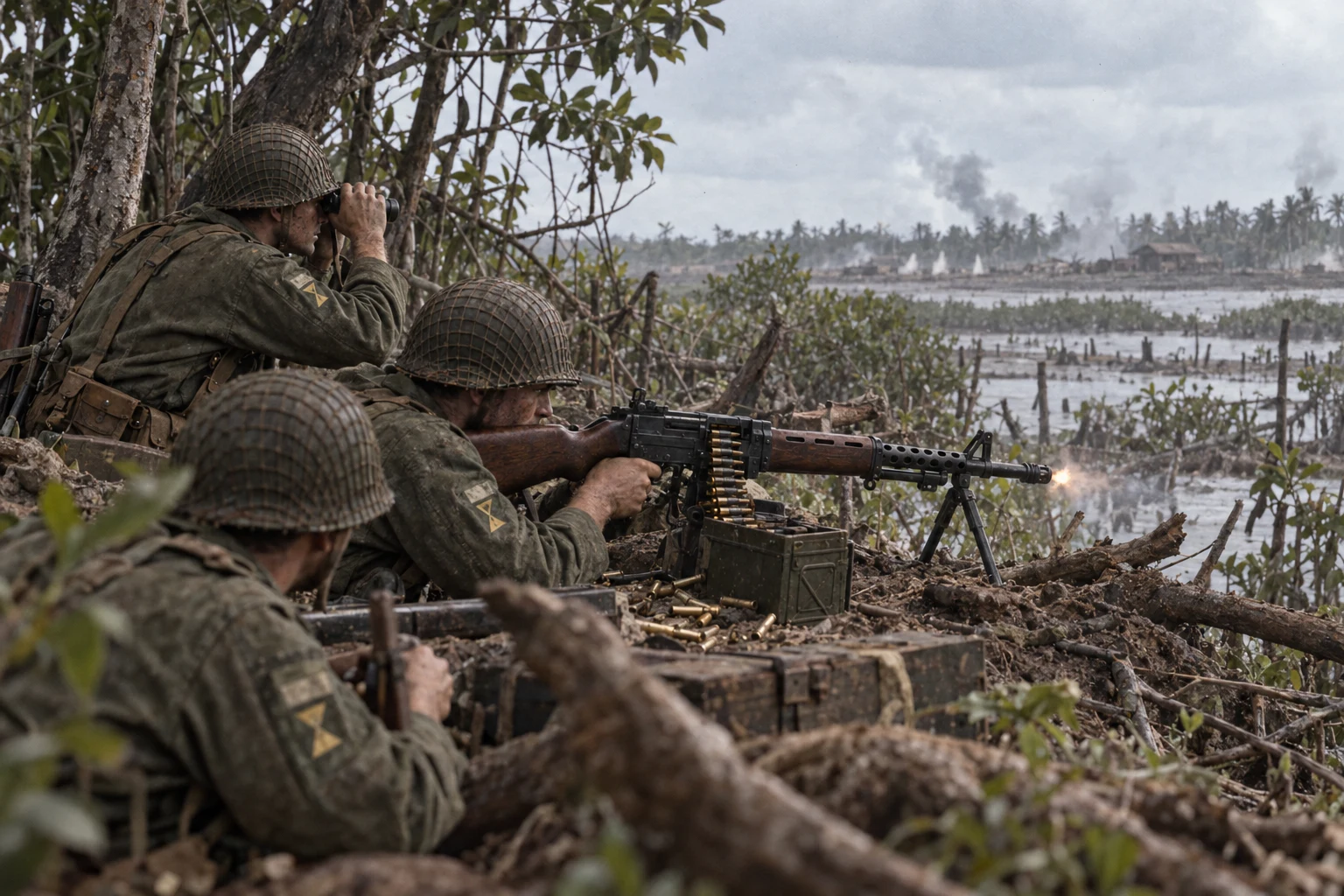
On July 16 a counterattack isolated one of Vale’s forward groups for several hours. Ammunition remained available while the immediate route for removing casualties was lost. The episode demonstrates why ammunition alone is an incomplete measure of a position’s viability. Men could continue fighting and still face deteriorating conditions that would make continued occupation increasingly costly. Neighboring troops helped restore contact while under pressure themselves, showing that no company could assess its survival wholly apart from the adjoining defense.
The relief succeeded at additional cost. Vale did not retain the recovered ground simply to justify that expenditure. He shifted his line to ground the company could maintain. This decision preserved a distinction often obscured by sacrifice: the effort to rescue people did not establish that the place from which they were rescued should be defended indefinitely. Continued occupation required a current military purpose, not an obligation to make earlier losses appear worthwhile.
Illness and the force hidden by its returns
Disease and exposure reduced strength alongside combat casualties. Some ill men remained with their units because admitting incapacity seemed likely to invite suspicion of unwillingness. A conventional count could then describe a soldier as present while his condition prevented effective service. Dalen required reports to include those limitations. The official force initially appeared weaker after the change, but the report became more useful for allocating treatment, relief and replacements.
This correction mattered to offensive decisions as well as care. An apparently full company might be unable to carry supplies, maintain its positions and provide a reserve simultaneously. A commander working from headcount alone could interpret failed movement as deficient effort. Recording condition helped identify which demands exceeded capacity. The army did not acquire more strength by acknowledging weakness. It reduced the risk of making plans that consumed the strength actually present according to an inflated picture.
Replacement allocation consequently aimed at restoring functioning formations rather than simply balancing paper totals. New men needed leadership, local understanding and supporting routines. Their arrival could not instantly replace the endurance lost to illness or the judgment of experienced junior personnel. The surviving veterans’ revised procedures helped reduce that dependence, but integration remained part of the battle’s cost. Maintaining a force meant attending to its changing composition while it continued to fight.
Why the observation shelter was abandoned
A forward observation shelter became the most contentious withdrawal. Its occupants trusted a structure that had protected them through repeated attacks. Their confidence had a rational basis in lived experience. Vale nevertheless found that surrounding changes had isolated it: wounded no longer departed regularly and neighboring ground had changed hands. The shelter’s immediate strength obscured the deterioration of the system that made occupation sustainable. Explaining departure through those conditions respected the men’s experience while reaching a different operational judgment.
Corporal Len Arven led the last party out with the observation notebook. Its drawings retained information worth preserving even though the viewpoint had been lost. Arven marked which entries belonged to the former position. Those annotations mattered because an arriving officer could otherwise mistake old observations for a current account of what his own unit could see. Material survival did not ensure that a record’s context survived with it. The notebook’s usefulness required knowing where and when its information had been obtained.
The Kelonese force occupied the shelter the next day and acquired stores the Silvians had not removed. That gain was real. It should not be discounted simply because the overall Allied foothold endured. Nor should the shelter’s capture be enlarged into the destruction of that foothold. Dalen’s report distinguished the building’s loss from the continued operation of the essential connections. A major-battle synthesis should preserve both scales rather than choose the one most convenient to its preferred side.
The episode also shows that improved competence involved knowing when to withdraw. An institution that defined maturation solely as increased willingness to attack would miss this change. At Red Mangrove, maintaining a strong-looking position could have consumed the people it supposedly protected. Withdrawal was useful because it addressed an identified loss of sustainability while preserving the wider objective. Its value did not rest on a general rule that less ambitious choices are always correct.
July 23–August 3: Work behind the retained ground
The final phase concentrated on holding the foothold under continuing pressure. Engineers improved handling and shelter while infantry protected that work. These activities gave the retained ground a purpose beyond the moment of capture. An operation could occupy useful space and fail if its force lacked the means to employ it. Red Mangrove’s result depended on converting contested occupation into a position through which supplies, relief and medical movement could pass with increasing regularity.
Vask’s naval arrangements included repair and rotation. Ships were not assumed to remain continuously on station in an unchanged condition. Weather and damage still interrupted deliveries, but the support organization increasingly absorbed interruptions without producing the disorder familiar from Orava. This was an improvement in endurance, not immunity to loss. The battle shows why the naval force’s own maintenance belonged within the land campaign’s causal explanation rather than outside it as a separate administrative matter.
Troops ashore experienced these changes in routine. Wounded could leave through a functioning chain, and replacements arrived with instructions matching the ground. Such improvements did not make fighting painless or eliminate uncertainty. They reduced repeated emergencies in which every movement depended on improvised rescue of a failing connection. The difference was particularly clear to survivors of the earlier operation, whose knowledge allowed them to recognize the practical value of a result narrower than complete island conquest.
Residents enter the Allied area
Civilian residents arrived gradually. Some had stayed nearby through the fighting; others came after hearing that treatment was available. Their presence created demands for food, urgent medical assessment and information about relatives outside the foothold. A coastal position’s usefulness thus included responsibilities beyond the combat units it sustained. Civilians were people with claims and relationships, not merely additional local knowledge or labor available for assignment to military tasks.
The Allies worked with surviving local authorities, imperfectly and sometimes slowly. Recognizing their role gave civil needs a place in the operation’s decisions. This cooperation should not be inflated into a claim that all residents were reached or all family separations resolved by August 3. The source supports a process of reception and assistance, not universal restoration. It also prevents military success from erasing the continuing occupation and uncertainty beyond the retained area.
Civilian arrival connected the foothold’s support capacity to its political meaning. People could judge Allied control by whether treatment, food and ordinary contact became possible, not only by a declaration that terrain had been taken. Those demands sometimes competed with military requirements. Including them in the organization made that competition visible. It did not ensure that respecting residents produced an immediate tactical advantage, but it made relief part of the result the operation was expected to sustain.
A turning point whose limits remain visible
By August 3 the Allies held a costly, usable foothold. They had not conquered the entire surrounding system or eliminated Kelonese resistance. This outcome was more limited than the opening expectations at Orava, and more durable. Its significance lay in the force’s ability to remain supplied, relieved and employable under pressure. The chronology should credit that achievement without converting it into a general turning of the whole world war during the summer of 1224.
The comparison with Orava identifies mechanisms rather than a slogan of experience. Partial occupation was reported as partial; cargo delivery was separated from unloading; illness entered strength assessments; a defended shelter was left when its connections failed; naval maintenance was incorporated into continued support. Each change addressed a particular way the earlier expedition’s components had become disconnected. Together they explain why a narrower objective could become a more substantial result.
Later island operations and the western chains would demand these practices on a larger scale. They would also create new problems, especially when fleet damage interrupted support for successive land objectives. Red Mangrove supplied a developing institutional capacity, not a completed solution to every future battle. Vale, Dalen and Vask’s recurrence across the campaigns allows readers to follow both continuity and change without assuming that their presence guaranteed success.
The opposing forces retained agency throughout. Kelonese counterattacks imposed loss and forced withdrawals, while the Allies adjusted their arrangements to preserve what mattered most. The result cannot be explained by enemy incompetence or by Allied numbers alone. It arose from decisions about which positions, people and connections the force could maintain. This makes Red Mangrove a useful major-battle Chronicle: it explains what changed between a failed landing and a retained foothold while preserving the real cost and limited extent of that improvement.