April 4: isolation becomes a military condition
The opening defense of Garamond lasted from April 4 to April 29, 1212, but its central difficulty existed before those dates. The country could ask the Allied coalition for assistance without possessing a secure land corridor through the hostile territory around it. That distinction limited the relationship between political commitment and material relief. A declaration of solidarity could preserve Garamond's place in the wider war; it could not deliver the daily bulk needed by factories, hospitals and formations. Zaganar's invasion therefore attacked a state whose remaining resources had to perform several tasks at once. Every retreat changed the amount of production and administration available to sustain the next position.
Ordan mattered because it joined industrial workshops, workers' housing and administrative stores within the central region's support system. Colonel Vesa Rinn inherited regular soldiers, local guards and technicians rather than a neatly separable military establishment. The same skilled worker could appear desirable to a guard commander and indispensable to a machine shop. Assigning that person twice made both offices' plans look better while leaving an impossible working day. Rinn's separation of roles was an operational decision about usable time. Its political cost arose because production, although essential, did not always look like service to observers judging commitment by visible presence in uniform.
Zaganar expected loss of the industrial district to accelerate Garamond's political collapse. The two states' communist identities made a simple ideological account inadequate: each government claimed to defend workers against the other. Those competing claims did not tell Ordan's residents whether remaining beside a machine under artillery fire would protect their families. Nor did they remove the military significance of production. The battle exposed the gap between political language treating workers as a collective and decisions distributing particular people's hours, shelter and chances of escape. The inherited account records that gap through Rinn's allocations and the local officials' interventions rather than through a single representative civilian voice.
Isolation also altered what could count as a successful defense. Garamond could not reasonably judge every abandoned workshop as proof that organized resistance had failed. It needed to retain enough force and productive capacity to continue after losing exposed ground. Zaganar, conversely, needed more than entry into substantial buildings if those buildings could not supply its advancing troops or compel surrender. These different requirements explain why the month ended with real aggressor gains and a surviving defending state. Neither result cancels the other. The opening defense should be read as the first reduction of Garamond's future options, rather than as a victory declared because complete collapse had not yet occurred.
The industrial guards' place in this history also limits the usefulness of a simple military headcount. A technician removed from production might add one person to a defensive roster while reducing the capacity that supported several others. Rinn's separation of roles addressed that relationship without claiming an increase in personnel. National census values and the practical strength of a local defense answer different questions. The source records assignment problems at Ordan, not a June national total, and no total is inferred here. This distinction keeps the battle's discussion of labor from becoming an unsupported statistical account of Garamond's mobilization.
April 4–10: the factory belt loses its functions
The first attacks overran forward positions before all stores had been moved. Military trucks then encountered families leaving the same district, bringing two urgent movements onto the same routes. Rinn's temporary holding area for civilians was intended to make room for ambulances. Its purpose did not determine its effect: the queue grew beyond the intended space and left people exposed to shelling. Local officials challenged the arrangement and secured revision. Their intervention belonged to the conduct of the defense, because the army lacked an adequate picture of the traffic it was controlling. It also preserved the distinction between accepting necessary coordination and accepting any measure merely because an officer had ordered it.
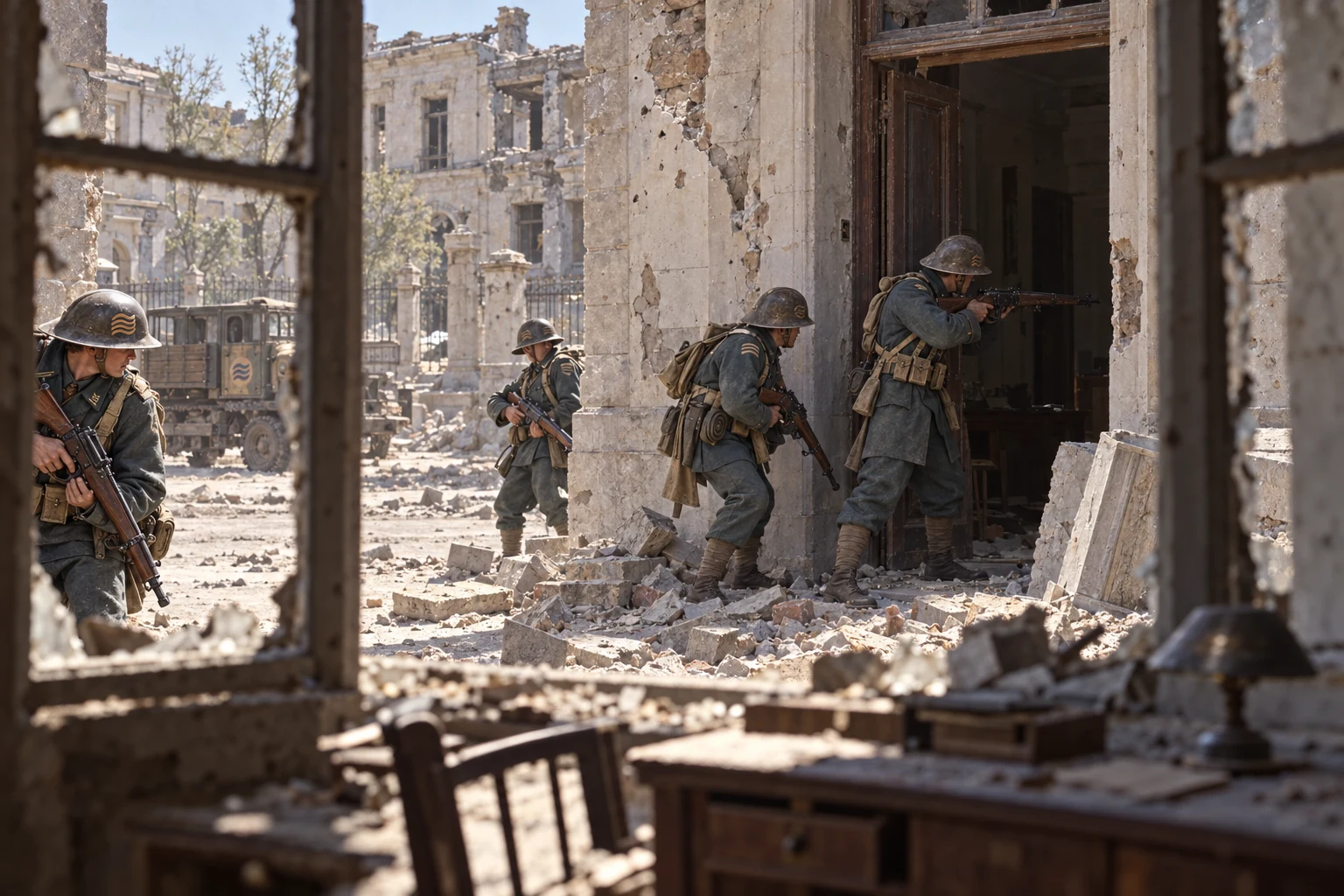
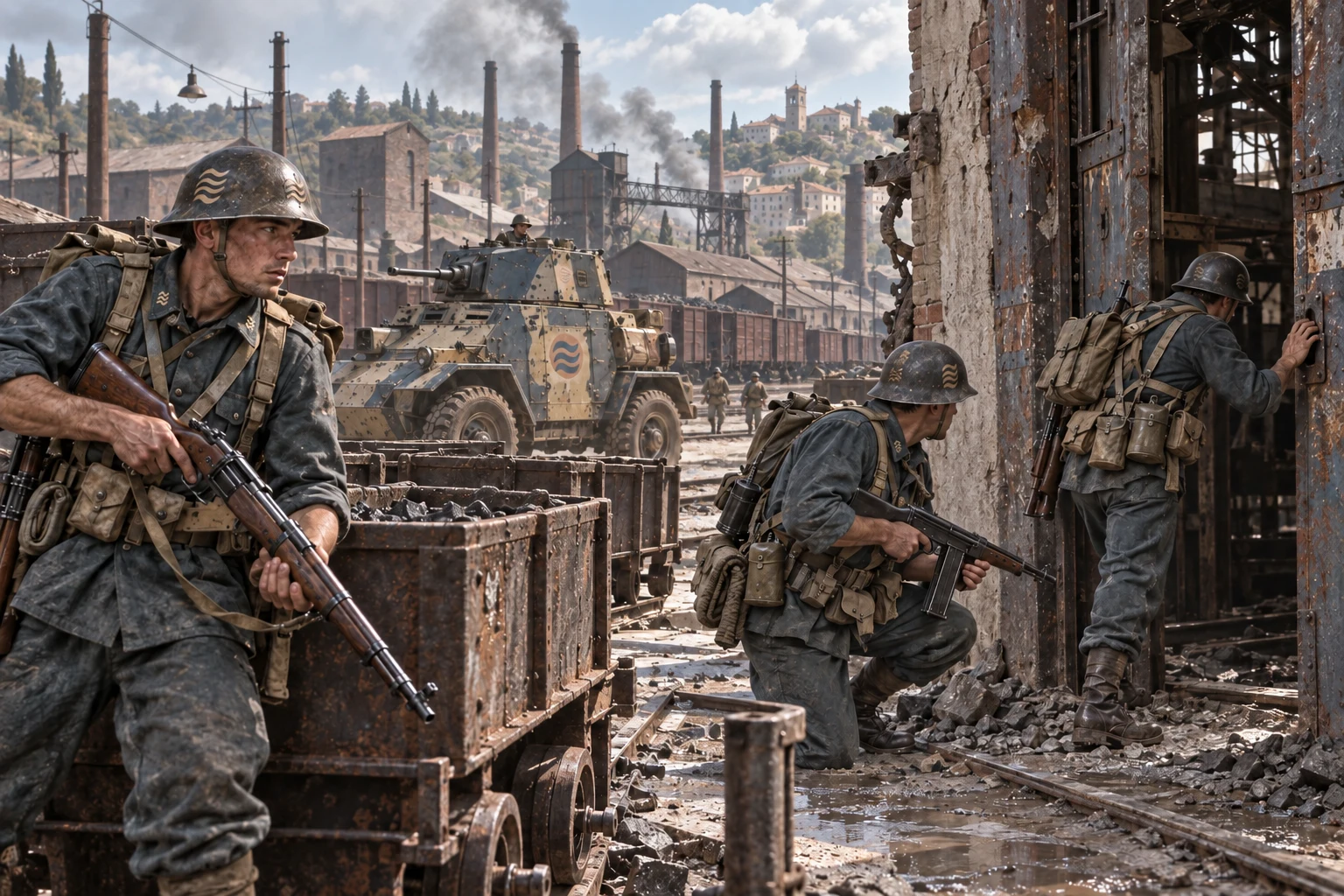
On April 7, fighting reached a metalworking plant whose interior workers understood better than arriving officers. A maintenance foreman guided a relief company through a service passage mistaken for a dead end. That movement reconnected an isolated position, demonstrating that civilian technical knowledge could have an immediate military effect. It did not recover the entire plant or return its machinery to use. Reporting the factory as relieved compressed several different conditions into one reassuring word: soldiers had regained contact, parts of the complex remained contested, and production was already vulnerable. The episode makes local agency visible without converting the foreman into an invented commander or implying that knowledge alone could overcome the invasion.
Fire disabled the plant's electrical distribution. Soldiers nevertheless held parts of the complex after much of its industrial value had disappeared. The surviving walls offered defensive cover and an identifiable place for command to demand endurance, but neither quality established that another night there would protect production. Rinn requested withdrawal, receiving an initial refusal grounded in the expected effect on morale. Her inventory of destroyed or removed machinery eventually changed the decision. The causal issue was the difference between an establishment's name and its remaining functions. A headquarters could defend the symbol of a factory while inadvertently spending troops needed to defend what productive capacity still existed elsewhere.
This sequence does not prove that every damaged industrial position should have been abandoned immediately. Defensive cover, time for evacuation and the neighboring front could still give a ruined plant military value. The source establishes the particular mismatch that Rinn documented; it does not provide enough detail to reconstruct all alternatives available to headquarters. A responsible synthesis therefore keeps the judgment at that scale. Her evidence secured permission, and the delay increased the cost of leaving. Those two conclusions can coexist without claiming an exact casualty total or imagining a simpler withdrawal that would certainly have succeeded. The battle's loss of capacity was a process, not a moment when a building changed hands.
April 11–20: a shorter perimeter and unequal endurance
As Garamond concentrated behind the factories, arriving formations brought incompatible impressions of the invasion. Soldiers who had seen confident enemy advances encountered others who had repulsed attacks and believed the wider front remained sound. Neither account had to be dishonest. Each described a different portion of an uneven battle. Headquarters tried to build a common picture by interviewing officers and messengers, taking time that the continuing fighting did not conveniently provide. The shortened perimeter improved the possibility of coordination while concentrating exhaustion and displacement within fewer districts. Better organization could limit avoidable losses; it could not restore the workshops, power connections or personnel already lost during the first week.
Zaganar's advance also produced friction. Its troops entered workshops containing wreckage and civilians rather than the usable resources anticipated in briefings. Supply vehicles were reassigned to evacuate wounded, postponing deliveries needed for renewed attacks. Political authorities treated requests for pauses as failures of determination, creating pressure on local commanders to demonstrate activity. The source describes limited attacks that maintained that activity without bringing the desired collapse. This is a specific form of aggressor competence constrained by an unrealistic political expectation: Zaganar could continue taking ground, yet exploitation depended on services and rest that declarations of urgency could not replace. Its genuine advantages should not be reduced to an effortless forward march.
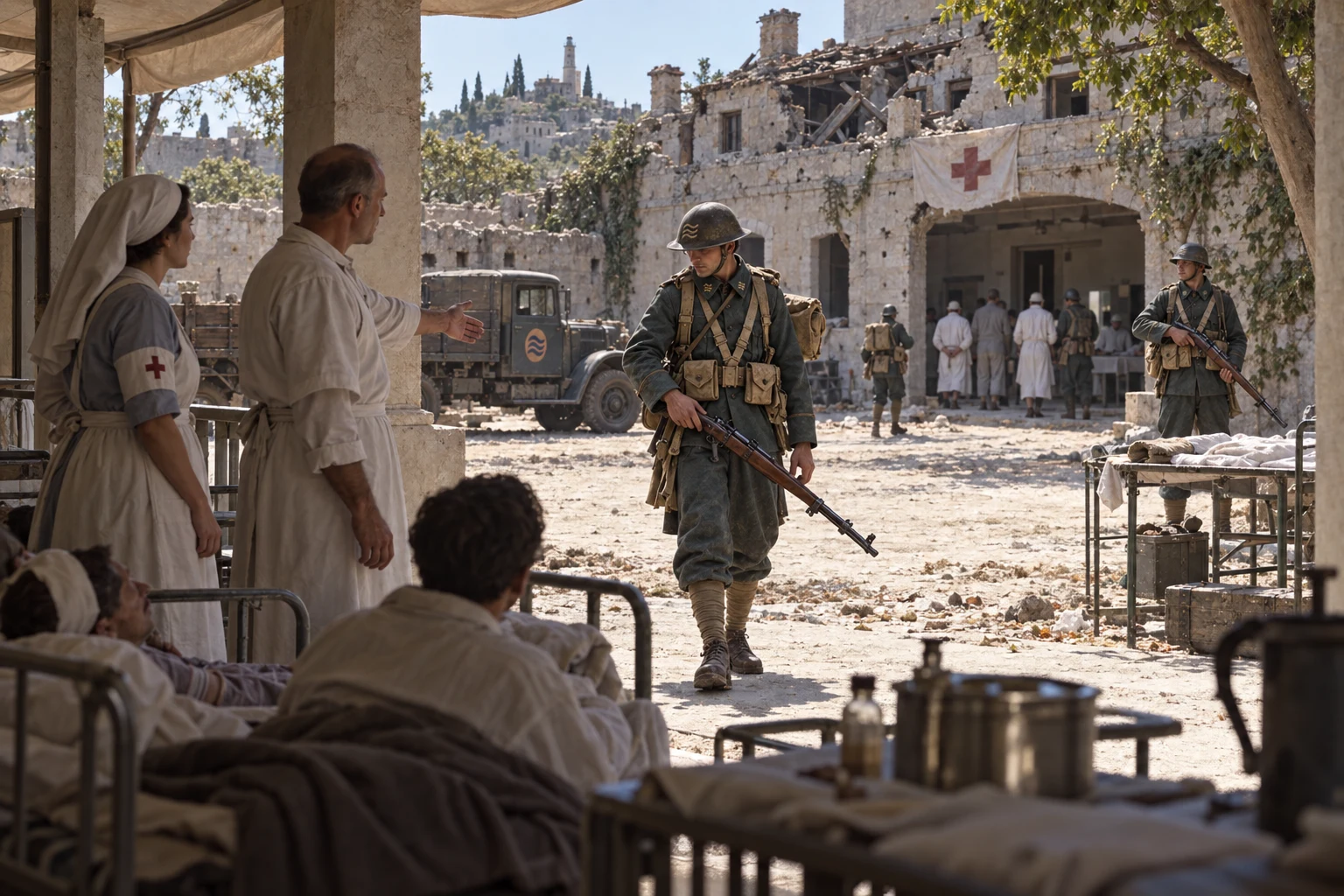
Civilian committees organized shelter and food inside the remaining district. Their work sustained residents whose needs could not be postponed until the front stabilized. Rinn prohibited taking the last medical supplies from a public clinic to refill a military store. That order did not create additional supplies; it required the military to bear a share of an existing shortage. It also maintained a civilian institution at a time when the concentration of military needs threatened to absorb all visible resources. Doctors recorded names when possible and physical descriptions when patients could not speak. Such identification connected urgent care to the later question of who had survived, moved or disappeared.
The clinic decision exposes a limit in the language of military necessity. Soldiers' health was essential to continued resistance, but exclusive military possession of scarce supplies would have shifted harm onto residents without necessarily producing an equivalent operational benefit. The inherited account does not calculate that benefit, and this essay does not invent one. Its evidence instead shows a commander recognizing obligations beyond a narrow unit inventory. Sharing shortage remained painful, and civilian committees did not become extensions of her headquarters simply because their work helped the defense. Their independent knowledge and responsibilities were part of the state's endurance, including responsibilities for people unable to contribute labor or fight.
Ven's request and the time that paperwork consumed
Lieutenant Orsa Ven carried the factory withdrawal request through a district where civilian communications still operated intermittently. A party official offered transmission through his office, but Ven waited for confirmation rather than treating sending as receipt. The receiving headquarters had moved and did not have the industrial inventory supporting Rinn's argument. Ven returned for the attachment while the defense deteriorated. This journey revealed that a sound recommendation depended on more than accurate wording. Its evidence had to reach the office empowered to act, arrive with the request and be considered before the battlefield made the proposed movement harder. The missing inventory was an operational delay expressed through administration.
The attachment named damaged motors, removed tools, disabled electrical connections and work that could no longer be performed. It challenged the assumption that a prewar industrial establishment still existed inside its surviving structures. The evidence eventually persuaded headquarters to authorize withdrawal. That result makes paperwork neither a trivial impediment nor an automatic safeguard. The inventory helped prevent a decision based on a false picture of what was being defended; the route by which it traveled also prolonged the exposure of soldiers. Improving the quality of a decision and shortening the time needed to make it were separate problems. Ven's experience showed how easily one could be mistaken for the other.
The retained annotated copy recorded when the request was drafted, transmitted and actually considered. Later accounts used those three times to explain why apparent promptness at one office did not mean troops received an actionable answer promptly. The distinction matters for responsibility. A signal's printed date might demonstrate that a staff member acted, while concealing the interval during which the recipient lacked the evidence necessary to decide. The original does not identify every official in that chain or assign a quantified share of casualties to each delay. It provides a narrower finding: the command process took longer than a single timestamp implied, and Rinn's force paid for the difference.
Ven's continued place in the archive comes from preserving that distinction, not from a new dramatic exchange invented for this essay. Her request connects the physical history of a factory to the documentary history of command. Machinery damage was translated into an inventory; the inventory changed authorization; authorization arrived after further fighting. This chain is unusually useful evidence because it allows analysis of decision and consequence without supplying an imagined speech or a claim of secret knowledge. It also prevents the battle from becoming a simple tale in which either soldiers or administrators always understood the situation. Accurate knowledge existed in one part of the state and failed to travel quickly enough through another.
April 21–29: preserving a force, dividing a community
During the final week Rinn contracted the defense again, abandoning positions before all movement became impossible. The choice preserved a coherent force and gave Zaganar further territorial gains. Local guards did not experience the decision uniformly. Some refused to leave while their families remained behind; others obeyed and later faced neighbors' accusations of abandonment. These responses were not simply measures of discipline. The guard's military role existed within an occupied or threatened community, so withdrawal altered obligations that an order could not cancel. The source does not establish the later fate of every family or guard. It does establish why a movement necessary for the army could remain a source of lasting personal conflict.
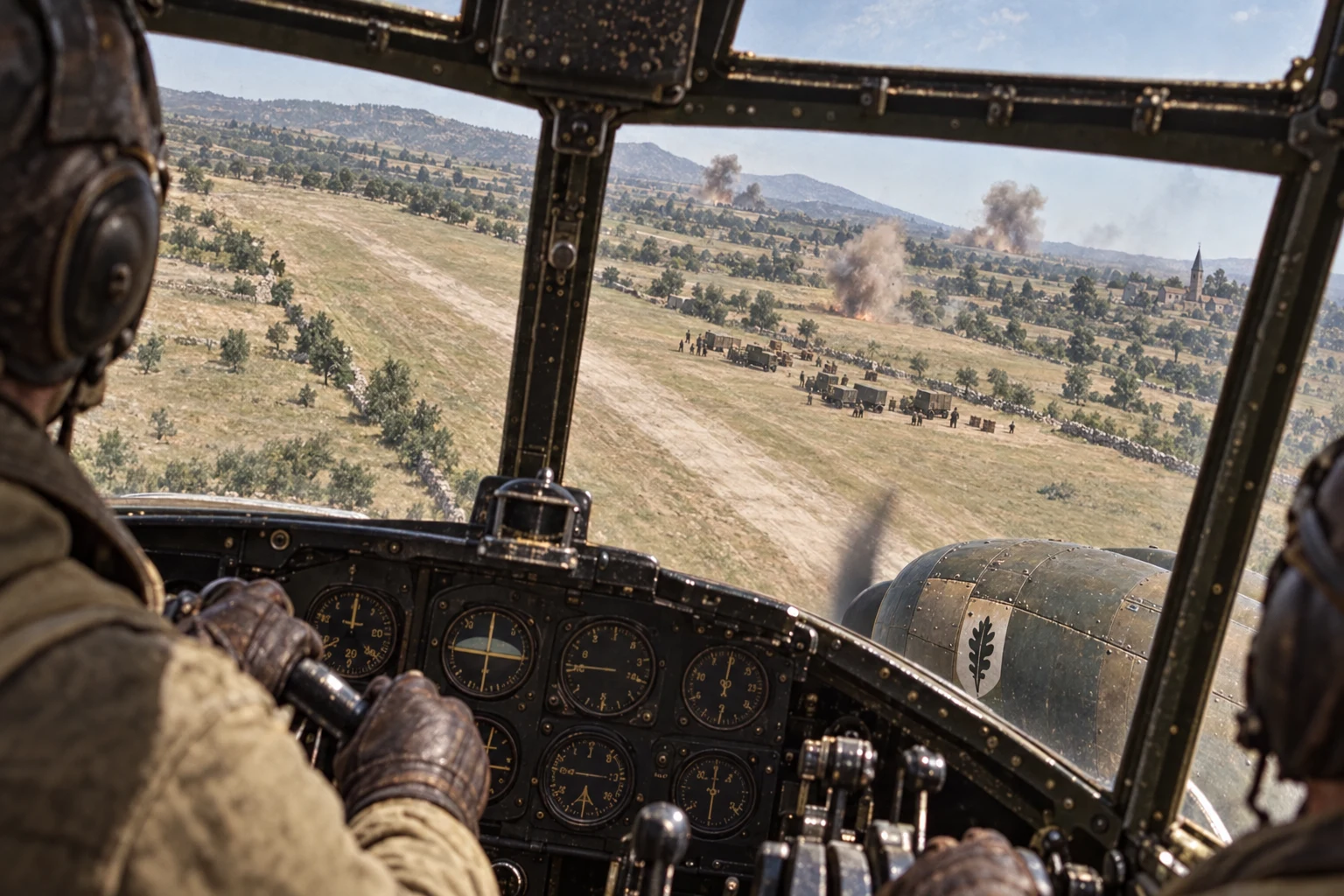
By April 29 Garamond's central government and organized defense survived. Zaganar had nevertheless secured significant gains, and the surviving state had less room, production and reliable power with which to continue. Limited air supply later brought useful items without supplying the bulk needed to restore a whole industrial economy or sustain an enclosed army indefinitely. That qualification is essential to geographic understanding. Garamond remained a Volaran state within the atlas's retained national setting; the narrative supplies no hidden corridor that resolves its isolation. Assistance had a volume as well as a route. Treating any successful arrival as adequate relief would mistake a limited contribution for a replacement of the national supply system.
Ordan's remaining workers resumed production in smaller facilities using dispersed machinery. Counting saved machines alone would understate the cost of missing skilled personnel, damaged buildings and unreliable electricity. Productive capacity depended on these elements operating together. The same reasoning applies to Rinn's surviving formation: retained soldiers provided continuity, but they now defended a state with fewer means to repair and replenish them. The central battle of 1213 should therefore follow this essay as a study of accumulated constraint. Its outcome cannot be read backward into April as inevitable, although the opening campaign materially narrowed the choices from which the next year's defenders would have to select.
The opening battle also establishes why Rinn remained important in the later archive. Her surviving formation carried knowledge of evacuation, industrial inventories and mixed military responsibilities into another year of defense. That continuity was useful, although it could not recreate Ordan's lost capacity. The reader can follow her into the central battle without assuming that the guards, technicians and regulars of April remained one intact body thereafter.