June 18: concentrated institutions, diminishing means
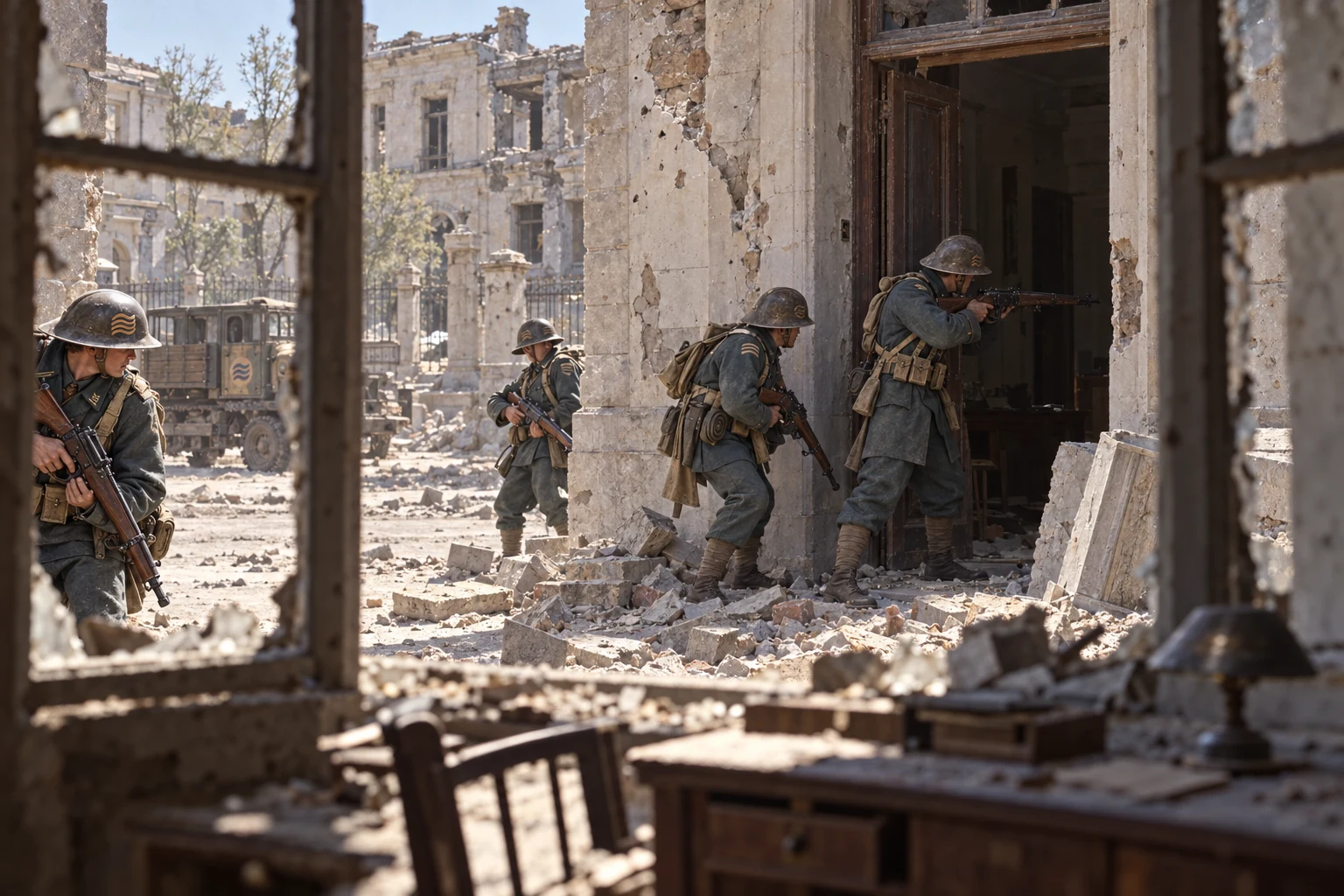
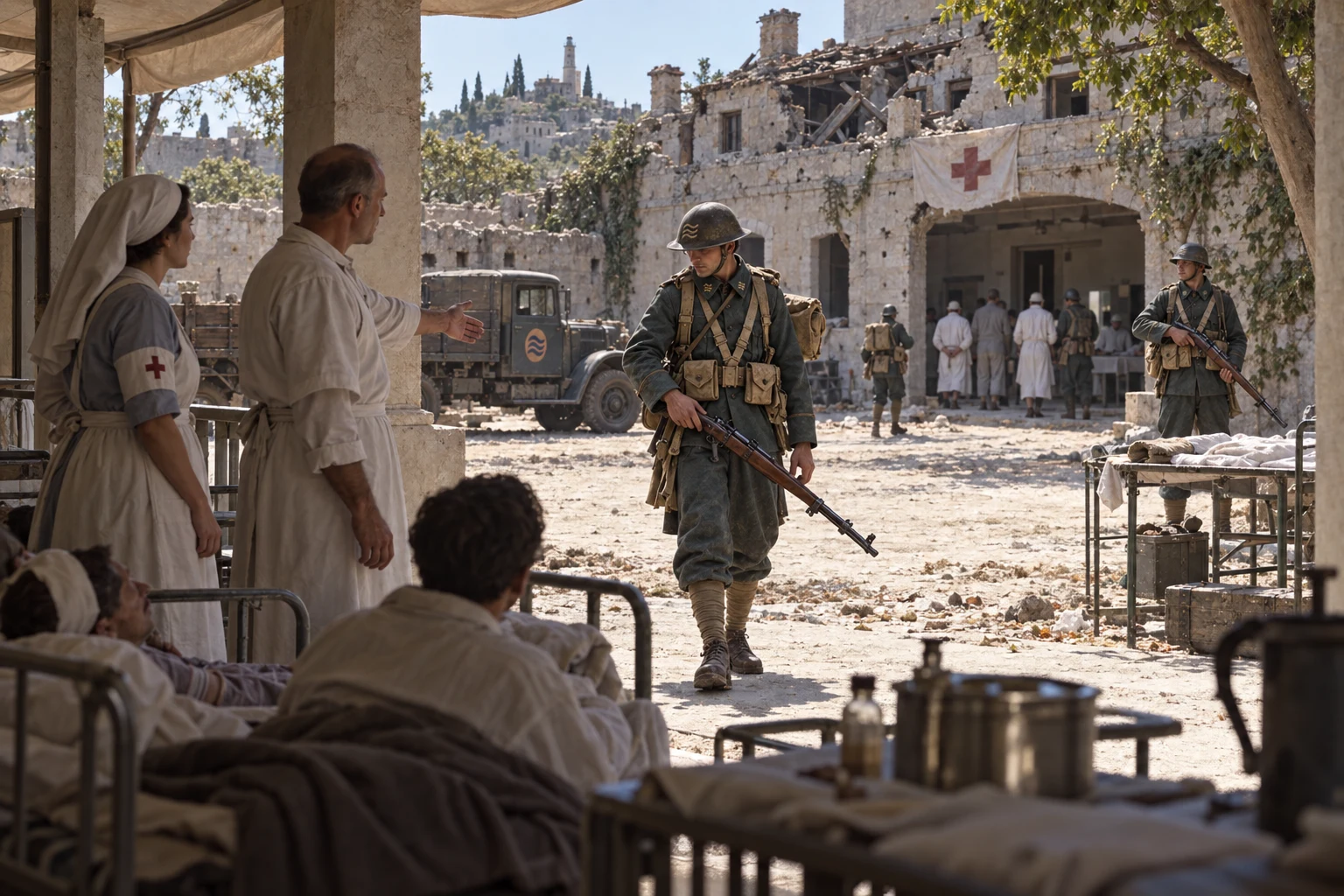
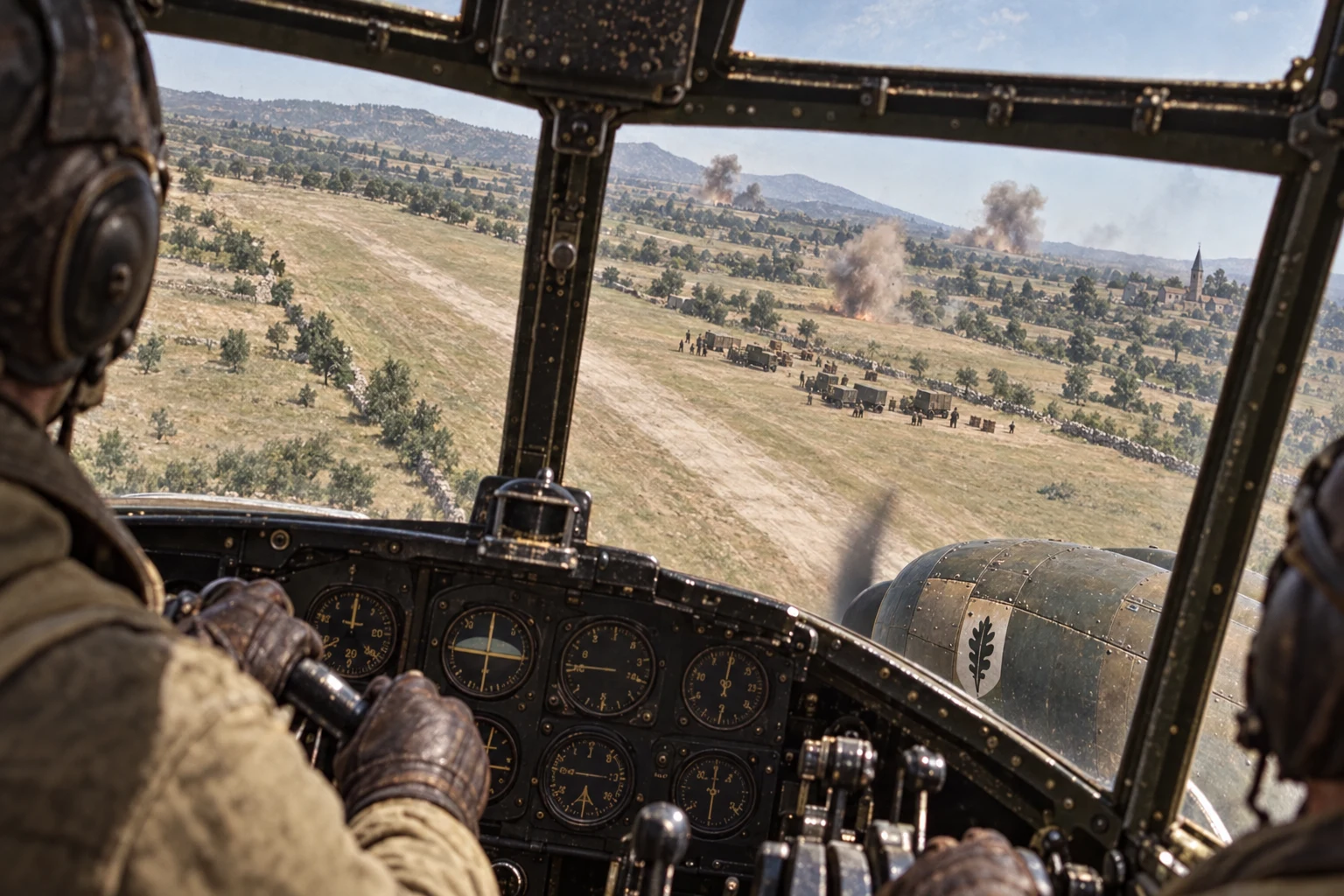
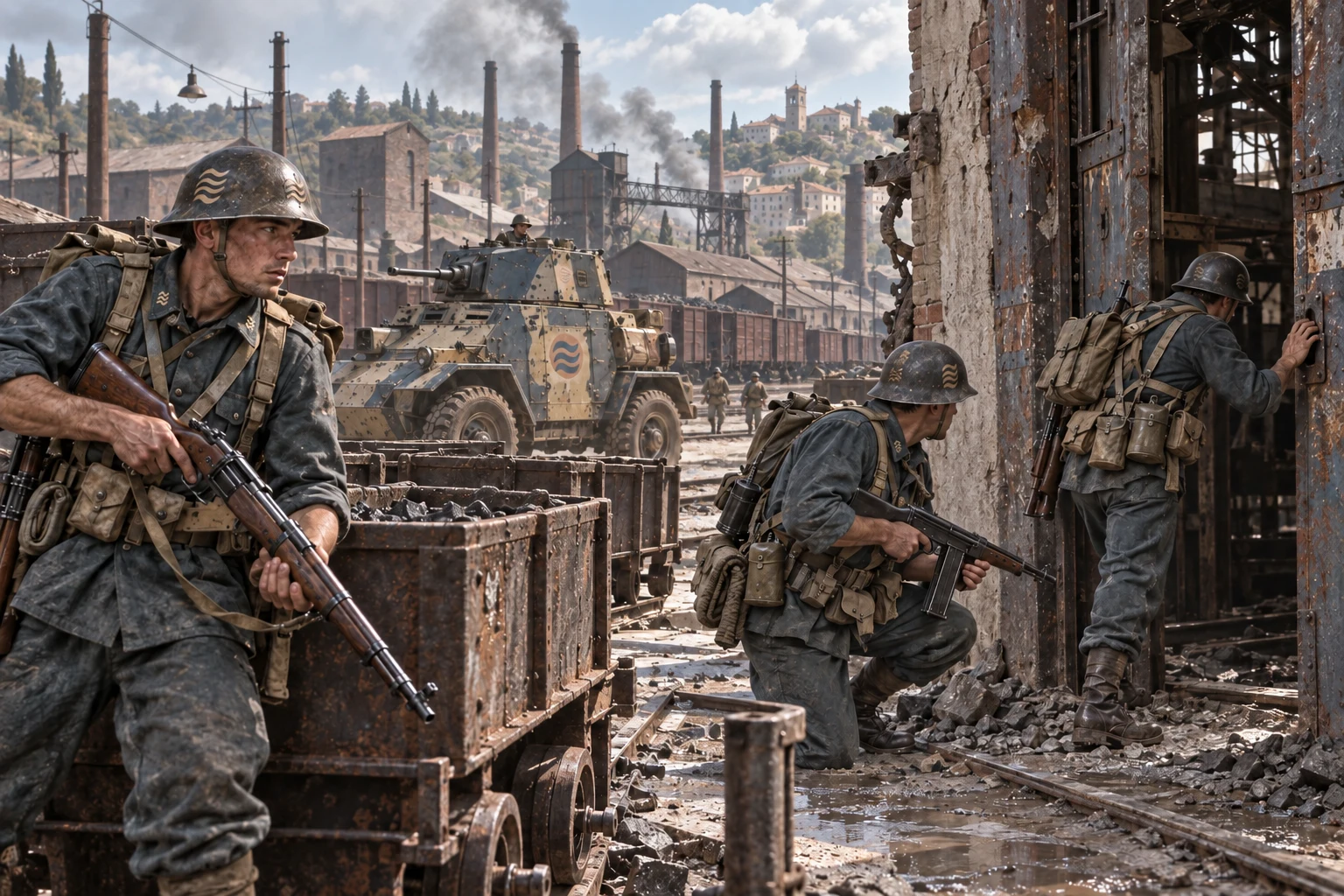
Garamond's central battle opened on June 18, 1213, after more than a year of resistance to Zaganar. The surviving central region accommodated military headquarters, relocated administration, workshops, hospitals and refugees. Concentration eased some coordination because offices and formations were closer together. It also brought functions formerly distributed across the country within reach of the same fighting. A commercial building could now contain a displaced ministry as well as stores, so the military significance of the district no longer matched its prewar appearance. The coming defeat was a rupture in connections among these functions, as much as a succession of captured defensive buildings.
Colonel Vesa Rinn provided continuity with the April 1212 defense of Ordan. Her reduced formation, however, had undergone repeated reorganization. Regular infantry, industrial guards and men returned from hospital were grouped under a title that did not describe their common level of fitness or supply. Their experience of damaged positions mattered: they knew how to keep resisting under conditions that might unsettle less seasoned troops. But knowledge could not replace equipment that the state could no longer produce or import in adequate amounts. Rinn's reports distinguished positions her troops could hold briefly from positions they could sustain. This distinction placed endurance, rather than nominal possession, at the center of her command problem.
Zaganar's force also bore the effects of a long campaign, yet had better access to replenishment. Its June offensive sought to separate Garamond's remaining positions and prevent coordinated defense. That objective helps explain pressure across connected sectors instead of a narrative centered on one spectacular breach. For the defender, choosing where to send limited support meant accepting that other crises would remain unanswered. For the attacker, openings produced by those choices could become routes into districts not directly defeated by the first assault. Zaganar's advantage was real, but the source describes its effective use against an exhausted system rather than an opponent that had ceased to possess agency.
The inherited chronology separates three events that should remain distinct: the offensive began on June 18, the principal center fell on July 14, and coherent conventional defense had collapsed by July 30. Compressing those dates into a single fall would erase decisions made by people who continued to fight, withdraw, negotiate or care for patients between them. It would also suggest an orderly outcome for every institution when the source emphasizes varied departures and captures. No numerical force ratio accompanies this account. The synthesis therefore follows the functions and constraints the source actually records instead of translating experience and replenishment into invented battlefield strength totals.
June 18–30: paperwork becomes part of the front
The first fighting reached warehouses and government service buildings outside the principal center. Offices had become sleeping quarters and aid stations, expanding their importance beyond their former civilian tasks. Rinn's soldiers defended a printing works producing forms, notices and replacement ration documents. Its machines helped the state identify and support a displaced population whose original papers were missing. The works thus supported a kind of endurance that an ammunition return could not fully describe. A displaced resident needed proof and instructions to receive food or locate relatives; the institutions producing those documents depended on a defending force keeping the district accessible long enough for the work to continue.
When power failed, workers completed limited tasks by alternate means, and a final batch of blank identification forms departed with messengers. The source does not say that this small dispatch saved the administration as a whole. Its importance lies in a more demonstrable connection: forms existed after the works that produced them was lost, providing a means to identify people whose institutions had been displaced. Calling the building a captured strongpoint records a military fact while omitting this consequence. The battle's documentary objects should be understood as tools used by people under pressure, not as decorative symbols that acquire meaning only once historians encounter them.
Zaganar entered through gaps created by withdrawals elsewhere. Garamond's commanders sometimes discovered a neighboring retreat from unfamiliar directions of fire, rather than from a received order. This was a failure of common knowledge, with consequences even where a particular position remained defensible. Rinn sent officers to reconnect sectors, but blocked roads lengthened their journeys. On June 28 she abandoned part of her own frontage to preserve contact with the remaining central defense. Authorization followed afterward. That sequence matters when evaluating conduct: retrospective permission did not mean she had possessed an answer at the moment action became necessary, and delayed paperwork should not be confused with a record of timely control.
Rinn's withdrawal also complicates the idea that holding more ground always represented a stronger defense. A formation could occupy a longer line yet become less useful if neighboring positions and routes ceased to connect it to the main force. Shortening the frontage sacrificed identifiable territory to preserve participation in a wider system. It did not stop Zaganar's offensive, and it may have left civilians behind the new line; the source does not enumerate those households. The narrow supported conclusion is that Rinn chose connection over continued frontage. This decision belongs in the same causal history as the attacker's exploitation of gaps, rather than in a separate moral tale about resolve or retreat.
July 1–14: the center falls unevenly
During July's first fortnight, officials prepared departure lists while officers requested vehicles for ammunition and wounded. The absence of a secure external land corridor prevented transport allocation from becoming a universal escape plan. Some people had already departed through small arrangements, while others remained because access, vehicles or time failed. Treating all departures as planned and all remaining personnel as deliberately sacrificed would impose clarity the evidence does not provide. Government movement and defensive movement occupied the same compressed space, but the capacities required to move offices, injured soldiers and dependent civilians differed. A place on a list was not the same thing as a route that could still be used.
Rinn defended a municipal service complex containing pumps and maintenance stores. Its military value and its importance to residents were inseparable: both soldiers and civilians required water. Zaganar's attack damaged pumping equipment before its troops fully occupied the buildings, reducing distribution on both sides of the immediate fighting. The defenders then carried containers from farther away, drawing people away from movement of wounded and stores. This consequence cannot be measured solely by the buildings captured. Equipment damage changed the allocation of labor within a defense already strained by displacement. The original records a shared deterioration of supply without implying equal responsibility for the invasion that produced the circumstances.
Zaganar secured the principal center on July 14. Government representatives had different outcomes: some escaped, some had already established themselves abroad, and others were captured. Rinn withdrew part of her command into surviving positions, deprived of much of the administrative and transport system formerly connecting them. Orders became intentions whose delivery could no longer be assumed. That phrase describes a precise limit of command authority: an officer could continue deciding what should happen while losing the means to tell particular troops. The center's capture was therefore a major Zaganar success without being proof that all remaining soldiers surrendered or all public authority disappeared on the same day.
The civic consequences began before any postbattle occupation arrangement could replace lost services. Interrupted pumps, damaged offices and dispersed records affected daily survival while military resistance continued nearby. This overlap distinguishes the central battle from an account that ends at the victor's entrance into an administrative district. It also prevents institutions from eclipsing their users. Refugees, patients and separated families were not merely demand on military transport; they were people whose prospects depended on whether records, communications and care remained accessible. The inherited source supplies several concrete examples of these connections, while leaving the full distribution of civilian losses and subsequent occupation conditions unresolved.
The exchange: verification under collapse
Operator Mira Pell worked at the last telephone exchange in Rinn's sector, located beneath an accounting office. Familiarity with callers' voices reflected months of use, but did not offer a complete security system when offices and units were moving. On July 9 an unfamiliar caller requested a neighboring position's withdrawal schedule. Pell refused to transmit it without the required verification, despite the claim that delay endangered troops. The battle did not immediately settle the caller's identity. Later investigation identified a Zaganar signals detachment using captured equipment. The sequence must stay intact: her action was based on the authentication requirement and the unresolved call, rather than foreknowledge of an enemy operation.
Verification introduced delays into several subsequent calls. Rinn chose a confirmation process rather than allowing suspicion to shut down the surviving network. Her response recognized two competing risks: an unverified message could expose movement, while refusal to communicate could itself isolate troops. Pell's conduct and Rinn's decision belonged to a defense trying to preserve useful communication under degraded conditions. Neither established that the exchange could remain secure indefinitely. It continued for two more days before damage forced abandonment, illustrating the limit of procedural care when the physical network was being destroyed. The source gives no basis for adding further intercepted messages or claiming a quantified operational effect beyond preserving the requested schedule.
Pell carried out a subscriber list that later helped survivors locate formations after the defense fragmented. The list changed function as the battle changed. In an operating exchange it identified connections; afterward it helped people reconstruct relationships among units no longer joined by a working circuit. Pell entered captivity with a medical party on July 24 and survived until liberation. Her testimony corrected the claim that all exchange operators had died at their posts. Two deaths remained recorded, but survival was restored to the narrative rather than treated as a less heroic ending. This correction is an important form of agency: Pell helped establish what the service had actually involved and who remained alive to describe it.
Her account also demonstrates why survivor testimony should not be forced into a tidy account of either triumph or total annihilation. She lost the exchange, became a prisoner and later supplied information that changed its history. These are distinct experiences, none erased by the others. The documented survival does not establish that captivity was safe or supply conditions the source does not record. Likewise, rejecting the inaccurate collective-death claim does not diminish the two recorded deaths. The essay preserves the narrower evidentiary achievement: a named survivor's account distinguished the staff's different fates and allowed imprisonment and later testimony to remain part of their service history.
July 15–30 and the continuity beyond defeat
After the center fell, Garamond's defense broke into isolated battles, attempted movements, negotiations and captures. Some units continued fighting in expectation of relief; others sought terms for wounded and civilians sheltering with them. Rinn rejected an unsupported general attack toward a reported opening after scouts could not confirm it. This refusal was a decision about evidence and usable movement, rather than proof that determination had failed. Her remaining soldiers retained cohesion for several more days, but a cohesive formation could not manufacture an external route. The same isolation that limited April 1212 relief now constrained the options of troops who had lost much of their internal support system as well.
By July 30 coherent conventional defense had collapsed. Surviving personnel later reached the wider Allied war through varied paths, while others remained prisoners or lived under occupation. The government in exile preserved Garamond's identity as a belligerent, but should not be imagined leading an intact enclosed army through hostile territory. The inherited account links that political continuity to a later contribution at SharkStrike's Gale sector. That connection establishes a relationship across time without proving that every formation or individual followed the same journey. The military organization that survived the defeat had to be reconstructed from people and authority that escaped, endured or later returned.
Zaganar achieved the central military objective and inherited an occupation burden. Acknowledging the victory requires naming its effect: Garamond lost the center, the functioning connections of its conventional defense and immediate power over much of its population. Acknowledging the defender's endurance requires equal precision: belligerent identity, some personnel and fragments of institutional knowledge survived. The forms taken from the printing works and Pell's subscriber list supported practical reconnection without substituting for the missing state. They helped identify people after buildings and territory were gone. Read beside the opening Ordan defense, the central battle explains defeat through accumulated loss of function while preserving the separate histories of resistance, escape, captivity and later Allied service.
Rinn's continuity across the two battles supplies a useful comparison without turning her formation into an unchanged unit. In 1212 she sought authorization to leave a factory whose productive value had largely vanished. In 1213 she abandoned frontage to preserve connection with the remaining defense and later rejected an attack through an unconfirmed opening. All three decisions concerned what a position or movement could actually achieve. Their common logic did not deliver the same outcome or prevent final defeat. It allows a reader to trace command judgment amid worsening conditions while recognizing that the resources and institutional setting behind each judgment had changed.
The retained printing and telephone episodes share a concern with identifying people, but their mechanisms differ. Forms supplied a portable means of recording identity after displacement; a subscriber list preserved knowledge of an interrupted network. Neither guaranteed contact with every missing person. Keeping their purposes distinct prevents the state's surviving papers from becoming one vaguely heroic archive. Each tool mattered because particular workers preserved it, and because later users could apply its limited information to an immediate need.