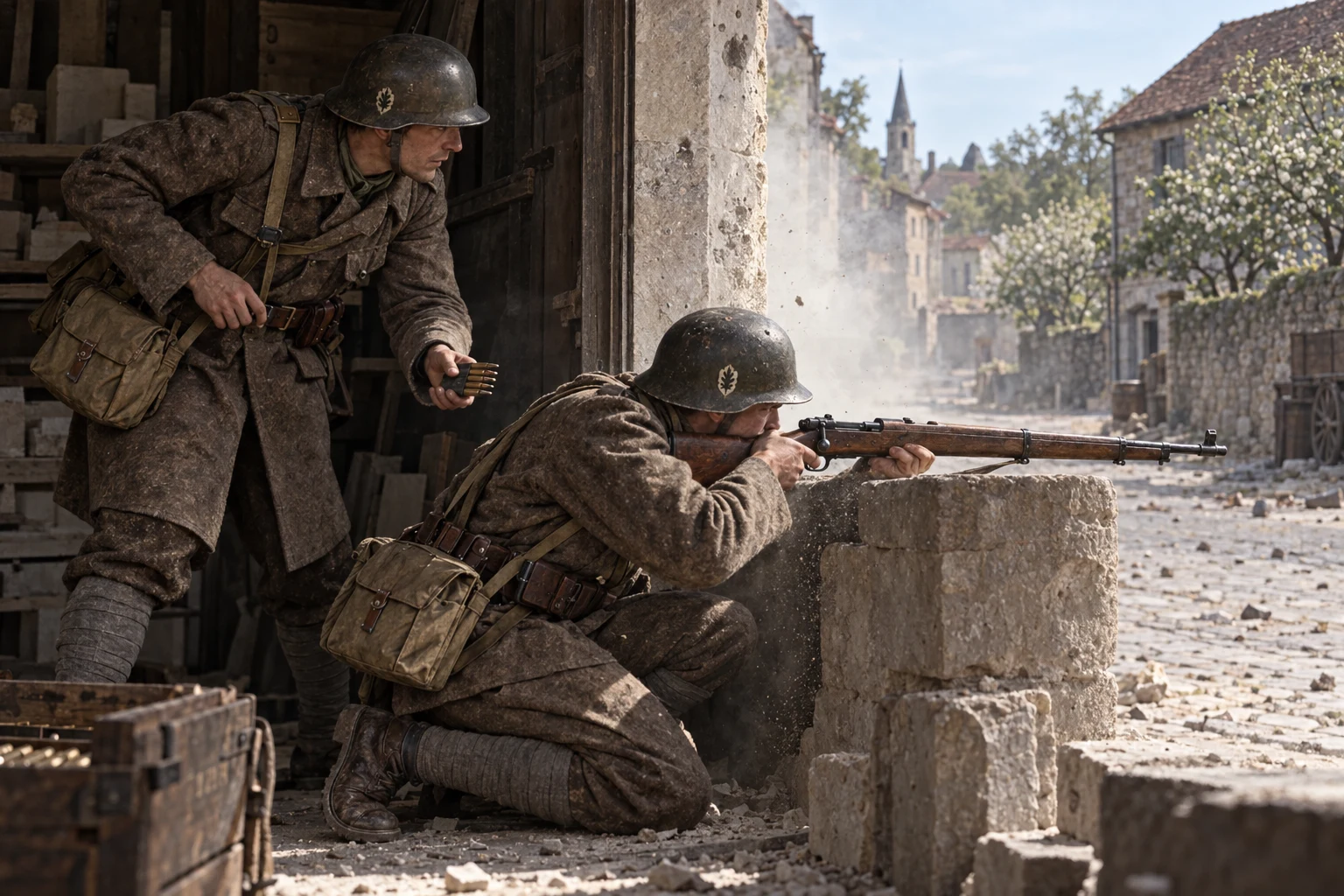
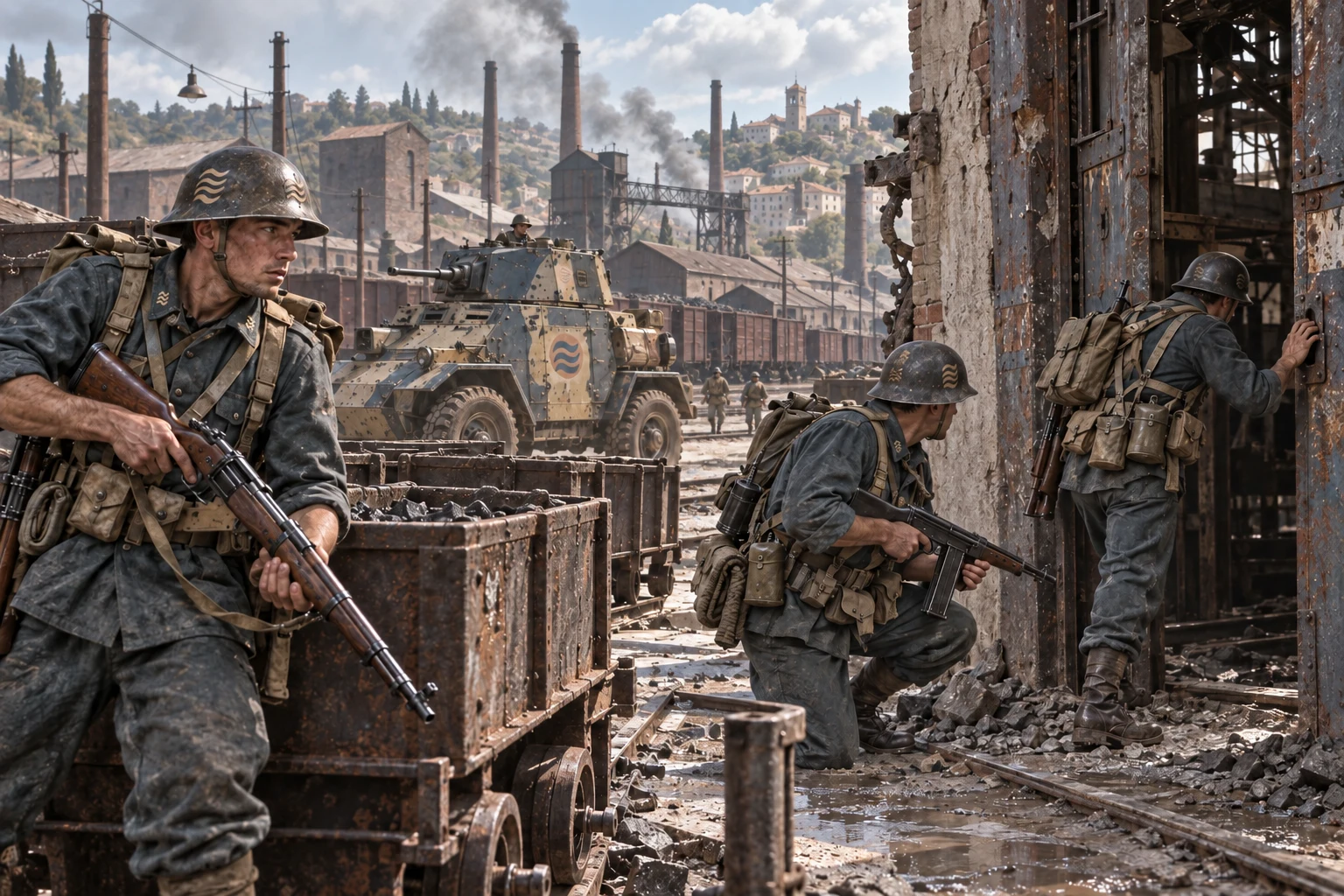
The opening defense of Garamond
April 4–29, 1212 · Garamond, Volara · Garamond against Zaganar
War inside an enclosure
Garamond's strategic isolation shaped its defense before the first attack. The country could appeal to the Allied coalition, but an appeal did not create a land corridor across hostile territory. Its command therefore planned to preserve forces and essential production while seeking whatever limited external assistance could reach it. The invasion by Zaganar on April 4 converted that difficult calculation into an immediate contest over how much territory could be abandoned without making the remaining state unworkable.
The Ordan industrial district contained workshops, workers' housing, and administrative stores supporting the central region. Garamond assigned Colonel Vesa Rinn to coordinate its defense. She had regular troops, locally organized guards, and technicians whose skills were needed both at the machines and in uniform. Mobilizing the same worker for guard duty and production created impressive lists and an impossible daily schedule. Rinn ordered the roles separated where possible, accepting criticism that some men appeared to be serving less visibly.
Zaganar's attacking command expected the industrial district's loss to accelerate political collapse. Both states possessed communist political identities, making the conflict resistant to a simple ideological division between the coalitions. Propaganda on each side claimed to defend workers against the other's government. In Ordan, workers confronted the more immediate question of whether to remain beside machines that now drew artillery fire.
April 4–10: The factory belt
The first attacks overran forward positions before Garamond's command had completed movement of its stores. Trucks carrying military supplies encountered families leaving the same district. Rinn established a temporary holding area for civilian traffic so that ambulances could pass, but the delay left people exposed to shelling and prompted accusations that the army had confined them. The arrangement was revised after local officials showed how quickly the queue had grown beyond its intended space.
Fighting reached a metalworking plant on April 7. Defenders used substantial buildings whose interior layout was familiar to workers and obscure to arriving officers. A maintenance foreman guided a relief company through a service passage that its commander had mistaken for a dead end. The movement restored contact with an isolated position without recovering the entire plant. Reports that the factory had been relieved concealed how little of it remained usable.
A fire then disabled the plant's electrical distribution. Soldiers continued holding parts of the complex after its industrial value had effectively vanished. Rinn requested permission to withdraw and was told that abandonment would damage morale. She answered with an inventory of machinery already destroyed or removed. The argument eventually secured authorization, but only after another night of fighting had increased the cost of departure.
April 11–20: The shortened perimeter
Garamond's forces concentrated around a more compact district behind the factories. Units arriving from different sectors brought contradictory impressions: some had seen Zaganar troops advancing confidently, others had repulsed attacks and assumed the broader front remained sound. Headquarters assembled a common picture through interviews with officers and messengers, an imperfect process that consumed time while new reports changed the situation again.
Zaganar's infantry had also suffered. Captured workshops contained wreckage and civilians rather than the immediately usable resources promised in briefings. Supply vehicles were diverted to evacuate wounded, delaying stores needed for further attacks. The invasion retained momentum, but its advancing formations began asking for pauses that political authorities interpreted as a lack of determination. Local commanders responded with limited attacks that maintained activity without producing the decisive collapse expected of them.
Within Garamond's remaining district, civilian committees organized food and shelter under growing military pressure. Rinn prohibited the removal of the last available medical supplies from a public clinic to replenish a military store. The decision did not resolve shortages; it made the army share them. Doctors treated soldiers and civilians in the same crowded rooms, recording names when possible and physical descriptions when patients could not speak.
Three times on one order
Rinn's liaison officer, Lieutenant Orsa Ven, carried the factory withdrawal request through a district where civilian communications still worked intermittently. A party official offered to transmit the message through his office, but Ven waited for confirmation rather than assuming transmission meant receipt. The reply came from a headquarters that had moved and lacked the industrial inventory supporting Rinn's request. Ven returned to obtain the missing attachment, losing hours while the defense continued to deteriorate.
The inventory listed damaged motors, removed tools, disabled power connections, and work that could no longer be performed. Its specificity mattered because the political argument referred to the factory as if the prewar establishment still existed inside its surviving walls. Once headquarters saw what remained, it authorized withdrawal. Rinn nevertheless lost additional soldiers during the interval, and her report made clear that paperwork had informed the decision while also becoming a costly obstacle to making it promptly.
Ven preserved the annotated copy after the campaign. It showed three times written beside the same request: drafted, transmitted, and actually considered. Later accounts of Ordan used those entries to reconstruct why an order issued promptly reached the troops so late. The case became a warning against measuring command responsiveness solely by the time printed on a signal rather than by the complete journey of the information required to act.
April 21–29: Holding without a route out
The final week of the opening campaign brought renewed Zaganar pressure and another contraction of Garamond's defense. Rinn preserved a coherent force by abandoning positions before all movement became impossible. Some local guards refused withdrawal because their families remained behind. Others obeyed and later faced accusations from neighbors who regarded departure as abandonment. Military necessity did not erase the social consequences of those choices.
By April 29, Zaganar held significant gains, but Garamond's central government and organized defense survived. Limited air supply would later bring valuable items, yet it could not carry the bulk needed to restore an entire industrial economy or feed an enclosed army indefinitely. The opening battle established endurance under isolation rather than an expectation of easy relief.
Ordan's surviving workers resumed production with machinery dispersed among smaller facilities. Their output mattered, but the loss of buildings, skilled personnel, and reliable power could not be measured simply by counting machines saved. Garamond had bought time at a cost that narrowed its future choices. The defense would continue into 1213, when the same isolation and accumulated damage made its central collapse harder to avert despite another year of resistance.
Original illustrations for this source record
Original archive artwork and captions are preserved. Dates, labels and claims printed within inherited images belong to the previous edition; the revised text governs the current history.