Mobilization interrupted rather than completed
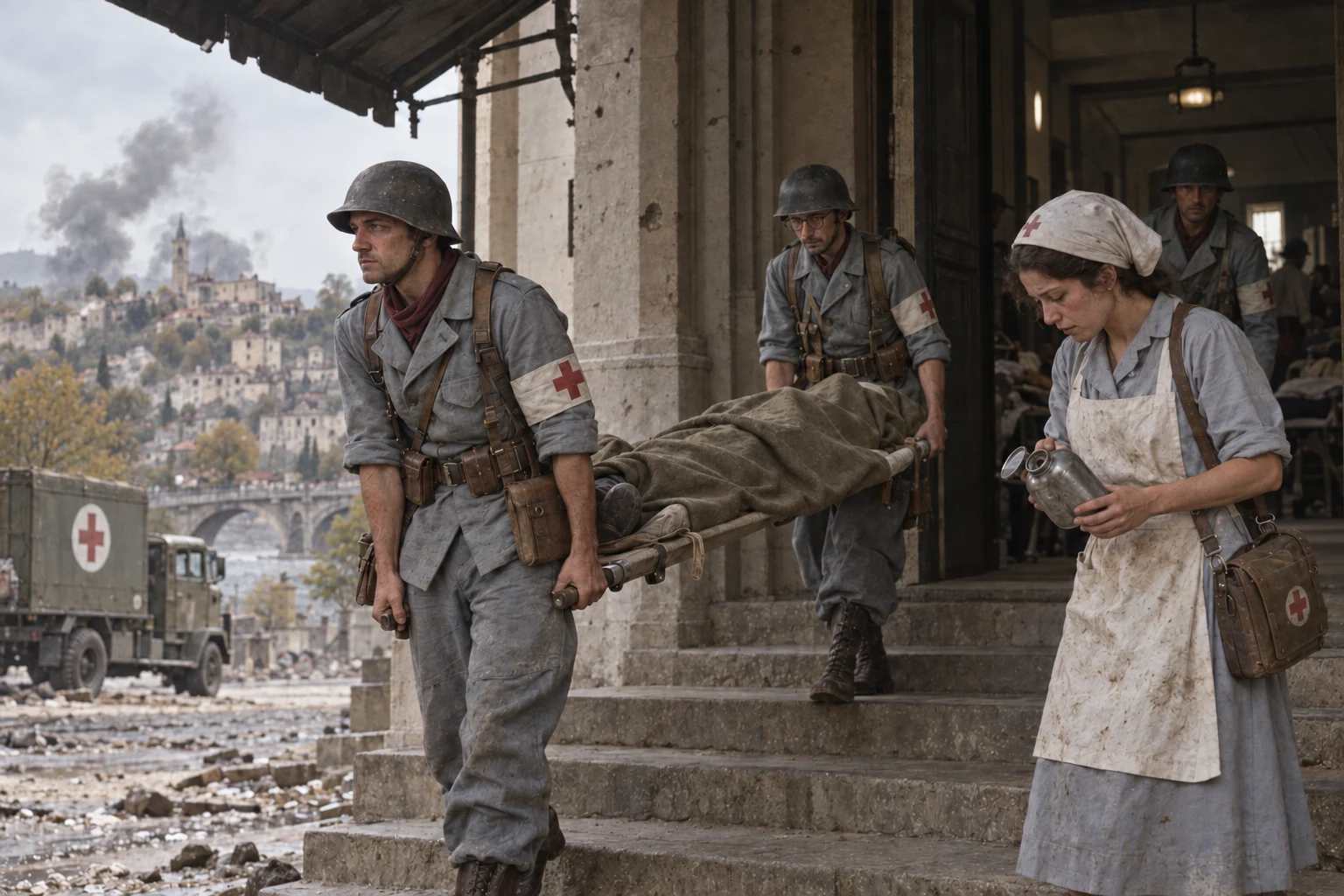
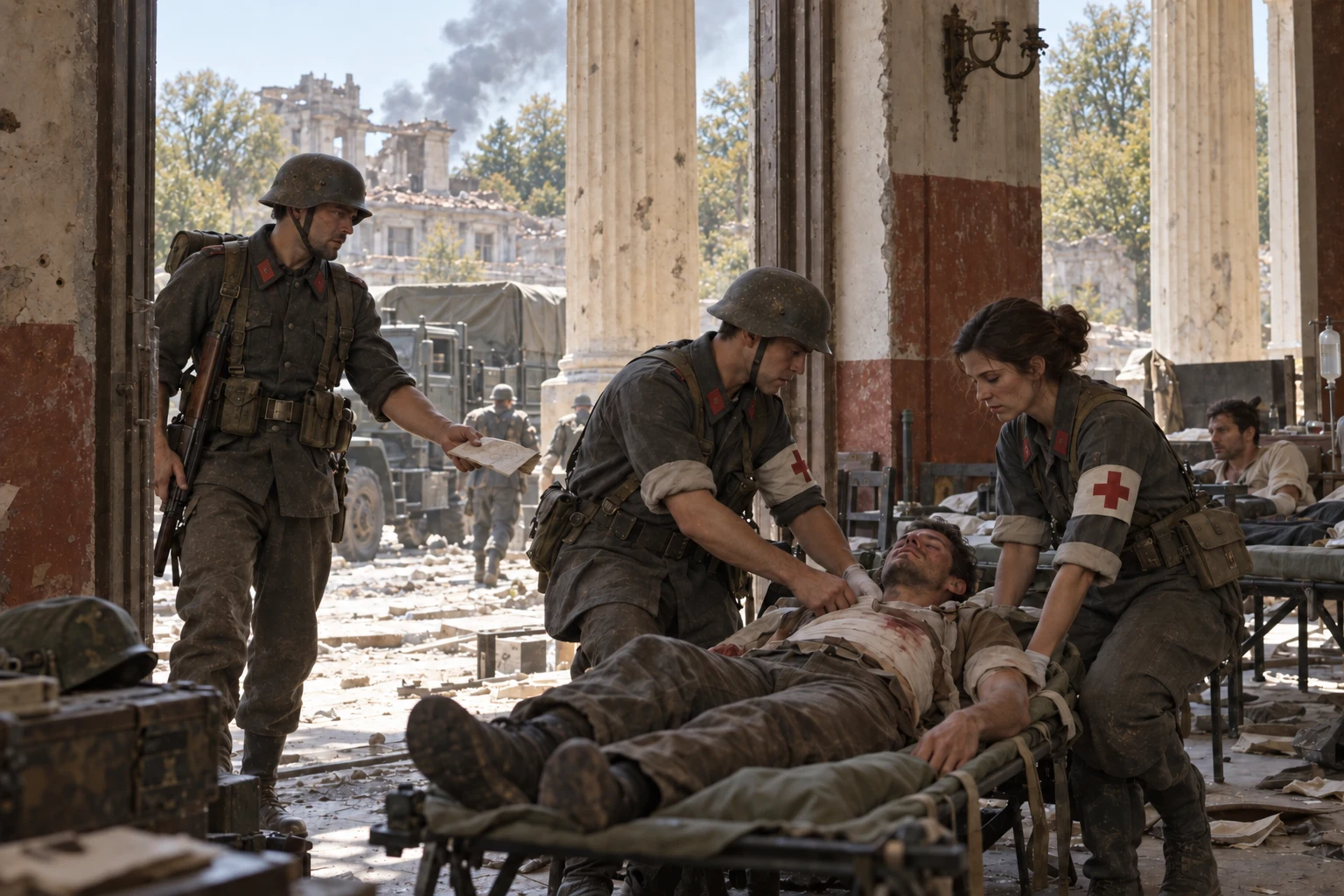
Rostan attacked while Praxen was still mobilizing, and the Meret district battle ran from April 17 to April 30, 1211. The reserve battalion led by Major Dena Kor assembled in an agricultural exhibition hall, carrying the uneven preparation of a force drawn from civilian institutions. Recent trainees served beside reservists familiar with procedures that had changed. Communications equipment was scarcer than men. The unit moved forward before instruction could resolve those differences. This starting point prevents the battle from being understood as a test between two fully constituted armies operating from equivalent readiness. Praxen's defense involved building a functioning arrangement during the fighting itself. The exhibition hall represents that transition concretely: a civilian place of organized gathering became a military assembly point, while its occupants had not yet acquired all the equipment and common practices necessary for their new tasks.
The inherited annual account for 1211 situates Viar within an earlier competition over credit, equipment and regional influence. That context explains why mobilization difficulties mattered without proving that economic dependence mechanically determined the battle. Rostan's offensive sought to disrupt Praxen's assembly rather than besiege every town immediately. Initial successes displaced officials and interrupted mustering areas, producing impressions of collapse beyond the actual military result. Many Praxen units remained intact although scattered. The critical question was whether they could be gathered before further enemy movement exploited the gaps. The difference between dispersal and destruction recurs throughout Kor's experience. It also defines the campaign's immediate limit: Rostan gained territory, but the opening blow did not eliminate the people and institutions needed to continue the defense farther back.
Meret’s ground offered opportunities without a continuous barrier
Irrigation channels, low ridges and villages shaped the district's defensive possibilities, but none created an uninterrupted obstacle. Their usefulness depended on season and on how separate positions related to roads. Rostan's leading forces used different approaches, leaving Kor uncertain which movement carried the main effort. Her orders specified a road connection without reliably establishing how long adjacent formations could hold. A defensive assignment can appear precise while leaving its practical boundaries unresolved. If neighboring units retire, a road held locally may cease to serve the wider defense as intended. The source does not provide a complete map from which to reconstruct exact distances or flank relationships. Its geography should therefore remain the retained description of a cultivated district in Praxen on Viar, without adding imaginary mountain ranges, frontier crossings or coordinates for Meret.
The landscape also belonged to a civilian economy whose operations were entangled with military use. Orchards could conceal troops, grain stores could offer observation and shelter, and roads supported both supply and population movement. Those functions did not make farms and storage buildings interchangeable military assets. Damaging an office or displacing employees could disrupt food distribution even if the food itself survived. The later grain complex episode is important because it separates material stock from the organization required to use it. Meret's defense was fought through places maintained for cultivation, transport and storage, and every conversion of their function affected civilian claims. The Chronicle interprets those relationships from the inherited battle rather than treating the region as vacant tactical ground. It does not supply undocumented property losses or assume that all civilians either departed or worked willingly for the army.
The orchard line and the recovery of identifiable units
Kor entered the orchard line on the evening of April 17. Trees concealed movement while preventing officers from seeing neighboring positions. Reservists accustomed to visual contact relied on familiar voices. An anxious sentry mistook returning men for an enemy patrol, starting night firing without a major Rostan assault. Ammunition and confidence were consumed before the following day's sustained attack. The episode illustrates a readiness problem without proving general cowardice. People operating in unfamiliar conditions interpreted limited information through habits poorly suited to their position. The source describes an error and its effect; it does not identify every participant or quantify the ammunition spent. A serious account can explain the relationship between concealment, contact and anxiety while preserving those evidentiary limits and resisting the temptation to make one incident representative of the entire national army.
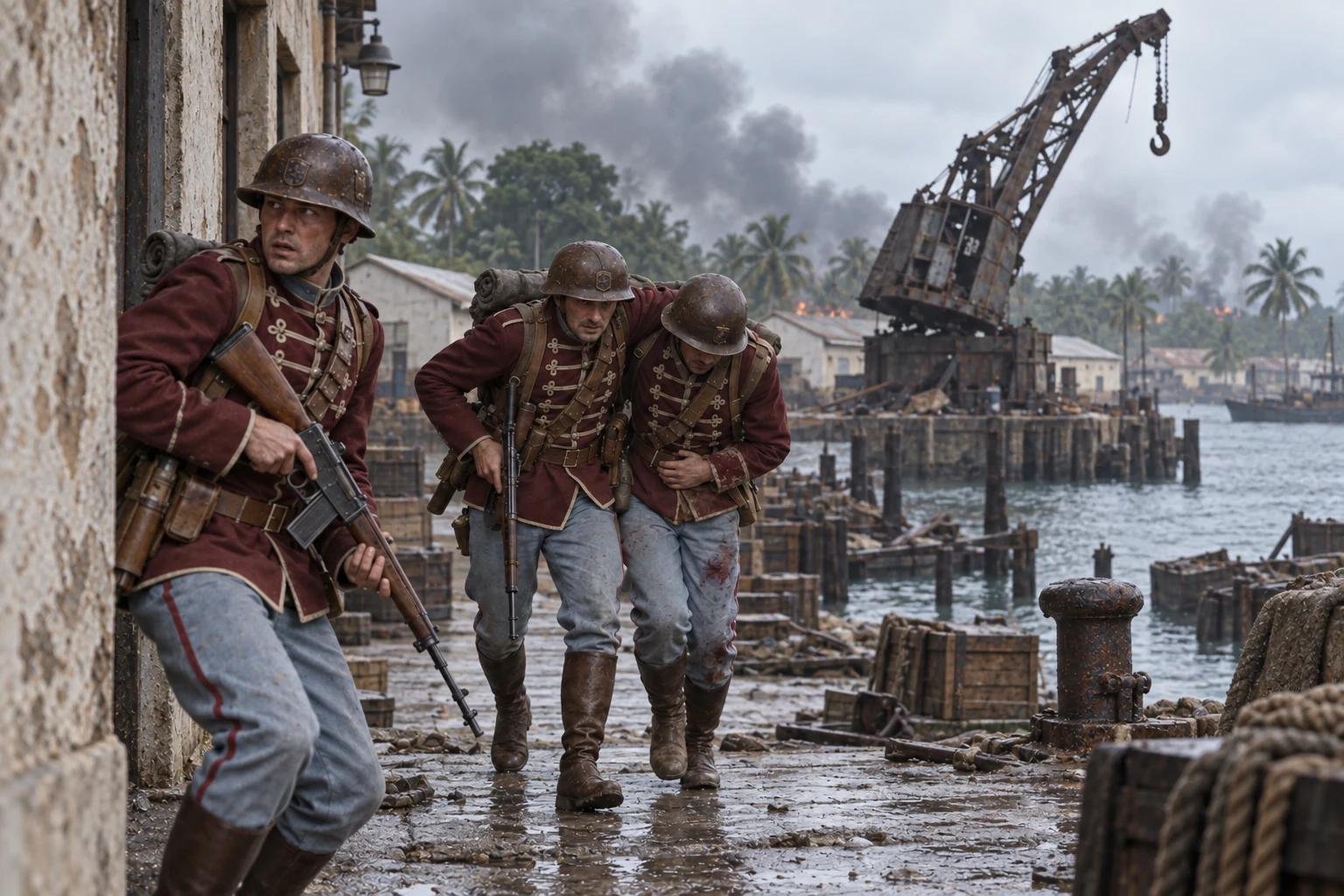
When the attack came on April 18, forward groups withdrew through trees and sometimes passed supporting positions without recognizing them. Kor sent officers to identify units at the road rather than sending every retreating person back indiscriminately. Wounded soldiers, messengers and displaced companies traveled in the same direction for different reasons. Recovering the formation required sorting those reasons. A direction of movement could not establish intent or capacity. Her response preserved distinctions that a punitive description of retreat would have erased. This was practical command work rather than a claim that withdrawal itself was harmless. Rostan still gained ground, and confused movement still endangered cohesion. The point is that an army under pressure could rebuild a usable arrangement only by understanding what its moving people were doing. Treating them all as fugitives would have removed the information necessary for that recovery.
Artillery restraint and civilian map knowledge
A Praxen field battery continued support after its ordinary observers lost contact. Its commander declined to fire at locations described only by smoke. Infantry who could see the enemy resented the delay because they could not transmit a location usable by the battery. The account presents a genuine conflict between urgent demand and insufficient information. It does not establish that the battery had no alternative communication method anywhere in the district, nor that firing without a reliable description would have produced a decisive result. Its restraint should therefore be explained in relation to the request actually received. The artillery commander needed a location, whereas the infantry's visible danger did not automatically create a description that another unit could use. Both perspectives were rooted in the immediate battle, and neither can be dismissed through hindsight alone.
A local surveyor later reconciled the maps and improved support, after the opportunity for a more decisive intervention had already passed. Civilian expertise repaired a military information problem, but the improvement's timing limited its effect. This makes the episode useful beside the survey office in Ravessa and the commercial guides at Selen: detailed knowledge became operationally important when standard representations failed. It does not demonstrate that all these civilians belonged to a common military organization or shared a transmitted doctrine. In Meret, the surveyor's intervention enabled better communication about ground already being contested. The retained account gives no name or complete record of that person's wider activities, so the Chronicle leaves them unspecified. Civilian agency can be recognized without manufacturing a biography. The relevant fact is the contribution and the limit: improved descriptions supported continued defense but could not recover the interval already lost.
Grain stock, observation and the temptation to concentrate
Praxen fell back toward concrete grain bins standing above the district's low ground. Soldiers initially regarded the complex as an obvious strongpoint. Kor instead recognized the danger of gathering beneath conspicuous structures with little dispersal space. She used the site for observation and temporary shelter while distributing much of her force around it. The decision separated the building's usefulness from an assumption that usefulness required total concentration. The source does not give exact positions or strength ratios, so no tactical diagram can responsibly claim a complete perimeter. What it provides is Kor's choice to use several functions selectively. Her battalion could benefit from the complex without committing every soldier beneath the feature most likely to draw attention. This was a limited adaptation within retreat, not a fortified solution that could guarantee possession of the district.
Civilian employees remained to run machinery and protect grain intended for the population. Rostan reached the outer buildings on April 22, and combat entered loading areas and offices. A records-room fire destroyed employment rolls and clothing while much of the grain survived. Both sides later claimed to have prevented the district's food from being destroyed. Those claims missed the distinction between stock remaining and the labor organization needed to distribute it. Employees, records and functioning equipment linked grain to households. Losing the records could affect recognition of workers and obligations even where bins remained full. The account thereby identifies a civilian consequence that cannot be measured by burned tonnage alone. It supports scrutiny of victory claims without requiring an invented famine or assigning subsequent outcomes absent from the source. The immediate damage was serious because food distribution depended on more than the survival of its stored commodity.
A unit rebuilt before its paperwork could catch up
Reinforcements included Praxen soldiers separated during the opening retreat. Command assigned them to companies already functioning rather than attempting immediate restoration of every original formation. This strengthened short-term cohesion and created later confusion over casualties and pay. A man could remain missing on one return while serving under another commander, causing families to receive contradictory notices. The source demonstrates how recovery of fighting capacity and recovery of administrative clarity could proceed at different speeds. The reassignment was neither a fictitious replacement system nor proof that command ignored its obligations. It met the immediate need to put dispersed soldiers into workable groups. Its consequences nevertheless imposed uncertainty on households whose information depended on unit records that had not yet reconciled the movement.
This administrative cost matters when assessing Kor's formation after the battle. A surviving battalion could appear more continuous than the experience of its members and their families. Unit identity remained useful for command, while individuals had moved across organizational boundaries in ways returns did not immediately capture. The distinction connects Meret to the Veylan problem of personnel classification, though here the central question was recognition rather than immediate fighting availability. Both accounts show military figures responding to specific information failures without establishing an army-wide cure. Meret's paperwork did not become accurate simply because the local defense grew more coherent. The Chronicle consequently treats reorganization as a process with benefits and unfinished duties. It does not invent a final reconciliation of every missing report or claim that all separated soldiers were recovered into Kor's battalion.
Dast’s maintenance gap and a useful admission
Machinist Elen Dast had trained on different equipment from that now entrusted to him. He concealed the mismatch because he feared removal while friends were already fighting. A mechanism he could not repair forced an admission. Kor paired him with a regular technician instead of treating the difficulty only as deception deserving dismissal. The regular supplied equipment-specific knowledge, while Dast contributed workshop judgment. Together they restored weapons previously set aside. This episode explains readiness through particular competencies rather than a general contrast between skilled regulars and incapable reservists. Dast possessed useful experience, but it did not automatically cover the equipment in use. The partnership made the distinction productive. Recognizing the gap allowed command to combine knowledge that concealment had kept separate, while retaining a reservist whose broader skill still mattered to the formation.
The event should not be expanded into a universal claim that admissions always received sympathetic treatment or that Kor faced no disciplinary difficulties. The retained account supplies this response to this problem. Its later significance rests partly on Dast's survival and subsequent instructional work in Praxen's maintenance service. His classes began with identification and condition checks rather than assumptions about what reservists ought to remember. This was a specific practice drawn from an exposed training gap, not proof that Praxen completed a comprehensive technical reform immediately after Meret. The distinction preserves the episode's force. Institutional learning began with a person able to name what had failed and carry that experience into instruction. It was valuable precisely because it replaced an appearance of readiness with an inquiry into actual knowledge, equipment condition and the support needed to make a skill usable.
Ammunition today and repair capacity tomorrow
During withdrawal from the grain complex, Dast and the regular technician carried recovered components that officers ordered abandoned to make room for ammunition. They kept only tools they could carry. The ammunition reached troops covering the departure, while later repairs took longer because the components were gone. Kor's review recorded the tradeoff without portraying either priority as foolish. That balanced explanation deserves preservation. Ammunition served an immediate protective task; repair material supported future capability. Under constrained movement, both could not necessarily be carried. An interpretation that praises preservation of technical knowledge while condemning the abandonment of every component would ignore the cover needed for the people possessing that knowledge to escape. Conversely, celebrating ammunition alone would erase a known future cost. The source provides a choice imposed by retreat, not evidence that one resource had no value.
The episode complements the reassignment of separated soldiers. Both actions increased the chance of maintaining a usable force in the immediate battle while leaving later rebuilding work. Reorganization required reconciling records; abandoned parts required additional maintenance effort. Those deferred burdens were not eliminated by the formation's survival. They were part of what survival cost. This is why Meret should be understood through functions rather than a binary label of collapse or success. Praxen preserved people and some weapons, but lost ground, transport and repair capacity. Rostan's pressure forced decisions that reduced the defender's future options even where it failed to destroy the unit. The Chronicle adds no component quantities or weapons totals, because none are available in the retained account. Its analysis rests on the documented relationship between immediate ammunition delivery and later repair delay.
A local Rostan victory with a strategic limit
By April 26, Rostan met firmer resistance and growing support demands of its own. It retained substantial gains but had not converted mobilization disruption into immediate national defeat. Kor withdrew when surrounding positions became untenable, taking some civilian staff while others refused departure. The surviving battalion joined a more continuous defense farther back. Its withdrawal thus surrendered a locality and preserved a role in the continuing war. These results cannot be reduced to the assumption that a surviving unit had won or that a retreating unit had ceased to matter. Rostan's local victory remained real. Its operational limit lay in the defender's continued ability to assemble forces beyond the threatened district. Kor's actions formed one part of that capacity and should not be enlarged into a claim that her battalion alone prevented national surrender.
Allied declarations and assistance widened the contest during April, but foreign troops did not appear beside Kor merely because their governments entered the war. Diplomatic change and useful military arrival had different timetables. Praxen would endure further fighting before its administrative center fell in 1219; reading that later defeat backward would undervalue what the first defense preserved. Meret demonstrates recovery from disorganization without restoration of everything lost. Its inherited account records mistakes, civilian contributions, local enemy success and the beginnings of a more continuous line. This authored Chronicle interprets those facts while withholding unsupported casualty figures, invented operations and precise geography absent from the atlas. Its link to the later fall of the administrative center makes the long trajectory visible, while maintaining the historical distinction between a state first preventing a fortnight's campaign from deciding its war and a state eventually losing a much later defensive struggle.