A political center within a damaged operational system
Ravessa's defense in September 1208 followed the loss of Ravell's eastern transport district earlier that summer. The capital therefore entered its battle with a problem that could not be solved entirely inside the city: its wider system of reinforcement and supply had already been damaged. The inherited account dates the struggle from September 1 to September 19 and identifies the eventual seizure of the principal governmental district by Hukular. That result was a decisive political and local military victory. It was not the national surrender of Ravell. Prime Minister Sera Danic's government survived abroad, and remaining field formations withdrew toward Serin. Keeping those outcomes distinct is essential to understanding why the city's fall changed the form of resistance rather than ending the country's participation in the war. A capital could cease to function as a seat of power while the institutions claiming national authority continued through other locations.
The defense operated through several overlapping schedules. General Levan Oset needed to know when positions and routes would become untenable. Danic needed to decide when maintaining national leadership inside the capital no longer served its purpose. Residents needed information about departure, shelter and missing relatives. Those schedules could not be reconciled by a single proclamation. Telephone service persisted unevenly, creating false reassurance in threatened neighborhoods and uncertainty in districts where physical destruction was less severe. An urban system can fail at connections distant from the people dependent on them. The continued operation of one circuit said little about access to the street beyond it. This separation between apparent continuity and actual service connects Ravessa to the earlier railway battle. In both, infrastructure was most misleading when its surviving parts suggested that the entire network still worked normally.
Danic and Oset: an argument over the effects of departure
Danic initially remained because she feared that government departure before the field command requested it would accelerate panic. The decision reassured some inhabitants and encouraged others to postpone leaving. Oset wanted a definite political decision in order to reassign transport reserved for ministries. Their disagreement was not a contest between a leader promising limitless resistance and a soldier already willing to surrender. The inherited account describes conflicting assessments of timing and consequence. Government presence had symbolic value, but it also maintained demands on transport during a shrinking defense. Government departure could preserve national continuity, but its public meaning might weaken confidence or reveal to residents how little evacuation capacity existed. Assessing the dispute requires recognizing both effects without inventing private motives or secret knowledge for either participant. Neither could make a departure decision harmless simply by choosing it earlier or later.
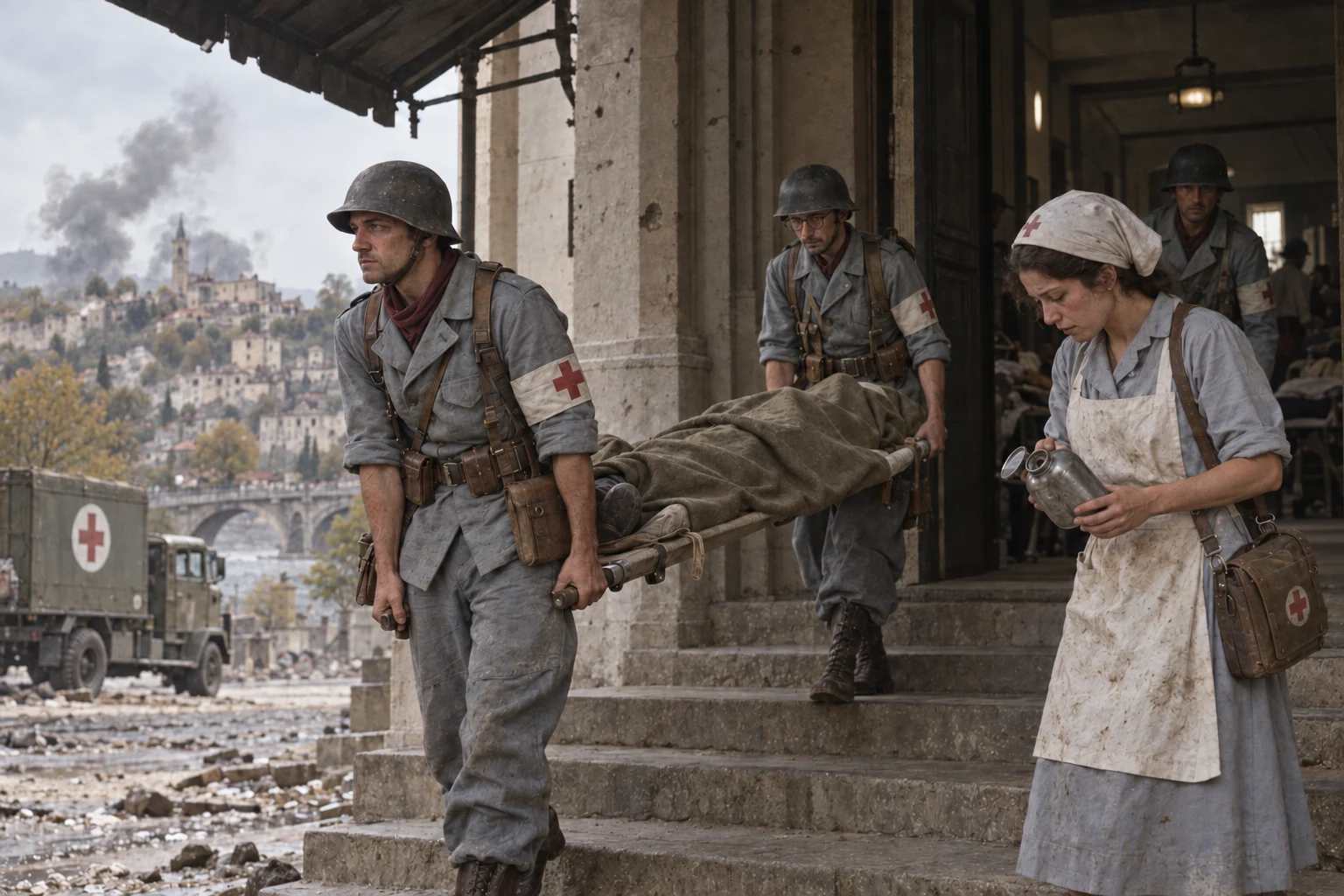
The same scarcity joined administrative and medical priorities. Artillery disruption reduced water pressure unevenly, and a hospital away from the most active fighting received casualties until its reserve tanks diminished. Officials requested transport for patients unable to walk while other authorities sought vehicles for archives and machinery. Each demand represented a function that would matter after the city's loss. Patients needed immediate protection; records could establish obligations to displaced people; equipment could support resistance elsewhere. Yet their shared importance did not make the available transport expand. The source does not provide a complete allocation ledger, so no precise ranking of these movements can be reconstructed. What it does establish is a government and army allocating scarce means among incompatible urgent needs. The resulting moral pressure came from material limitations as well as from disagreements over how the capital should be represented to the public.
The outer districts and the trouble with partial contact
Major urban fighting developed around the freight approaches during September 6 to 11. Masonry buildings offered some protection, but fire could block exits and turn apparently strong positions into traps. Some units interpreted continued telephone contact as evidence that a withdrawal route remained open and moved too late. Others lost contact and retired before adjacent formations, exposing gaps. Oset's reconstruction of the front on September 7 depended on reports describing different hours. This was a problem of temporal alignment as much as a shortage of messages. A position held earlier could be recorded beside another held later, producing a front that had never existed simultaneously. The account therefore cautions against reading a headquarters map as a direct picture of events. Oset's command was continually reconstructing what remained possible from descriptions whose individual accuracy could not guarantee their compatibility.
Captain Mira Sellen's mixed force of reservists and railway guards held a tram depot to delay enemy entry while civilian traffic passed behind it. Disabled tramcars offered cover and impeded movement. When a neighboring formation withdrew, Sellen remained because her written order had not changed. Authority to retire eventually arrived by dispatch rider after two previous messengers failed to return. Her persistence can be read as disciplined compliance, but its operational cost depended on delayed communication rather than on a freely chosen refusal to move. The source records the missing messengers without establishing their fate, and that uncertainty should remain. The episode also shows how a limited rear-guard task could extend unexpectedly when the information necessary to end it failed. A mixed unit defending an evacuation route needed an updated relationship to the whole front; its courage alone could not supply that relationship.
Streets carrying several kinds of retreat
Once defenders and civilians entered the same streets, municipal workers tried to separate carts and military vehicles at intersections. Shelling displaced traffic repeatedly, so a planned division of routes could not be treated as a stable arrangement. Urban evacuation was a changing process rather than a procession following a prepared line. Civilian movement did not simply obstruct military withdrawal: it was one of the purposes the depot defense had served. At the same time, military vehicles occupied space that families, medical teams and municipal services also needed. The physical conjunction made competing obligations visible. A military account centered only on the final position of units would miss the effort required to move those units through a population whose own departure was incomplete. It would also miss the municipal labor that preserved some order while the army's urban command lost contact.
Children separated from adults were collected in a school basement, where a teacher used the backs of attendance sheets to maintain a register. The temporary shelter later changed, while the record continued to matter. This detail is a useful corrective to an account of urban defense written only in terms of buildings held and lost. A basement's protective value could expire when fighting moved, but a portable list could connect people after displacement. The teacher's contribution belonged to the continuity of civilian relationships, not to an official military plan. Its significance does not justify inventing subsequent reunions or a total of children saved. The retained source establishes the improvised collection point, the register and a later movement. The Chronicle can explain why those acts created a basis for recognition without turning the existence of a record into proof that every family eventually recovered its members.
A shorter defensive line and broken expectations
Between September 12 and 16, Oset shortened the defense instead of holding every municipal boundary. Militarily, contraction could preserve a coherent force by reducing the frontage it had to occupy. For residents of surrendered districts, it overturned promises of protection. Soldiers with relatives nearby faced an immediate conflict between their assigned positions and the search for family. Limited collection parties could not find everyone. Some defenders left their posts to search; others remained and learned later what had occurred. The source's acknowledgment of both responses prevents an easy moral division between discipline and abandonment. Orders acted on people whose military and civilian identities could not be detached from one another. The shorter line may have improved the army's surviving arrangement while deepening fear and resentment among the communities it no longer covered. Those consequences are part of the operational decision's meaning.
Hukular's advance also remained uneven. One formation passed abandoned barricades while another struggled for successive buildings nearby. Reports extrapolating a unit's progress into a general picture encouraged reserves toward openings that were less usable than they appeared. Damaged vehicles and troops awaiting instructions blocked roads. The attackers were approaching a major victory, but coordinating its last stages demanded more than possession of superior force. This evidence sustains a serious account of Hukular's competence without turning it into perfect execution. Its units exploited the weakening defense and seized the governmental district, yet urban fragmentation imposed delay and confusion on them as well. For the defender, enemy uncertainty created limited intervals; for the attacker, it complicated the use of success. Neither perspective supports treating the capital's final days as a single uninterrupted collapse visible equally clearly from every street.
Survey plans, payroll and obligations that survived the city
On September 13, Sellen's surviving company briefly occupied the municipal survey office. Surveyor Elat Ren and two clerks helped interpret property plans showing courtyards and alleys missing from smaller military maps. Their corrections assisted the movement of wounded through municipal property away from a street where the company had suffered casualties. The tactical use came from the relationship between plans and people capable of reading them. A collection of detailed maps alone would not have identified whether a marked opening represented an actual passage or an apparent gap left by an outdated plan. Civilian administrative work became operationally important without losing its original character. The surveyors were not transformed into officers; their specialized knowledge met a military need during a brief occupation of their workplace.
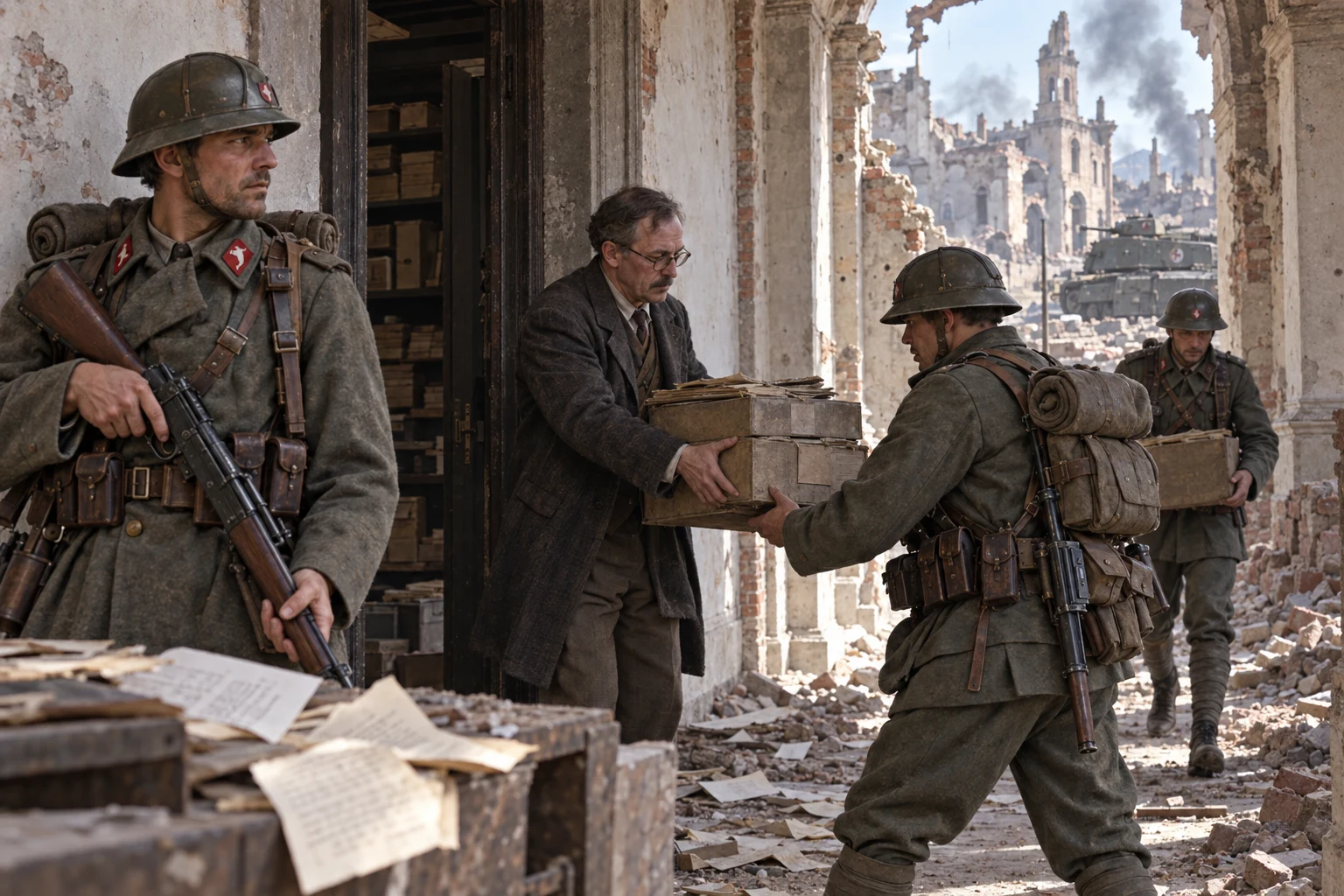
The clerks selected plans for the remaining withdrawal district and sent duplicates with separate messengers. One reached Oset; the other was captured. This outcome prevents an uncomplicated celebration of informational advantage. The plans assisted Ravell's defense, and related information probably became available to Hukular. Duplication increased the chance of successful delivery while also creating another object that could fall into enemy hands. Sellen and Ren additionally recorded money in a municipal payroll drawer and transferred it to the departing civil authority rather than paying troops from it. Soldiers had unpaid claims of their own, but the choice preserved an existing obligation to municipal laborers. The payroll later helped identify evacuated workers. The importance lies in administrative continuity under severe pressure: institutions could retain commitments to civilians even while military need pressed on their remaining resources. The source establishes this choice locally, not as proof of faultless conduct throughout the defense.
The government’s route and the army’s route
The central exchange stopped working on September 15, deepening reliance on substitute circuits and couriers. Danic could still communicate with representatives outside the city while local departments increasingly learned of military decisions late. Oset advised evacuation of national leadership. The prepared air departure accommodated a small governmental party, not the army or the general population. That limitation should remain explicit when explaining political survival. Danic authorized removal of national seals, essential records and a limited staff. Departments debated which files established obligations to citizens and which might be reconstructed later; duplicate summaries departed through different means. What survived was sufficient for continued recognition of personnel, debts and claims, but did not amount to an intact administration transported effortlessly abroad. Continuity was partial and had to be assembled from the materials that escaped.
Danic departed toward Hestunia, whereas surviving field formations withdrew toward Serin. These routes express different requirements and should never be collapsed into a single national evacuation. Political authorities needed recognition and communications beyond the occupied capital. Soldiers needed a place where organized resistance could continue. Oset divided his command into rear guards and retreating groups, but some positions received orders too late. Captured parties included wounded people who could not be moved and intact groups whose exit closed. Those distinctions matter for understanding the loss of personnel. Being captured did not establish that a formation had refused withdrawal or that its members had ceased resisting. Nor did the escape of the government mean that the city's population had enjoyed a comparable choice. The final movements preserved important national functions through a defense whose human losses and unfinished evacuations remained substantial.
The limit of what capital records can prove
The surviving documents offer different windows into the city's fall. Survey plans describe physical connections, payroll establishes obligations to named workers, departure records identify those recognized by the surviving administration, and military orders describe intended movement. None alone provides a complete account of everyone who remained. A worker identified later through payroll might still have experienced uncertain protection, while a resident absent from evacuated files had not thereby ceased to hold a claim on the state. The source's archival details should therefore support continuity without being mistaken for a census of safety. This distinction is especially important in a capital whose principal offices were captured while civilians continued presenting requests in them. Government survival preserved a framework through which claims could be pursued; it did not settle the claims or place every petitioner beyond the occupying power. The battle's political afterlife rests in that unfinished responsibility as well as in the continued existence of national seals abroad.
A capital captured and a war continued
On September 19, Hukular controlled Ravessa's principal governmental district. Empty offices stood near rooms still occupied by civilian petitioners. That juxtaposition captures the distance between capturing the symbols of authority and resolving the needs that authority had administered. Residents faced new restrictions, unfamiliar officials and uncertainty over relatives. The inherited annual account for 1209 situates much of Ravell under occupation while its surviving army rebuilt in Serin. A reopened service under occupation could sustain a community while also serving requisitions or coercive administration. The capital's fall thus opened another phase of civilian vulnerability. Survival of bombardment was not equivalent to safety under the victorious army, and the continued existence of an exiled government did not provide immediate protection inside the city.
Ravessa's significance is best understood through the separation of military position, political authority and civilian continuity. Hukular won the capital; Danic preserved a governmental claim abroad; Ravell retained a field force elsewhere; municipal records helped carry obligations and identities beyond their former offices. These results coexisted rather than cancelling one another. The Chronicle's interpretation draws on the retained battle and annual accounts and does not add evacuation totals, invent the fate of missing people, or certify every administrative decision as successful. Its cross-links to the railway defense and the later defense of Pavren's capital invite comparison of recurring problems, not the assumption that all capitals fell through identical causes. Ravessa demonstrates how a major defeat could break a state's territorial center while leaving enough people, records and organized force for the struggle over its future to continue.