A front organized around reception
Serin's reception campaign extended from April 1209 to the final isolated-field fighting of February 1220. Its central problem was the maintenance of a living military network under repeated local defeats. Reception meant receiving stores, troops, displaced people and the information needed to send them onward. A formation could remain intact on paper yet become unable to fight coherently if those flows were separated. Hukular's 12th Corridor Army, under resident commander Jalen Vosk, repeatedly attacked the places where reception became distribution. Tasen Vale's defense sought to preserve a working front even as the shortest roads and most convenient facilities passed into hostile hands.
This was also a campaign with more than one national continuity at stake. Ravell's exile troops did not cease being Ravell troops because their capital had fallen in 1208. Their service within Serin's reception system connected the earlier invasion to a wider war. Serin itself retained a recognized government abroad after its field formations surrendered in February 1220. The campaign's closing capitulation therefore belongs to a military grouping exhausted and isolated on the ground. It cannot be described as the disappearance of the nation or as a surrender of its government's continuing legal identity.
Hukular's gains deserve an operational explanation. Vosk did not obtain a functioning reception district merely by taking one height, nor did repeated successes remove the need to support his own troops. His army operated within Rauk's system until the national command change of October 1, 1215, and thereafter within Soren Kast's. That transition matters because this front outlasted the promise of a short northern war. The material mechanisms of supply denial remained recognizable, but they became part of a longer strategy aimed at trained reserves, transport and the productive capacity of the opposing coalition.
Observation and the lengthening journey
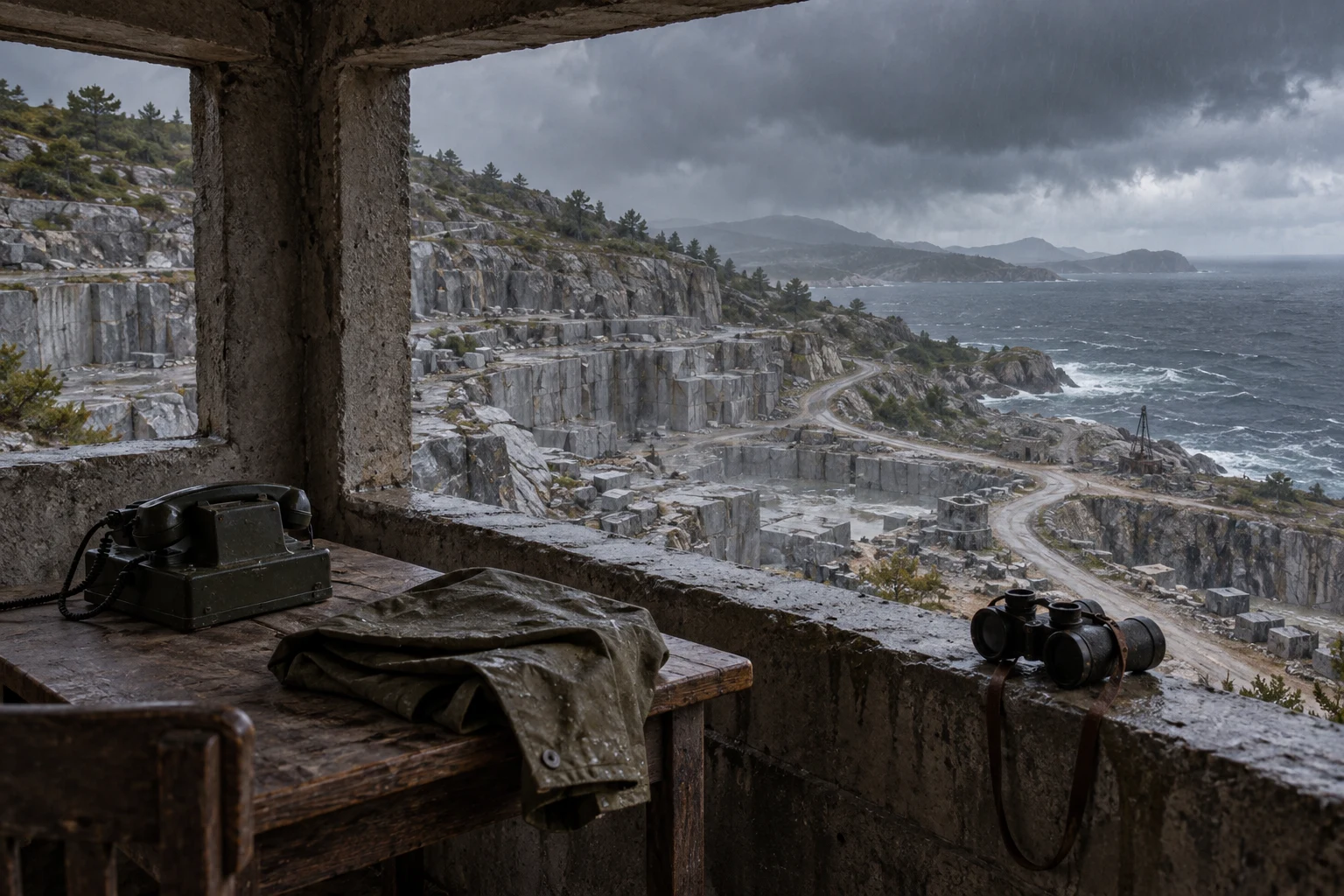
Seren Limestone Shelf in April 1209 gave Hukular a better observation line over the reception road. The shelf had to be held after a counterattack; its value depended on a shoulder over which reinforcement and supplies could reach the crest. Vale's reserve made the first occupation unstable. Vosk's revised sequence and Ilva Korr's carrying work made it durable. The battle illustrates the campaign's characteristic interaction. A defended road remained a road even under observation, but selected movements became more dangerous and more expensive. The invader's advantage lay in changing the conditions of use, not in making every vehicle below the shelf vanish.
Tolren Mill Island then became a bridge assembly position without overrunning Serin's field army. Belen Orchard Spur forced use of a longer inland route after the supply road came under fire. Dorsen Signal Farm interrupted reinforcement only after the alternate switchboard was lost. The defenders had fallback arrangements, and those arrangements worked long enough to matter. Hukular's success required identifying and defeating the alternatives as well as the obvious installation. The cumulative result was a front whose movement and communication increasingly depended on longer routes and less convenient places, even while its soldiers continued to occupy defensible ground.
Residents and Ravell families displaced by the preceding invasion shared those routes with the army. A military detour could extend a civilian journey to food or medical care beyond available vehicles, guides or endurance. At Seren, clerks kept duplicate allocation records for household and clinic provisions; concealed copies survived changes of control. Their action cannot be measured as a victory over Vosk's army. It preserved evidence of what had been intended for civilians before distribution became subordinate to the advancing command. The archive must keep that sequence visible so that efficient military observation does not become the only surviving interpretation of the road.
The reception establishment contracts
Marven Dairy Ridge in 1210 drove the defending battalions to reconstruct communications farther from their depots. Osvel Winter Farm in 1211 forced a shorter frontage after shelters and track access were lost. Lesser Darvek Bridge opened a new lower crossing for Hukular and cut the far-bank road, making the higher span's defense untenable. These were distinct tactical solutions to a common operational aim. Taking a ridge, recovering a track and bypassing a defended bridge all reduced Vale's ability to keep the receiving establishment near the field line. Each success also created new commitments for the attacker to secure and maintain.
Karven Frozen Wharf in early 1212 narrowed the remaining distribution choices when part of its stock was captured. Narev Broken Mill later removed the power channel and repair sheds, increasing the journey required for each recoverable vehicle. Marek Dren's presence in this kind of engagement reflects the importance of the repair cycle. A disabled vehicle might still exist, and an army might still list it, while the time and distance needed to make it usable denied the next battle its support. The campaign therefore operated on readiness as well as territory, steadily changing what the same nominal defending force could actually accomplish.
Valet Ferry Road in 1213 forced battalions to separate their receiving points. Solen Ridge Fork displaced the defense beyond particularly useful observation ground, and Saval Orchard Neck in 1214 lengthened withdrawal through upland tracks. These engagements did not constitute a single leap across Serin. They disaggregated the defending network. A battalion receiving supplies at one point could not automatically reinforce another whose road and messages had been cut. Vale's choices increasingly involved preserving portions of the field force at the expense of the common frontage. Such decisions demonstrate agency under worsening constraints; they do not reverse the documented victories of the attacking army.
Repairs, water and the command change
Talek Reception Quarry in September 1214 reduced the capacity to repair and redistribute heavy equipment. Melat Power Sheds in June 1215 continued the pressure on transport maintenance, forcing damaged vehicles farther from the threatened line. These attacks took place before Rauk lost national operational command. Rauk remained an adviser after October 1, 1215; he should not be restored as the field chief in later Serin battles merely because he had helped design the original military system. Kast assumed the wider command, while Vosk remained the resident operational commander of the 12th Corridor Army on this front.
Daven Lower Main in February 1216 made water distribution a military limit. Capturing the repair point forced the defenders to shorten the line their available water transport could serve. Talor Orchard Pack Road in September took both trail junctions and obliged a flank position to withdraw before its reserve food ran out. These results explain how a front could be defeated without every position being stormed to the last man. Once the means of sustaining a position had been taken, withdrawal could preserve troops who would otherwise be trapped there. That choice remained possible in some districts long after the cumulative direction of the campaign had turned against Serin.
At Neren Frozen Bank in January 1217, control of the wall and road exit brought Hukular guns nearer increasingly isolated formations. This was a forward advance enabled by previous work on the network, not evidence of unlimited firepower. Supporting weapons still needed ammunition and routes. The same logic applies to the defending guns: possession of weapons alone could not compensate for a shrinking receiving system. Kast's operational coordination could select and sustain local advantages, while Vale's command increasingly had to ration the tasks its surviving establishment could perform. The disparity grew through repeated contests rather than through a sudden loss of military will.
The last stores and the last junctions
Belven Replacement Road in May 1218 captured the detour's meeting point. Vale abandoned a larger forward grouping rather than consume the last reserves there. Replacement in this context concerns the movement and allocation of available military personnel and matériel. It is not a license to project a compulsory recruiting policy onto other nations, particularly Silvia's volunteer-only establishment. Elar Frozen Reception Yard in December then reduced winter distribution capacity. Together these defeats shortened the time for which Serin could preserve a coherent field force, because they affected both the arrival of relief and the delivery of the resources that relief needed.
Navel Upper Bread Road in April 1219 forced withdrawal from an outlying line after the gate and ditch junction fell. Velor Winter Stores in December left the isolated army with fewer food and ammunition reserves for its final crisis. These locations matter because the campaign's end had a material chronology. Hunger and shortage were not atmospheric descriptions appended to a battle story; the recorded losses of roads and stores explain the reduced alternatives available to command. The defending army still made decisions, but each decision was increasingly concerned with how long a smaller grouping could endure and how many people could be preserved before its supplies were consumed.
Teren Last Cart Junction in January 1220 completed the local isolation of a grouping already unable to replace its stocks. Varen Encirclement Shoulder in February closed a remaining military escape possibility and accepted the surrender of local formations during the field capitulation. The register thus records an operational end to this campaigning establishment. Vosk's army had secured the decisive local relationships between junctions, stores and exits. Vale's field command could no longer assemble a sustainable alternative inside the encirclement. Neither fact allows the historian to treat surrendered prisoners as anonymous freight or to excuse abuse on the grounds that the victors faced transport difficulties.
What field capitulation did not settle
The records of reception also held names that strength returns left out: families displaced from Ravell, local residents diverted from food and care, workers maintaining installations under restriction, and people waiting for information about missing kin. Copies of allocations and shelter entries preserved some of that experience. Their survival was uneven and cannot be turned into an assertion that every victim's fate was documented. They nevertheless challenge a summary written entirely from the successful army's timetable. The capture of a wharf or quarry had consequences for civilian subsistence as well as for the proportion of defending vehicles returned to service.
The twelve years between the wider war's opening and Serin's isolated-field surrender should not be compressed into a claim of instantaneous conquest. The linked register here begins in 1209 and contains twenty-three battles, including the two closing engagements of 1220. The year accounts and the major synthesis of the enclosed army provide the chronology beyond these local records. The 12th Corridor Army later redistributed formations to the Pavren corridor and occupation campaign. That redeployment followed the end of the Serin field front; it does not permit the same entire army to appear simultaneously at every later point in the war.
Serin's history consequently has two endings in this campaign account. One is the destruction of the isolated military grouping's capacity to continue organized resistance in February 1220. The other is a deliberately unfinished national story: a recognized government abroad, survivors, exile service and records of occupation remained part of the Allied war. Hukular's military victory was substantial because it removed a functioning field opponent and released forces for other tasks. Its political limitation was equally substantial. An empire could close the last cart junction and still fail to close the continuing claims of the country whose soldiers had surrendered there.