The defeat before the final battle
The final Serin campaign began on February 3, 1220, with a strategic disadvantage that maps of the immediate positions could conceal. Serin was enclosed inland. No usable harbor stood behind its remaining army, and the coalition possessed no mass airlift capable of substituting for one. Individuals and small parties had departed earlier, but those departures did not establish a means of saving the force still present. The difference explains why accounts of other Allied retreats cannot simply supply an evacuation ending to this battle. The soldiers’ problem was how long an enclosed force could maintain organized resistance and what obligations survived when it could no longer do so.
Ravell formations had continued fighting alongside Serin since the opening invasion of 1208. Their presence made the defeat an ending to a long military continuity rather than a newly isolated expedition’s sudden disaster. Years of service also accumulated physical damage. A surviving soldier might possess extraordinary local experience while lacking the endurance required for another withdrawal with equipment. Command had to preserve the distinction between a man’s commitment to resistance and his remaining capacity to perform a particular task. Counting the former as proof of the latter could turn loyalty into an unrealistic operational assumption.
Dr. Lena Oric’s medical record supplied evidence that conventional unit returns could miss. Illness, incompletely treated wounds and the absence of rest reduced the army before its final positions were lost. A nominally available formation could hold familiar shelter but fail to move the distance demanded by a plan to restore contact elsewhere. This was not a dispute between humane caution and military realism. Medical condition was part of military reality. The problem became sharper when officers measured their forces against the establishments they remembered rather than the bodies they could actually inspect.
Saret and the cooperation that remained
The Saret administrative district supported the final defensive grouping. Its significance came from the connections among command, treatment and surviving movement, not from a claim that possession of one administrative place could reverse the strategic enclosure. Serin and Ravell personnel had developed cooperative arrangements over years. Those arrangements enabled a common defense while preserving different national records and chains of responsibility. The army’s mixed identity therefore survived beyond the point at which separate national resources could sustain it independently.
For Ravell officers, continued resistance had become a visible expression of the country’s continued existence after its capital fell. Serin’s soldiers were defending their own occupied country and the institutions they could still support. Neither expectation was merely symbolic; both affected how commanders assessed withdrawal and surrender. Yet an operational judgment could not be settled by assigning greater patriotism to whichever officer favored one more attack. The relevant question was whether that attack could preserve a useful capacity to resist, and whether its risks were honestly represented to the people expected to bear them.
The shared medical system also exposed the practical limits of cooperation. Wounded from neighboring formations entered the same overcrowded station while retaining records important to different families and governments. Losing those identities would create consequences lasting well beyond a lost position. The station’s personnel were doing more than preparing statistics for a future history. A name connected a person to relatives, service, treatment and later captivity. At an army’s end, preserving that connection could be one of the last protective acts still within Allied authority.
February 3–11: A defense loses its connections
Hukular pressure initially worked by narrowing the defenders’ options. The attackers did not need to storm every surviving strongpoint simultaneously. Taking ground between positions could oblige the defense to spend its remaining reserves on movement and reconnection. Such pressure converted a succession of apparently local contests into a change in the whole army’s ability to function. A position might remain occupied while its usefulness declined because it could no longer exchange supplies, orders or patients with the rest of the force.
Serin’s local counterattacks sometimes achieved their immediate objectives. That fact matters because a defeat described as uninterrupted collapse would erase real defensive competence. It also matters that a successful counterattack consumed rested men whom the next emergency required. The relevant balance concerned what the army retained after an action, not simply whether soldiers recovered ground during it. Under enclosure, replacement of that expenditure was particularly difficult. The same force repeatedly supplied both the emergency response and the next day’s exhausted defense.
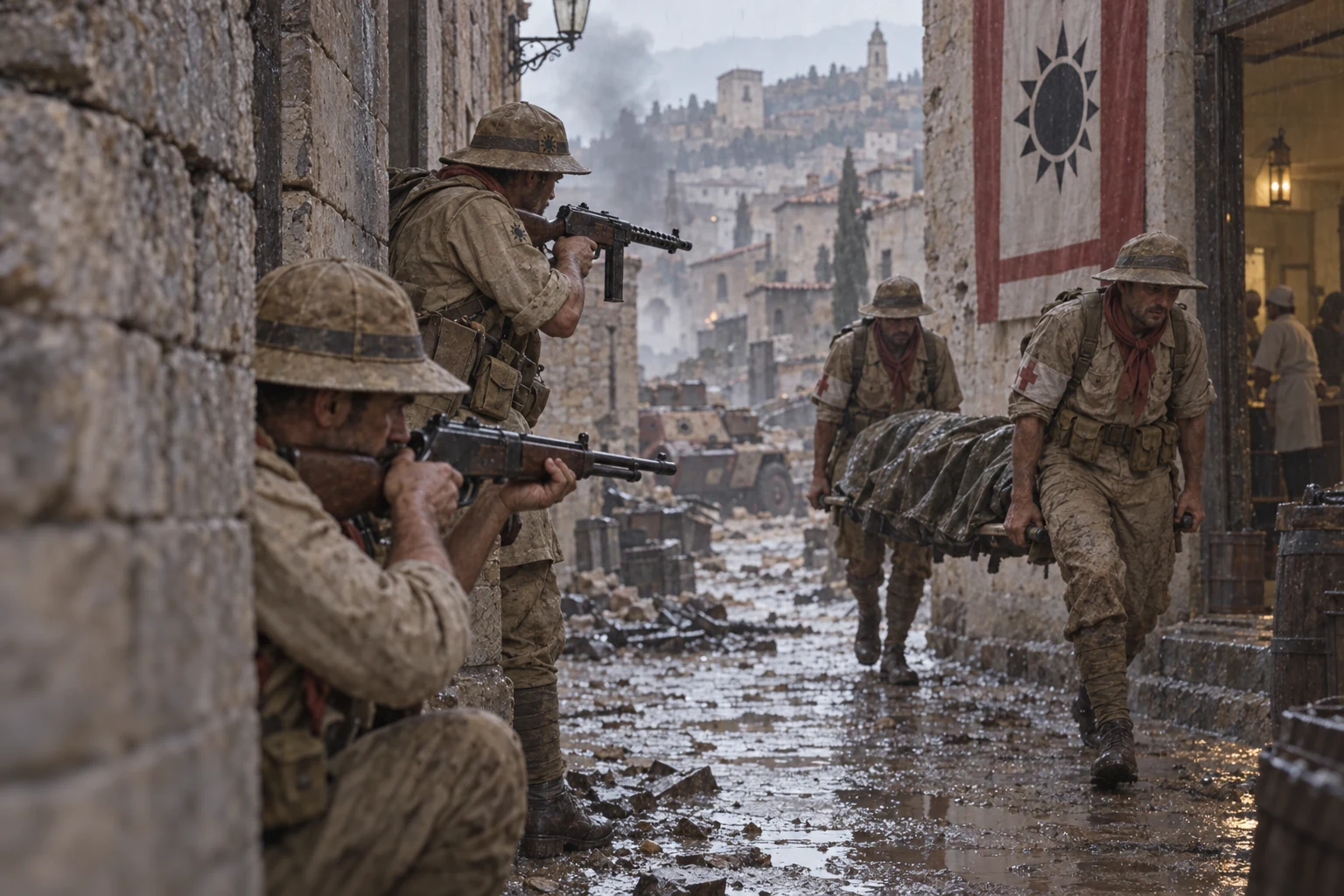
A Ravell formation’s stand at an old depot illustrates this shrinking relationship between ground and purpose. The original stores had already been distributed, but the buildings remained useful shelter and a recognizable assembling point. When neighboring positions withdrew, the formation’s continued occupation became hazardous. Its commander sought permission to leave and was ordered to cover a medical movement first. Holding therefore served a specific surviving purpose. It was neither an attempt to pretend the depot still contained strategic stores nor a reason to sacrifice the formation indefinitely to the prestige of its name.
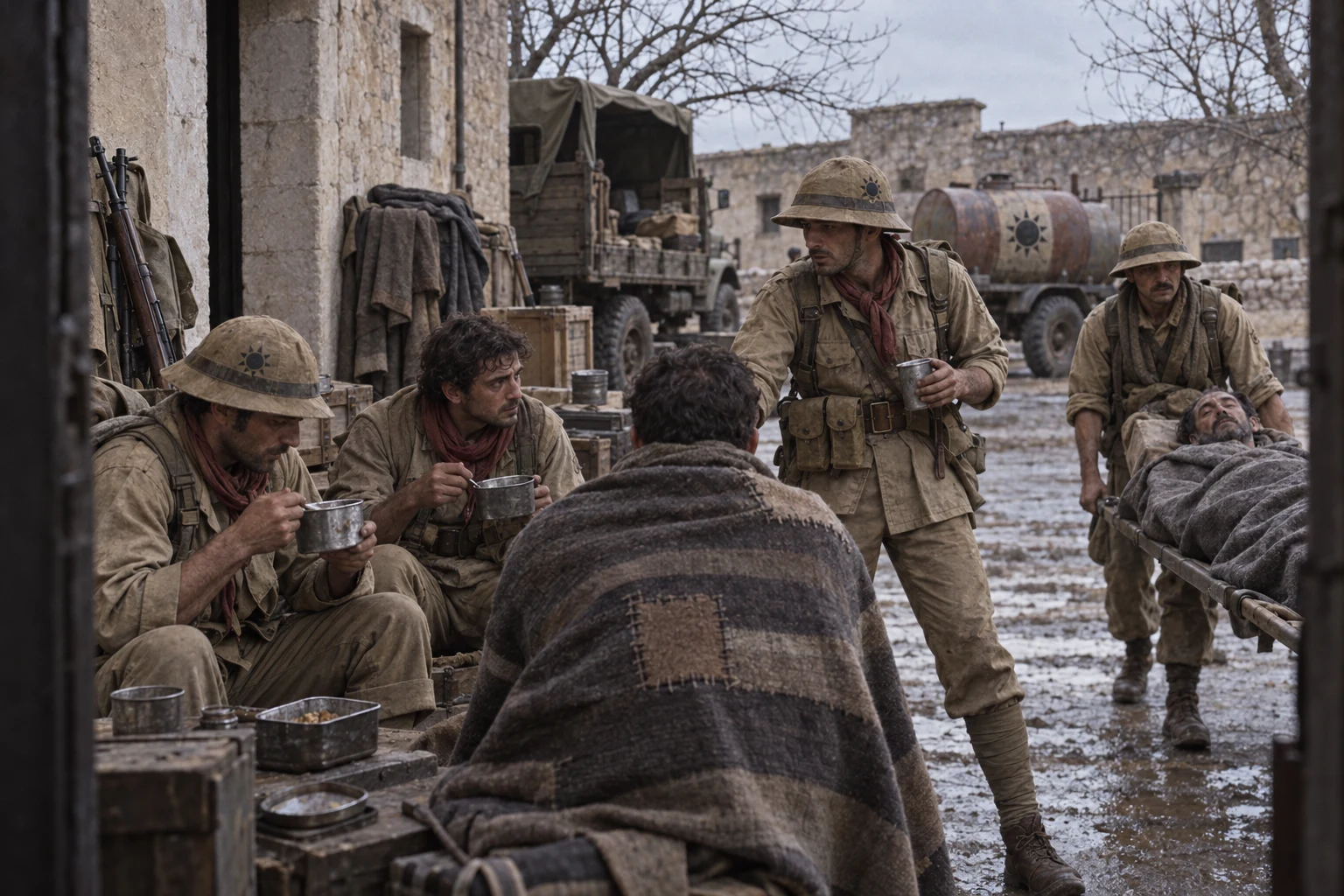
The men eventually withdrew carrying wounded from the depot and the covered road. Their arrival increased pressure on Oric’s station, where administrative furniture gave way to mattresses and whatever treatment remained possible. Each movement redistributed scarcity: leaving a threatened position saved some people while placing greater demands on those receiving them. To understand the battle’s human cost, the evacuation within the pocket must be followed as carefully as the attacks that made it necessary. Reaching another Allied position did not automatically restore safety, transport or care.
February 12–21: The disputed effort
Commanders then debated a limited attempt to reconnect separated groups. The argument cannot fairly be reduced to hope against despair. Supporters recognized that continued separation made the loss of organized resistance more likely. Opponents questioned whether the operation’s force existed in the condition assumed by its plan. Both assessments concerned a real danger. A command decision had to choose among worsening alternatives rather than compare a risky action with a secure course that remained available.
The effort briefly restored contact but failed to create a connection the army could use regularly. Friendly men could see one another without exchanging the movement necessary to sustain a coherent front. That distinction explains why the operation’s limited achievement did not refute those who doubted its feasibility. Contact was an event; a working connection required repeated movement despite enemy pressure, fatigue and inadequate transport. A history that reports the first without testing the second can make the later surrender appear to have followed an opportunity the defenders actually lacked.
The return of parties unable to carry all the wounded added another measure of the army’s depletion. Their inability did not mean an absence of willingness to rescue comrades. Carrying required strength, time and usable movement that determination could not reproduce indefinitely. These failures belonged in the command assessment because the next proposed operation would depend on the same personnel and resources. Ignoring them would make the most committed survivors carry the burden of repeated plans whose assumptions their condition no longer supported.
Reports reaching headquarters also reflected the incentives of impending defeat. Some officers understated shortage because continued official capability seemed the only means of obtaining aid. Others reported accurately and feared that accuracy would identify them as responsible for collapse. Comparing their statements with Oric’s evidence and the visible condition of arrivals helped expose the problem. The comparison did not supply a precise formula for surrender. It supplied a less distorted account of what another effort would require and whom it would endanger.
Patients become a responsibility in captivity
The negotiations included a medical annex identifying treatment sites, patients unable to move, attendants and stocks necessary to continue care through transfer. This was an important exercise of agency by people whose army was losing the power to protect them. Oric helped define obligations in terms receiving officers could not legitimately replace with an undifferentiated number of sick prisoners. The annex could not compel humane conduct in every location. Its practical and evidentiary value depended on preserving particular commitments against which later events could be examined.
Captain Mira Sellen’s appearance on the final Saret roll connected the surrender to Ravell’s earlier history. She had survived the capital battle in 1208 and subsequent service before a February leg injury made further marching impossible. Correcting her missing status established that she entered custody wounded rather than disappearing at an unknown stage of the campaign. The correction eventually reached the government abroad; her family still waited months. The episode gives a measure of continuity without pretending that wartime administration conveyed every answer promptly.
Oric retained a duplicate patient list through captivity inside a document cover. Its later use after liberation demonstrates why evidence preservation mattered before there was any assurance of accountability. The duplicate helped establish deaths, transfers and survivors missing from camp records. It did not settle every case and should not be presented as an instrument that recovered all the missing. Its achievement was narrower and more credible: some individuals could be traced because a record survived outside the single official chain on which their captors controlled the next entries.
Prisoner abuse and criminal occupation make these documentary choices consequential without requiring a description of violence as spectacle. The people entering custody had obligations owed to them regardless of whether their units remained militarily useful. Named records could later help demonstrate a failure to fulfill those obligations. Responsibility still required connecting conduct and authority through evidence. An army’s surrender created no moral permission to neglect patients or erase prisoners, and medical annexes were not waivers of protections the captives already possessed.
February 22–27: Ending a field command
The final negotiations concerned surviving field forces and those immediately dependent upon them. They did not transfer the political allegiance of Serin or Ravell. Serin’s government abroad and Ravell’s administration under Sera Danic remained Allied. This distinction was central to the limits of the commanders’ authority. They could order men under their control to cease resistance; they could not use the defeat to dissolve national continuity or legitimize the occupation as the whole nation’s choice.
Communications damage made the last days dangerous. Isolated troops heard rumors before formal instructions, while sporadic fighting continued. Movement begun on an assumed ceasefire could expose men to fire or be interpreted as a new military action. Commanders therefore had to communicate terms through a system already weakened by the battle that produced them. The process was part of the defeat’s cost. A decision at headquarters did not end danger everywhere at the moment it was made.
The field capitulation took effect on February 27. Most coherent Serin defenses and surviving Ravell formations were captured or disarmed. There was no mass evacuation concealed behind the surrender and no sudden harbor invented to make the ending more consoling. Oric stayed with patients during the transfer. The defenders’ remaining capacity to act lay partly in care, identification and maintaining distinctions among the people entering custody, even though those acts could no longer prevent the loss of the field army.
What the enclosed army left to the coalition
Hukular achieved the removal of an enduring center of organized resistance. The result increased its occupied territory and prisoner population while reducing the Allied coalition’s available field strength in this area. Recognizing that operational success is necessary to understand the revised war’s long Axis ascendancy. Recognition does not validate invasion, occupation or abuse. The broader responsibilities of imperial rule remained distinct from the immediate skill by which attacks deprived the defenders of connections and viable options.
For the Allied governments, the surrender changed their work rather than ending it. They now had to represent soldiers they could no longer command in the field and civilians whose own institutions operated under occupation. The medical annex and surviving rolls supplied pieces of that representation. The archive should follow those records into later liberation and accounting, while distinguishing the original battle’s evidence from conclusions reached after additional records became available. The people named at Saret were not merely symbols waiting to decorate a future victory.
This battle consequently belongs beside both the early Ravell capital defense and later campaigns of recovery. Its importance lies in a long resistance reaching the limit of what an enclosed army could do, then preserving some forms of responsibility after military control was lost. February 1220 should remain a genuine defeat in the chronology. Allied ultimate victory did not retroactively give these defenders the evacuation, strength or supplies absent when their commanders had to decide.
The outcome also clarifies how strength should be carried into the annual chronology. Captured and disarmed formations no longer belonged in active national forces simply because their names survived in exile correspondence. At the same time, their removal from an active return did not make the prisoners cease to be members of their nations or eliminate the governments’ obligations toward them. Military availability, institutional identity and human responsibility followed different rules. Conflating them would either exaggerate surviving Allied field power or obscure the people whose captivity became part of the war’s continuing history.
The source does not provide a reliable numerical return for every position in the final pocket. This synthesis therefore measures depletion through its recorded effects rather than manufacturing precision: units unable to march as assumed, parties unable to carry all wounded, and connections restored only briefly. Those observations explain the operational limits without assigning an invented strength to the army. They also preserve the difference between evidence that an institution was exhausted and speculation about exactly how many additional days a particular unit could have resisted under circumstances that never occurred.