Proposed canon. Dates, tactical sequences and local positions are newly developed unless the text explicitly identifies a creator or source anchor. Related images document the wider war; they are not photographs of this proposed battle.
Strategic objective
The Viar Allies seek coordinated pressure that prevents Axis reserves from concentrating against one threatened national front. The purpose is to recover operational freedom while retaining separate national commands.
Ground & operational constraints
Several disconnected fronts and transport systems make synchronization difficult. Neutral Braskor, Valmyr and Seradune are not assigned offensive roles.
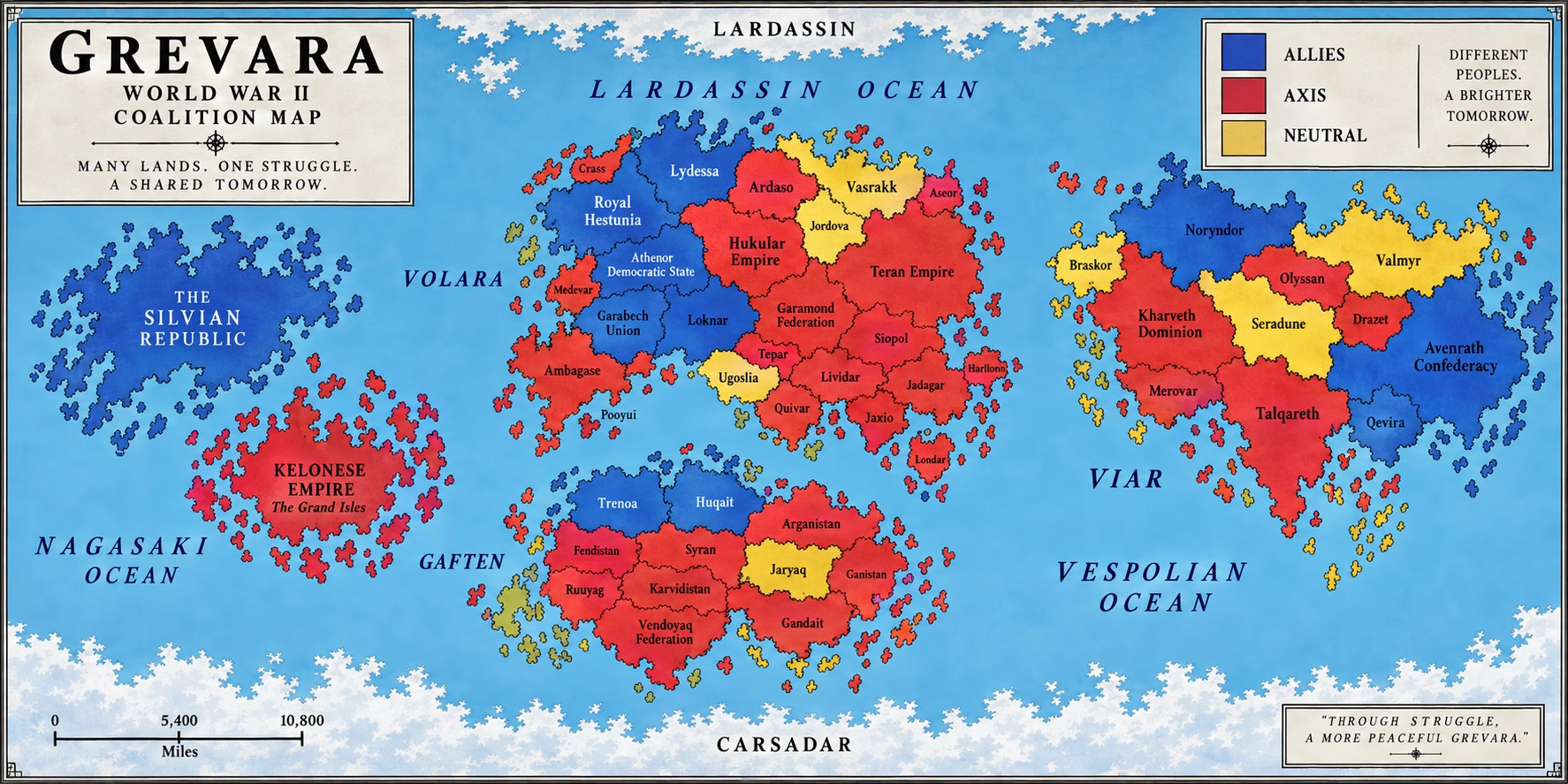
● Axis ● Allied ● Neutral · Zoom reveals cities, engagements and local positions. Drag to pan; use +/− or Ctrl+scroll to zoom. Hold over a marker for 5 seconds; click, tap or press Enter for immediate details.
Battle reference table
| Reference | Record |
|---|---|
| Dates | 1226-03-16 — 1226-11-30 |
| Participants | Avenrath Confederacy; Noryndor; Qevira; Kharveth Dominion; Olyssan; Drazet; Merovar; Talgareth |
| Scale | Major |
| Status | Proposed canon |
Commands & participating forces
Named operational commanders and supporting force groupings below are proposed additions unless explicitly marked creator-established. They are not a recovered order of battle or a claim of precise unit strength.
| Nation | Commander | Status | Forces |
|---|---|---|---|
| Avenrath Confederacy | Selan Avrek | Proposed operational commander | Provincial infantry contingents, a confederate artillery pool and a centrally controlled reserve defend crossings under common traffic and engineer coordination. |
| Noryndor | Evan Norren | Proposed operational commander | District field formations protect mobilization centers with reserve infantry, railway services and a dispersed repair organization; survivors later operate through Allied support. |
| Qevira | Qeren Valis | Proposed operational commander | Compact infantry defenses, coastal transport detachments and local relief services preserve a reduced state and later support resistance networks. |
| Kharveth Dominion | Varek Khorr | Proposed operational commander | Operational columns combine mechanized advance guards, infantry follow-up, heavy guns and occupation detachments; repair and rail control enable sustained advance. |
| Olyssan | Orven Lysar | Proposed operational commander | Northern infantry groups, artillery concentrations and reconnaissance forces seek to fix reserves for coordinated coalition attacks. |
| Drazet | Drazan Merik | Proposed operational commander | Armored and infantry groups depend on bridging parks, recovery units and protected crossing throughput to exploit river lodgments. |
| Merovar | Meren Ovar | Proposed operational commander | Cantonal infantry brigades work with federal engineers, artillery and transport services under a renewable common command mandate. |
| Talgareth | Talven Rusk | Proposed operational commander | Infantry columns, road-repair services and occupation security sustain the southern Viar offensive while stretching a limited transport pool. |
Fighting, tactics & logistics
Planning begins with a practical disagreement: Avenrath can support a larger effort than the reorganized Noryndorian forces, while Qevira faces its own southern commitments. A common calendar therefore does not imply identical attacks or equal strength. The Allies define separate objectives intended to reinforce one another’s effects.
The opening operations force Kharveth, Olyssan, Drazet, Merovar and Talgareth to assess threats through different headquarters. Some Axis commanders prefer local reserves; others seek transfers across the continent. The campaign tests the speed of that coordination rather than assuming that the Axis has one perfectly unified pool of troops.
Allied progress is uneven. Where roads and receiving facilities support the effort, limited penetrations can be held. Elsewhere the offensive slows before its initial objectives are reached. Liaison staff revise priorities and make explicit which forces will pause. The proposed campaign ends with improved Allied freedom of action, not the immediate collapse of all Axis governments in Viar.
Civilian consequences
Changes in the front disrupt local authority and transport. Relief planning must include civilians in Axis-held districts rather than treating military alignment as a judgment on the population.
Outcome & wider significance
The counterstroke reduces the Axis’s ability to choose the timing and location of every major action. Its coalition is Avenrath, Noryndor and Qevira, with Merovar correctly placed on the Axis side.