Proposed canon. Dates, tactical sequences and local positions are newly developed unless the text explicitly identifies a creator or source anchor. Related images document the wider war; they are not photographs of this proposed battle.
Strategic objective
Allied commands target the transport connections that let Axis forces shift resources among Viar’s fronts. Territorial gain is useful when it changes the enemy’s ability to sustain or reinforce a sector.
Ground & operational constraints
Junctions and receiving areas form a network across different national territories. The offensive cannot assume passage through neutral central or northern states.
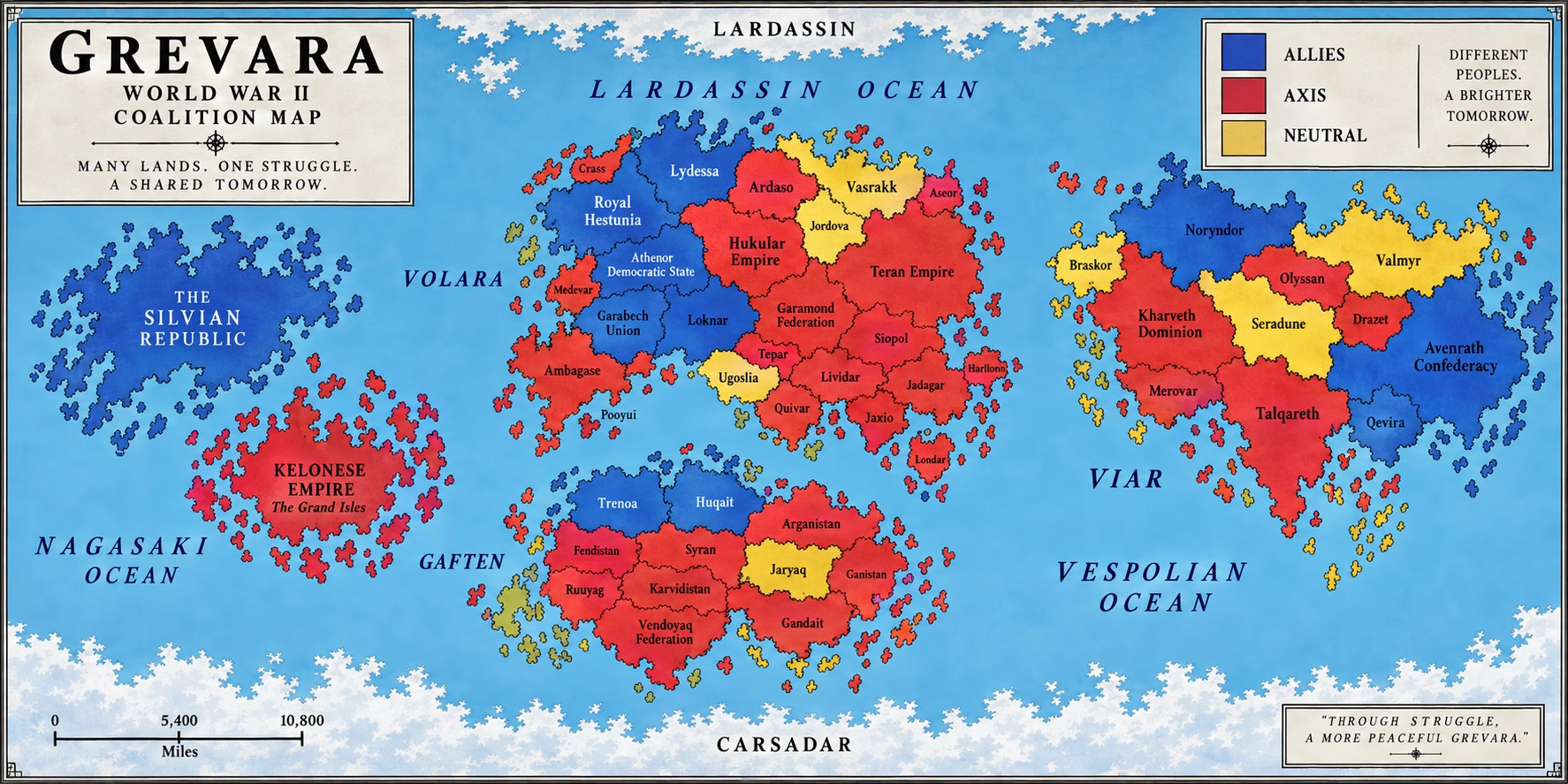
● Axis ● Allied ● Neutral · Zoom reveals cities, engagements and local positions. Drag to pan; use +/− or Ctrl+scroll to zoom. Hold over a marker for 5 seconds; click, tap or press Enter for immediate details.
Battle reference table
| Reference | Record |
|---|---|
| Dates | 1228-05-06 — 1229-01-23 |
| Participants | Avenrath Confederacy; Noryndor; Qevira; Kharveth Dominion; Olyssan; Drazet; Merovar; Talgareth |
| Scale | Major |
| Status | Proposed canon |
Commands & participating forces
Named operational commanders and supporting force groupings below are proposed additions unless explicitly marked creator-established. They are not a recovered order of battle or a claim of precise unit strength.
| Nation | Commander | Status | Forces |
|---|---|---|---|
| Avenrath Confederacy | Selan Avrek | Proposed operational commander | Provincial infantry contingents, a confederate artillery pool and a centrally controlled reserve defend crossings under common traffic and engineer coordination. |
| Noryndor | Evan Norren | Proposed operational commander | District field formations protect mobilization centers with reserve infantry, railway services and a dispersed repair organization; survivors later operate through Allied support. |
| Qevira | Qeren Valis | Proposed operational commander | Compact infantry defenses, coastal transport detachments and local relief services preserve a reduced state and later support resistance networks. |
| Kharveth Dominion | Varek Khorr | Proposed operational commander | Operational columns combine mechanized advance guards, infantry follow-up, heavy guns and occupation detachments; repair and rail control enable sustained advance. |
| Olyssan | Orven Lysar | Proposed operational commander | Northern infantry groups, artillery concentrations and reconnaissance forces seek to fix reserves for coordinated coalition attacks. |
| Drazet | Drazan Merik | Proposed operational commander | Armored and infantry groups depend on bridging parks, recovery units and protected crossing throughput to exploit river lodgments. |
| Merovar | Meren Ovar | Proposed operational commander | Cantonal infantry brigades work with federal engineers, artillery and transport services under a renewable common command mandate. |
| Talgareth | Talven Rusk | Proposed operational commander | Infantry columns, road-repair services and occupation security sustain the southern Viar offensive while stretching a limited transport pool. |
Fighting, tactics & logistics
The first stage identifies which connections serve several Axis commands and which have only local value. This prevents political pressure to liberate a prominent town from automatically defining the entire operational plan. National authorities still debate priorities because every transfer of Allied resources leaves another task waiting.
Avenrath provides the largest coordinating framework while Noryndorian and Qevira formations pursue objectives appropriate to their own positions. Axis defenders damage some facilities during withdrawal, complicating the difference between capturing a junction and using it. Engineering and traffic control become essential follow-up tasks.
The later offensive concentrates on consolidating usable connections rather than extending into unsupported salients. Allied staffs must account for remaining Axis routes through Merovar and other red states, not treat them as friendly rear areas. Local Axis resistance remains capable of delaying traffic and increasing repair demands even after the principal junction changes hands.
Civilian consequences
Rail and road damage interrupts food distribution and civilian return. The proposed history distinguishes military traffic restoration from full reconstruction of a community’s economy.
Outcome & wider significance
The Allies gain selected transport advantages that support later settlements. No exact surrender date or national collapse is inferred from a single captured junction.