Proposed canon. Dates, tactical sequences and local positions are newly developed unless the text explicitly identifies a creator or source anchor. Related images document the wider war; they are not photographs of this proposed battle.
Strategic objective
The Axis seeks to stretch Garabech’s defense by combining pressure from Medevar and Garamond with Ambagase’s southern contribution. Garabech aims to retain its receiving areas and maintain movement between threatened sectors.
Ground & operational constraints
The proposed battle centers on southern approaches, receiving points and connecting roads. Ambagase is an Axis participant under the corrected map, not an Allied rear-area provider.
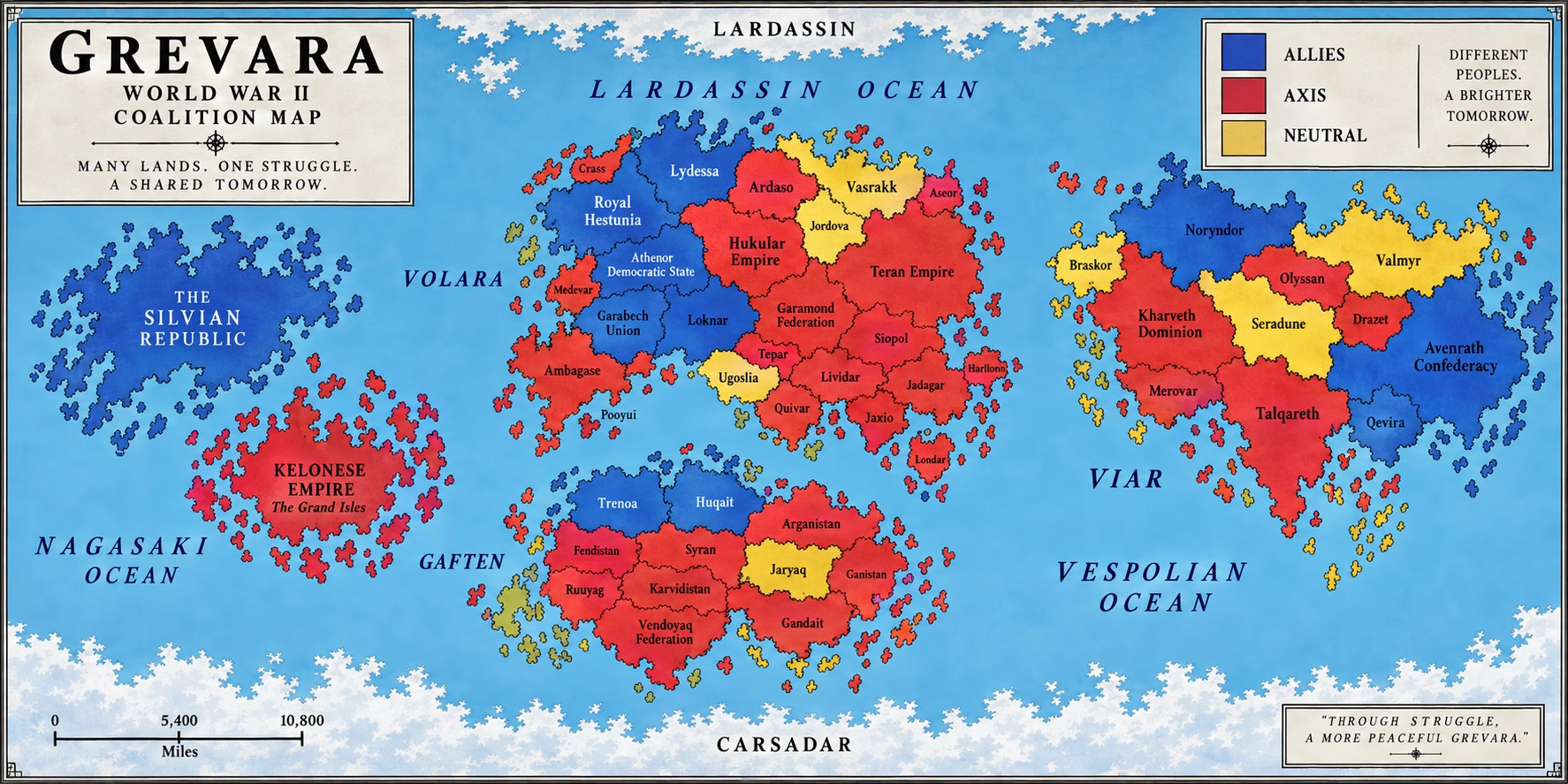
● Axis ● Allied ● Neutral · Zoom reveals cities, engagements and local positions. Drag to pan; use +/− or Ctrl+scroll to zoom. Hold over a marker for 5 seconds; click, tap or press Enter for immediate details.
Battle reference table
| Reference | Record |
|---|---|
| Dates | 1216-02-14 — 1216-11-27 |
| Participants | Medevar; Garamond Federation; Ambagasae; Garabech Union |
| Scale | Colossal |
| Status | Proposed canon |
Commands & participating forces
Named operational commanders and supporting force groupings below are proposed additions unless explicitly marked creator-established. They are not a recovered order of battle or a claim of precise unit strength.
| Nation | Commander | Status | Forces |
|---|---|---|---|
| Medevar | Alvek Sornel | Proposed operational commander | Princely infantry brigades, concentrated siege guns and a bridge-observation service attempt to isolate Garabech crossings before assault. |
| Garamond Federation | Daren Kelm | Proposed operational commander | Federally coordinated divisional groups combine member-state infantry with common artillery, transport and engineer services. |
| Ambagasae | Amren Bessa | Proposed operational commander | Coastal infantry, harbor engineers and a dispersed unloading service support the Garabech rear while defending local receiving areas. |
| Garabech Union | Tomas Verren | Proposed operational commander | Divisional infantry, corps-level artillery coordination and a dedicated crossing-repair command protect the bridge system and its approaches. |
Fighting, tactics & logistics
Garabech begins by moving emergency stocks away from the most exposed receiving areas. That protects supplies from immediate capture but lengthens the journey to the front. The Union’s transport authorities must therefore balance dispersal against the risk of starving forward units of essential cargo.
Ambagase’s Axis participation changes the southern problem. Garabech cannot rely on that neighbor to provide a safe unloading zone. Medevar presses the nearer approaches while Garamond seeks opportunities created by reserve movements. The three Axis contributions are coordinated imperfectly: their interests overlap, but their transport systems and local priorities remain distinct.
Garabech’s defense develops around maintaining at least one functioning internal connection. Engineers repair damaged road sections while local reserves cover the transfer of stores. The Union gives up some exposed positions rather than commit every formation to a continuous perimeter. Its success rests on keeping a workable defensive system intact, not on preventing every Axis advance.
Civilian consequences
Dispersal moves storage and military traffic into communities farther from the original front. Municipal authorities face billeting, road damage and arguments over compensation. The revised narrative does not assume that Axis-aligned civilians share their government’s war aims.
Outcome & wider significance
Garabech preserves a reduced but functioning southern support system. Axis pressure gains ground and imposes costs without achieving the intended separation of the Union’s defended sectors.