Proposed canon. Dates, tactical sequences and local positions are newly developed unless the text explicitly identifies a creator or source anchor. Related images document the wider war; they are not photographs of this proposed battle.
Strategic objective
Garamond concentrates to defeat Loknar's remaining conventional army. Loknar must choose between a final stand and dispersal that preserves future resistance.
Ground & operational constraints
The reduced defensive zone lacks the roads needed to shift an intact army quickly. Supply dumps become easier to locate as movement funnels into fewer valleys.
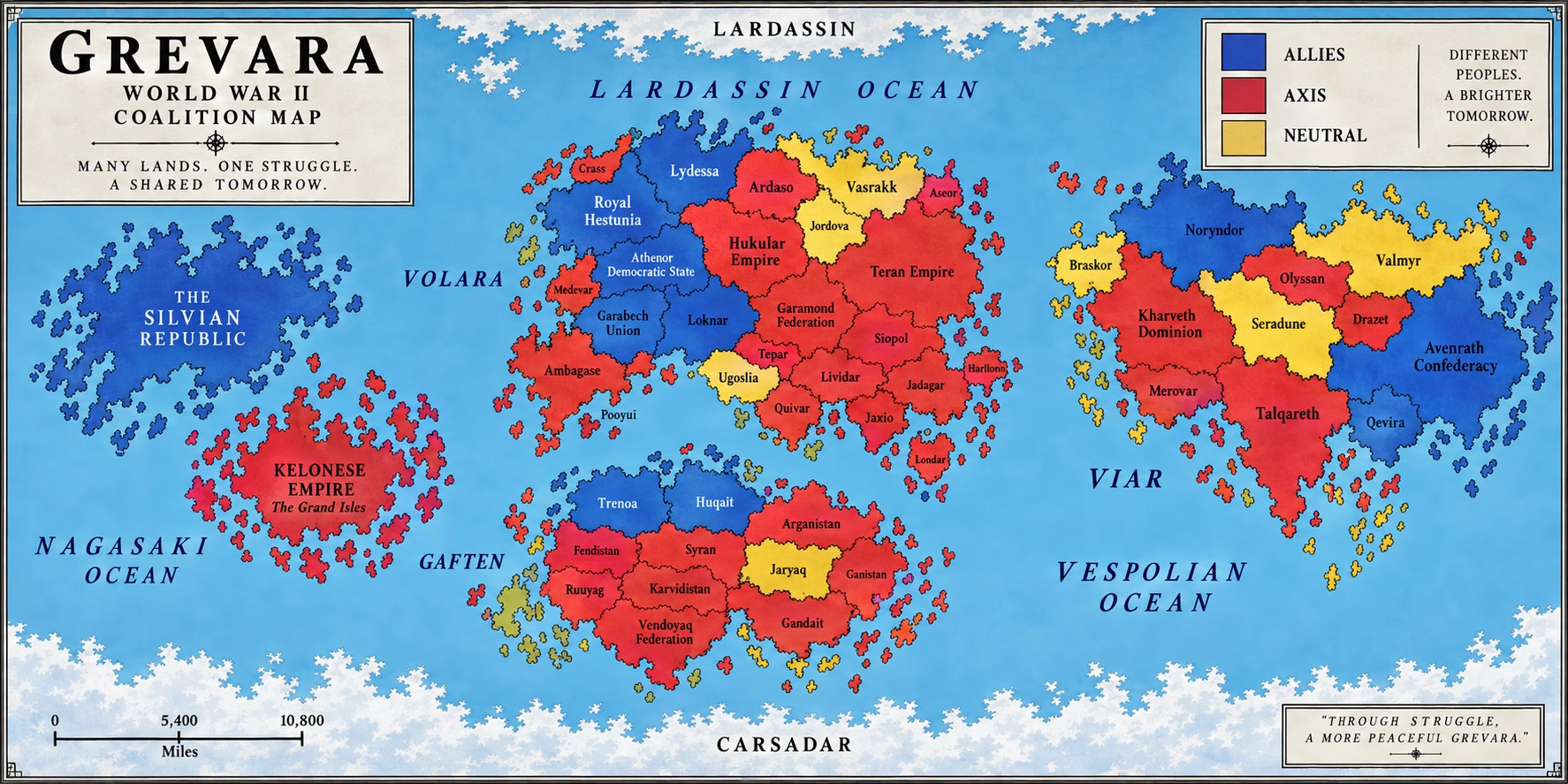
● Axis ● Allied ● Neutral · Zoom reveals cities, engagements and local positions. Drag to pan; use +/− or Ctrl+scroll to zoom. Hold over a marker for 5 seconds; click, tap or press Enter for immediate details.
Battle reference table
| Reference | Record |
|---|---|
| Dates | 1213-03-12 — 1214-02-20 |
| Participants | Garamond Federation; Loknar; Garabech Union |
| Scale | Colossal |
| Status | Proposed canon |
Commands & participating forces
Named operational commanders and supporting force groupings below are proposed additions unless explicitly marked creator-established. They are not a recovered order of battle or a claim of precise unit strength.
| Nation | Commander | Status | Forces |
|---|---|---|---|
| Garamond Federation | Daren Kelm | Proposed operational commander | Federally coordinated divisional groups combine member-state infantry with common artillery, transport and engineer services. |
| Loknar | Ruvan Talek | Proposed operational commander | Tribal contingents retain local leadership while a confederate field council assigns common objectives, reserve stores and withdrawal routes. |
| Garabech Union | Tomas Verren | Proposed operational commander | Divisional infantry, corps-level artillery coordination and a dedicated crossing-repair command protect the bridge system and its approaches. |
Fighting, tactics & logistics
Garamond methodically closes the lateral routes. Loknari commanders organize a final reserve attack to reopen one withdrawal track. It succeeds locally but cannot sustain a conventional front. Garabech receives scattered formations while other groups demobilize into clandestine networks. The field command ceases to function as a single army.
Civilian consequences
Communities face occupation searches and confiscations. Proposed resistance narratives distinguish armed groups from ordinary families struggling to survive.
Outcome & wider significance
Garamond ends the principal conventional defense, consistent with the source's broader outcome. The proposed reconstruction explains the transition to resistance without inventing a universal surrender.