Proposed canon. Dates, tactical sequences and local positions are newly developed unless the text explicitly identifies a creator or source anchor. Related images document the wider war; they are not photographs of this proposed battle.
Strategic objective
Lydessan raiders seek to delay the invading army's rail transfer.
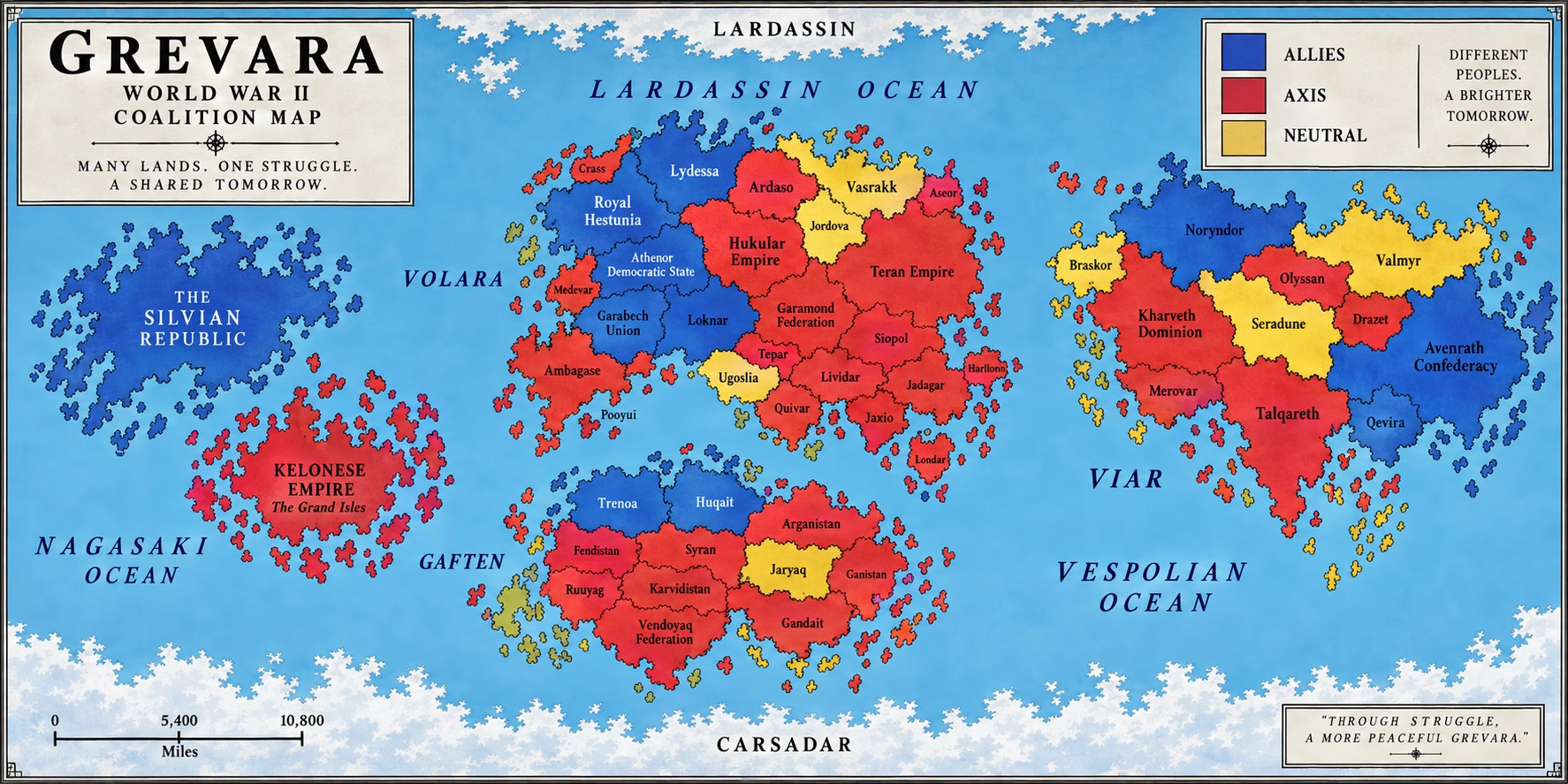
● Axis ● Allied ● Neutral · Zoom reveals cities, engagements and local positions. Drag to pan; use +/− or Ctrl+scroll to zoom. Hold over a marker for 5 seconds; click, tap or press Enter for immediate details.
Battle reference table
| Reference | Record |
|---|---|
| Dates | 1208-08-07 — 1208-08-12 |
| Participants | Tera; Ardaso; Lydessa |
| Scale | Moderate |
| Status | Proposed canon |
Fighting, tactics & logistics
The raid damages unloading equipment but fails to destroy the track junction. Ardaso repair crews restore limited service within days; Teran heavy guns arrive late enough to postpone a local attack.
Civilian consequences
Rail workers suffer losses and nearby homes are requisitioned for repair crews.
Outcome & wider significance
Ardaso repair crews restore limited service within days; Teran heavy guns arrive late enough to postpone a local attack.
Developed battle history
The battle in detail
Expanded Grevara lore: new events, characters and in-world accounts developed for this archive. Supplied historical quotations retain their source links.
An interruption behind the invasion
On 7 August 1208, three days after the Teran invasion entered Lydessa through Ardaso, General Elian Veyr authorized a raid against the Karev railhead. His defenders were already falling back toward Eastbridge. He could not remove enough troops from that defense to contest the whole invasion corridor, but he hoped a small force could delay equipment whose arrival would make the next attack harder to stop. The target was not a distant national railway system. It was the immediate transfer point at which incoming military cargo became road traffic bound for the advancing army.
Karev lay inside Ardaso, behind the troops conducting the main offensive. Its location created a political complication that Veyr understood and accepted. A raid there would strike Ardaso personnel and property as well as Teran military preparations. Ardaso’s access agreement and active support made the terminal part of the invasion, but its workforce included civilians who had little influence over the agreement. Veyr’s order consequently identified military unloading facilities as the objective and prohibited attacks on the residential quarter simply to create confusion.
Major Lysa Verr received command of the raiding force. Lysa was an experienced infantry officer, not the commander of a previously established special service. Her force was assembled from available troops, railway personnel familiar with the work and a small supporting detachment. Its greatest initial weakness was that these people had never operated together as a single unit.
What the railhead actually did
The Karev terminal joined a main railway, several sidings, loading platforms and roads leading toward the invasion staging areas. Its track junction was important, but the terminal’s usefulness depended on more than rails. Loads had to be identified, moved from wagons, assembled with their required components and directed to the correct road column. Heavy equipment could occupy scarce unloading space long after a train arrived if the receiving transport or lifting apparatus was not ready.
Captain Orven Hest, the Ardaso officer responsible for terminal security, had repeatedly requested additional guards. His problem was not simply the length of the perimeter. Trains, workers, drivers and military parties moved through different entrances at irregular intervals, making it difficult to distinguish routine congestion from a developing threat. His men guarded obvious access points while relying on terminal employees to report unusual activity within the working areas.
Teran movement officer Major Selk Arven occupied an office beside the principal platform. He controlled the priority list for military arrivals but depended on Ardaso staff to execute it. Hest and Arven disagreed over whether keeping cargo moving justified leaving some areas less tightly controlled. Each saw the other’s requirement as an obstacle to the task for which he would be held responsible.
Lysa’s briefing identified that friction as an opportunity without assuming it meant the terminal was undefended. A congested facility might react slowly, but congestion could also trap the raiders inside narrow routes. The terminal’s ordinary complexity promised openings and dangers in equal measure. Capturing a gate would not necessarily provide a clear path to the unloading machinery beyond it.
The force assembled
Lysa received two reduced infantry companies and supporting personnel, giving her a proposed strength of roughly two hundred and forty people at the beginning of the operation. Not all would enter the terminal. A covering group was assigned to protect the withdrawal, while messengers and guides maintained contact with the receiving area on the Lydessan side. The assault group was therefore smaller than the total strength in the order.
Captain Daren Pell led the first infantry company; Lieutenant Mira Soven temporarily commanded the second after its captain was wounded in the opening invasion. Pell preferred a direct attack on the nearest unloading area and an early withdrawal. Soven argued that the force needed enough time inside to identify which facilities were actually serving the delayed Teran guns. Lysa combined their proposals by setting a limited primary objective and requiring explicit authorization before extending the action.
Railway foreman Evin Nall accompanied the headquarters party. He had worked on cross-border traffic before the war and could interpret the arrangement of sidings and transfer equipment. His knowledge was useful but not current in every detail. New military stores and temporary barriers had altered the terminal since his last visit. Lysa warned the officers against treating his recollections as a complete map of the present position.
The force spent its preparation period comparing duties and withdrawal arrangements rather than pretending it could rehearse every possible encounter. Its troops were familiar with infantry fighting, but a raid through an operating railhead presented unfamiliar demands. They would have to distinguish military objectives, maintain contact among separated groups and leave before a local success drew them into a battle they lacked the strength to sustain.
The approach and the missing guide
The approach began through country already unsettled by the invasion. Civilian traffic moved away from threatened districts while military parties traveled in the opposite direction. Reports about control of individual roads changed rapidly. Lysa therefore relied on several sources of local information rather than a single guide whose knowledge might have become obsolete during the previous day.
One expected guide failed to reach the rendezvous. The absence delayed the force while officers considered whether the route had been compromised or the guide had simply been unable to travel. Lysa refused to interpret uncertainty as proof of betrayal. She selected an alternate approach recommended by Nall and sent scouts ahead to confirm its condition before committing the main body.
The scouts encountered an Ardaso patrol near a farm road. A brief exchange forced both groups into cover, and the patrol withdrew toward the terminal district. The raiders had avoided being fixed in place, but they could no longer assume that every defender remained unaware of their presence. Pell urged an immediate advance before the warning could be acted upon. Soven favored another pause to establish whether additional troops were already moving toward them.
Lysa chose to continue while reducing the distance between the leading and covering groups. The decision preserved momentum and sacrificed some concealment. It also changed the nature of the operation. The force was no longer approaching an entirely unsuspecting target. Its prospects depended on reaching the selected facilities before the defenders could translate a partial warning into a coordinated response.
The warning at Karev
Hest received the patrol’s report while the terminal was dealing with a delayed military train. The report described an armed group but offered an uncertain estimate of its size. It might be a reconnaissance party, a withdrawing Lydessan detachment or the leading element of a raid. Hest ordered the threatened entrances reinforced and requested that movement near the western sidings be restricted until the situation was clearer.
Arven objected to a general halt. Wagons were already occupying space needed for another arrival, and stopping work would produce exactly the interruption an enemy raid might seek without requiring the raiders to enter the terminal. Hest agreed to maintain essential unloading while clearing civilians from the most exposed working area. The compromise preserved activity and made the defensive arrangements harder to organize.
Several workers did not receive the instruction immediately. Others misunderstood which part of the terminal was being closed and moved into routes reserved for the arriving guards. The resulting confusion was not evidence of universal panic. It was the predictable consequence of issuing an exceptional order through a system designed for routine traffic, with different offices using different descriptions for the same places.
Hest placed his mobile reserve beside the administrative buildings, where it could move toward either the sidings or the main platform. He did not yet know which objective the approaching force would choose. His response was more substantial than Lysa hoped and less complete than he would later wish. Both commanders were acting on warnings that revealed danger without specifying its exact shape.
Contact at the western sidings
Pell’s leading troops reached the western sidings and met fire from guards positioned behind a line of stationary wagons. The wagons divided the engagement into narrow fields of view. Soldiers could hear firing close by without seeing who was involved, and officers found it difficult to judge whether neighboring groups were advancing, stopped or withdrawing.
Pell directed one platoon toward the end of the wagon line while another held the defenders’ attention. The movement encountered a second guard position near a signal cabin. That position had not been identified during the approach, and its fire halted the platoon before it could turn the original defense. Pell reported the obstruction to Lysa rather than committing his entire company to the same limited opening.
Soven’s company approached from farther south and reached a maintenance access point. Its first success opened a route toward the unloading area, but the route passed buildings whose occupants were uncertain. Soven left troops to secure the connection as she advanced, reducing the number available at the objective. The decision slowed exploitation while protecting the force against being cut off inside the terminal.
Lysa now faced the central choice of the raid: reinforce Pell to clear the western sidings or exploit Soven’s opening before Hest’s reserve closed it. She chose the opening. Pell received orders to maintain pressure and then withdraw toward the designated covering position. His fight became the action that kept part of the defense occupied while the principal effort moved elsewhere.
The unloading platform
Soven’s leading group entered the military unloading area during a period of confused movement. Some workers were still leaving, while guards attempted to establish positions around the platform. The raiders halted briefly to direct civilians away from the immediate fighting before advancing against the armed defenders. That delay reduced the speed of the assault but prevented the working crowd from being treated as an indistinguishable part of the enemy position.
The guards resisted from the far side of the platform and a nearby store building. Soven’s troops gained the nearer end after a short, intense exchange. They could see machinery and partially unloaded military cargo but could not immediately determine which items mattered most to the intended Teran gun movement. Nall reached the position with Lysa’s headquarters party and identified the transfer equipment whose loss would delay the heaviest loads.
Lysa ordered the supporting detachment to disable the selected military facilities while the infantry secured enough surrounding space for the work to proceed. The account does not require a technical description of the damage to explain its military effect. The essential point is that the raiders attacked the terminal’s ability to unload and prepare heavy equipment, rather than assuming that any visible destruction would produce an equal delay.
Hest’s reserve began arriving before the work was complete. Fire from the administrative side forced Soven to pull one group into cover and narrowed the area the raiders could use safely. The unloading platform had become a contested objective inside a defended terminal, not a facility the attackers could inspect and destroy at leisure.
A junction beyond reach
The track junction remained the more ambitious objective. If the raiders could disable it as well as the unloading equipment, the terminal’s recovery would become considerably harder. Reaching it, however, required crossing an area now covered by Hest’s reserve and by guards withdrawing from positions Pell had threatened. Lysa’s force had gained access to part of the terminal without gaining freedom to move across the whole of it.
A patrol sent to examine the approach came under fire before reaching the junction. Its leader reported that a direct movement would require a larger infantry commitment than the raiders could provide while also holding the platform and protecting their exit. Pell’s company was already disengaging from the western sidings under pressure. It could not simply be redirected as a fresh reserve.
Soven proposed one further attempt using troops still near the maintenance access point. Lysa rejected it after learning that Ardaso reinforcements had been reported on the road outside the terminal. The available time was shortening, and success at the junction would be useless if the force could not withdraw with enough cohesion to rejoin the defense of Lydessa.
The refusal later became controversial among officers who believed the raid had stopped just short of a decisive result. Lysa’s report emphasized the conditions visible at the time: an intact defending reserve, an uncertain reinforcement threat and an exit that required continued protection. The junction survived because the raiders failed to reach it. That failure must remain part of the account rather than being rewritten as a deliberate preference for the smaller objective.
The counterattack from the offices
Hest organized his counterattack from the administrative side because it offered the clearest connection between his reserve and the threatened platform. He ordered a leading group to recover the store building while another moved toward the maintenance access point. The second movement aimed to threaten the raiders’ exit and compel them to leave before they could extend the damage.
The attack against the store building met strong resistance. Soven had placed troops to cover that approach, and the guards could not cross the exposed ground without taking losses. Hest adjusted the movement rather than repeating the same advance immediately. He concentrated pressure against the maintenance route, where the raiders had fewer troops and where even a partial success could affect the whole assault group.
Lysa received reports that her exit was under attack while the supporting detachment was still working at the unloading equipment. She ordered the work stopped once the principal damage was confirmed and directed Soven to begin a staged withdrawal. The command was not received everywhere at the same moment. One group continued firing from the platform after its neighbors had started moving, then had to leave under heavier pressure.
Hest’s counterattack did not trap the force inside Karev. It did bring the raid’s working period to an end and prevent the attackers from returning toward the junction. Its success was therefore defensive and limiting rather than annihilating. The terminal had been penetrated and damaged, but the defenders retained enough organization to recover its central functions once the raiders departed.
The last party leaves the platform
Lieutenant Elra Ves commanded the final infantry party covering the withdrawal from the platform. Her troops had entered as part of Soven’s company and were now responsible for holding the position long enough for the others to move through the maintenance route. They could hear firing from that route but could not see whether it remained open.
Ves sent a messenger to establish contact and kept her group behind the platform’s remaining cover. The messenger returned with confirmation that the route was usable but under pressure. Ves divided the movement into small groups, leaving a final element to continue firing while the others crossed the exposed section near the access point. The arrangement required discipline from troops who knew they were among the last still inside the terminal.
A wounded soldier could not move without assistance. Two comrades carried him while others took over the equipment they could manage. Additional material was left behind. The choice was made under immediate pressure, not through a later calculation of what the army could afford to lose. The group reached Soven’s covering position with fewer stores and more casualties than it had carried into the platform fight.
Ves’s action did not create a separate rescue operation inside the battle register. It was the withdrawal phase of an armed raid, including the ordinary obligation to recover wounded members of the fighting force where possible. The distinction matters because the raid’s military purpose, enemy resistance and contested exit remained the defining features of the engagement.
Pell’s road fight
Pell’s company had its own difficult withdrawal. After holding the western guards in place, it moved toward the road where the covering group was waiting. The defenders followed and established fire from the end of the sidings, forcing Pell to change the route used by his rear platoon. A movement that had been planned on paper as a single withdrawal became several connected local actions.
At a bend outside the terminal, Pell encountered an Ardaso party attempting to reach the same road. The two forces exchanged fire from opposite sides of a low embankment. Neither initially knew how much support the other had nearby. Pell chose to hold the bend briefly because abandoning it would expose the route needed by Soven’s troops coming from the maintenance access point.
The covering group reinforced him, allowing the company to maintain a short defensive line while the assault parties passed through. The Ardaso troops continued pressure but did not launch a general attack against the position. Their commander was waiting for additional information from the terminal and was unwilling to commit his small force against what might be a larger enemy concentration.
That hesitation gave Lysa time to bring the separate groups together. Once Soven’s last party had passed, Pell withdrew from the bend and joined the movement toward the receiving area. His company had failed to clear the western sidings and had nevertheless performed an essential part of the raid. It occupied defenders during the assault and protected the connection that allowed the assault group to leave.
The workers return
After the raiders withdrew, terminal workers returned to a facility whose damage was uneven. Some tracks remained usable. Certain platforms could still handle ordinary loads. The equipment needed for the heaviest military unloading had suffered more serious disruption, while the intact junction offered a basis for restoring traffic sooner than Lysa had hoped.
Ardaso repair superintendent Neral Dov organized the initial survey. He separated facilities that could be used immediately from those requiring inspection and those clearly out of service. Military officers pressed for a single estimate of when the terminal would reopen. Dov resisted giving one because the answer depended on what kind of traffic they meant. A limited freight movement was possible before the heavy-gun transfer could resume at its previous pace.
The repair effort drew labor and materials from nearby settlements. Homes were requisitioned for crews working extended shifts, and families whose members had been injured in the attack faced further disruption as military priorities governed the recovery. The raid’s effects therefore reached beyond the interval of gunfire and beyond the forces that had conducted it.
Hest established a more restrictive security arrangement while repairs continued. The change reduced some vulnerabilities and slowed routine movement. Arven complained that excessive controls threatened to prolong the interruption the defenders were trying to end. Their earlier disagreement returned in a new form, shaped by the knowledge that the threat had been real and that the terminal would remain valuable enough to be attacked again.
The guns arrive late
The clearest operational consequence appeared in the movement of Teran heavy guns intended for an attack near Eastbridge. Their arrival at the forward area was delayed while the railhead restored suitable unloading arrangements and reorganized the transfer schedule. Equipment that could have moved under ordinary terminal conditions now required additional handling and waiting time.
General Varek Selden adjusted the local attack timetable rather than sending infantry forward on the assumption that the promised support would somehow arrive during the action. The postponement gave Lydessan defenders a period in which to reinforce positions, move stores and improve their arrangements around the freight approaches. It did not make the Teran guns disappear. Once the transfer resumed, they still became part of the campaign.
Veyr’s headquarters regarded the delay as sufficient to justify the raid’s immediate cost. Lysa’s officers were less unanimous. Some believed the force had spent too much strength on an interruption measured in days. Others argued that those days had mattered precisely because the defense was still forming. The disagreement reflected a common problem in assessing raids: local losses can be counted more directly than the value of an attack the enemy was forced to postpone.
The defensible conclusion is limited but concrete. Karev’s unloading damage delayed a particular movement and contributed to the postponement of a local assault. The raid did not sever the entire invasion corridor, destroy the track junction or determine the outcome of First Eastbridge by itself. Its importance lies in the additional time it created within a larger defense already relying on many such intervals.
The return to the line
The receiving officers initially expected the returning force to rejoin the Eastbridge defense as soon as it arrived. Lysa objected. Her companies had spent their available strength in different ways: Pell’s troops had endured extended contact during the approach and withdrawal, while Soven’s had fought inside the terminal and carried more of the burden of recovering wounded personnel. Treating both companies as fresh infantry because they were physically present would conceal the condition in which they had returned.
A short reorganization established who could return to duty immediately and which groups required rest, replacement equipment or medical attention. The process also identified weapons and stores lost during the withdrawal. These losses mattered even when the people assigned to them survived. A company’s ability to hold a position depended on its remaining equipment and internal organization, not simply the number of names still appearing on its roll.
Veyr granted a limited period for this work, then assigned the usable elements to positions where their experience could assist less-tested troops. Pell’s men described the difficulties of fighting through stationary railway wagons to defenders preparing the Eastbridge freight district. Soven’s officers emphasized how quickly an apparently open maintenance route could become the decisive point in a withdrawal. The transfer of those lessons was one consequence of the raid that did not appear in the terminal’s damage report.
For Nall, the return raised a different problem. He had helped identify military facilities in a terminal where he knew some of the workers personally. He could regard the raid as necessary to resist the invasion without regarding the injuries among those workers as incidental. His later account distinguished the terminal’s military use from the choices available to individual employees. That distinction preserved the raid’s strategic explanation while refusing to turn everyone on the opposing side of the tracks into the same kind of participant.
The report and the dispute
Lysa submitted her report after the force completed its return and accounting. She recorded the unloading damage as a confirmed result, the junction as an objective not reached and the enemy reinforcement reports as information whose exact accuracy remained uncertain. The distinction prevented later readers from treating every warning received during the raid as an established fact about the defender’s strength.
Pell’s accompanying account emphasized the resistance at the western sidings. Soven’s account emphasized the opportunity inside the terminal and the pressure that ended it. Neither account was complete on its own. The officers had fought in different parts of the action and had experienced different constraints. Where their reports disagreed about timing, headquarters retained the uncertainty rather than constructing a falsely precise sequence.
“We bought a pause. The men at Eastbridge had to decide what to do with it.”
— Major Lysa Verr, newly written in-world account of the Karev raid.
The statement rejected both an inflated victory claim and the suggestion that a temporary interruption had no value. A raid’s result depended partly on what the supported force could accomplish during the delay. Veyr’s defenders used the interval, but they still had to fight the attacks that followed.
Ardaso’s report reached a similarly mixed conclusion from the opposite side. Hest had failed to prevent penetration of the terminal and had succeeded in retaining its junction and recovering control. Dov’s repair crews restored limited service within days. The defender’s recovery reduced the raid’s effect without undoing the losses or making the initial security failure imaginary.
The campaign after Karev
By 12 August, the raid’s active phase had ended and its consequences were being absorbed into the wider Eastbridge campaign. The surviving raiders did not remain a permanent independent force. Personnel returned to formations that needed experienced infantry, while the railway specialists continued work on transport problems closer to the defending city. Their temporary concentration at Karev had achieved a narrow purpose and then dispersed back into the war that had produced it.
The Teran command introduced additional precautions at transfer points and required more explicit confirmation of unloading capacity before scheduling some forward movements. Those changes improved resilience at a cost in administrative effort and speed. A terminal could be made harder to raid, but not without assigning guards, controlling access and accepting that security procedures would interfere with some routine activity.
For Ardaso, the engagement made its participation in the invasion visible at home. The war was no longer only columns passing through under an access agreement. It had brought armed attackers, casualties and repair demands to a working district inside Ardaso territory. Local criticism focused variously on the raiders, the military agreement and the authorities who had promised that the corridor was secure.
The battle’s place in the archive is therefore specific. It was an armed Lydessan raid against an Ardaso railhead supporting Tera’s invasion, fought through defended sidings, a military unloading area and a contested withdrawal route. It achieved damaging interruption and failed to destroy the junction. Its temporary success belongs beside the defenders’ recovery and the civilian cost, giving the operation a complete outcome rather than a single triumphant label.