Proposed canon. Dates, tactical sequences and local positions are newly developed unless the text explicitly identifies a creator or source anchor. Related images document the wider war; they are not photographs of this proposed battle.
Strategic objective
The Teran invasion through Ardaso aims to open Lydessa's interior before mobilization can finish. Lydessa makes Eastbridge the center of its delay.
Ground & operational constraints
Approaches run from Ardaso into Lydessa, respecting the map rather than inventing a direct Teran border. Railway embankments shelter defenders but channel reserves into visible junctions.
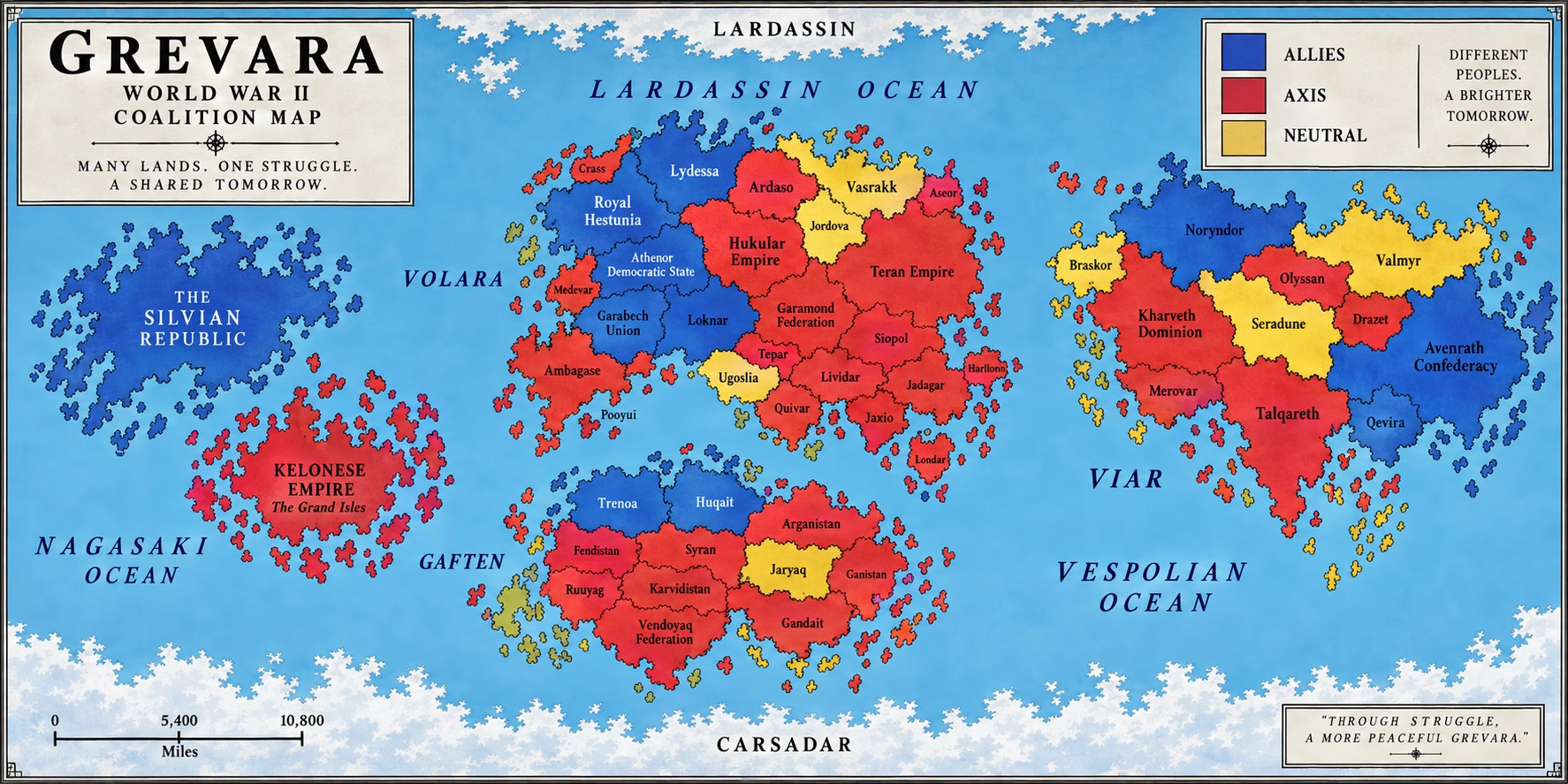
● Axis ● Allied ● Neutral · Zoom reveals cities, engagements and local positions. Drag to pan; use +/− or Ctrl+scroll to zoom. Hold over a marker for 5 seconds; click, tap or press Enter for immediate details.
Battle reference table
| Reference | Record |
|---|---|
| Dates | 1208-08-04 — 1209-03-19 |
| Participants | Tera; Ardaso; Lydessa |
| Scale | Colossal |
| Status | Proposed canon |
Commands & participating forces
Named operational commanders and supporting force groupings below are proposed additions unless explicitly marked creator-established. They are not a recovered order of battle or a claim of precise unit strength.
| Nation | Commander | Status | Forces |
|---|---|---|---|
| Tera | Edran Vesk | Proposed operational commander | Corps headquarters coordinate infantry belts, artillery and rehearsed counterattacks. The 81st Elite Corps is the creator-established opponent on the Silvian Western Line. |
| Ardaso | Keral Vos | Proposed operational commander | Rail-security troops, frontier infantry and transport detachments maintain the access system supporting Teran operations. |
| Lydessa | Maren Eldwick | Proposed operational commander | District infantry regiments and railway engineers protect successive defensive lines. Exile formations retain national records while relying on Hestunian supply. |
Fighting, tactics & logistics
Teran infantry forces the outer frontier, then pauses for bridging and ammunition. Lydessan engineers separate freight movement from troop movement, keeping one rail connection operational at night. A winter assault reaches the outskirts but is stopped by reserves released from quiet sectors. Artillery losses persuade Tera to prepare a larger siege rather than repeat unsupported attacks.
Civilian consequences
The municipality disperses food stocks among school cellars. Evacuation trains also carry machinery, creating bitter arguments over which loads receive priority.
Outcome & wider significance
Lydessan defensive success buys time, but leaves Eastbridge exposed to renewed assault. The August invasion and city's initial resistance are documented anchors; this battle division and detailed chronology are proposed.
Developed battle history
The battle in detail
Expanded Grevara lore: new events, characters and in-world accounts developed for this archive. Supplied historical quotations retain their source links.
A border crossed through Ardaso
The first fighting of the Eastbridge campaign began on 4 August 1208, when Teran columns moved from their established positions in Ardaso into Lydessan territory. The route mattered politically as well as militarily. Tera did not possess a convenient direct frontier with the region it intended to invade. Its access arrangement with Ardaso supplied the approach, the staging areas and the protected depth in which ammunition and transport could be assembled before the attack. Ardaso’s participation therefore cannot be reduced to the presence of a few supporting formations. Its territory made the invasion’s opening geometry possible.
General Varek Selden commanded the Teran advance. He expected the frontier detachments to withdraw before his main formations and hoped to turn that withdrawal into a continuous pursuit. His orders emphasized keeping contact, but his staff attached conditions that were harder to reconcile: the leading forces were also to preserve their transport, maintain communications and avoid outrunning the artillery. Each instruction was sensible in isolation. Together they required a level of control that deteriorated as soon as different columns encountered different resistance.
Lydessan General Elian Veyr had no intention of defending every frontier village to the last unit. He organized a series of delaying positions along the approaches to Eastbridge, using local detachments to identify the main enemy routes before committing the larger reserve. The decision exposed him to criticism from officials whose districts were being abandoned. It also preserved the troops needed to defend the transport junction on which the rest of the region depended. Eastbridge became the center of the defense because losing it would turn several separate retreats into one logistical crisis.
The city behind the name
Eastbridge was more than a bridge and more than a fortified line. The city joined an eastern freight yard, a river crossing, machine workshops and roads serving the surrounding agricultural districts. Its industrial buildings were not arranged for military defense. Long sheds created covered approaches in one direction and dangerous open corridors in another. Railway embankments offered protection from distant fire, but their cuttings could trap a formation whose exits came under observation.
The river divided the city unevenly. Most of the larger storage areas lay on the eastern side, while municipal offices and several residential quarters stood farther west. That distribution complicated every decision to abandon ground. Moving the front toward the river could shorten the military line while surrendering precisely the stores the defenders needed to keep fighting. Holding the outer yards protected those stores but demanded a longer perimeter and more troops.
Veyr assigned Colonel Mara Elsen to the eastern approaches and Lieutenant Colonel Davren Holt to the river sector. Their commands overlapped around the freight junction, a deliberate arrangement intended to prevent the railway from becoming an administrative boundary through which the enemy could advance. It also created arguments about responsibility. Elsen wanted the junction reserve available to reinforce the outskirts. Holt wanted it kept near the crossing in case an attack penetrated farther than expected.
The municipal engineer, Irena Voss, supplied a practical answer. She identified routes by which the reserve could move between the two sectors without entering the main freight traffic. The routes were imperfect and required local repairs, but they made the command arrangement physically possible. The defense’s first important preparation was thus neither a new trench nor a new gun position. It was a movement plan that allowed two commanders to share a reserve without assuming it could be in two places at once.
The first road position
The Teran advance first met sustained resistance at a road position outside the eastern market district. Captain Saren Pell’s Lydessan company occupied a line of stone boundary walls and a shallow rise overlooking the road. Pell had been told to delay the enemy, not to hold until surrounded. He nevertheless faced the usual uncertainty of a delaying action: leave too early and the enemy would continue without interruption; remain too long and his own withdrawal would become a fight for survival.
The leading Teran infantry probed the walls during the morning, drawing fire from several positions. Selden’s local commander then sent a supporting group along a low track south of the road. Its movement was concealed at first by orchards, but workers withdrawing from the district reported soldiers crossing a drainage ditch behind the Lydessan flank. Pell sent a section to verify the report before acting on it. The section returned under fire, confirming that the flanking movement was real.
Pell withdrew his forward platoon in stages while the rear platoon continued firing from the rise. The Terans pressed harder when they recognized the movement, and the last Lydessan group had to cross an exposed gap under fire. Several men became separated from their units and reached the city by different routes. The company therefore arrived with less cohesion than its surviving strength suggested.
The position had delayed the advance and forced the Terans to deploy, but it had not inflicted the decisive check that optimistic reports later implied. Its real contribution was time. Elsen used that time to reinforce the freight yard and move ammunition away from stores already visible from the approaching road. Pell’s survivors entered the next phase exhausted, carrying an experience of the enemy’s pressure that fresh reserves had yet to acquire.
An embankment under fire
The main railway embankment became the focus of the next Teran attack. Its height offered observation over the eastern approaches, and its sheltered side provided a route for Lydessan movement. Selden’s staff argued that taking it would expose the freight yard and force the defenders back toward the river. The attack therefore aimed at a section where a road passed beneath the railway, hoping to gain both elevation and a passage through the obstacle.
Teran artillery struck the embankment and nearby buildings before the infantry advanced. The bombardment damaged the visible defenses but also cut the road and scattered debris across the underpass. The attackers reached the approaches to the opening and found their own movement constrained by the destruction intended to assist them. Lydessan defenders fired from positions set back from the crest, exposing themselves briefly and then withdrawing below the line of observation.
A Teran company eventually gained part of the embankment. Its success created a narrow lodgment rather than a breakthrough. Men on the crest could see more of the city, but they were also visible to Lydessan positions farther inside the freight district. Reinforcements approaching the lodgment encountered fire near the damaged underpass, and ammunition had to be carried along routes that changed as shelling continued.
Elsen committed a reserve platoon against the lodgment during the evening. The counterattack failed to clear the entire crest, but it drove the attackers away from the point where they could most directly observe the yard. Both sides held parts of the railway overnight. By morning, neither could claim that possession of the embankment alone had settled the sector. The fighting had created a contested seam inside the defense, one that demanded continuous attention and consumed reserves even when no larger assault was underway.
The junction counterattack
Veyr authorized a larger counterattack to restore the junction’s eastern approaches before the Terans could consolidate. Holt objected to releasing the river reserve in full, arguing that the enemy might be using the embankment fight to draw troops away from a crossing attempt. Veyr split the reserve, sending one group to Elsen while retaining another near the bridge. The compromise reduced the weight of the counterattack but limited the consequences if his reading of the enemy plan proved wrong.
The attack began before dawn along two routes through the freight district. The northern group advanced behind warehouse walls and reached the contested railway before the defenders expected it. The southern group lost time negotiating a yard where abandoned wagons blocked the passage shown on its map. A railway foreman guided the leading section through a workshop gate, but the delay prevented the two groups from arriving together.
The northern group fought its way onto the embankment and briefly held the crest near the underpass. Without the southern group beside it, however, it came under fire from the Teran lodgment’s surviving flank. Lieutenant Nera Vald, commanding the leading platoon, pulled her men back behind a retaining wall instead of continuing toward the next position. Her decision preserved the platoon but surrendered the opportunity for a rapid exploitation.
When the southern group finally arrived, the defenders had reorganized. Fighting continued through the morning without producing the complete restoration Veyr wanted. The Lydessans secured a better line and reduced the enemy’s view of the freight yard, but they did not eliminate the threat. The counterattack’s limited result became a recurring feature of First Eastbridge: the defenders repeatedly prevented a decisive penetration while lacking the strength to turn that success into a sustained advance of their own.
The Ardaso corridor
Behind the Teran attack, the movement system through Ardaso began to show strain. Forward officers requested ammunition and replacements in quantities that bore little relation to the road capacity available on any particular day. Damaged vehicles remained near unloading points because recovery equipment had been assigned elsewhere. Empty transport returning west competed with incoming columns, and local officials protested when military traffic blocked the movement of food into towns that had not expected to become permanent staging centers.
Colonel Arel Dovan, Ardaso’s liaison officer to the Teran headquarters, insisted that the corridor could not be managed as though it belonged to a single formation. Ardaso maintained its own units, civil requirements and administrative priorities. Dovan could arrange cooperation, but he could not make every local obligation disappear because a Teran staff officer marked a request urgent. The resulting friction was not a simple failure of alliance loyalty. It was a conflict over scarce capacity inside a coalition whose members expected different things from the same roads.
Selden responded by reducing the number of separate forward delivery requests and assigning collection points for groups of formations. The change improved accountability while introducing another problem: a unit whose collection point fell behind the advance could receive its authorized cargo too late to use it. The staff gradually learned to treat delivery time as part of the requirement rather than an inconvenience to be explained afterward.
These difficulties did not stop the invasion. They changed its rhythm. The Terans could assemble strong local attacks, but sustaining pressure across every sector proved harder. Lydessan observers noticed the pauses and used them to rotate exposed units, repair communications and move stores. Eastbridge’s defense benefited not from an enemy incapable of fighting, but from an enemy whose fighting power arrived in uneven pulses.
The school cellars
The municipality’s decision to disperse food into school cellars began as a response to damage near the central stores. It soon became a political dispute. Families living beside one school could see supplies arriving while their own neighborhood distribution point remained closed. Rumors spread that the army had reserved the best stocks or that municipal officials were protecting favored districts. Clerk Sena Rell, responsible for the receiving lists, found that accurate totals did little to answer people who could not obtain food that afternoon.
Rell reorganized the lists by delivery destination rather than by the office that had issued the order. The change exposed several consignments recorded as dispatched but not yet received. Some had been delayed by fighting; others had been redirected by officers responding to urgent local needs. Neither explanation made the missing stocks available, but identifying the interruption allowed the municipality to stop promising deliveries it could not yet make.
The cellars themselves differed in suitability. One had a dry floor but a damaged entrance. Another could hold more food but lay near a road used by military transport. Voss’s engineering staff inspected them and recommended limits on loading and access. The recommendations were sometimes ignored when incoming carts needed to be cleared before the next shelling alarm, leaving later workers to correct preventable congestion.
The civilian system therefore developed under pressure rather than according to a completed plan. Its survival supported the defense because soldiers could not concentrate on their positions while receiving repeated reports that their families had no food or shelter. That relationship did not turn every civilian activity into a military operation. It showed how the battle’s endurance depended on a city continuing to perform ordinary functions in increasingly extraordinary conditions.
The argument over the evacuation trains
The remaining railway connection served incompatible demands. The army needed it for ammunition, replacement personnel and wounded soldiers. Industrial managers wanted to remove machinery that would be difficult to replace if the city fell. Families wanted seats on trains whose departures were announced and then delayed. Every group could explain why its own cargo should move first, and no timetable could satisfy all of them simultaneously.
Veyr ordered military and civilian loading to be separated where the track layout allowed. The order reduced direct interference but could not create additional rolling stock or repair a damaged section of line. At the western loading point, a train carrying machinery occupied space needed for a casualty movement. Railway officials proposed shifting it to a side track; the military transport officer warned that the side track’s exit might not remain usable after another bombardment.
The dispute ended with part of the machinery unloaded so the train could be reconfigured. The decision saved time for the casualty movement and sacrificed equipment the factory managers had spent days preparing to remove. Their anger remained justified in its own terms. A later administrative summary described the adjustment as an orderly reprioritization, a phrase that concealed the labor, distress and lost material involved.
Fighting repeatedly interrupted departures. When shells struck near a signal cabin, dispatchers used messengers to coordinate movements until a temporary connection could be established. Trains moved cautiously because an intact line was not necessarily a line whose condition had been verified. The evacuation history belongs in its own account; within the battle, the railway’s significance was that the defenders could still exchange wounded and exhausted personnel for supplies and reinforcements. Losing that exchange would have made every further day of resistance progressively more costly.
Autumn changes the approaches
As autumn rain softened the roads outside Eastbridge, the Terans found that positions useful during the opening advance were becoming difficult to supply. Guns placed on firm ground could still fire effectively, but the tracks leading to them deteriorated under repeated movement. Teams spent increasing amounts of time recovering equipment that had not been damaged by the enemy at all. Selden’s staff initially treated these delays as local inefficiency. Reports from several sectors eventually established that the problem was widespread.
The Lydessans faced the same weather from different positions. Their shorter movements inside the city were sometimes easier to organize, yet shell damage redirected water into cellars and communication trenches. A protected route could become unusable overnight, forcing troops to cross ground they had previously avoided. Voss’s repair parties worked beside infantry to reopen drains, brace damaged walls and mark passages through unstable buildings. They could not restore every route, so commanders had to decide which connections were essential to the next day’s defense.
The weather also changed observation. Mist concealed movement on some mornings and then lifted abruptly, exposing groups that had advanced under cover they assumed would last longer. Both armies learned to distinguish a temporary opportunity from a dependable condition. A commander who committed his reserve because visibility was poor could find it caught in the open when the air cleared.
During this period the battle became less a sequence of sweeping moves than a contest over whether local gains could be maintained. A captured outbuilding mattered if it improved observation or protected a route. It mattered less if its occupants could not be supplied or relieved. The map of positions changed only slightly while the practical value of those positions changed from day to day.
A crossing threatened
Selden attempted to widen the battle by threatening a crossing north of the city. The movement was not initially large enough to carry the whole invasion forward. Its purpose was to compel Veyr to divide his reserve, weakening the eastern defense before another assault. A Teran detachment approached the northern bank under cover of scattered firing elsewhere, bringing material for a limited crossing and establishing positions to support it.
Lydessan patrols reported unusual activity, but the first descriptions were ambiguous. Movement near water could indicate reconnaissance, preparation for an attack, or an effort to draw attention. Holt sent an experienced officer to assess the reports rather than immediately transferring the main reserve. The officer observed material being brought toward the bank and confirmed that the activity exceeded a routine patrol.
Holt then moved a company north, keeping the rest of his reserve inside the city. The company arrived as the Terans attempted to establish a foothold across the water. Fighting developed along the bank and around a small riverside storehouse. The attackers gained temporary shelter but could not bring enough support across to expand the position. Lydessan fire interrupted subsequent movement, leaving the forward detachment dependent on a connection that became increasingly dangerous to use.
The Terans withdrew the surviving group after dark. Their attempt had failed to establish a lasting crossing, but it had consumed Lydessan attention and ammunition. Selden regarded that diversion as useful, although it fell short of the larger effect he wanted. Veyr’s reserve remained divided for several days afterward because the defenders could not assume the threat had ended merely because the first attempt had failed.
The winter assault begins
The winter assault followed a more deliberate preparation than the attacks of August. Selden concentrated fire on selected sections of the eastern defense and reduced the number of objectives assigned to his leading formations. Instead of expecting a general collapse, he sought a breach wide enough to move supporting units through without forcing them into the same narrow approaches. The change reflected lessons learned at the embankment, where a successful leading company had become isolated because the route behind it could not sustain further movement.
The bombardment damaged several Lydessan positions and interrupted communications between the eastern sector and headquarters. Elsen’s forward reports arrived late or by indirect routes, producing a picture in which some units appeared intact after they had already withdrawn. Veyr resisted the temptation to issue a sweeping counterattack order on that incomplete information. He sent the nearest reserve to protect the freight junction while waiting for confirmation of where the Terans had actually penetrated.
The attackers entered the outer streets and gained ground around a row of workshops. Their advance was not uniform. One group moved rapidly through damaged buildings; another stopped before a defended courtyard whose exits covered the route it needed. The difference opened a gap between the attacking groups, and Elsen directed a local counterattack into that gap. The counterattack did not recover the workshops, but it prevented the more advanced group from turning freely toward the junction.
By evening, the Terans had reached the outskirts in greater strength than before. The Lydessans still held the connections that made the city defensible. Both headquarters recognized that the following day would matter more than the first day’s territorial totals. Selden needed to reinforce his gains before they became exposed lodgments. Veyr needed to restore a coherent line before separate local withdrawals combined into a larger retreat.
The reserve from the quiet sector
The troops that checked the winter penetration came partly from a sector that had seen little fighting during the previous weeks. Their commander, Major Teren Alv, objected when ordered to leave only a thin screen behind. He had spent that period improving his own defenses and regarded their strength as the reason the enemy had not attacked. Removing his troops seemed to invite the very pressure his preparations had prevented.
Veyr accepted the risk because the immediate threat at the junction outweighed the possibility of an attack elsewhere. Alv’s formation moved through the city by routes that had been inspected during earlier preparations, but damage forced several changes. A company arriving first was directed toward a workshop block whose name differed between military and municipal maps. The resulting confusion was resolved by a local guide, costing time that neither headquarters recorded accurately afterward.
Alv deployed his troops in depth rather than pushing them all into the first counterattack. The leading company engaged the Terans at the workshop exits while a second occupied positions covering the road behind it. When the first company’s advance stalled, the second could support its withdrawal instead of being trapped beside it. This arrangement produced less immediate movement on the map than a concentrated rush might have achieved, but it preserved the reserve’s ability to continue fighting.
The Terans renewed their attack and were met by a defense that had become more coherent overnight. Their leading troops still held parts of the outer district, yet each further move required them to cross ground covered from several positions. By the end of the fighting, Alv’s formation had prevented the junction’s loss. It had not made Eastbridge secure. The quiet sector it had left remained thinly held, and the reserve itself was no longer fresh enough to answer another crisis without relief.
The guns that could not be replaced quickly
Artillery losses weighed heavily on Selden’s next decision. The issue was not simply the number of weapons destroyed. Some guns had damaged carriages or fittings; others remained serviceable but lacked the transport needed to move them from exposed positions. Crews had been reduced by casualties and exhaustion, and replacement personnel did not always arrive with the experience required by the equipment they were assigned to operate.
The Teran command tried to maintain the appearance of a continuous fire system by moving available weapons between sectors. That practice could support an immediate attack but made the wider front harder to manage. A formation promised fire at a particular hour might discover that the battery had been reassigned to answer an urgent request elsewhere. Forward officers increasingly demanded confirmation that support was physically ready rather than merely entered into a plan.
Lydessan counterfire contributed to these losses, particularly when observers identified repeated firing positions near the damaged approaches. Yet the defenders’ own artillery system was under strain. Ammunition had to be conserved, and batteries sometimes changed position because a route was failing rather than because the enemy had located them. Neither side possessed an unlimited ability to sustain the tempo its infantry commanders desired.
Selden concluded that another immediate general assault would consume resources without providing a reliable path to the city’s capture. His staff began preparing a larger siege effort, with more deliberate ammunition accumulation and a clearer plan for supporting the advance beyond the first breach. The decision did not represent acceptance of defeat in the larger campaign. It acknowledged that First Eastbridge had exposed the limits of the invasion’s initial method.
The last counterattack of the first battle
The Lydessans attempted a final limited counterattack as the Terans reduced their immediate pressure. Elsen wanted to recover an observation position near the eastern freight approaches before the enemy could incorporate it into a stronger siege line. The objective was deliberately narrow: improve the defense’s view and remove a position from which Teran observers could monitor movement into the yard.
Pell’s rebuilt company participated alongside troops from Alv’s formation. Their experiences differed. Pell’s men remembered the frontier withdrawals and the difficulty of breaking contact under pressure. Alv’s men had recently stopped a penetration and were more confident that a coordinated attack could recover ground. Elsen’s briefing emphasized the withdrawal arrangements as carefully as the advance, recognizing that confidence could become dangerous if the limited objective was mistaken for the beginning of a general pursuit.
The attack reached the observation position after fighting through a line of damaged sheds. The Teran defenders withdrew from the forward post but maintained fire from a second position beyond it. Lydessan troops began preparing the captured ground while supporting elements secured the route behind them. A subsequent Teran counterattack failed to retake the post, although it prevented the defenders from extending their gain farther east.
The operation improved local observation and reduced one immediate threat to the freight movement. Its cost also confirmed that the army had little capacity for a larger offensive. Veyr ordered consolidation rather than further advance. The first battle thus ended with a small Lydessan improvement in position, not a sweeping expulsion of the invading army. The enemy remained close enough to return, and the city remained dependent on routes that could be threatened again.
What Eastbridge had bought
By 19 March 1209, the first campaign had produced a Lydessan defensive success with strict limits. Eastbridge remained in Lydessan hands. The invasion had not achieved the rapid opening of the interior that Selden’s original plan anticipated. The defenders had preserved a working, if damaged, connection between the front, the railway and the wider state. Those results bought time for mobilization and for preparations elsewhere.
The price of that time was visible in the units that had survived the battle. Companies retained their names while losing experienced leaders and reorganizing around new personnel. Workshops that continued operating did so with damaged machinery and depleted stocks. Municipal services functioned through improvisations that could not be maintained indefinitely. A defense that had endured one campaign did not automatically possess the resources to endure another of equal intensity.
“We held the junction. We did not hold the calendar still.”
— General Elian Veyr, newly written in-world reflection on First Eastbridge.
The quotation captures the distinction between tactical success and strategic postponement. The Terans had learned from the fighting and were preparing a stronger effort. Their road and supply arrangements through Ardaso had become more practiced, even as losses complicated their preparations. The Lydessans had learned as well, but learning could not replace every lost weapon or restore every exhausted formation.
The later fall of Eastbridge on 11 November 1209 therefore does not erase the first defense. It explains why the first defense must be understood as a separate engagement within a longer struggle. The city resisted the initial invasion, forced changes in the attacker’s methods and preserved Lydessan options for several crucial months. Its eventual loss belongs to the next phase. First Eastbridge’s achievement was to make that next phase necessary.