Proposed canon. Dates, tactical sequences and local positions are newly developed unless the text explicitly identifies a creator or source anchor. Related images document the wider war; they are not photographs of this proposed battle.
Strategic objective
Tera tests a raised railway approach before committing to a larger assault.
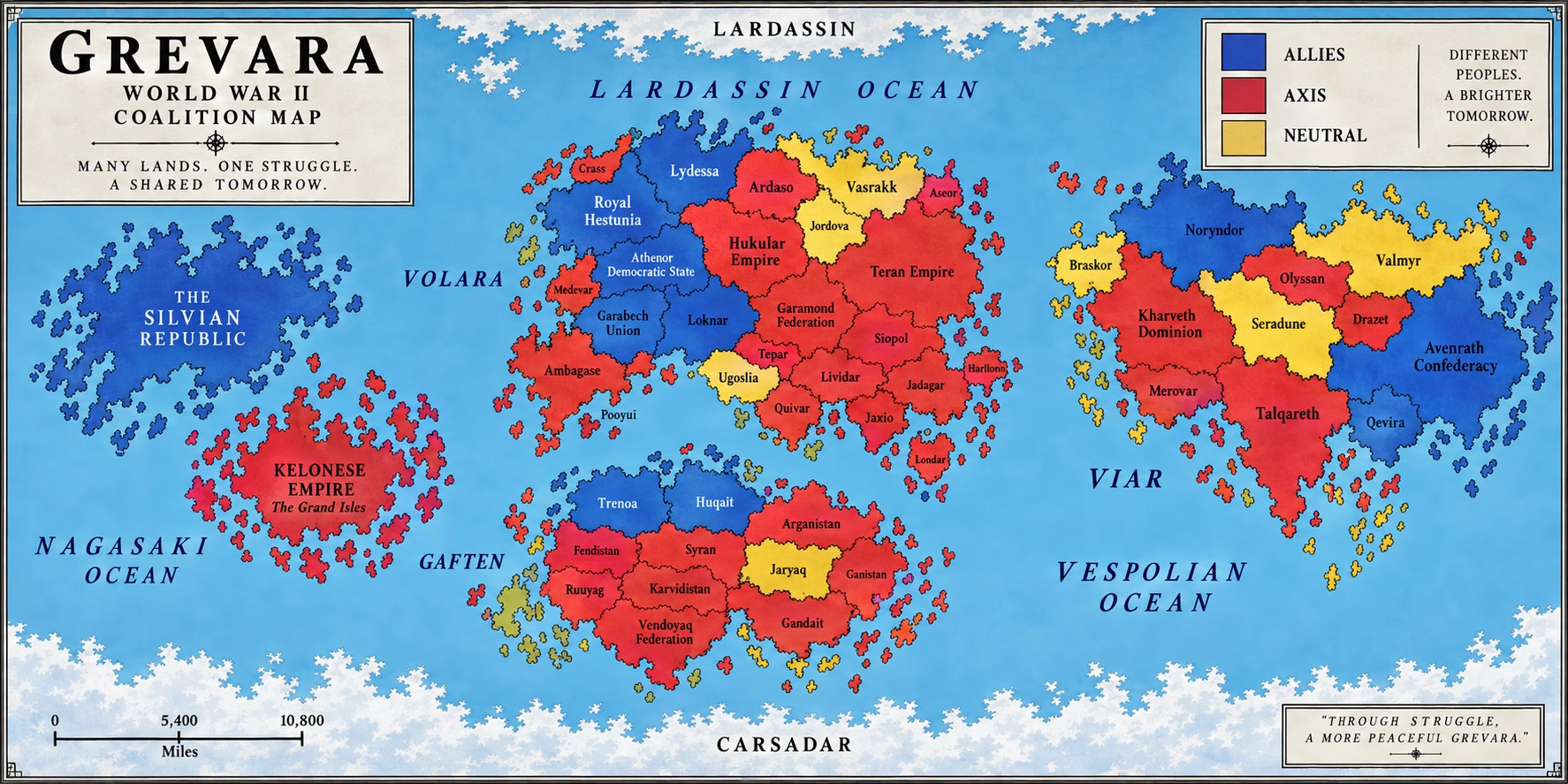
● Axis ● Allied ● Neutral · Zoom reveals cities, engagements and local positions. Drag to pan; use +/− or Ctrl+scroll to zoom. Hold over a marker for 5 seconds; click, tap or press Enter for immediate details.
Battle reference table
| Reference | Record |
|---|---|
| Dates | 1208-09-15 — 1208-09-21 |
| Participants | Tera; Lydessa |
| Scale | Moderate |
| Status | Proposed canon |
Fighting, tactics & logistics
Lydessan guns wait until assault units leave cover. The attack withdraws, but its reconnaissance identifies several firing positions later subjected to bombardment. A tactical defense therefore carries a future cost.
Civilian consequences
Families living beside the railway move into crowded municipal shelters.
Outcome & wider significance
A tactical defense therefore carries a future cost.
Developed battle history
The battle in detail
Expanded Grevara lore: new events, characters and in-world accounts developed for this archive. Supplied historical quotations retain their source links.
A reconnaissance written as an attack
The fighting of 15–21 September 1208 developed from General Varek Selden’s need to understand the defenses east of Eastbridge before committing to another larger assault. His leading formations had encountered railway embankments, damaged industrial buildings and positions that became visible only when Lydessan troops opened fire. Reports identified isolated weapons and stretches of defended ground without explaining how those positions supported one another. Selden wanted a clearer picture and was willing to order a limited attack to obtain it.
The objective assigned to Colonel Meran Vos was the outer embankment beside the eastern freight approaches. Vos was to test the line, gain a foothold if conditions allowed and report the principal sources of defensive fire. Those purposes were related but not identical. A commander concentrating on observation might avoid the losses involved in taking ground. A commander trying to seize the embankment might commit troops beyond the point at which the reconnaissance had already produced useful information. Vos’s orders left him to judge where one purpose should give way to the other.
Colonel Mara Elsen, commanding the Lydessan eastern defense, recognized that an attack might be intended to reveal her positions as much as to capture them. She could not respond by refusing to defend the embankment. Its loss would expose movement around the freight yard and make later attacks easier. Her problem was to stop the immediate advance while preserving enough uncertainty about the defense that the enemy could not prepare the next bombardment with complete confidence.
The outer bank and the cutting
The embankment rose above an approach divided by warehouse yards, drainage channels and small roads. On its outer side, the slope offered little continuous cover once troops left the last buildings. On the inner side, the ground fell toward railway working areas through which Lydessan supplies and reserves still moved. A cutting interrupted the raised line and created an obvious route through it, but the approaches to that route were visible from positions on either side.
Lieutenant Nera Vald’s platoon occupied part of the defense near the cutting. Her men had improved existing cover rather than constructing a uniform trench line. Some positions stood in damaged structures, others behind railway earthworks. Their apparent irregularity made them harder to interpret from a distance, while also making command and movement more complicated for the defenders themselves.
Elsen placed supporting weapons where they could engage the approaches without all appearing on the crest. She kept additional positions unoccupied until needed, hoping to retain options if the first line became too exposed. Those alternatives were only useful if their access routes remained open and their crews knew when to move. Preparation therefore included inspections of passages behind the embankment and arrangements for carrying ammunition between positions.
The municipal engineer Irena Voss assisted with those routes because the railway district’s civil plans contained information absent from the military sketches. A covered passage on an old drawing might be blocked by recent damage; an insignificant service lane might now be the only usable connection. The ground’s military meaning came from its current condition, not from the neatness of the map on which it was represented.
The defenders wait
Elsen ordered the forward troops to avoid revealing every position in response to the first movement. The instruction required restraint from soldiers who could see the enemy preparing beyond their effective engagement area and who knew that waiting would bring the attackers closer. Officers explained that the defense needed to act together rather than answer each uncertain sighting independently.
Vald’s men watched Teran parties move among the outer buildings during the morning of 15 September. Some activity appeared to involve observation; other movements suggested that infantry was assembling under cover. Reports passed back to Elsen through a mixture of telephone messages and runners. The overlapping channels reduced the chance of a complete communications failure but also produced duplicate reports that made the enemy seem more numerous than any single observer had established.
Elsen’s staff compared the reports by location and time before treating them as separate groups. The process took attention that might otherwise have gone to issuing orders, yet it prevented a series of uncertain sightings from becoming a false picture of several simultaneous attacks. The reserve remained near the inner road rather than moving toward every reported threat.
For the troops on the embankment, the wait was physically and mentally demanding. Men remained in cramped positions while work continued behind them, and ordinary railway noises complicated efforts to identify activity farther away. The opening of the battle was therefore not a clean transition from peace to firing. It was a period in which the defenders already lived under the expectation of an attack and had to preserve the discipline needed when it finally came.
The first advance from the sheds
Vos’s first attack emerged from the cover of a group of outer sheds. Captain Arlen Vesk led the principal infantry element, with a second group moving toward the cutting. Their orders required them to maintain contact while discovering which parts of the embankment were most strongly defended. The requirement proved difficult once the troops crossed ground broken into separate fields of view.
The Lydessans waited until the advancing groups left the protection of the buildings, then opened fire from several positions. Vesk’s leading troops sought cover in shallow folds and near damaged boundary walls. The second group came under fire before reaching the cutting and stopped short of the place from which it expected to support the main advance.
Vos received reports of resistance but initially lacked a clear account of its arrangement. Different officers described fire from the same general area in ways that made it appear to come from different positions. His observers began marking the sources they could identify, while the infantry tried to avoid remaining exposed long enough for the defenders to concentrate on one group.
The attack gained little ground. It did reveal more of the defense than earlier distant observation had shown. From Selden’s perspective that information had value; from Vesk’s position among troops unable to continue safely, the immediate result was a checked advance that needed either reinforcement or an order to withdraw. The gap between those perspectives shaped the arguments that followed.
The decision not to send the reserve
Vos considered committing his reserve to restore momentum. A local foothold might turn the attack from a costly reconnaissance into a useful territorial gain. His staff, however, could not identify a dependable route by which the reserve would reach the leading troops without crossing the same exposed ground under the same defensive fire. Additional infantry might increase the weight of the effort while doing little to solve the problem that had stopped it.
He ordered supporting fire against the positions the observers had identified and told Vesk to prepare a controlled withdrawal if the pressure did not ease. Vesk interpreted the order as permission to leave the most exposed ground while retaining small groups where they could cover the movement. Some troops withdrew before the supporting fire had its intended effect, reflecting the practical limits of synchronizing an action through delayed reports.
The Lydessans did not pursue immediately. Elsen wanted to avoid drawing her forward troops out of cover or revealing the reserve she had kept behind the embankment. She allowed limited fire against the withdrawal and instructed Vald to report any enemy group that remained close enough to renew pressure.
By the end of the first attempt, Vos had preserved his reserve and brought most of the leading infantry back to cover. He had also accepted that the attack would not gain its objective that day. The decision contained neither an uncomplicated success nor a collapse of will. It reflected his judgment that the information already obtained did not justify spending the remaining force on an approach that still appeared unfavorable.
A disputed observation
Among the reports brought back from the first attack was an identification of a Lydessan gun position near a brick workshop. One observer insisted that the weapon had fired from the building itself. Another placed it farther back, where the workshop wall could conceal movement without containing the emplacement. The distinction mattered because a bombardment aimed at the wrong point could destroy the visible structure while leaving the effective position largely untouched.
Vos sent an observation party to compare the sightlines from two locations still held by his troops. Its work did not produce complete certainty. Smoke, damaged roofs and intermittent firing complicated the view. The party concluded that the workshop was associated with the position but could not establish that the weapon stood exactly where the first report placed it.
The revised report used an area rather than a single claimed point. Selden’s staff accepted the limitation while requesting further observation before the next major attack. In later retellings, this cautious language was sometimes reduced to a statement that the Terans had located the Lydessan guns. The more accurate account is that they had narrowed some uncertainties and retained others.
On the defending side, Elsen learned that the workshop area had drawn unusual attention. She ordered its alternative positions inspected and shifted some activity away from the most visible route. The enemy’s observations therefore influenced the defense before any later bombardment occurred. Information was not a fixed possession acquired once and used unchanged; both armies continued acting while the other tried to understand them.
Night work behind the embankment
The defenders used the night after the first attack to repair communications, move ammunition and improve the positions that had been most exposed. Darkness reduced observation without eliminating danger. Teran fire continued intermittently, and workers moving through the railway district had to avoid places where sound or movement might draw attention.
Voss’s engineering parties concentrated on the passage behind Vald’s sector. Damage had narrowed it enough that men carrying loads had difficulty passing one another. The congestion mattered because the same route served supply, relief and casualty movement. A position could continue firing while becoming less sustainable with every hour that its rear connection remained obstructed.
The work did not restore the district to a tidy condition. Material removed from one passage had to be placed somewhere else, and improvements useful to the military could block access needed by remaining civilian workers. Voss kept a record of the changes so later parties would not rely on an earlier description of the routes. That modest administrative effort prevented some avoidable delays during the following fighting.
Vald rotated men through short periods away from the most exposed positions. The relief was incomplete, and many returned without adequate rest. Yet even limited rotation allowed weapons to be checked, messages clarified and the condition of individual soldiers assessed. The next attack would meet troops whose positions had improved in some respects and whose endurance had declined in others.
The cutting tested again
The second significant Teran effort focused more directly on the cutting. Vos hoped that pressure there would expose the relationship between the positions on either side and perhaps open a passage through the embankment. The approach was narrower than the first attack’s frontage, allowing closer control of the leading troops but increasing the danger that they would be stopped in a confined area.
Vesk’s company advanced after supporting fire struck the visible edges of the defense. One group reached a damaged service structure near the cutting and established a temporary firing position. From there it could threaten movement close to Vald’s sector, but it could not move freely into the inner railway district. Lydessan positions farther back still covered the route beyond the opening.
Vald requested support and adjusted her forward groups to contain the foothold. Elsen sent a small reinforcing detachment rather than the whole reserve. She judged that the enemy had gained a position from which to cause difficulty, not yet a breach requiring a general counterattack. Her choice preserved strength elsewhere while placing more responsibility on the troops already in contact.
The Terans held the service structure for several hours. Their observers used the opportunity to identify additional defensive fire, and their infantry tried unsuccessfully to widen the foothold. By evening, the position had become expensive to supply and difficult to reinforce. Vos again faced the question of whether a limited gain served his larger purpose or merely invited him to commit more troops to preserve something of diminishing value.
Vald’s counterstroke
Elsen authorized a local counterattack against the service structure once reports indicated that the Teran foothold had become isolated from dependable support. Vald coordinated the action with the reinforcing detachment, assigning one group to maintain pressure while another approached from the protected side of the cutting. The arrangement depended on the rear passage repaired during the previous night.
The first movement encountered resistance sooner than expected. Teran troops had extended their observation toward the approach, and the leading Lydessan group came under fire before reaching its intended position. Vald halted that part of the advance and used the supporting group to keep the defenders occupied while the movement was reorganized. The pause prevented the counterattack from developing at its planned speed but preserved its connection to the main line.
The renewed effort reached the edge of the service structure. Fighting there remained localized and difficult for higher headquarters to follow. Reports described progress in terms of walls, doorways and nearby track features rather than a clean movement across a map. The Teran commander inside the foothold requested assistance and received instructions to withdraw if the connection could not be held.
The surviving attackers left the structure under pressure. Vald’s troops occupied it briefly, then pulled back to positions that could be supported more reliably. Their purpose had been to remove an enemy foothold, not to create an equally exposed one of their own. The counterstroke restored the immediate defense while costing the Lydessans men, ammunition and some of the reserve strength they had hoped to preserve.
The families beside the tracks
Residents beside the railway left their homes in successive groups as the fighting approached. Some had delayed because they expected the first attack to pass or because they had nowhere prepared to go. Others returned briefly to retrieve belongings and found that military movement now controlled access to streets they had used every day.
The municipality directed families toward shelters farther inside Eastbridge. Those shelters were already receiving people displaced by earlier fighting, and the arrival of another district strained space, food distribution and the ability to keep households together. The problem was not solved simply by identifying buildings large enough to contain everyone. Water, sanitation, medical needs and information about missing relatives became immediate concerns.
Clerk Sena Rell, who was also involved in the city’s dispersed food arrangements, worked with shelter staff to record arrivals by household. The record was incomplete when people entered through different routes or moved between shelters without informing the clerks. Nevertheless, it gave the municipality a better basis for distributing supplies than estimates based only on a building’s apparent capacity.
The displacement affected the battle indirectly. Soldiers from Eastbridge sometimes learned that their families had moved without knowing where they had gone. Railway workers who remained on duty worried about homes near the firing. Commanders could not remove those concerns by declaring them outside military business. A defense fought inside a city depended on people whose obligations continued beyond the position they had been ordered to hold.
The price of answering fire
The Lydessan defense had stopped repeated advances, but each engagement disclosed information. Some weapons could be moved afterward; others depended on positions whose advantages could not easily be reproduced elsewhere. Elsen had to decide which locations to retain, which to modify and which to abandon before the Terans acted on what they had learned.
Moving everything was impossible. Alternative positions needed access, protection and a useful field of fire. Crews had to know the new arrangements, and ammunition had to reach them. A rushed displacement could exchange a known vulnerability for a position that failed its basic purpose. Elsen therefore ordered selective changes rather than a wholesale rearrangement.
Vos’s observers compared their notes with reports from the infantry. They identified several likely areas for later bombardment and distinguished positions confirmed by repeated observation from those seen only once. The resulting picture was more useful than the one Selden possessed before the engagement, but it was not a complete blueprint of the defense.
The tactical success at the embankment thus carried a future cost. Lydessan troops had demonstrated that they could hold the approach. They had also shown parts of the system by which they held it. That tradeoff could not be avoided entirely: a position that never revealed itself might remain concealed while allowing the enemy to pass. Elsen’s task was to keep the immediate defense effective and limit how much advantage its necessary exposure gave the next attack.
The damaged telephone room
One of the bombardment’s most disruptive effects came from damage near the small telephone room serving the cutting sector. The forward positions did not all lose communication at once. Some could still reach neighboring posts, while others could receive messages without being able to confirm them clearly. The uneven failure was initially harder to interpret than a complete silence because headquarters continued receiving enough traffic to assume the system was broadly intact.
Signal corporal Eren Salk compared the messages arriving by runner with those recorded in the room. He found that several instructions had been repeated without confirmation that the original recipient had received them. A reserve group had consequently remained near its assembly point while the forward officer believed it was already moving. Salk sent a messenger to resolve that specific discrepancy before attempting to restore the wider circuit.
The reserve reached the intended position later than planned, after Vald had adjusted her defense to manage without it. Its arrival still helped, but the delay illustrated the danger of treating an issued order as an accomplished movement. Elsen’s subsequent instructions required the staff to distinguish between an order sent, an order acknowledged and a movement confirmed. The distinction added work during a period when the headquarters was already overloaded, yet it reduced the chance that a missing connection would be concealed by reassuring entries in a message book.
Salk’s repair party remained near the room while intermittent fire continued. It restored a limited connection and marked the channels that still required runners. The work gave the defense a less convenient but more accurate understanding of its own communications. In the next local alarm, officers knew which reports might arrive late and assigned messengers accordingly. The improvement did not make the network secure against further damage. It made its limitations visible enough that commanders could account for them.
The bombardment after the test
Teran fire against the identified defensive areas increased after the principal infantry attempts had been checked. The bombardment did not immediately accompany another general assault. It served to damage positions, interfere with repair and test whether the defenders had moved the weapons and groups observed earlier.
Some rounds struck areas the Lydessans had already reduced or reorganized. Others damaged positions still in use and interrupted movement behind the embankment. The defenders could not infer from one ineffective concentration that the whole enemy picture was wrong. Nor could the Terans infer from every visible impact that they had destroyed the force they intended to suppress.
Vald’s sector lost part of a covered connection and had to use a less protected route until Voss’s workers could make another passage usable. The change slowed relief and ammunition movement. It also demonstrated how fire directed against the support of a position could impair the defense even when the forward troops remained in place.
Elsen resisted pressure to answer every bombardment with all available weapons. She wanted to preserve ammunition and avoid confirming positions the enemy had not yet located securely. Her restraint was unpopular among troops enduring the incoming fire, especially when they could not see the wider reasons for it. The defense’s discipline depended on officers explaining what they could without pretending that restraint made the immediate experience less dangerous.
A final probe on the flank
The last notable infantry action of the engagement occurred along a flank near the outer freight road. A Teran party advanced to determine whether the defenders had weakened that area while repairing the cutting sector. The movement was smaller than the earlier attacks and carried a more limited purpose, but it still produced a sharp fight when it encountered a Lydessan position that had been reinforced during the night.
The defenders allowed the party to approach close enough to establish that it was an armed probe rather than isolated movement among damaged buildings. Their fire forced the leading group into cover. A supporting Teran element attempted to improve its position and met resistance from farther along the road, confirming that the defense extended beyond the first point of contact.
Vos ordered the party back after receiving the report. He had enough evidence to reject an immediate exploitation on that flank and no reason to spend additional infantry proving the same conclusion through heavier losses. The withdrawal was covered from the outer buildings, and the Lydessans again declined a pursuit that might expose their own arrangement.
The action changed little ground and clarified part of the front for both sides. Elsen learned that the enemy was still examining alternatives after the main attacks failed. Vos learned that the flank did not offer the easy opening he had hoped might emerge from the defenders’ repair demands. The battle ended through the exhaustion of useful immediate options rather than a single dramatic final charge.
The officers compare their losses
Neither headquarters judged the engagement solely by the line shown on the evening map. Elsen’s officers reviewed casualties, ammunition expenditure, damaged positions and the condition of the units that had held them. A company might still occupy its assigned sector while lacking the strength to repeat the same defense without relief.
Vald emphasized the vulnerability of the connections behind the cutting. Vos’s reports from the opposite side emphasized the difficulty of supporting troops once they left the outer buildings. These assessments described the same ground from different operational positions. Each commander identified not only where fighting occurred but where his force became less able to act coherently.
The reports also contained disputes. Some Teran officers believed their infantry had been committed without enough support for an attack that was supposedly limited. Others argued that observation from a distance would never have revealed the positions the infantry exposed. On the Lydessan side, officers disagreed about whether the service structure should have been held after its recapture or abandoned as Vald had done.
Those arguments did not vanish because headquarters issued a final assessment. They influenced later orders, the allocation of reserves and the attention given to routes that had seemed secondary before the battle. The engagement’s lessons were not abstract principles discovered by everyone at once. They were contested interpretations of recent experience, carried forward by officers whose next decisions would test whether those interpretations were useful.
The embankment and the longer siege
By 21 September, the outer embankment remained part of the Lydessan defense. The Teran attacks had withdrawn, and the immediate threat of a penetration through the tested sector had been checked. Eastbridge’s defenders had preserved observation, protected the freight approaches and denied the enemy a foothold from which to press directly into the inner railway district.
The result did not leave the campaign unchanged. Selden possessed a better understanding of several defensive areas and of the difficulties his troops would encounter in approaching them. His later preparations could incorporate that information. Elsen, in turn, understood that holding the line required changes before the next assault, particularly where the recent fighting had revealed weapons, routes and reserve movements.
“We kept the bank. We had to change the defense behind it.”
— Colonel Mara Elsen, newly written in-world assessment of the September engagement.
The quotation captures why the battle belongs as a distinct account within First Eastbridge. It was neither the entire defense of the city nor an insignificant preliminary that mattered only because something larger followed. Soldiers fought repeated attacks, a foothold was gained and removed, civilians were displaced and both armies changed their plans.
Its immediate outcome was a Lydessan tactical success. Its longer effect included the exposure of positions subjected to later bombardment. Those consequences can coexist. The defenders earned the time and ground they retained, while the attackers extracted information from a failed advance. The next phase of the Eastbridge campaign would be shaped by both results, demonstrating that a battle can be won locally without making the next battle easier.