Proposed canon. Dates, tactical sequences and local positions are newly developed unless the text explicitly identifies a creator or source anchor. Related images document the wider war; they are not photographs of this proposed battle.
Strategic objective
The first major Western Line breakthrough occurs on 12 January 1227 and widens by 8 March. Lathorne must turn penetration into a corridor that supports continued operations.
Ground & operational constraints
Prepared Teran belts, damaged roads and supply congestion constrain exploitation. Exact battlefield coordinates remain uncertain, and maps show only estimated regional placement.
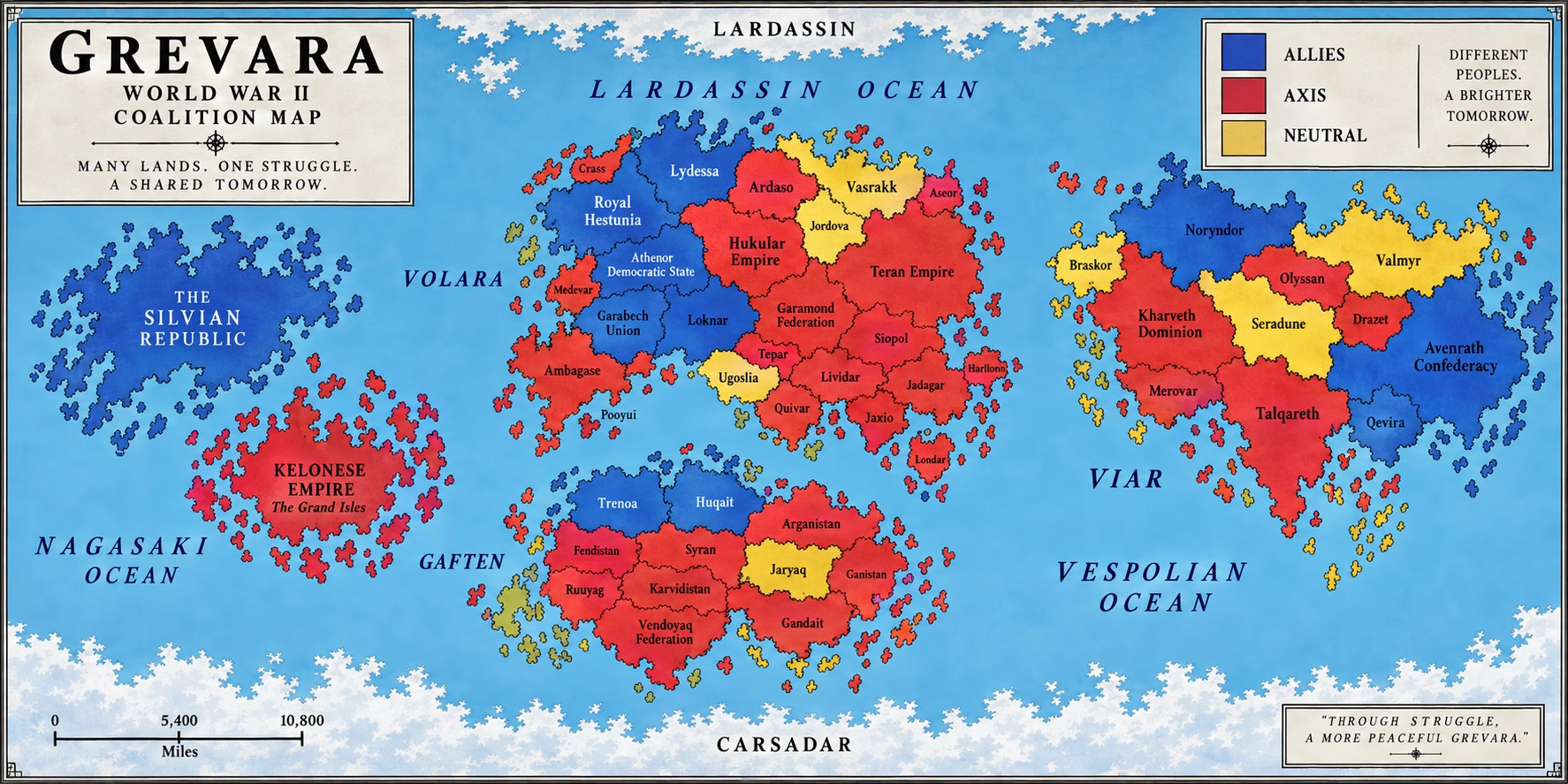
● Axis ● Allied ● Neutral · Zoom reveals cities, engagements and local positions. Drag to pan; use +/− or Ctrl+scroll to zoom. Hold over a marker for 5 seconds; click, tap or press Enter for immediate details.
Battle reference table
| Reference | Record |
|---|---|
| Dates | 1227-01-12 — 1227-03-08 |
| Participants | Silvian Republic; Tera |
| Scale | Major |
| Status | Canon + proposed detail |
Commands & participating forces
Named operational commanders and supporting force groupings below are proposed additions unless explicitly marked creator-established. They are not a recovered order of battle or a claim of precise unit strength.
| Nation | Commander | Status | Forces |
|---|---|---|---|
| Silvian Republic | High General Hujo Lathorne | Creator-established commander | Permanent divisions operate within mission-based field armies. Specialist brigades, Logistics Divisions and Security Divisions provide distinct support roles; the original formation documents govern their organization. |
| Tera | Edran Vesk | Proposed operational commander | Corps headquarters coordinate infantry belts, artillery and rehearsed counterattacks. The 81st Elite Corps is the creator-established opponent on the Silvian Western Line. |
Fighting, tactics & logistics
The dates and breakthrough are established canon. Proposed detail: artillery and engineers prepare limited lanes, infantry secures their shoulders, and mobile units advance only as traffic routes open. The Teran 81st Elite Corps conducts counterattacks and withdrawal rather than disappearing after the first rupture. The widening phase reduces dependence on the original narrow gap.
Civilian consequences
Damaged settlements contain civilians, wounded and unexploded ammunition. Relief and route clearance move at different speeds, complicating both military traffic and return.
Outcome & wider significance
A durable breach changes the Western Line's operational balance. The wider war is affected through pressure on Teran reserves and transport, not a claim that every Teran formation collapses.
Developed battle history
The battle in detail
Expanded Grevara lore: new events, characters and in-world accounts developed for this archive. Supplied historical quotations retain their source links.
The winter front before the rupture
By January 1227, the Western Line had existed for more than two years. Its opening on 3 July 1224 had created a sustained Silvian commitment against the Teran 81st Elite Corps, but the intervening campaigns had taught both commands that a local advance could be reversed. Ground won at considerable cost might become difficult to hold when roads deteriorated, supporting units fell behind or neighboring formations failed to move at the same pace.
The reconstructed sector beyond Drasten centers on a low industrial settlement called Merrow Cut, a railway embankment and several roads connecting forward positions to the rear. These are newly developed local features. They give the chapter a coherent setting without claiming to locate Drasten or the battlefield precisely on the supplied political map. The important relationship is between the defended belt and the movement system supporting it.
The Teran position is more than a row of isolated strongpoints. Forward units depend on neighboring sectors, communications routes and reserves behind them. Its strength lies partly in making an attacker solve several connected problems before a narrow gain can become a useful opening. Its vulnerability emerges when those connections cease to work together.
Lathorne’s Seventh Army has its own accumulated weaknesses. Experienced personnel are dispersed among formations, vehicles need repair, and the support network must sustain ordinary defensive duties while preparing for a larger effort. The command cannot devote every resource to the intended breakthrough without leaving other responsibilities uncovered. The approaching battle therefore begins as an argument over concentration: how much force can be assembled for one purpose without making the rest of the front too fragile?
The last reports before the attack
At Seventh Army headquarters, a fictional staff major named Edran Vale collects reports that describe the front through different professional lenses. Infantry officers report occupied positions and the condition of their units. Engineers describe usable approaches and work still unfinished. Transport staff report vehicle availability and the time required to move stores. None of these reports can stand alone as a complete assessment of readiness.
Vale’s task is to expose discrepancies before they become operational surprises. A formation may describe a route as open because infantry has used it, while engineers consider it unsuitable for the heavier traffic expected later. A supply return may record equipment dispatched even though it has not reached the receiving unit. Reconciling those statements does not produce certainty, but it prevents headquarters from treating unlike measurements as agreement.
Lathorne’s reconstructed decision is to judge the coming effort by the ability to sustain an opening, rather than by the promise of a dramatic first movement. That emphasis does not mean abandoning offensive ambition. It means recognizing that reserves, engineering and transport must be connected to the assault before a gap appears, because organizing them afterward would surrender time to the defender.
The Teran 81st Elite Corps also receives indications of increased Silvian activity. The defenders do not need perfect knowledge of the plan to prepare for pressure. Local commanders strengthen connections between threatened sectors and request clarity about reserve responsibilities. Their difficulty is deciding which reports indicate the main danger and which reflect the constant work of an active front. The battle begins with both sides making consequential decisions from incomplete but not entirely absent information.
12 January: the belt begins to separate
The established breakthrough on 12 January develops in the reconstruction as a series of linked local failures within the Teran defense. Silvian troops move beyond Drasten and contest the approaches around Merrow Cut. The first reports reaching higher headquarters do not announce that an entire defensive system has collapsed. They describe positions gained, contact lost and movement occurring where it had previously been stopped.
Captain Halen Dorr, a fictional Silvian infantry commander, reaches the edge of the settlement with a company whose neighboring units are not yet equally far forward. His immediate success creates an exposed relationship rather than a completed victory. The position offers access toward the embankment, but its value depends on whether other troops can secure the connection behind it and extend contact to either side.
Teran defenders in an adjacent sector initially continue operating according to the earlier arrangement. Their reports lag behind the changed position near Merrow Cut. When contact with a neighboring formation becomes uncertain, local officers face a dangerous choice: hold a position that may now be bypassed, or withdraw before receiving a clear account of the larger situation. Different units make that decision at different times.
This uneven response helps explain the source’s report that the 81st Elite Corps loses contact with neighboring units in several sectors. It does not imply that every Teran formation dissolves. Some withdraw toward prepared fallback positions, while others continue contesting the approaches. The opening becomes significant because those local movements no longer support one continuous defensive arrangement. The Seventh Army has an opportunity, but it still has to turn that opportunity into a corridor.
The railway embankment and the cost of going forward
Dorr’s company encounters its next difficulty at the railway embankment. The ground appears to offer a useful observation position and a connection toward the settlement’s far side, but reaching it separates forward groups from some of their support. The company’s movement becomes less a single advance than a series of efforts to maintain contact across broken buildings, damaged access points and uncertain neighboring positions.
A Teran detachment remains on ground from which it can interfere with the connection behind the company. Its continued resistance prevents the Silvians from treating the settlement as a secure passage. Dorr requests help, but the request competes with similar demands elsewhere along the opening. He cannot assume that a reserve exists solely for his sector.
The reconstructed local outcome depends on cooperation between the forward infantry and units following through the gap. Supporting troops secure part of the connection, allowing Dorr to hold a limited position instead of withdrawing from everything gained. The company does not immediately continue toward the most distant visible objective. Its leaders spend the next period reorganizing, accounting for personnel and finding a workable relationship with their neighbors.
The episode illustrates a recurring feature of the wider breakthrough. Forward movement creates new responsibilities faster than it creates new capacity. Every additional position requires communication, supplies, casualty evacuation and some means of relief. The infantry’s achievement matters precisely because the army must build those connections while the Teran defense is still reacting. A map drawn after the battle can make the result look continuous even when the people producing it experienced a succession of disconnected crises.
The 81st Elite Corps finds a new line
The reconstructed Teran response is followed through Colonel Arven Selk, a newly invented officer responsible for coordinating part of the fallback movement. Selk does not possess complete authority over the corps, nor does he know the condition of every neighboring unit. He receives fragments of surviving formations, requests for transport and reports of Silvian movement whose timing is uncertain.
His first priority is to preserve a functioning command relationship among units that have left different parts of the old belt. Some arrive with most of their equipment, others with personnel separated from vehicles and supporting weapons. Treating them as identical replacement blocks would exaggerate the strength available for an immediate response. Selk’s staff records what each element can actually do before assigning it a place in the new arrangement.
The fallback positions buy time but impose costs. Roads fill with withdrawing units and the services supporting them. Damaged equipment competes with other traffic, while stores left in exposed locations may no longer be recoverable. Decisions to abandon material become a source of dispute between officers focused on preserving combat units and officials responsible for accounting for losses.
The Teran command nevertheless restores resistance on portions of the new front. That recovery limits the depth of the Silvian advance and explains why the January rupture does not end the Western Line campaign. The 81st Elite Corps has lost the coherence of its earlier position, not all capacity for organized action. Its survival forces Lathorne to consider flank security, counterpressure and the possibility that an apparently retreating opponent is already assembling another obstacle.
Reserves and the shoulders of the opening
The source establishes that Lathorne commits reserves to widen the gap. In the developed narrative, the central debate concerns how much of that reserve should deepen the advance and how much should strengthen the shoulders of the opening. A narrow penetration can look impressive on a headquarters map while remaining vulnerable to pressure against the roads sustaining it.
Vale’s staff compares reports from the forward formations with the condition of those roads. The most distant unit is not necessarily the one best positioned to receive reinforcement. A less advanced sector with a dependable connection may offer a better foundation for widening the corridor. This produces disagreement with commanders who believe that their immediate opportunity will vanish if they are asked to wait.
Lathorne’s decision favors a supported widening rather than an unrestricted pursuit. The choice creates no guarantee of success. Reserves committed to securing one shoulder cannot simultaneously exploit every weakness farther ahead. Some Teran forces gain time to withdraw because the Seventh Army declines to chase them beyond its current ability to support the movement.
The benefit appears gradually. Better contact between sectors reduces the number of isolated forward groups, while more reliable access allows supplies and relief personnel to reach positions that would otherwise remain precarious. The breakthrough begins to acquire width in an organizational sense as well as a geographical one. The army is no longer merely pushing troops through a gap; it is establishing relationships that can survive a renewed enemy response.
The road behind the victory
Engineer officer Lieutenant Nera Halven enters the reconstruction through a road assignment that appears minor compared with the fighting beyond Drasten. Her party must restore a damaged connection between a receiving area and the developing corridor. The work becomes important because several formations have begun relying on the same approach, making every interruption affect more than one local commander.
Halven’s reports distinguish work that permits limited passage from work that will support sustained traffic. Headquarters initially hears that the road is open and begins assigning movements faster than the route can absorb them. Clarification forces the staff to revise the schedule. The problem is not deception; it is the difference between a local engineering milestone and the broader operating capacity others assume it represents.
Traffic control becomes part of the campaign. Incoming stores, returning casualty transport, replacement personnel and disabled vehicles all need access. Delays ripple forward: a unit waiting for ammunition may postpone a planned movement, while another waiting for relief remains exposed longer than intended. The road’s condition therefore influences decisions that appear on the battle map as purely tactical choices.
As the connection improves, Halven’s party is moved to another task rather than receiving a clean conclusion to its story. Maintenance continues behind it. The developed history treats engineering as repeated work across a changing network, not a single heroic repair after which the problem disappears. That continuity helps explain how the initial January rupture can remain useful long enough to support the later widening.
Civilians between the old belt and the new
The movement of the front exposes communities to changing military demands before normal administration can return. In Merrow Cut, surviving residents encounter damaged services, unfamiliar commands and uncertainty about whether the settlement will remain behind the new line. Some have already moved more than once during earlier fighting and hesitate to leave possessions that cannot easily be carried.
A fictional school administrator, Ivena Rusk, keeps a list of households using a damaged public building as temporary shelter. Her records concern food, missing relatives and the location of children, not the army’s operational objectives. Military authorities nevertheless need that information when arranging access and deciding which buildings can be used without displacing everyone inside them.
The first improvement is often access rather than restoration. A road that can carry relief allows supplies to arrive, but it does not repair homes or settle property claims. Military vehicles may damage surfaces that civilians need for their own movement. Requests for labor and materials create further strain even where residents welcome the removal of the previous occupying force.
The narrative does not attribute a single political attitude to every household. Some residents cooperate readily, some remain wary and others focus on immediate survival. Their experience belongs to the breakthrough because the new corridor passes through inhabited places rather than empty strategic space. What the army calls secured ground still contains unresolved human needs that will outlast the movement of its leading units.
From January’s rupture to March’s widening
The interval between 12 January and 8 March is not treated as a blank space filled by an inevitable advance. The source anchors establish the initial breakthrough and its later widening, but the developed history supplies a sequence of consolidation, local fighting, repair and renewed movement that makes the relationship between those dates intelligible.
During the first stage, units stabilize connections created by the January battle. The army identifies which positions can be supplied regularly and which remain exposed to interruption. Relief becomes essential because the formations that produced the opening cannot sustain every later task without rest, replacement and maintenance. Their withdrawal from a local sector does not mean that the breakthrough has failed; it may be necessary to preserve the army’s continuing effectiveness.
The next stage contests additional roads and the positions controlling access to them. Teran forces continue resisting and conducting local counterpressure, while their command seeks a more sustainable defensive arrangement farther east. Both sides are adapting to the January result rather than simply repeating the first day’s fighting.
By the March widening, the operational change is therefore more substantial than an enlarged colored area on a map. Additional routes reduce dependence on a single connection, and the Seventh Army can coordinate a broader effort. The 81st Elite Corps remains part of the campaign’s history as an organized opponent forced into a less favorable position. The result establishes a major Silvian success without prematurely converting it into the end of the continental war.
What the breakthrough changed for the Seventh Army
The battle changes expectations within the Seventh Army as well as the position of the front. Before January, the Western Line could be understood as a prolonged commitment producing costly local gains and reverses. The rupture demonstrates that the established Teran defensive system can be broken under the right conditions. That conclusion strengthens confidence, but it also creates pressure to reproduce success before the army has restored the resources consumed in achieving it.
Lathorne’s reconstructed staff review therefore considers failures alongside accomplishments. Reports distinguish units that advanced through reliable support from those that became isolated, and roads that carried sustained movement from those that only briefly appeared usable. The review does not produce a magical universal formula. It identifies relationships worth preserving and assumptions that proved dangerous.
For Dorr, Halven, Vale, Rusk and the Teran officer Selk, the campaign continues beyond the chapter. Their invented experiences represent different consequences of the same event: infantry reorganization, continuing engineering work, revised command expectations, civilian recovery and the rebuilding of a defensive line. None is offered as authenticated testimony.
The established conclusion remains precise. Lathorne’s Seventh Army achieves the first major Western Line breakthrough on 12 January 1227, with widening documented by 8 March. The developed detail explains how such a result could emerge from coordinated effort and survive the enemy’s response. It gives the victory texture without changing its place in the larger chronology or pretending that success removed the need for further fighting.
Full campaign dossier
Each chapter below identifies its evidence status. Source-grounded analysis interprets the cited record; proposed chapters develop additional history for creator review.
Chapter 1 · Source record
A front three years in the making
The Western Line opens on 3 July 1224 under High General Hujo Lathorne. The Seventh Army faces a sector held by the Teran 81st Elite Corps and coordinates with Hestunian forces. The opening report is explicit that this is the beginning of a major campaign, not a breach through the enemy front. That qualification should govern everything written about the army’s first months.
Ports, railheads and roads must sustain an army fighting inland. Many Silvian units enter major continental combat for the first time against experienced opposition. Their later improvement is therefore a historical development, not an inherent condition that can simply be assumed from the Republic’s national power. The army has to learn how its formations, fire support, engineers and transport work together under actual pressure.
Chapter 2 · Source record and analysis
LOGCOM and the geography behind the front
The 30 August 1224 report connects Hestunian rail facilities with Silvian depots and protected road convoys. S-101 trucks carry stores, with S-100 utility vehicles and S-102 halftracks accompanying movements. Security formations guard bases, outposts and supply routes in the operational rear.
The important geographical unit is a chain of transfers. Cargo moves from ships to port facilities, from railheads to road transport, and from distribution points toward formations. A large stock at the wrong point is not equivalent to a delivered shell or a repaired vehicle at the front. Bridge capacity and unloading space determine schedules. A delay at one transfer can propagate through several others even when the Republic has abundant matériel overall.
Lathorne’s endurance therefore depends on maintaining the system through damage, weather and attack. Logistics explains how the army can keep fighting long enough to reach January 1227; it should not be introduced only after the breakthrough as if earlier operations required no equivalent work.
Chapter 3 · Source record
The Velen foothold was a different stage
The Velen report is dated 5 March 1225. Engineers make a crossing capable of supporting armored movement, and S-105 and S-108 tanks reinforce infantry beyond the river. The foothold expands while thawing ground and congestion slow fuel, ammunition and recovery equipment. Teran resistance continues.
This is a useful precursor to the 1227 breakthrough, but it is not the source for the widening on 8 March 1227. The two events must remain distinct. Velen demonstrates an earlier improvement in combined operations: engineers increase crossing capacity, armor joins infantry, and command must support a growing lodgment. It also demonstrates the recurring limit that every advance creates additional routes and ground requiring protection.
Using the earlier report as a lesson in institutional learning is stronger than moving it two years forward. The historical sequence becomes more detailed precisely because the archive preserves the separate steps.
Chapter 4 · Source record
12 January 1227: the rupture
The January newspaper reports sustained fighting beyond Drasten and a rupture of a connected belt of Teran defenses. Silvian formations move through the opening. The Teran 81st Elite Corps loses contact with neighboring units in several sectors and withdraws toward fallback positions. Lathorne commits reserves to widen the gap while engineers open routes behind the assault.
This is more than the capture of an isolated strongpoint. The connected defensive system is disrupted, creating an opportunity to move formations beyond the local gains of previous campaigns. Yet the source explicitly denies an immediate strategic collapse. Teran troops continue to resist and withdraw toward positions from which they can restore a coherent defense.
The report contains a confusing force-summary panel whose labeling resembles the Desert Rats material. The archive should not automatically transfer every figure in that panel into an uncontested Seventh Army establishment. The breakthrough narrative and the clearly supplied command identity are secure; a detailed numerical order of battle requires reconciliation with the formation documents and creator instructions.
Chapter 5 · Proposed canon
The proposed exploitation conference
The proposed conference at Lathorne’s headquarters asks three questions: which routes can carry reinforcement, which shoulders of the breach remain exposed, and where the Teran withdrawal is becoming organized again. Each answer limits the next decision. Sending the fastest units forward before those questions are answered risks creating a deep but unsustainable penetration.
The first reserve is assigned to secure the opening’s sides and relieve assault units that have become disorganized. Engineers mark separate routes for forward stores, vehicle recovery and casualty movement where terrain permits. Artillery displaces by sections so that support does not vanish while every battery moves at once. Mobile formations probe beyond the breach but report road condition and enemy organization rather than simply distance traveled.
This proposed sequence gives the breakthrough a command logic. Lathorne accepts a slower apparent advance in exchange for a corridor that can continue to function under counterattack. It also preserves an active Teran role: the enemy can exploit congestion, exposed flanks and the temporary separation of advancing units from their support.
Chapter 6 · Proposed analysis grounded in the report
The Teran withdrawal as an operation
The 81st Elite Corps’ withdrawal should not be written as a continuous rout. Losing contact with neighboring units creates danger, but fallback positions and counterattacks can restore local order. Teran commanders need to identify which troops can hold, which must pass through them, and which roads must remain open long enough to remove guns and wounded.
In the proposed reconstruction, rear guards protect junctions rather than trying to defend every lost trench. Artillery fires from positions with prepared exit routes. Engineers delay pursuit but avoid destroying a crossing before the formations depending on it have passed. These measures cannot reverse the breakthrough, yet they can prevent its exploitation from destroying the corps as an organized opponent.
The cost of the withdrawal includes abandoned stores, broken communications and uncertainty among adjacent units. The detailed account should show those losses without treating professional defense and severe defeat as mutually exclusive.
Chapter 7 · Source record
8 March: a larger opening
The correct March report describes the widening of January’s breakthrough and the securing of additional roads feeding the advance. Silvian troops force Teran formations from former strongpoints. The 81st Elite Corps establishes new positions farther east, while engineers repair crossings to bring artillery and supply vehicles forward.
The enlarged opening reduces the risk that the leading formations will be cut off. That is the central strategic improvement: the army gains alternative movement and support options. The source still describes counterattacks threatening the flanks and exploitation depending on transport and reserves. It is therefore a report of improved operational freedom, not a declaration that the enemy has ceased to matter.
The source’s inconsistent abbreviated rank label does not supersede the creator’s High General Hujo Lathorne. Names, ranks and institutional claims must be reconciled through the creator’s explicit instructions rather than whichever OCR fragment happens to appear in a panel.
Read source 085: Lathorne widens the January breakthrough · 8 March 1227
Chapter 8 · Proposed canon
Replacements, recovery and sustained pressure
The proposed replacement system distinguishes infantry replenishment, specialist replacement and formation recovery. A battalion that receives enough people to restore its headcount may still lack practiced junior leaders or communications personnel. A tank returned from a workshop may still need a trained crew and a functioning recovery arrangement. These shortages explain why some units require time out of the line even while national reserves remain large.
Lathorne’s command schedules relief around the road system supporting the breach. Incoming units receive route and sector briefings before they displace exhausted formations. Damaged equipment is classified near the front for local repair, rear evacuation or recovery of parts. Sending every damaged vehicle back to the same depot would congest the corridor and consume transport unnecessarily.
The policy supports repeated pressure on the Teran defense. Its purpose is to prevent a successful attack from consuming so much organization that the army cannot exploit its own achievement.
Chapter 9 · Proposed civilian reconstruction
The civilian corridor
The roads feeding the advance also serve displaced residents, relief teams and people searching for family members. Military control of a route does not make nearby fields, wells or buildings safe. Unexploded ammunition, damaged bridges and scattered fighting can continue behind the apparent front.
The proposed civil liaison system records which settlements can be reached safely and which still require clearance. Relief teams use scheduled routes rather than following every advancing column independently. Evacuated civilians receive information about return conditions so that a rumor of liberation does not send them back into an active military passage.
Property records and requisition receipts matter because the corridor will remain in heavy use. Repairing a road through a farm or converting a workshop into a recovery site imposes costs even when the local population supports the Allied advance. A detailed history should preserve that difference between consent to liberation and the burden of military occupation of everyday space.
Read source 085: Lathorne widens the January breakthrough · 8 March 1227
Chapter 10 · Historical interpretation
Why the breakthrough changes the war
The January–March sequence changes the Western Line because it disrupts an established defensive system and then makes the opening more sustainable. The Republic demonstrates that it can learn, coordinate and support a continental advance against an experienced enemy. The result pressures Teran reserves and complicates decisions in other sectors.
It does not establish the exact date of Tera’s eventual political settlement. The later armistice and fuel-crisis narratives on the site remain proposed connecting history. Their credibility rests on explaining how repeated operational pressure affects institutions, transport and coalition choices, not on declaring that one breakthrough automatically causes surrender.
Read together, the 1224 opening, 1225 Velen foothold and 1227 rupture provide a much richer campaign than a single triumphant date. They show the difference between entering a theater, improving local coordination, breaking a defensive belt and sustaining the resulting opportunity.
Read source 085: Lathorne widens the January breakthrough · 8 March 1227