Proposed canon. Dates, tactical sequences and local positions are newly developed unless the text explicitly identifies a creator or source anchor. Related images document the wider war; they are not photographs of this proposed battle.
Strategic objective
Sharkstrike opens on 6 August 1227 against Hukular's mainland, with Hell, Yullor and Garamor beaches. The total commitment is four million Silvians and five million other Allies.
Ground & operational constraints
The beach names are canonical; their precise coordinates are not. The atlas uses estimated landing markers rather than fabricating surveyed locations.
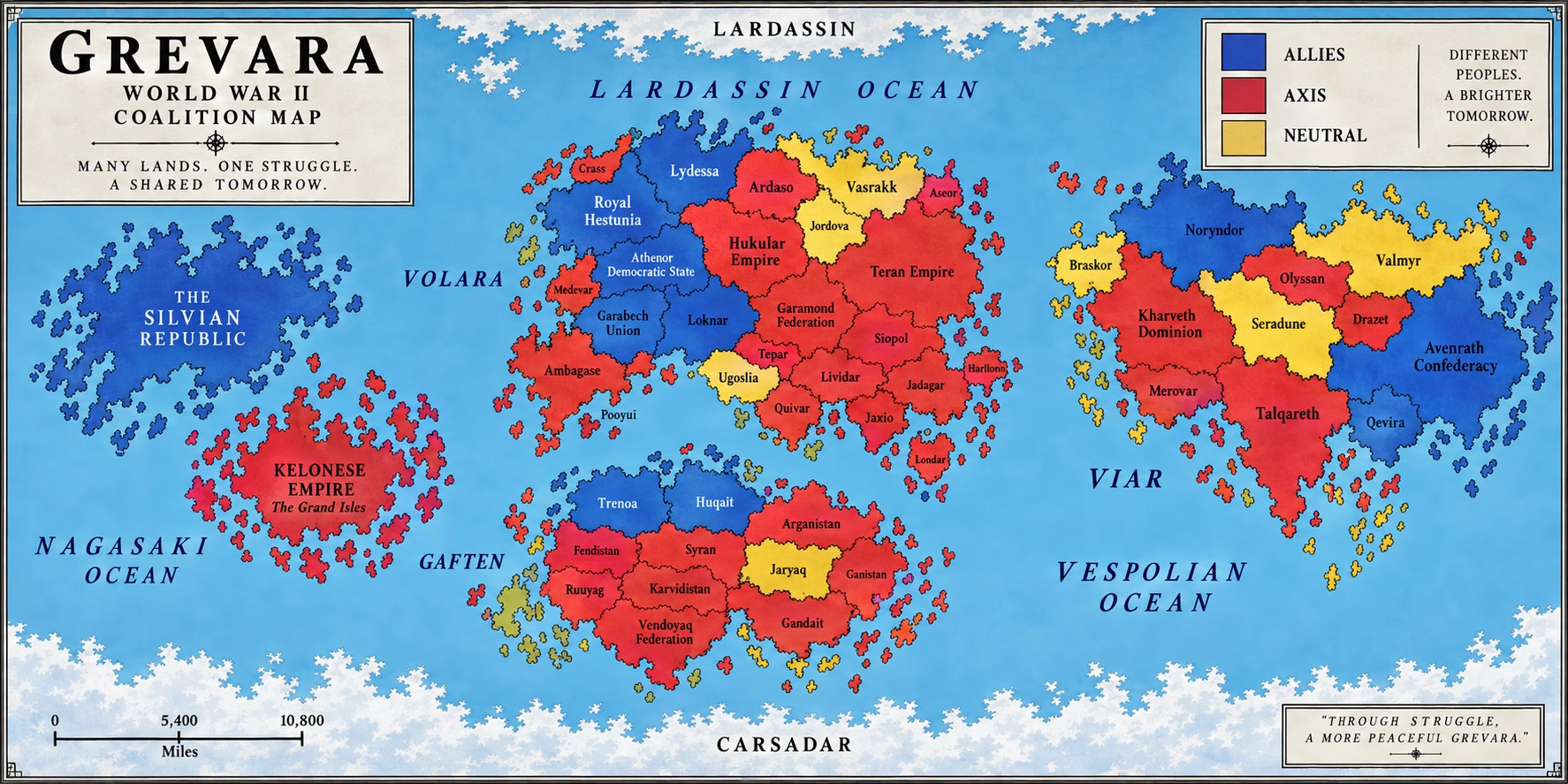
● Axis ● Allied ● Neutral · Zoom reveals cities, engagements and local positions. Drag to pan; use +/− or Ctrl+scroll to zoom. Hold over a marker for 5 seconds; click, tap or press Enter for immediate details.
Battle reference table
| Reference | Record |
|---|---|
| Dates | 1227-08-06 — 1227-12-20 |
| Participants | Silvian Republic; Royal Hestunia; other Allied forces; Hukular |
| Scale | Major |
| Status | Canon + proposed detail |
Commands & participating forces
Named operational commanders and supporting force groupings below are proposed additions unless explicitly marked creator-established. They are not a recovered order of battle or a claim of precise unit strength.
| Nation | Commander | Status | Forces |
|---|---|---|---|
| Silvian Republic | Arlen Meztor | Proposed operational commander | Permanent divisions operate within mission-based field armies. Specialist brigades, Logistics Divisions and Security Divisions provide distinct support roles; the original formation documents govern their organization. |
| Royal Hestunia | Oren Valcrest | Proposed operational commander | County-raised infantry, assault engineers, artillery and transport units sustain the front. Royal and coalition authorities retain separate responsibilities. |
| Hukular | Marvek Doran | Proposed operational commander | A central assault group with concentrated artillery, engineer columns and infantry reserves; its effectiveness depends on rail delivery and the protection of its flanks. |
Fighting, tactics & logistics
Hell includes the Silvian Army's 1st Infantry Division. Yullor includes the Silvian 18th Marine Brigade and the Army’s 15th Infantry Division. Garamor includes Hestunia's 3rd Assault Division and two Commonwealth divisions. Proposed follow-through emphasizes exits, repair, unloading and reserve arrival over months. Nine million describes total commitment, not everyone landing on the first day.
Civilian consequences
Civilians in the lodgment face bombardment, movement restrictions and damaged services. Relief competes with troop reinforcement for unloading capacity.
Outcome & wider significance
The canonical landing opens a major front. The December article boundary and subsequent inland sequence are proposed, while the beach forces and total commitment retain creator authority.
Developed battle history
The battle in detail
Expanded Grevara lore: new events, characters and in-world accounts developed for this archive. Supplied historical quotations retain their source links.
The coalition before the crossing
The proposed reconstruction begins with a coalition that agrees on the importance of reaching Kadoria but must still decide how to turn a commitment of millions into a sustainable campaign. The creator’s nine-million figure describes the wider commitment over time. It does not describe one landing wave, one convoy or the number of troops the beaches can immediately accommodate. Planning therefore concerns sequence as much as strength.
The Silvian and Allied staffs distinguish the assault formations from follow-on combat units, support services and the forces needed to continue the campaign inland. A formation waiting to embark is part of the commitment but cannot help a unit ashore until shipping, unloading and routes permit it to arrive. The proposed staff debates concern which capabilities must accompany the first footholds and which can follow without leaving the beachhead unable to function.
Hell, Yullor and Garamor receive different combinations of forces under the established assignments. Their names identify operational sectors, not interchangeable landing strips. A favorable report from one beach does not cancel a crisis at another, and a reserve cannot be moved between them merely by drawing an arrow on a staff map. The narrative treats their early histories separately before examining how their support systems begin to connect.
The landing force also carries political expectations. Occupied Allied nations represented in Commonwealth formations want to participate in the defeat of the Axis on equal terms, while the Silvian Republic brings enormous resources and its own command traditions. Coalition planning has to make room for both realities. That tension becomes especially visible at Garamor, where national identity survives inside a common operation.
Hell Beach: the first day’s broken footholds
On 6 August the Silvian Army’s 1st Infantry Division encounters the severe resistance established in the supplied account. The proposed local narrative follows Captain Envar Sol, a newly invented company commander whose unit reaches a sector beneath an inland rise called the Grey Step. The place and officer are narrative additions, not names recovered from the newspaper. The division’s landing and the failure to open the bluffs and exits that day remain the controlling facts.
Sol’s first problem is discovering which parts of his company have arrived together. Noise, scattered landing points and casualties have broken the planned sequence into smaller groups. He receives reports from one direction but cannot assume that the neighboring stretch of beach contains the expected unit. The first usable line is assembled from positions that can actually communicate, rather than from the neat frontage drawn before embarkation.
A group that moves toward the foot of the rise gains cover but cannot immediately turn that local gain into an open exit. Another element reaches a damaged structure and finds that its view inland is narrower than expected. The company’s reports consequently describe fragments: occupied cover, an obstructed approach, an isolated party needing contact. These are meaningful gains, but none justifies announcing that Hell Beach has been secured.
By evening, surviving leaders concentrate on holding the scattered footholds and identifying routes for casualty removal and essential supplies. Sol abandons the idea of measuring the day against every prelanding objective. His immediate responsibility is to keep the surviving formation coherent enough to continue. The episode ends with the division still under severe pressure, preserving the source’s account of an unfinished and costly first day.
Yullor: joining positions without opening the whole front
The Yullor reconstruction follows the established cooperation between the 18th Marine Brigade and the Army’s 15th Infantry Division. By 7 August, connected footholds and a narrow vehicle exit represent real progress. The proposed story gives that achievement a local setting around an inland track known as Ferry Road, while making clear that neither the name nor its precise position is established by the political map.
Marine liaison officer Tavin Rell, an invented character, spends much of the day reconciling reports from units using different local landmarks. One group calls a position the broken warehouse; another identifies the same place by a nearby drainage crossing. Until the references are reconciled, headquarters risks treating one position as two or assuming a gap where neighboring units are already in contact.
The connection allows the defenders of the foothold to coordinate support and movement more reliably. It does not create unlimited road capacity. Vehicles arriving through the narrow exit compete with returning casualty transport, while damaged equipment narrows the usable space further. Units farther inland request supplies that cannot all be delivered in the order requested.
A proposed afternoon counterattack tests the connection between the Army and Marine positions. The threatened ground is held through local cooperation, but the response consumes reserves intended for further movement. The tactical result is therefore mixed: Yullor becomes more coherent and less vulnerable to isolation, yet its expansion slows. The distinction matters because a connected beachhead can be a success even when the day’s hoped-for advance does not occur.
Garamor: the Commonwealth formations take their place
At Garamor, the established Hestunian 3rd Assault Division operates alongside two Commonwealth divisions drawn from fallen Allied nations. The proposed narrative avoids inventing national identities for those divisions where the creator has not specified them. Instead it follows the political and administrative importance of their continued existence as recognizable formations inside the coalition.
The 8 August fighting develops around an embankment and deeper defensive positions consistent with the supplied report. Hestunian assault elements face the immediate problem of extending the shore lodgment, while Commonwealth units help hold its perimeter and sustain the connection behind the forward effort. These roles can change as the situation develops, but they are not reduced to a hierarchy in which one nation fights and the others merely watch.
A fictional Hestunian staff officer, Major Leren Vos, receives conflicting requests for the same unloading capacity. Forward units need stores, an engineer party needs equipment, and damaged landing craft complicate the timetable. Commonwealth liaison representatives insist that their formations’ requirements be entered directly into the common schedule rather than passed through an informal chain of favors.
The resulting arrangement is modest but significant: requests are grouped by operational need while the identity of the receiving formation remains visible. It improves accountability without creating an invented permanent Allied army. Garamor’s early progress depends on that practical cooperation as well as on combat. The episode also preserves the limited result of the source: fighting continues beyond the immediate shore, and the deeper defense has not simply disappeared.
The Axis reserve dilemma
The opposing command is not treated as a passive obstacle waiting for Allied resources to overwhelm it. In this proposed reconstruction, an Axis sector commander, Colonel Marvek Raal, receives reports from several coastal approaches and must decide which indicate a temporary foothold and which threaten a durable lodgment. His authority is local and does not replace Hukular’s established national leadership.
Early reports encourage contradictory conclusions. Severe Allied losses at Hell suggest that the assault might still be contained near the water. Progress at Yullor suggests that a more coherent base is forming. Garamor’s multinational force complicates estimates of the reinforcement capacity behind it. Raal cannot infer the coalition’s exact strength from the number of craft visible at one moment.
A proposed reserve movement is delayed because the same inland roads serve supply and evacuation traffic from threatened positions. The delay is not attributed to an implausibly foolish officer or a convenient total communications collapse. It grows from ordinary competition for movement space under pressure. Units arrive in a sequence different from the one their commander expected, narrowing the choices available when they are committed.
Axis resistance consequently appears uneven from the Allied side. One sector receives a strong local response while another sees little movement for several hours. That unevenness should not be mistaken for the disappearance of the enemy command. The proposed episode explains how a still-functioning defender can lose the ability to coordinate its best resources at the exact moment and place where they would have the greatest effect.
The night between landing and campaign
The first nights ashore are not an empty interval between dramatic daytime attacks. They are when units try to find separated personnel, redistribute essential stores, collect casualty information and establish which positions remain connected. The proposed narrative concentrates on the night after the Yullor footholds have begun to join, when relative local stability creates work rather than ending it.
Rell’s liaison party traces the chain of reports from the forward positions to the receiving staff near the shore. Messages travel through several people, and each relay introduces the possibility of misunderstanding. The staff begins marking reports by location and time so that an earlier request is not mistaken for the latest situation. This is a narrative explanation of command work, not a recovered communications log.
At Hell, Sol’s company receives replacements for some missing equipment but not a complete restoration of its original organization. Survivors redistribute tasks according to who is present and capable of doing them. A section that appears intact on a morning roster may lack a specialist, a working set of communications equipment or a leader who knows the neighboring unit.
The night also changes the emotional texture of the landing. Men who were occupied by immediate danger have time to ask about people they have not seen since embarkation. Reports of survival, injury and death move through units unevenly. The reconstruction leaves some questions unanswered, reflecting the difference between a headquarters eventually compiling losses and a soldier trying to discover the fate of a friend before the next day begins.
Medical movement and the price of congestion
Sharkstrike’s casualty system shares the same limited geography as the incoming army. The proposed medical narrative follows Elra Naven, a fictional receiving officer responsible for organizing transfers near one of Yullor’s evacuation points. Her role is administrative coordination, not an invented ability to determine the outcome of every casualty or command all medical services across the beaches.
Naven’s staff records where patients have come from and where they have been sent. Without that continuity, units can lose track of wounded personnel even when treatment has been provided. The records also help distinguish a crowded receiving point from one that has space but is difficult to reach. The task grows more complicated as the Army and Marine systems interact with shared transport arrangements.
Congestion creates difficult choices. A vehicle returning toward the water may be needed for wounded personnel, damaged equipment or another essential task. No account of the landing can honestly assume that every requirement is met immediately. The proposed narrative follows the effort to establish priorities while acknowledging that waiting itself imposes a human cost.
The wounded do not disappear from the battle history once they leave the firing line. Their evacuation affects available transport, personnel accounting, replacement needs and the experience of the surviving unit. This chapter does not assign an invented survival percentage or a precise total of hospital beds. It explains why the movement of casualties belongs to the operational history rather than being confined to a sentimental paragraph after the fighting.
A lodgment large enough to matter
During the proposed consolidation period after the initial landing reports, the coalition’s central question changes. It is no longer enough to ask whether troops remain ashore. Commanders need to know whether the lodgments can receive, organize and sustain enough force to support the next stage of the campaign. A beachhead can survive without yet being capable of the offensive expected of it.
Engineers, transport staff and security elements work on the connections behind the forward positions. Their progress changes what the fighting units can attempt. Opening another usable route may matter more than a visually impressive movement into ground that cannot be supplied. Equally, a route is not secure merely because the first vehicle has passed along it; continued use depends on maintenance and protection.
The three beaches retain different problems. Hell carries the consequences of its costly and fragmented opening. Yullor’s connected footholds provide a stronger framework but remain constrained by movement capacity. Garamor must consolidate its multinational organization while fighting continues beyond the shore. The proposed narrative does not collapse those experiences into a single moment when the whole operation becomes successful.
By the end of this early phase, the coalition has established the basis for a continuing campaign, while the Axis still possesses organized forces capable of opposing it. That result fits the larger war rather than ending it prematurely. Sharkstrike’s importance lies in creating a new strategic problem for the Axis and a new set of responsibilities for the Allies. The nine-million commitment becomes consequential through a long process of making forces usable ashore, not through one overwhelming image of men landing everywhere at once.
Full campaign dossier
Each chapter below identifies its evidence status. Source-grounded analysis interprets the cited record; proposed chapters develop additional history for creator review.
Chapter 1 · Creator canon
The operation and its scale
Sharkstrike begins on 6 August 1227 against Hukular’s mainland theater of Kadoria. The creator’s total commitment is nine million personnel: four million Silvians and five million other Allies. This is an operational commitment figure. It does not state how many people are afloat on the opening morning, how many are combat troops, how many belong to support services, or how many reach each beach that day.
Treating all nine million as first-day assault strength would erase the very system that makes such an operation possible. Assault troops require following formations, engineers, transport personnel, medical services, replacement pools, maintenance organizations and port capacity. The historical question is how the commitment is introduced over time and sustained ashore. Exact shipping manifests and daily landing totals are not supplied, so this dossier does not manufacture them.
The opening force is distributed among Hell, Yullor and Garamor. Their different experiences matter. The published reports do not describe three identical beaches progressing on a single schedule. Hell remains fragmented at dusk on the first day; Yullor’s local groups establish contact by the next report; Garamor expands under continued fire.
Chapter 2 · Source record
Hell Beach: 6 August, evening
Hell is identified as the strongest fortified sector among the main beaches. The Silvian Army’s 1st Infantry Division lands into surviving Hukular fire despite the opening bombardment. Companies arrive scattered, and groups remain pinned behind obstacles or the sea wall. This is a failure to achieve immediate cohesion, not simply a statement that the beach is dangerous.
Small parties reach the base of the bluffs and attack isolated defenses. Those actions create useful footholds, but the newspaper explicitly warns that they do not yet amount to an open route for vehicles and following troops. The distinction is operationally decisive. Infantry on a bluff can survive or clear a local position while the division’s artillery, transport and reserve movement remain blocked below.
Naval fire continues against identified strongpoints. Smoke and broken communications complicate support, meaning that firepower cannot always be delivered at the right place and time. The evening report describes severe losses but no verified total. Any exact casualty number for Hell would therefore be a proposed addition, not a fact extracted from this report.
Chapter 3 · Proposed canon
Hell: the proposed command decision
The proposed divisional response is to define limited exit objectives rather than order every isolated party to advance inland independently. Beach groups collect surviving radios and identify which strongpoints directly control movement off the shore. Engineers and infantry form local task groups around those exits. Naval liaison personnel request fire on confirmed targets rather than treating all visible inland ground as a single bombardment zone.
The immediate reserve is used to strengthen a connected route once one begins to form. Committing it equally across every scattered foothold would increase the number of isolated groups without necessarily opening a vehicle passage. At the same time, the command cannot abandon other groups to uninterrupted fire. Smoke, limited covering attacks and casualty collection must preserve their ability to hold until the route becomes useful.
The decision accepts that not every objective can be achieved on the initial timetable. Its measure of progress is a functioning connection between the shore and defensible inland ground. This is a proposed operational explanation for how the source’s scattered evening footholds could develop into a sustainable part of Sharkstrike.
Chapter 4 · Source record
Yullor: 7 August
The Yullor newspaper names the 18th Marine Brigade and the Army’s 15th Infantry Division. This corrects the earlier site’s loose treatment of the marine formation. The report states that their forward groups establish contact, giving the landing force a continuous section of shoreline. Hukular positions still overlook the inland approaches.
Marines fight near the waterfront while Army infantry presses buildings and fieldworks beyond the sea wall. Headquarters works to restore reliable communications with the fleet, while the two formations coordinate locally. This combination is important: tactical cooperation can occur before a complete higher-level communications system is restored. The beach is not paralyzed merely because headquarters lacks perfect contact, but neither is local cooperation a substitute for sustained coordination.
Engineers clear damaged exits and permit limited vehicle traffic. Incoming supplies compete with casualty evacuation for space at landing points. Hukular counterattacks test the perimeter, and neither formation reports an unrestricted road into the interior. The achievement is a joined foothold whose continued survival now depends on increasing throughput.
Chapter 5 · Proposed canon
Yullor: movement as a combat function
A proposed joint traffic-control post is established where the first usable vehicle route meets the shoreline. Its authority is narrow but crucial: assign unloading windows, stop vehicles from blocking the exit, and separate casualty movement from incoming ammunition whenever physical space permits. It does not replace either formation’s combat command. Its purpose is to prevent two successful local organizations from obstructing each other at their shared bottleneck.
The initial priority order favors engineer equipment, communications stores and ammunition needed to hold the perimeter. Vehicles without an immediate task remain afloat or in designated waiting areas until space exists. Recovery crews are positioned close enough to remove a disabled vehicle before it closes the only exit. This makes traffic management a direct contribution to combat power.
Marine and Army liaison teams exchange simple written sector boundaries when radios fail. The boundary follows identifiable ground and is revised as the perimeter grows. The proposed arrangement reduces the risk that both units assume the other is covering the same threatened approach.
Chapter 6 · Source record
Garamor: 8 August
Hestunia’s Royal Army 3rd Assault Division fights beside two Commonwealth divisions drawn from the remnants of fallen Allied nations. The source gives those formations a specific military division of labor: Hestunian assault troops attack principal shoreline defenses, while Commonwealth infantry expands and protects the landing position.
The battle centers on a coastal embankment and fortified approaches overlooking unloading areas. Several enemy positions fall, but Hukular fire continues from deeper works. Shelling disperses supply parties, and damaged landing craft obstruct parts of the shore. Engineers work to preserve passages as fresh troops arrive. These are not background details; they explain why local captures have not yet become an unrestricted inland advance.
The newspaper acknowledges the significance of the landing for soldiers whose governments are in exile. It nevertheless presents their immediate tasks as holding, maintaining contact and supplying the force. The emotional importance of returning to the offensive strengthens the narrative, but does not replace the operational requirements.
Chapter 7 · Proposed canon
Coalition command at Garamor
The proposed shared command uses national liaison officers to connect formation headquarters without erasing the identity of the Commonwealth units. Orders specify the objective, neighboring formations, fire-support arrangements and the time at which control of captured ground changes hands. This is more useful than merely announcing that all Allies are cooperating.
Ammunition distribution is organized by weapon compatibility rather than nationality alone. Mixed supplies arriving in the same landing area are sorted into clearly marked holding points. Repair teams record which vehicles can use locally available parts and which must wait for national maintenance services. The arrangement accepts that common command does not make every equipment system interchangeable.
Casualty records preserve national identity even when treatment occurs in a shared facility. This matters to replacement administration, family notification and eventual accountability to exile governments. A soldier can fight under combined operational direction without disappearing from the records of the nation represented by that formation.
Chapter 8 · Historical interpretation and proposed detail
The defender’s problem
Hukular’s coastal forces need not destroy every landing craft to threaten Sharkstrike. Holding observation over a beach exit, preventing an unloading area from becoming predictable, or delaying the arrival of repair equipment can keep an apparently substantial foothold shallow. The source reports show exactly why defenders care about inland approaches as well as the waterline.
The proposed Hukular response distinguishes local counterattacks from a larger attempt to reach the shore. Local actions seek to recover observation, isolate advanced parties or force the Allies to expend ammunition. A larger counterattack requires concentration, transport and timing, which may expose reserves to naval or air attack. The defender therefore faces its own tradeoff between remaining dispersed and massing enough strength to change the battle.
A failed counterattack is not automatically irrational. It may disrupt engineering long enough to delay a follow-on landing. Conversely, a tactically successful recapture may offer little strategic value if it consumes the reserve needed to defend the main inland route. The detailed history should assess these choices by their effect on the operation’s support system.
Chapter 9 · Proposed canon
From beaches to an operational lodgment
The proposed buildup passes through three conditions rather than three fixed dates. First, the force must hold enough ground to survive between deliveries. Second, it must move stores and casualties without recurrent total blockage. Third, it must support operations beyond the immediate range of beach unloading. These conditions can overlap and differ by sector.
Permanent road repair, covered storage, workshop space and casualty reception are introduced as the perimeter permits. Security formations protect rear facilities and routes in accordance with the Silvian doctrine. Specialist brigades provide capabilities that the field command needs without implying that every brigade is a substitute for an ordinary division. The supplied formation documents govern those distinctions.
The nine-million commitment becomes meaningful through this progressive organization. Some personnel reinforce the fighting front, others build the system that lets it remain in action, and others replace losses or rotate exhausted units. The article does not assign unsupported exact proportions. Its claim is that total commitment must be understood across the operation’s duration and functions.
Chapter 10 · Proposed operational analysis
Air and naval support: what power can and cannot do
The bombardment at Hell fails to silence every defensive position. That source detail rules out a narrative in which naval power removes all uncertainty before infantry arrives. Concealment, damaged communications and limited observation allow surviving defenders to remain dangerous. Support forces must respond to identified threats after the landing begins.
The proposed support plan allocates observers and communications redundancy to the exits rather than relying on a single central radio. Aircraft reconnaissance reports roads and reserve movement, while naval fire addresses targets whose location is sufficiently clear. Smoke can shelter a movement but can also obscure friendly positions, so its use must be coordinated with the troops expected to exploit it.
The fleet also carries logistical and medical responsibilities. Escort, unloading, recovery of damaged craft and the movement of wounded compete with spectacular bombardment missions. Treating those tasks as part of naval combat power produces a more convincing campaign than describing the fleet solely through the size of its guns.
Chapter 11 · Proposed civilian reconstruction
Civilian life inside the expanding perimeter
Civilians near the beaches face danger from both immediate fighting and the disruption of ordinary services. A house outside the principal assault route may still lose water, electricity or access to food. A family moving toward the shore for evacuation may encounter areas reserved for ammunition handling or active unloading. The expanding military perimeter therefore needs a civil movement plan.
In the proposed arrangement, local officials and military liaison teams establish marked reception points away from the busiest exits. Food and medical allocations are tracked separately from the combat formations’ immediate stocks so that civilian needs do not disappear inside a general supply total. Interpreters and surviving municipal records help reunite separated households and identify people requiring continuing care.
Civilian testimony written later for this campaign must be labeled fictional reconstruction unless a complete authentic source is supplied. The current analysis describes institutional and material pressures; it does not invent a named survivor and present that person as a witness from the uploaded newspapers.
Chapter 12 · Historical interpretation
Why Sharkstrike matters beyond the landing
Sharkstrike adds a major Allied front against Hukular and changes the distribution of reserves, transport and political attention. Its significance is not exhausted by which beach becomes secure first. A sustainable lodgment forces the defender to plan around an enduring threat and gives the coalition an opportunity to connect maritime delivery with inland operations.
The existing sources close their early reports while fighting remains active. A credible continuation must retain that uncertainty. The proposed later history develops roads, supply zones and coordinated advances before claiming a decisive continental outcome. It also gives Hestunia and the Commonwealth formations continuing roles instead of reducing them to ceremonial participants in a Silvian operation.
The distinction between source and proposal is particularly important here because the commitment figures are enormous. Scale alone cannot substitute for a sequence of decisions. The operation becomes convincing when the reader can follow why a damaged exit delays vehicles, why a missed unloading window affects artillery, and why a limited local success eventually changes the larger campaign.