Original source · Visual archive
GNN newspaper · record 131
Searchable transcription · OCR may contain errors
This is uncorrected machine transcription. The uploaded image is authoritative for names, punctuation and quotations.
TRUTH PEOPLES
IN TURBULENT TIMES NATIONS
A STRONGER A MORE STABLE
TOMORROW WORLD
GREVARA NEWS NETWORK

VOL. XLVI, NO. 501

INTERNATIONAL EDITION

2 August 1220

LANDNGCRAT BATTLE TOUGHEST COA

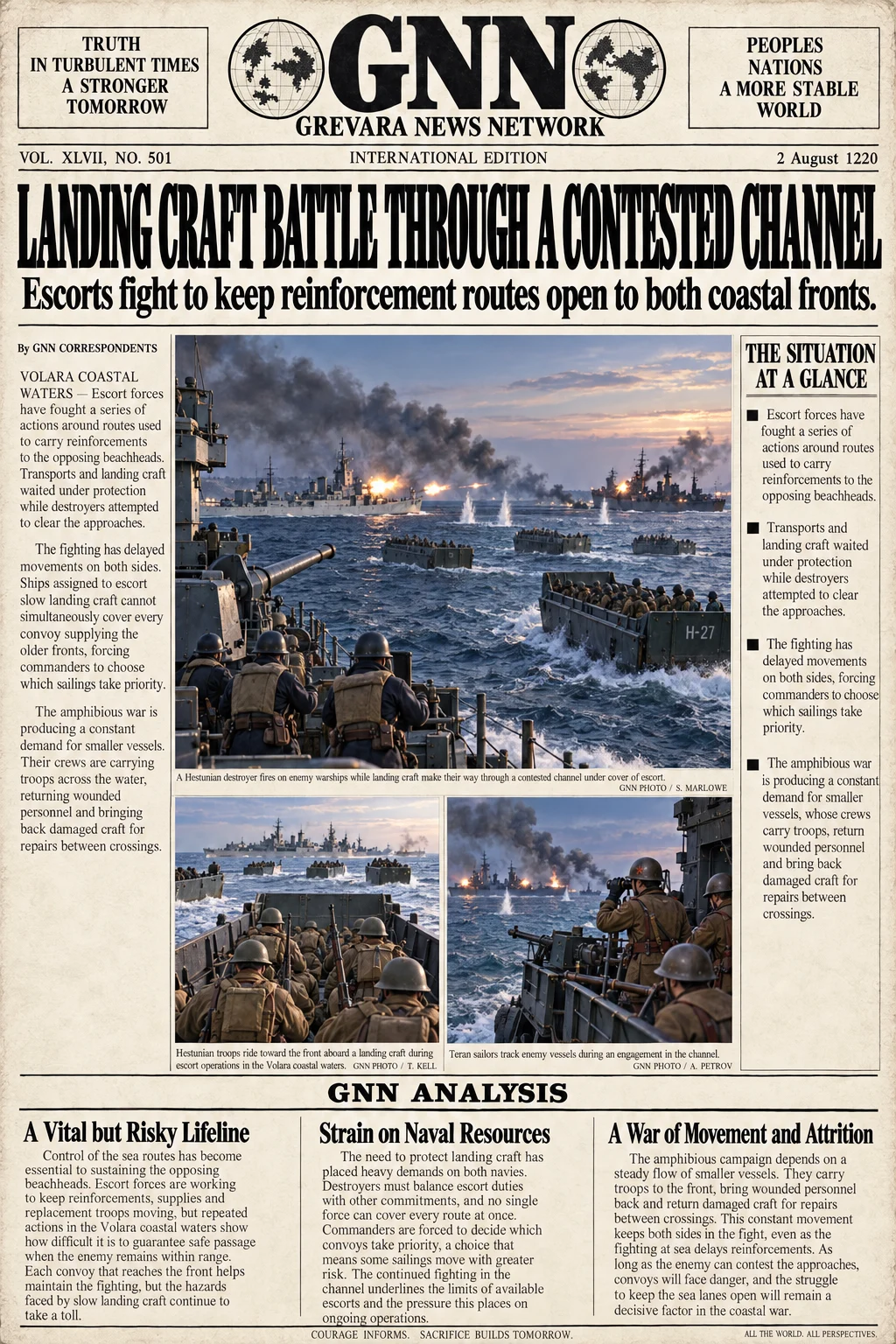
Escorts fight to keep reinforcement routes open to both coastal fronts.

By GNN CORRESPONDENTS

VOLARA COASTAL
WATERS sort forces
have fought a series of
actions around routes used
to carry reinforcements

to the opposing beachheads.
‘Transports and landing craft
waited under protection
while destroyers attempted
to clear the approaches,

The fighting has delayed
movements on both sides
Ships assigned to escort
slow landing craft cannot
simultaneously cover every
convoy supplying the
older fronts, forcing
commanders to choose
which sailings take priority.

The amphibious war is
producing a constant
demand for smaller vessels.
Their crews are carrying
troops across the water,
returning wounded
personnel and bringing
back damaged craft for
repairs between crossings.

Hestuian troops 1

toward the font aboard a landing craft during
e Volara costal waters. GNN PHOTO /. KELL

A Hestunian destroyer fies on enemy arships while landing craft make their way through a contested channel under cove of esor.

Teran sailors track enemy vessels during an engagement inthe channel

THE SITUATION
AT A GLANCE

I Escort forces have
fought a series of
actions around routes
used to carry
reinforcements to the
opposing beachheads.

I Transports and
landing craft waited
under protection
while destroyers
attempted to clear
the approaches.

I The fighting has
delayed movements
on both sides, forcing
commanders to choose
which sailings take
priority

i The amphibious war
is producing a constant|
demand for smaller
vessels, whose crews
carry troops, return
‘wounded personnel
and bring back
damaged craft for
repairs between
crossings

(GN PHOTO / S. MARLOWE

GN PHOTO / A. PETROV ae

GNN ANALYSIS

A Vital but Risky Lifeline

Control of the sea routes has become
essential to sustaining the opposing
rt forces are working
to keep reinforcements, supplies and
replacement troops moving, but repeated
ons in the Volara coastal waters show
passage
when the enemy remains within range.
Each convoy that reaches the front helps
maintain the fighting, but the hazards
faced by slow landing craft continue to
take a toll.

Strain on Naval Resources

The need to protect landing craft has
placed heavy demands on both navies
Destroyers must balance escort duties
with other commitments, and no single
force can cover every route at once.
Commanders are forced to decide which
convoys take priority, a choice that
means some sailings move with greater
risk. The continued fighting in the
channel underlines the limits of available
escorts and the pressure this places on
ongoing operations.

‘A War of Movement and Attrition

The amphibious campaign depends on a
steady flow of smaller vessels. They carry
troops to the front, bring wounded personnel
back and return damaged craft for repairs
between crossings. This constant movement
keeps both sides in the fight, even as the
fighting at sea delays reinforcements. As
long as the enemy can contest the approaches,
convoys will face danger, and the struggle
to keep the sea lanes open will remain a
decisive factor in the coastal war.

COURAGE INFORMS. SACRIFICE BUILDS TOMORROW.

TIL THE WORLD. ALL PERSPECTIVES,

.
Provenance
Wwii 4/8542529B-8274-492A-A63F-38EBB2350873.PNG
Source identifier: 131