Original source · Visual archive
GNN newspaper · record 074
Searchable transcription · OCR may contain errors
This is uncorrected machine transcription. The uploaded image is authoritative for names, punctuation and quotations.
TRUTH
IN TURBULENT TIMES
A STRONGER
TOMORROW

GNN6)

GREVARA NEWS NETWORK

VOL. XLVII, NO. 516

INTERNATIONAL EDITION

PEOPLES
NATIONS

A MORE STABLE
WORLD

18 November 1222

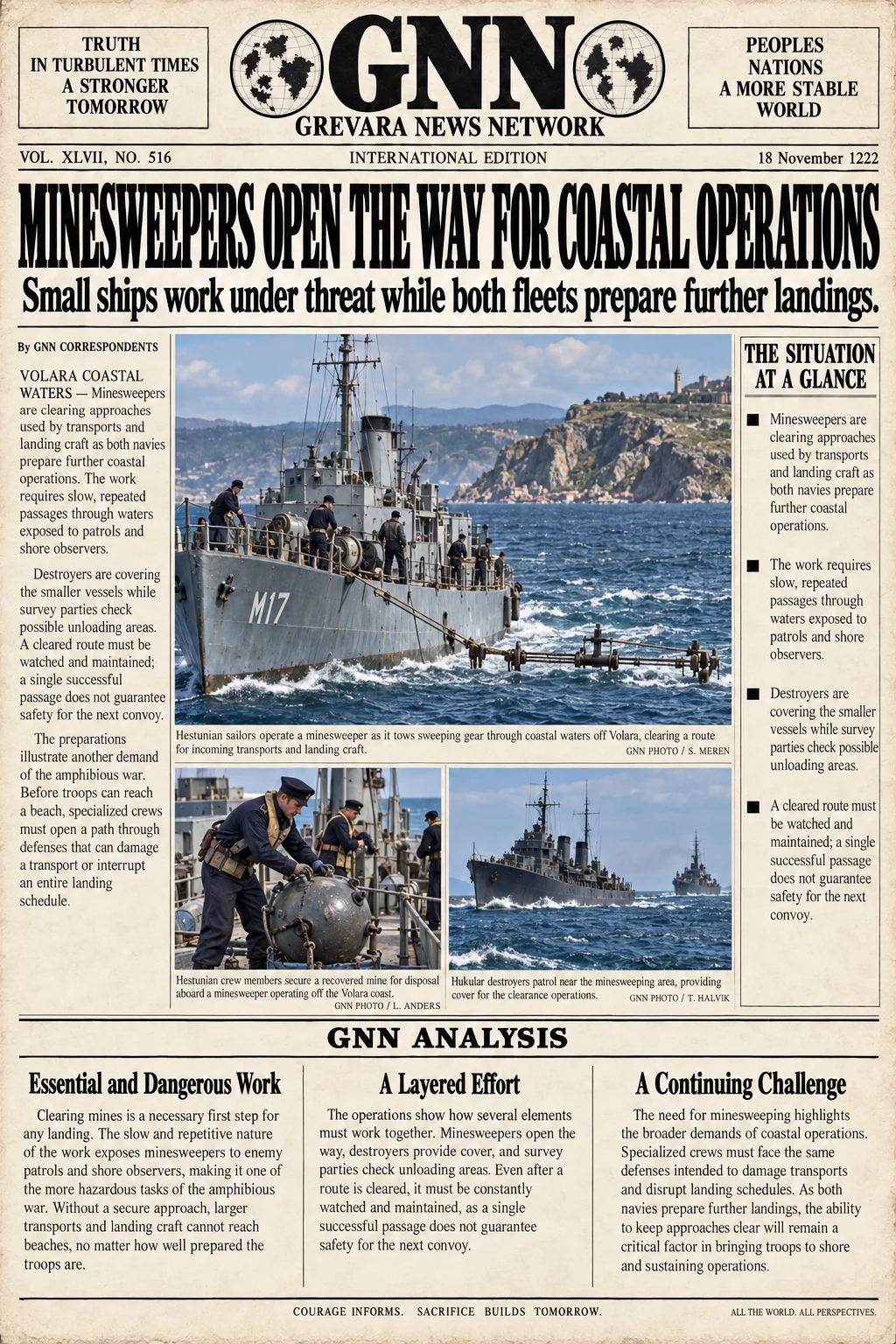
MINESWEEPRS VPN TH WAY PUR COASTAL PERATIONS

Small ships work under threat while both fleets prepare further landings,

By GNN CORRESPONDENTS

VOLARA COASTAL
WATERS — Minesweepers
are clearing approaches
used by transports and
landing craft as both navies
prepare further coastal
‘operations. The work
requires slow, repeated
passages through waters
exposed to patrols and
shore observers.

Destroyers are covering
the smaller vessels while
survey parties check
possible unloading areas.
A cleared route must be
watched and maintained;
a single successful
passage does not guarantee
safety for the next convoy.

The preparations
illustrate another demand
of the amphibious war.
Before troops can reach
a beach, specialized crews
must open a path through
defenses that can damage
a transport or interrupt

an entire landing
schedule.

aboard a mit

Hestunian crew members secure a recovered mine for disposal

sweeper operating off the Volara coast.

He

——

Hestunian sailors operate a minesweeper as it tows sweeping gear through coastal waters off Vola
for incoming transports and landing craft.

cover for the clearance operations.
GN PHOTO /L. ANDERS

Hulkular destroyers patrol near the minesweeping area, providi

THE SITUATION
AT A GLANCE

I Minesweepers are
clearing approaches
used by transports
and landing craft as
both navies prepare
further coastal
operations,

I The work requires
slow, repeated
passages through
waters exposed to
patrols and shore
observers.

Destroyers are
covering the smaller
vessels while survey
parties check possible
unloading areas

clearing a route
GNN PHOTO / S. MEREN

A cleared route must
be watched and
maintained; a single
successful passage
does not guarantee
safety for the next
convoy.

GNN PHOTO / T. HALVIK

GNN ANALYSIS

Essential and Dangerous Work

Clearing mines is a necessary first step for
any landing. The slow and repetitive nature
of the work exposes minesweepers to enemy
patrols and shore observers, making it one of
the more hazardous tasks of the amphibious
war. Without a secure approach, larger
transports and landing craft cannot reach
beaches, no matter how well prepared the
troops are.

A Layered Effort

The operations show how several elements
must work together. Minesweepers open the
way, destroyers provide cover, and survey
parties check unloading areas. Even after a
route is cleared, it must be constantly
watched and maintained, as a single
successful passage does not guarantee
safety for the next convoy.

A Continuing Challenge

The need for minesweeping highlights
the broader demands of coastal operations.
Specialized crews must face the same
defenses intended to damage transports
and disrupt landing schedules. As both
navies prepare further landings, the ability
to keep approaches clear will remain a
critical factor in bringing troops to shore
and sustaining operations.

COURAGE INFORMS. SACRIFICE BUILDS TOMORROW.

ALL THE WORLD. ALL PERSPECTIVES.
Provenance
Wwii 2/71319A51-4597-4DA7-A500-8203CE2DB09F.PNG
Source identifier: 074