A theater that could not be imported
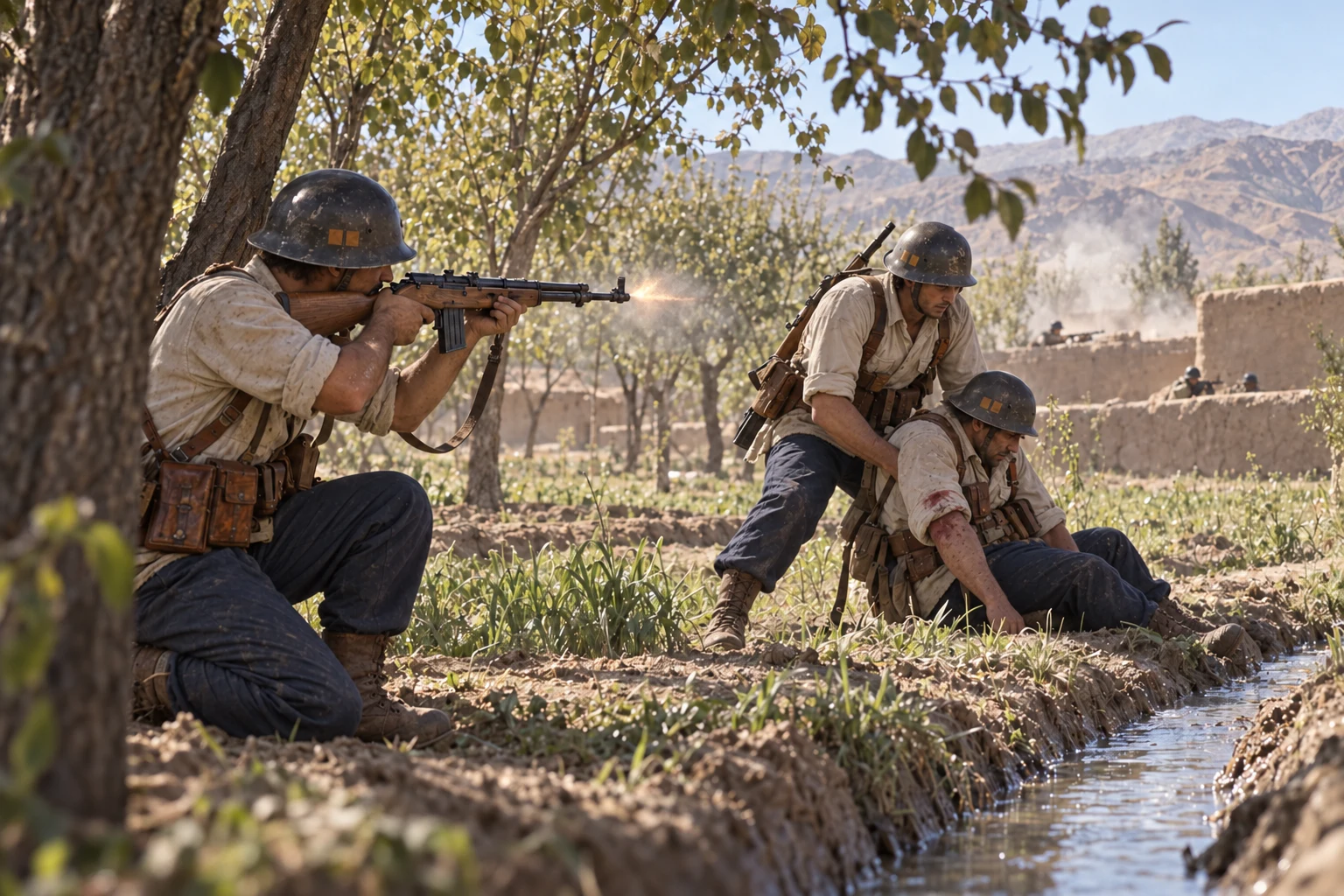
The Allied offensive in the established Handistan–Qarim theater during April–June 1228 began with an improvement that was real and insufficient. Silvia's commitment had allowed exhausted regional formations to receive relief during 1227. Rest, replacement and a larger supporting establishment made another offensive conceivable. They did not restore every road, processing facility or water connection damaged during years of war. The inherited account places the attempted recovery in the Sarem agricultural district, within an existing contested campaign area. Its central question is therefore not whether fresh troops arrived. It is how commanders converted their arrival into expectations about what a damaged district could sustain, and how those expectations survived contact with the district itself.
The participating armies belonged to a coalition with established arrangements, not to a newly unified continental command. Handistani, Qarimi, Trenoan, Huqaiti, Syran and Silvian participation provided different capacities and obligations. General Tessa Varin led one expeditionary grouping within those arrangements. She did not command all Gaften. Nor did Ruuyaq acquire a direct frontier with Handistan because a campaign map needed an uncomplicated arrow. The geographic distinction matters to the explanation: access had to exist through actual theaters and permissions. An army's national establishment could grow while the usable routes connecting its personnel to an objective remained constrained. Treating the coalition as a single freely moving mass would conceal precisely the difficulty that the offensive exposed.
This Chronicle reads the operation as a test of supportable recovery. The interpretation follows the inherited battle's sequence, rather than supplying a new order of battle or an invented timetable. The Sarem district offered roads, settlements and irrigation works that mattered simultaneously to troops and residents. Recovering those assets promised a military advantage, yet using them intensively could damage the civilian economy needed to sustain the recovery. The difficulty was not a sentimental interruption of military logic. It lay inside that logic. A force that consumed the means of the next harvest would increase its own future import requirement while telling its governments that the offensive had made the theater more secure.
April: progress outruns the meaning of possession
The opening attacks recovered outlying positions and several settlements. These gains should not disappear from the history simply because the offensive later stalled. They changed where residents could move, where soldiers could shelter and which positions the coalition could attempt to connect. Ruuyaqi and partner formations withdrew from some exposed ground while retaining more consequential connections. Their selective resistance produced a misleading combination: visible advance beside enduring structural vulnerability. Political visitors and reports could describe a recovered settlement without being able to demonstrate a dependable route between it and the next useful position. The map recorded possession more quickly than the army established a routine of supply, relief and repair.
Varin's leading troops reached a damaged processing complex whose storage buildings offered immediate shelter. The captured contents initially appeared in army inventories as available food. Civilian specialists explained why that description was incomplete. Some stocks could be consumed at once; others required machinery and labor that the army had not yet provided. The discrepancy was more than a clerical error. An inventory had assigned the same military value to materially different resources. Correcting it reduced the apparent benefit of a successful advance without reversing the advance itself. The defenders had lost ground, but the attackers had not acquired all the capacity they believed that ground contained.
Local counterattacks then required reinforcements at positions intended as stages toward further objectives. The coalition's reserve diminished as temporary stops became defended commitments. Varin inspected forward formations whose numerical strength obscured exhaustion from carrying stores and construction work as well as combat. Her request for a revised timetable followed that inspection. It did not mean the soldiers had become unwilling to fight. It recognized that a man recorded as present could be unable to perform the next demanding task after repeated work and interrupted rest. Counting personnel without accounting for their condition turned fresh national resources into an exaggerated estimate of immediate operational power.
Three Reservoirs: a district, not a magic point
The principal May battle centered on the Three Reservoirs road-and-waterworks district. The inherited source explicitly limits the name: these local facilities did not control all water throughout Gaften. Their importance arose from their effect on nearby movement and subsistence. Repair teams worked intermittently while fighting continued, and military consumption increased pressure on usable supply. This specificity prevents an inflated explanation in which capturing three objects would have unlocked a continent. The coalition needed a functioning local connection. It obtained part of the district without securing the whole arrangement on which the planned advance depended.
Enemy shortages contributed to selective defense. Ruuyaqi and partner formations did not have to hold every available position to frustrate the operation. They needed to prevent separate Allied gains from becoming a dependable system. The outcome illustrates an asymmetry between a defender retaining essential connections and an attacker requiring them to work together. A local attack might succeed tactically yet fail to remove the interruption that made the next movement unreliable. Repeated success on individual pieces of ground therefore produced neither a simple victory nor a simple defeat. It produced an increasingly costly obligation to hold pieces whose collective utility remained below the plan's assumptions.
Varin's staff began recording which positions could be reached regularly. That distinction made uncertainty legible. A position might be occupied and intermittently accessible while still unsuitable as the base of another advance. Regular access meant troops could expect stores, medical movement and relief without each journey becoming an improvised emergency. The staff's method replaced a broad territorial claim with a practical test. It also provided a reason to stop that could be explained through observable conditions rather than through an impression of declining morale. The offensive's limit emerged from the relationship between positions, not simply from the distance its leading troops had marched.
The grain ledger as a command document
Civil authorities objected to requisitions threatening the next harvest. Their challenge concerned household survival and the coalition's future support burden together. At a liaison conference in a cooperative office, Qarimi administrator Halen Suri separated four categories that army inventories had grouped as food stocks: household grain, seed, wages owed in kind and stores available for sale. Each category embodied a different obligation. Household grain sustained families; seed preserved future production; grain owed as wages represented work already performed. Only treating every entry as uncommitted saleable stock allowed the proposed requisition to look straightforward. The ledger exposed the social relationships hidden inside an apparently neutral quantity.
Varin suspended the order and required the categories to remain separate. The decision narrowed the resources her grouping could obtain locally and made dependence on imported stores more visible. That was a cost, not a disguised immediate battlefield advantage. The source records criticism of civil authorities for apparently concealing resources at a moment of military need. Suri responded by opening the ledger to a joint audit. The audit found discrepancies while confirming the essential distinction. Civilian agency therefore did not rest on a perfectly pure document or an uncontested appeal. It consisted of presenting categories that survived scrutiny and compelled the military to revise the allocation.
The army received a lawful allocation and accepted a transport burden. After the operation was curtailed, surviving farms planted part of the preserved seed. The resulting harvest did not feed the whole theater. It reduced the district's relief requirement and helped some displaced residents remain near their homes. That limited consequence is the appropriate scale of the claim. The decision demonstrates that respecting civilian needs can impose an immediate military delay and still preserve useful capacity over time. It does not support a universal promise that humane administration instantly improves combat performance. Sarem's history is stronger when the real short-term sacrifice remains visible.
Coalition authority under disappointment
A joint board restricted some military demands, requiring commanders to obtain stores through slower national channels. This was an exercise of coalition authority over a shared district. It reveals why national resources and local consumption cannot be equated. The participating states could support a campaign while retaining separate supply obligations and political limits. A faster requisition might have simplified the commander's immediate problem by transferring costs to residents. The restriction prevented that transfer in some cases but required the army to confront the slower system on which its lawful allocation depended. Administration shaped what the operational timetable could honestly promise.
The disappointment that followed was also distributed unevenly. Governments had expected Silvia's increased presence to produce a rapid reversal. Forward troops saw their reserve absorbed, their labor increase and useful local capacities remain damaged. Residents heard announcements of liberation while asking whether food, shelter and the next harvest would permit them to return. These perspectives were not interchangeable measures of one outcome. Each described a consequence of the same incomplete recovery. A serious account must allow the political claim, the soldier's condition and the household's decision to coexist without selecting one as the only legitimate reality.
Varin's role became especially consequential because she could translate those different conditions into a military argument for changing the plan. Her grouping's task remained part of an agreed theater operation. She could inspect its condition and argue against continuation without assuming supreme authority over the continent. The inherited account attributes the curtailment to theater command, preserving the distinction between recommendation and decision. That distinction protects the analysis from a familiar simplification in which one perceptive commander either rescues the entire coalition or bears sole responsibility for its frustration. The decision developed through information and authority at several levels.
June: the value and cost of stopping
By June, another advance required reconstruction of support rather than a simple addition of combat troops. Some commanders urged continuation because the enemy was also exhausted. Varin disputed the implication. Reciprocal exhaustion did not guarantee a useful result for an attacker who still needed to connect, repair and maintain newly occupied ground. Continuing might impose additional losses on Ruuyaq's coalition while leaving the Allies with a commitment they could not sustain. The argument distinguished hurting an opponent from achieving an operational purpose. A larger establishment made the former possible without making the latter inevitable.
Theater command curtailed the offensive and retained supportable gains. This outcome disappointed expectations of rapid recovery while avoiding an attempt to consume the force around inaccessible objectives. The retained positions still mattered. Calling the operation a failure should not erase them, just as calling it progress should not erase the abandoned ambition. Hospitals, maintenance, water provision and replacement training received greater priority afterward. These changes belonged to the battle's consequences. They were the institutional response to discovering that the force's usable power depended on support arrangements that had been treated as secondary during planning.
Sarem remained partly recovered and partly contested. Residents moved according to shelter and food actually available rather than according to dates in military announcements. The survival of some seed and local production did not abolish danger or displacement, but it altered the choices available to households after the army stopped. Their response supplies an essential measure of consolidation. Ground that could be visited by officials was not necessarily ground on which families could stay. Civilian decisions revealed how far the coalition's declared recovery had become a durable change in everyday conditions, without requiring residents to serve as symbols for a military verdict.
From a stalled offensive to a continental sequence
Silvia's earlier island experience offered lessons in supply, medical movement and maintaining troops under difficult conditions. It could not automatically solve Gaften's political access, agricultural systems or established regional arrangements. The offensive therefore belongs to Silvia's learning history as well as to the regional armies' long struggle. The Republic's growth remained volunteer based under the revised canon. No supposed compulsory intake is needed to explain its participation here. Nor does the national strength ledger provide a theater strength for Varin's grouping. The inherited battle supplies neither a complete numerical allocation nor a basis for manufacturing one.
The campaign continued through later limited recoveries, counterattacks and sustained pressure before Ruuyaq's final defeat in 1234. Reading the 1228 operation backward from that defeat would make stopping appear merely a necessary step in an assured victory. In June, it was a contested choice made with incomplete knowledge, disappointments and remaining enemy power. Its subsequent value lay in preserving a force and some civilian productive capacity for further work. This interpretation makes no claim that Varin possessed a complete plan for the six years ahead. The evidence supports a narrower conclusion: she recognized that the present operation had outgrown the means needed to sustain it.
The stalled offensive changed the relationship between what the coalition could count and what it could use. Troops present required rest and support; stores captured required processing; district possession required connections; grain available required lawful categorization. Ruuyaq's coalition exploited gaps among those relationships through selective defense and counterattack. Civil officials exposed another gap through the ledger. The military response became effective when these facts entered the decision together. That is the operation's distinct contribution to the wider war: an account of operational limitation that preserves enemy competence, Allied adaptation and the consequential choices of civilians without converting any of them into an uncomplicated moral or tactical formula.