A neutral port becomes a battlefield
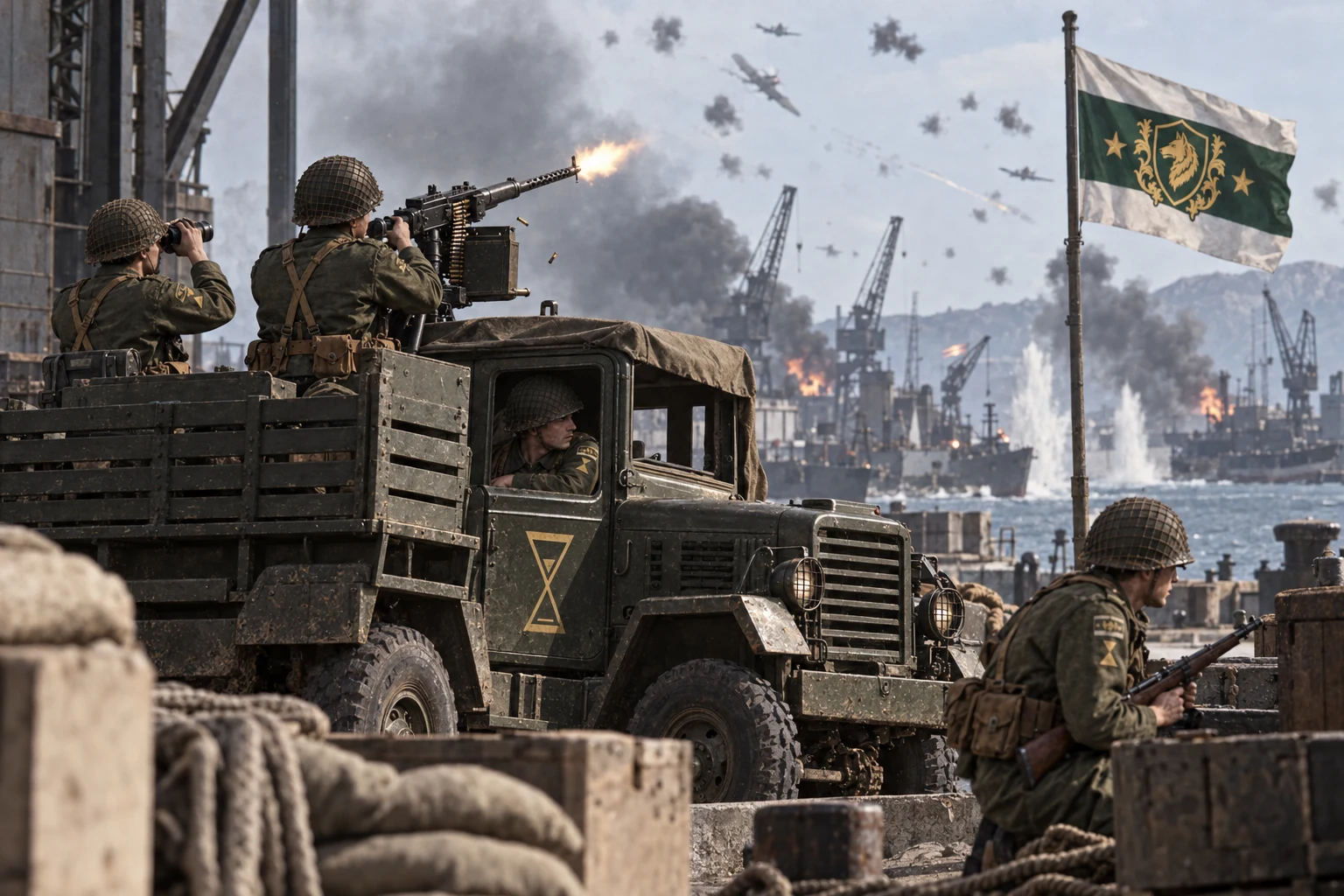
Kandar Harbor was attacked on June 8, 1223, while Silvia remained neutral. Its defensive action during the attack and declaration that evening marked the transition into belligerency. This order of events matters to the campaign’s meaning. The harbor was not an existing Allied war base, and the attack cannot be explained as interruption of a secret Silvian war already under way. Previous harassment and deteriorating diplomacy had encouraged preparations, but preparation for possible violence was different from a decision to join the world war.
The port also possessed several overlapping functions. Warships were undergoing repair, maintaining ordinary service or preparing for other work. Commercial and civilian activity shared facilities with the navy. A battle strength assembled from every vessel present therefore does not describe a single ready formation waiting to maneuver together. The relationship between physical presence and immediate availability is essential to understanding the scale of destruction. It is also essential to understanding rescue, because people and craft outside the usual lists of fighting strength performed indispensable work once the attack began.
The Kelonese plan sought to damage Silvian naval power and constrain the republic’s choices before its full mobilization. That objective contained two different predictions: military losses would reduce immediate capacity, and the political effect of those losses would favor imperial purposes. The first could be measured in damaged facilities and ships. The second depended on decisions by Silvia’s government and people, whom the attackers did not control. Kandar’s importance comes partly from the divergence between a destructive tactical achievement and the wider consequences that followed it.
Kuro’s operation and Seko’s wider authority
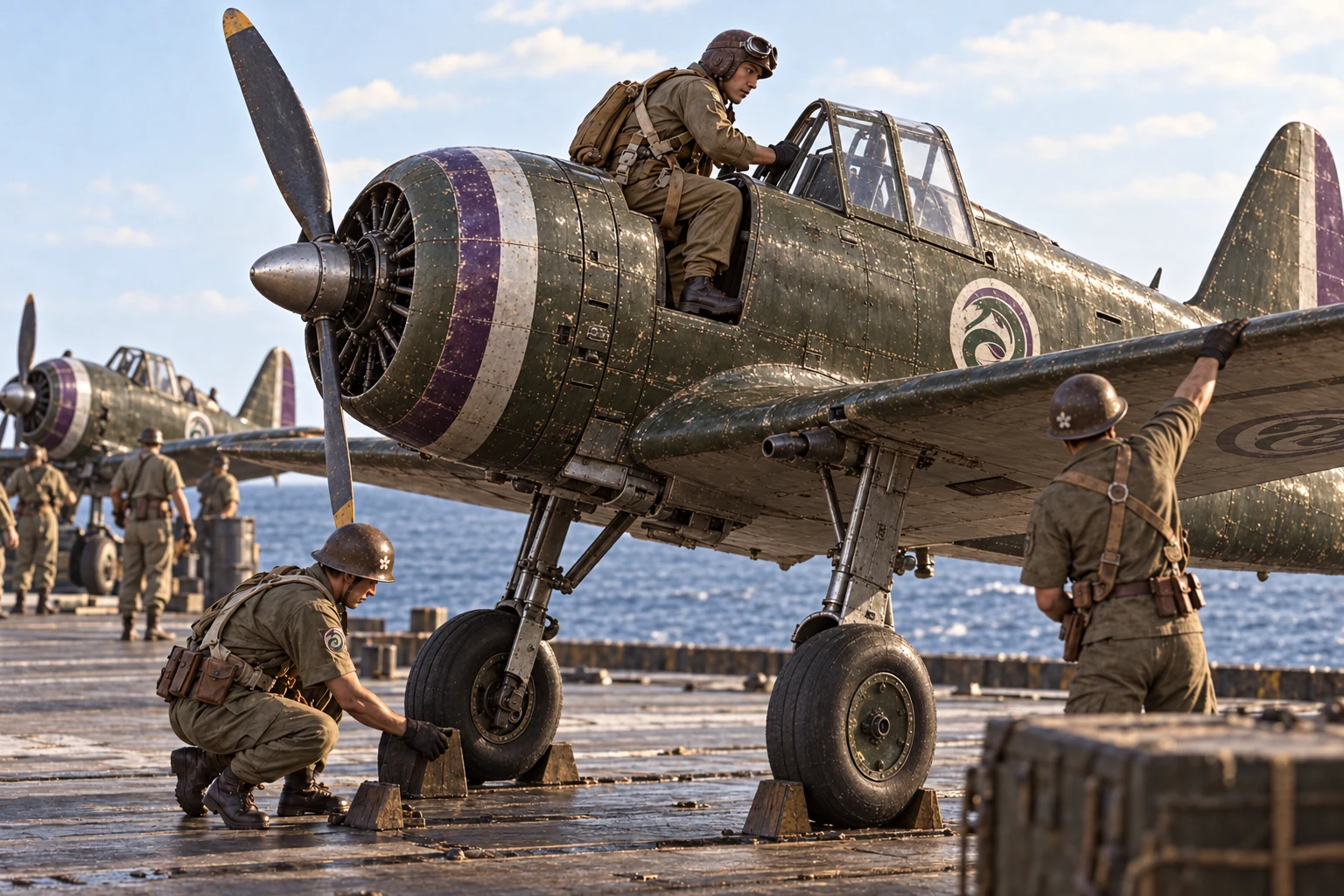
Vice Admiral Masen Kuro commanded the Kelonese 3rd Strike Fleet for the operation. Six fleet carriers launched 432 aircraft in two principal waves. The first reached the harbor at 06:12 and the second at 07:26. Thirty-one attacking aircraft were lost. These figures belong to this particular action. They should not be enlarged by importing the later establishments of either navy or treating every ship under imperial authority as if it participated off Kandar that morning.
Admiral Taren Seko retained wider naval authority. Distinguishing his position from Kuro’s prevents two opposite errors: attributing every tactical decision to the supreme naval level, and presenting an operational commander as if he independently determined imperial policy. The attack required organized resources and authority beyond a single flight group. Its immediate conduct nevertheless occurred through a specific striking fleet. A serious account needs both levels to discuss purpose, execution and consequence without making one officer a fictional substitute for the whole system.
The two waves did not meet a harbor whose awareness changed everywhere at once. Warnings reached different installations at different moments. Some observers recognized the threat promptly; others faced unfamiliar activity amid the ordinary movement of a large port. A warning transmitted from one office could be absent at a ship already losing its usual means of communication. This unevenness explains why simultaneous attacks could produce markedly different responses without requiring a simple division between vigilant crews and negligent crews.
The first minutes: Readiness changes under damage
Crews trying to reach defensive stations found routes altered by the attack itself. Damage blocked, flooded or crowded passages with wounded. Silence from a gun station could mean destruction, broken communications or a crew too occupied to report. Commanders had to act while those possibilities remained unresolved. Familiar drills offered habits of response but could not guarantee that the ship’s physical arrangement still permitted the practiced movement. The harbor’s first battle was therefore partly a struggle to reestablish a usable picture of its own forces.
Defensive fire developed unevenly because installations had different views and different communications. The crowded setting added danger from misidentification and falling fragments. Visible fire would later dominate recollection because it gave a recognizable military form to resistance. Less visible work kept surviving systems useful: passing corrected information, locating isolated personnel and maintaining access for repair parties. Those tasks help explain why some ships survived severe damage, and why merely identifying the moment a crew opened fire does not describe its whole contribution.
Lieutenant Nara Vesk acted at a repair berth after the normal command route was interrupted. She organized surviving deck personnel, established which compartments remained occupied and required that rescue assignments be recorded. Written messages helped preserve instructions obscured by noise and smoke. The measure did not mean she possessed accurate knowledge of the entire ship. Its value lay in making incomplete knowledge and subsequent corrections usable, so that scarce parties were not sent into damaged spaces without anyone retaining an account of where they had gone.
The same conditions confronted attackers evaluating results. Smoke, disrupted facilities and damaged ships could show that strikes had achieved destruction without revealing each vessel’s final disposition. A tactical report made during the action was not yet a reconciled inventory of losses. Keeping those forms of knowledge separate does not diminish the attack’s catastrophic scale. It prevents later definitive totals from being placed in the mouths of people who, while fighting, could only observe a fragment of the damage.
The harbor’s small craft and shore hospitals
Rescue began before the attack and its dangers had ended. Civilian crews joined naval craft in recovering people from the water and moving wounded from damaged ships. The craft were not interchangeable. Capacity, stability and ability to approach wreckage shaped whom they could carry and where they could work. Harbor officers redirected some boats as information changed, so a craft’s original assignment might not describe the people it eventually saved. This was coordination through an evolving emergency rather than a complete rescue plan unfolding as rehearsed.
The shore hospitals received casualties before comprehensive notification reached them. Personnel cleared space, summoned colleagues and asked transport to return for further patients. Identification followed treatment when immediate injury made delay unacceptable. Temporary records helped maintain continuity as patients moved through rooms and institutions. This administrative work had consequences for medical care and for families. A survivor could become effectively missing to his unit if transfer preserved his body but lost the connection to his name and destination.
Vesk’s berth became a collection point for survivors from several vessels. The growing crowd made it harder to move medical parties and maintain defense. She separated those able to assist, those needing treatment and those prepared for transfer. These distinctions allocated tasks according to current condition rather than treating every surviving sailor as immediately available combat strength. They also resisted the tendency to describe rescue as one decisive moment. Receiving, sorting, treating and moving people remained necessary after a boat had brought them out of the water.
Sailors who could still act resisted leaving comrades whose locations were uncertain. Continued search was necessary wherever it remained possible, but damaged compartments and recurring danger placed limits on what officers could promise. Those limits should remain visible in the account. There is no need to invent complete recovery to credit the rescuers’ courage. Their agency consisted partly in making difficult decisions with incomplete information and in preserving a record that later searches and reconciliations could improve.
Resolute Civic: The return that changed a register
Resolute Civic was at Eastbank Repair Berth Four for machinery work. Some crew members were ashore when the attack began. On returning, they encountered blocked access to their customary stations. Petty Officer Jalen Eri gathered them at a yard office, recorded names and sent parties aboard through the entrance still confirmed usable. The shore register prevented absence from a station being turned automatically into a missing-person report. It showed that readiness and accountability depended on people coordinating outside the hull as well as those already aboard.
Engineer Sora Venn examined reports after electrical service failed in parts of the cruiser. Damaged wiring could trigger alarms that resembled evidence of flooding, while real flooding demanded limited repair parties. Her distinctions directed work toward confirmed needs, and she revised them when parties returned with better information. Maintaining confidence in an initial diagnosis would have been less useful than correcting it. The ship’s survival depended on decisions that accepted an evolving picture rather than a single authoritative first report.
At 09:18 a trapped repair gang was located in an adjoining service chamber. Restoring access took forty-six more minutes. The recovered group included two yard civilians and a sailor whom witnesses had reported dead after the compartment was struck. This episode illustrates why eyewitness evidence was indispensable and still subject to correction. Witnesses could accurately describe the strike without knowing what happened to every person inside. Rescue supplied another kind of evidence, changing the disposition of people who had already entered provisional accounts of loss.
The cruiser returned to service in March 1224. That recovery should not be used to minimize the losses incurred while its condition was uncertain. It also should not be understood as if the ship resumed an uninterrupted operational identity the moment damage stopped. Repair, medical recovery and reconciliation took time. The February 1224 register placed the rescued people within the definitive accounting before the ship’s return. A damaged institution and the lives connected to it followed related but different chronologies.
Destruction and the dates of its accounting
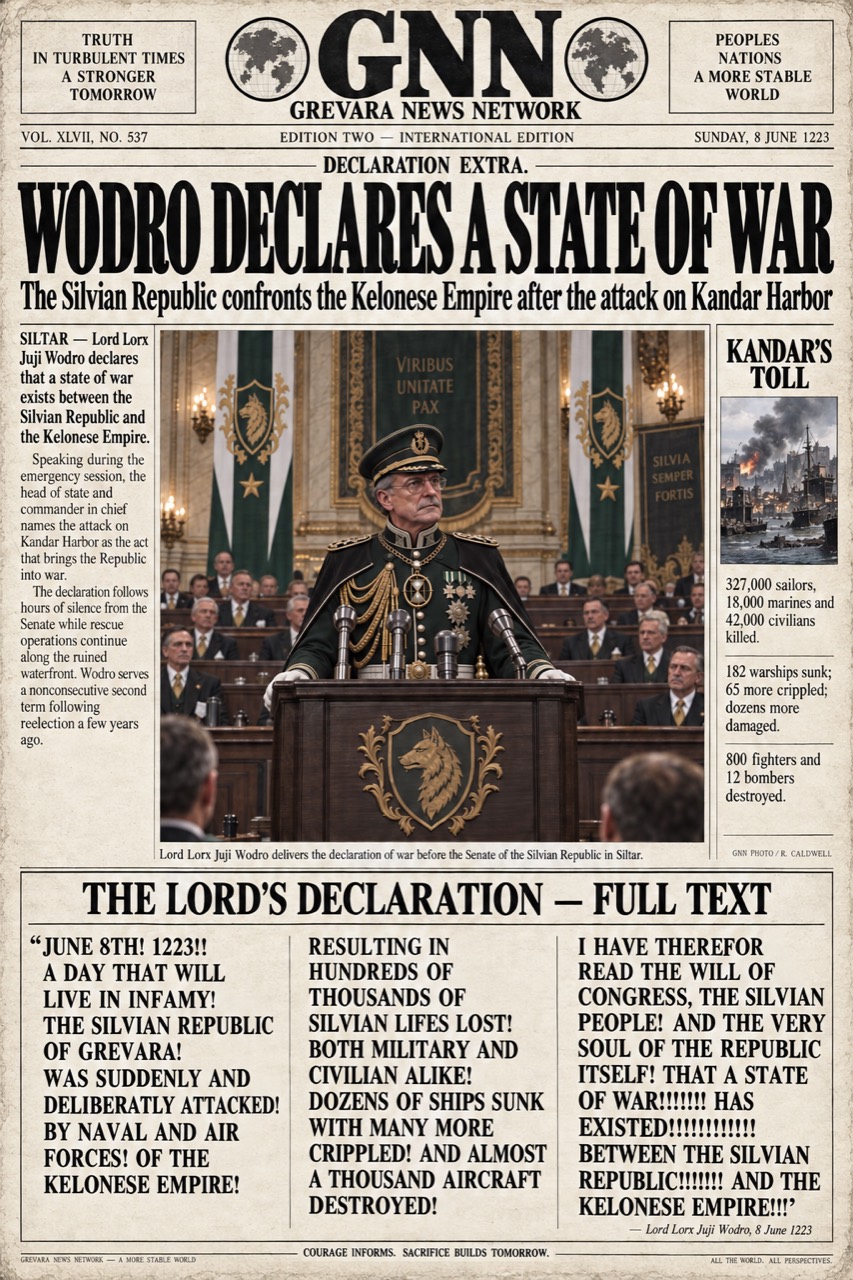
The June 8 GNN declaration extra reported 327,000 sailors, 18,000 marines and 42,000 civilians killed, totaling 387,000. The later individual register, fixed in February 1224, also recorded 5,927 wounded, including 1,824 civilians. The retained account identifies 182 warships sunk, sixty-five crippled and dozens more damaged. Silvian aircraft losses were 800 fighters and twelve bombers destroyed. These are the archive’s stated totals; this synthesis does not infer additional victims or reduce their scale through comparison with an external historical war.
The figures describe different kinds of loss and different moments of knowledge. The newspaper’s extraordinary same-day report presented the catastrophic national event. Reconciliation identified people and dispositions through later evidence. A first-day report that a sailor was dead could be corrected without making the final register optional or treating its definitive totals as instantaneous knowledge at every hospital and ship. Reading both layers together preserves the catastrophe’s recorded scale while permitting the narrative to follow uncertainty as participants experienced it.
Civilian deaths and wounds cannot be relegated to a supplementary harbor statistic. The port’s workers, craft crews, medical staff and families belonged to the functioning society attacked there. Some civilians were saved alongside naval personnel; others entered the final register because the destruction reached their workplaces and ordinary movements. A military inventory alone would conceal this dimension. Conversely, recording civilian suffering does not require inventing individual biographies or scenes unsupported by the retained account. The known repair gang and hospitals already connect operational events to human outcomes.
Evening: A declaration with a defined enemy
Lord Lorx Juji Wodro received military assessments while the government prepared its response. Senate concurrence came late in the afternoon, and the evening declaration ended neutrality. The attack’s perpetrator was the Kelonese Empire. A declaration against it did not automatically place Silvia at war with all 107 eventual Axis nations. Distinguishing the immediate declaration from the expanding alliance roster keeps the chronology precise and preserves the political acts through which participation widened afterward.
Silvia’s pre-entry force in 1223 was 450,000 under a volunteer-only system. Kandar did not transform that system into conscription. The later expansion to eighteen million in 1232 and twenty-four million in 1235 required institutions, incentives, training and support beyond the immediate declaration. Those later strengths belong to their own annual dates and cannot be assigned to the harbor’s defense. They demonstrate the scale of the subsequent national commitment without implying that the casualties and harbor damage were effortlessly replaced.
For families gathering at information points that evening, national belligerency did not resolve individual uncertainty. Search, treatment and repair continued. The declaration gave the attack a public political meaning while survivors still lacked complete lists of missing comrades and hospital staff revised destinations. A campaign synthesis needs to hold these times together: the decision that altered the world war and the unfinished work by which people learned what that decision meant for their households.
Kandar’s place in the wider war
The striking fleet inflicted devastating damage and Silvia responded by entering the conflict. The resulting strategic effect cannot be judged solely by the success of the two waves in reaching targets. The republic’s future forces became a major component of Allied recovery, but that future depended on decisions and institutions constructed after the attack. Kandar opened that trajectory; it did not contain an already complete plan for Orava, Red Mangrove or SharkStrike waiting to be implemented.
The recurring officers and ships illuminate a second consequence: the republic had to learn how to preserve operational institutions amid mass loss and disruption. Resolute Civic’s repaired hull, corrected crew record and delayed return are evidence of that work on one scale. The amphibious failures that followed showed that entering war with determination did not supply every needed skill. Kandar belongs at the beginning of that learning sequence precisely because its destruction was real and its survivors’ subsequent competence had to be built.
Another distinction concerns destruction and capacity. A crippled vessel might survive and still be absent from the force able to fight the next operation. A rescued sailor might remain alive and require months of treatment before returning to service. Counting only sunk hulls would understate interruption, while treating every surviving hull as ready would overstate recovery. Resolute Civic’s chronology provides a concrete example of why inventories require dates and conditions. National expansion later in the war should be read with the same care rather than treated as an undated reservoir from which the harbor’s losses could immediately be restored.
The attacker’s thirty-one aircraft lost also belonged to a continuing institution. The retained figures establish the cost of this strike without establishing the subsequent availability of each carrier, air group or crew. It would be misleading to invent a complete imperial replenishment history from the result alone. What the battle does show is that the striking fleet retained enough organization to carry out two major waves and inflict immense losses. The campaign’s later political failure did not mean its operational execution was ineffectual, just as successful execution did not confer control over Silvia’s political response.
The most useful connection to the later archives is consequently a set of questions rather than a claim of inevitable victory: how did the republic restore lost functions, preserve trained experience, recruit volunteers and coordinate a much larger force? Kandar supplied urgency and survivors, but each answer required subsequent work. Keeping those questions open allows the campaigns that follow to retain their own causes, failures and decisions instead of becoming illustrations of an outcome supposedly decided on the first day.