Proposed canon. Dates, tactical sequences and local positions are newly developed unless the text explicitly identifies a creator or source anchor. Related images document the wider war; they are not photographs of this proposed battle.
Strategic objective
Noryndorian remnants and Avenrath seek a viable route for personnel, equipment and relief supplies. Kharveth attempts to isolate those forces from the resources needed to continue the war.
Ground & operational constraints
The proposed corridor uses Allied-controlled receiving points and maritime transfers. It does not assume a military transit agreement through neutral Braskor, Valmyr or Seradune.
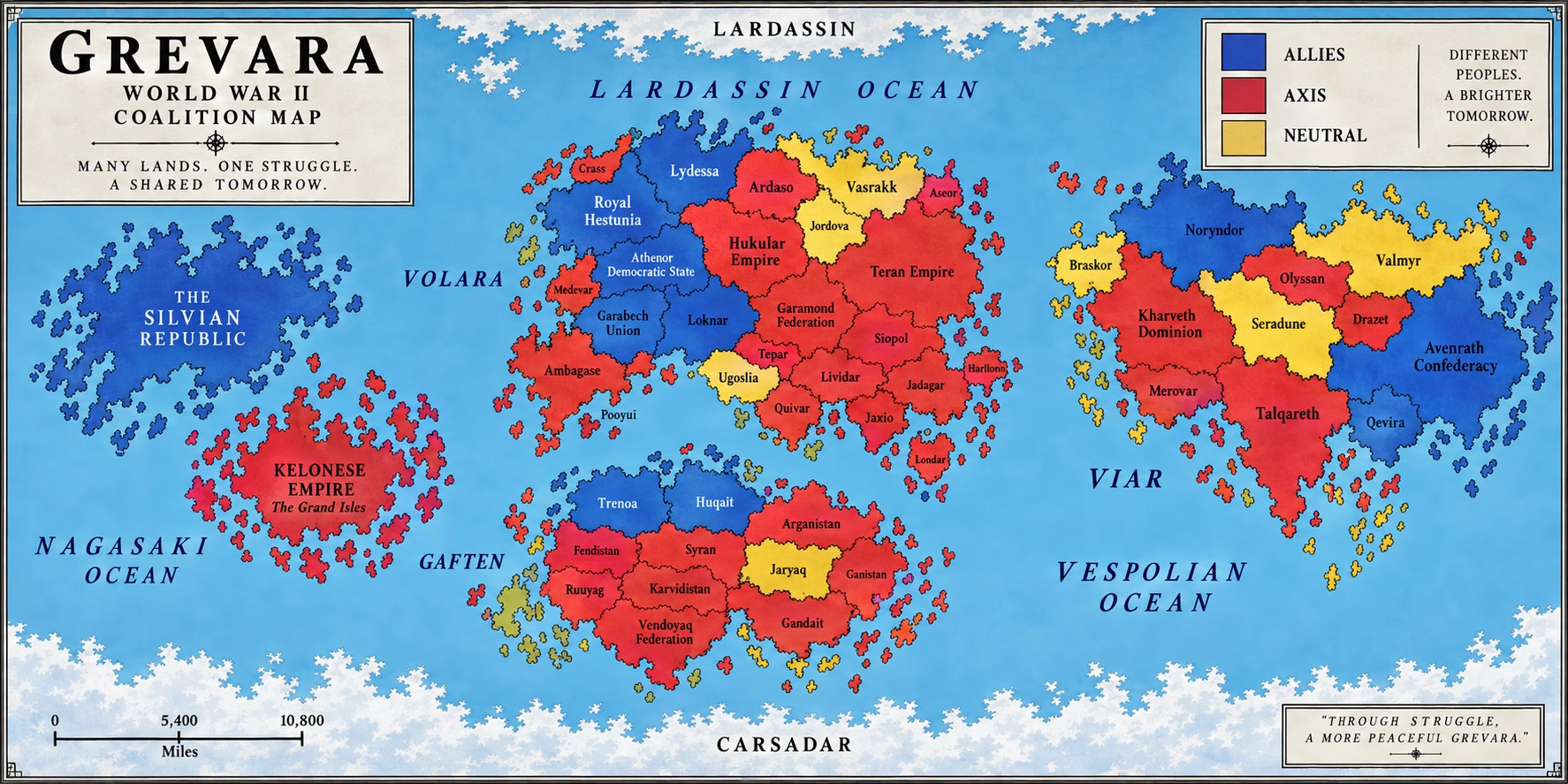
● Axis ● Allied ● Neutral · Zoom reveals cities, engagements and local positions. Drag to pan; use +/− or Ctrl+scroll to zoom. Hold over a marker for 5 seconds; click, tap or press Enter for immediate details.
Battle reference table
| Reference | Record |
|---|---|
| Dates | 1213-05-04 — 1214-01-31 |
| Participants | Kharveth Dominion; Noryndor; Avenrath Confederacy |
| Scale | Colossal |
| Status | Proposed canon |
Commands & participating forces
Named operational commanders and supporting force groupings below are proposed additions unless explicitly marked creator-established. They are not a recovered order of battle or a claim of precise unit strength.
| Nation | Commander | Status | Forces |
|---|---|---|---|
| Kharveth Dominion | Varek Khorr | Proposed operational commander | Operational columns combine mechanized advance guards, infantry follow-up, heavy guns and occupation detachments; repair and rail control enable sustained advance. |
| Noryndor | Evan Norren | Proposed operational commander | District field formations protect mobilization centers with reserve infantry, railway services and a dispersed repair organization; survivors later operate through Allied support. |
| Avenrath Confederacy | Selan Avrek | Proposed operational commander | Provincial infantry contingents, a confederate artillery pool and a centrally controlled reserve defend crossings under common traffic and engineer coordination. |
Fighting, tactics & logistics
The first requirement is administrative: surviving Noryndorian personnel need destinations, unit records and a recognized command relationship before evacuation can become renewed military participation. Avenrath’s receiving authorities separate wounded personnel, civilians and troops capable of immediate reorganization. This prevents the entire movement from being described as an intact army magically reappearing abroad.
Kharveth’s pressure focuses on predictable transfer points. Allied commanders respond by dividing the movement among smaller receiving sites, but that choice creates new problems. Stores become scattered, specialists arrive separately from equipment, and the receiving side needs reliable records to reconstruct usable formations. Avenrath commits transport and liaison staff to make the scattered arrivals useful.
The final phase connects reorganized detachments with the wider Viar defense. Noryndorian officers retain responsibility for their personnel, while Avenrath supplies specified support and movement capacity. The corridor remains vulnerable and cannot sustain every desired operation. Its achievement is the survival of organized participation despite the loss of a secure national rear.
Civilian consequences
Displaced households travel within the same restricted transport system. The proposed narrative distinguishes civilian relief from military rebuilding and does not treat refugee admission by a neutral state as proof of alliance.
Outcome & wider significance
The corridor preserves Noryndorian military and political continuity. Its limited capacity explains why recovery remains gradual and dependent on Allied cooperation.