Proposed canon. Dates, tactical sequences and local positions are newly developed unless the text explicitly identifies a creator or source anchor. Related images document the wider war; they are not photographs of this proposed battle.
Strategic objective
Silvian responders clear a channel for rescue amid the documented harbor catastrophe.
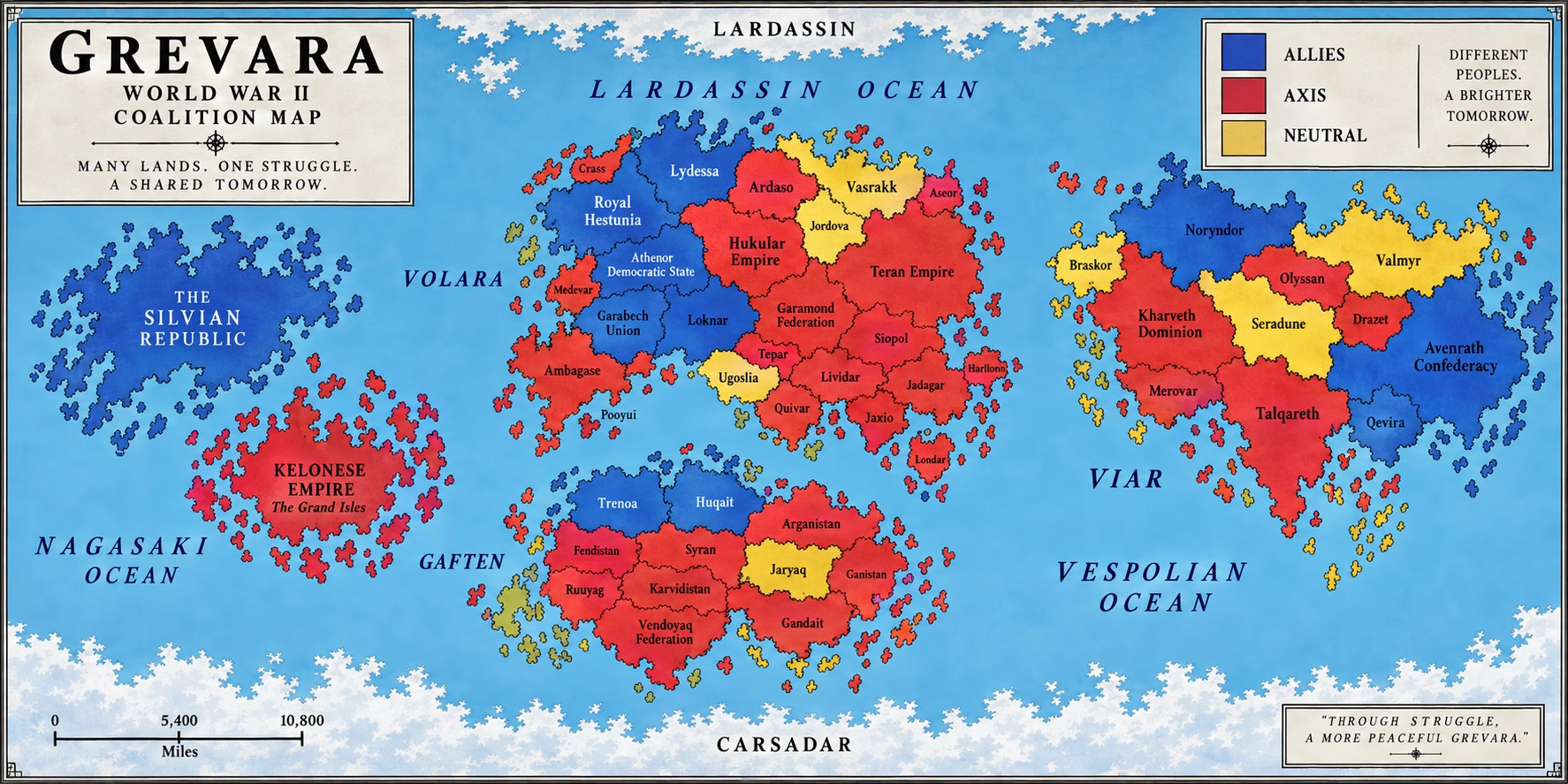
● Axis ● Allied ● Neutral · Zoom reveals cities, engagements and local positions. Drag to pan; use +/− or Ctrl+scroll to zoom. Hold over a marker for 5 seconds; click, tap or press Enter for immediate details.
Battle reference table
| Reference | Record |
|---|---|
| Dates | 1223-06-08 — 1223-06-11 |
| Participants | Kelonese Empire; Silvian Republic |
| Scale | Moderate |
| Status | Proposed canon |
Fighting, tactics & logistics
The attack and its supplied casualty totals are canon; this rescue action is proposed. Guard teams separate rescue traffic from burning wreckage while naval crews mark hazards. The channel helps survivors without reversing the fleet losses.
Civilian consequences
Hospitals receive military and civilian casualties simultaneously, and identification work continues after rescue ends.
Outcome & wider significance
The channel helps survivors without reversing the fleet losses.
Developed battle history
The battle in detail
Expanded Grevara lore: new events, characters and in-world accounts developed for this archive. Supplied historical quotations retain their source links.
The morning watch and the harbor economy
In this proposed reconstruction, Kandar’s waterfront begins 8 June with several overlapping routines. Naval working parties prepare stores for ships alongside the piers. Dockyard shifts exchange tools and work orders. Civilian shopkeepers expect business from the parade, while families make their way toward the waterfront. The people involved do not experience themselves as occupants of a future battlefield. Their immediate concerns are wages, duty rosters, children, transport and the ordinary inconvenience of sharing a crowded port with a large fleet.
The proposed harbor district of East Ledger illustrates how those routines depend on one another. Its warehouses stand behind a line of naval receiving offices, with tram stops farther inland and a municipal dispensary serving dockworkers. The name and arrangement are newly developed geography, not locations established by the supplied map. Their purpose in the narrative is to give the destruction a human and administrative setting without pretending that an exact harbor survey survives.
Among the fictional figures introduced here is Mara Venn, a municipal records clerk assigned to help register parade visitors arriving through the eastern district. Her work places her near civilian transport rather than inside naval command. Another is Chief Dock Engineer Oren Tal, whose authority concerns cranes, workshops and damaged facilities. Neither replaces an established commander or becomes the secret architect of the entire response. Their separate perspectives allow the history to follow a city and a fleet whose needs overlap without being identical.
The harbor’s concentration of skilled labor later magnifies the consequences of the attack. A destroyed workshop represents equipment, drawings, apprenticeships and relationships between specialists. Losing its workforce cannot be repaired simply by delivering another machine. Kandar’s importance rests partly on this accumulated knowledge, which the casualty totals describe only indirectly.
An attack understood in fragments
The attack reaches different parts of the harbor as noise, smoke, interrupted movement and contradictory reports. This reconstruction does not assign an unsupported minute-by-minute timetable, aircraft count or numbered sequence of attack waves. Instead it follows the fragmentation of information. A sailor inside a machinery space, a sentry on a quay and a civilian near the parade route can all witness the same catastrophe while knowing very little about its overall extent.
At East Ledger, the first useful information is local: a route is blocked, a building has caught fire, injured people are arriving from the waterfront. Venn begins writing destinations on scraps of office paper because the usual system for directing visitors has become useless. Her earliest lists concern places people have been sent, not authoritative casualty returns. Later investigators would have to distinguish these hurried movement notes from confirmed records of death.
Tal receives incompatible requests from naval and municipal messengers. One asks for lifting equipment at a damaged berth; another reports people beneath a collapsed loading shed. The proposed episode gives him no miraculous view of the whole disaster. He sends workers toward tasks that can be reached and completed with the available equipment, leaving other requests unanswered until conditions change. Those omissions become a source of later bitterness even where the decision was unavoidable.
Across the port, surviving commands try to discover which communications still function. A report that a ship is afloat does not establish whether it can move, fight, provide power or accept wounded personnel. A report that a building remains standing does not establish whether anyone can enter it. The first command picture is therefore a patchwork of usable functions rather than an accurate map of intact and destroyed objects.
The eastern quay rescue
The proposed eastern quay episode begins with a loading shed whose waterside entrance has become inaccessible. Survivors can be heard from the landward side, but debris blocks the approach needed by the available lifting equipment. Tal’s workers join naval personnel and nearby civilians in clearing a narrow access lane. The work proceeds in short intervals because surrounding fires and unstable structures repeatedly force people back.
This is deliberately a small story within a catastrophe of enormous scale. The rescue party does not save an implausible share of Kandar’s population or alter the established totals. Its significance lies in the competing demands placed on ordinary expertise. A dockworker knows where a service passage runs; a naval electrician recognizes that a damaged cable must be isolated; a municipal driver finds a way to move injured people without blocking the next vehicle. None of those contributions is visible in a simple list of ships lost.
As casualties emerge, the group discovers that removal from the building is only the first stage. Carrying parties need a destination with space, staff and supplies. Venn’s improvised receiving list becomes useful because it records which nearby stations are already overwhelmed. People are redirected farther inland, increasing journey time but preventing the closest dispensary from becoming a place where incoming patients simply accumulate.
The episode ends without a clean moment of triumph. Some people are recovered alive, others are found too late, and some remain unreachable when the party must withdraw. The proposed narrative preserves that uncertainty instead of giving every named rescuer a successful outcome. Rescue work can be necessary, courageous and incomplete at the same time.
When a fleet loses its shore
For surviving naval officers, the destruction of shore facilities creates a different emergency from the loss of ships themselves. A vessel may retain its engines yet lack a clear route out. Another may have enough crew to fight a fire but not enough to restore normal operation. Ships dependent on shore services suddenly require functions that neighboring damaged vessels are also seeking.
The proposed temporary harbor coordination office occupies a surviving administrative building away from the main waterfront. Its staff begins with a functional inventory: available tugs, working communications, accessible medical spaces, intact fuel-handling points and berths that can still be approached. The inventory changes as new reports arrive. It is not presented as a complete list of Kandar’s surviving assets, because the sources do not supply one.
An early dispute concerns whether scarce towing capacity should clear a channel or help an individual damaged ship. The answer depends on whether opening the channel will allow several other movements to proceed. Officers responsible for a particular vessel naturally see the urgency of their own situation; the coordination staff must compare it with needs elsewhere. The resulting choices can look callous from the deck of a ship left waiting.
Tal’s dockyard assessment feeds into those decisions. He identifies which damaged cranes might be restored locally and which require equipment no longer available in the harbor. Commanders discover that nominally surviving installations are not equally useful. A pier with no safe landward access may contribute less than a modest berth connected to an intact road. The proposed episode explains why recovery is measured in working relationships among facilities, rather than the appearance of individual structures.
The Guard and the movement of a wounded city
The creator-established Guard response becomes more concrete in the proposed inland reception district. Guard personnel organize access to roads, protect temporary treatment areas and help direct people searching for relatives. Their task is not portrayed as an effortless restoration of order. Many responders have incomplete instructions, damaged communications and personal reasons to fear what has happened near the harbor.
A fictional Guard lieutenant, Sera Dalven, receives responsibility for a road junction serving both a treatment station and an emergency supply point. Her immediate problem is incompatible traffic. Families want to reach the waterfront; vehicles carrying injured people need to leave it; medical supplies need to move in the opposite direction. Simply admitting everyone would prevent the junction from serving any of those purposes.
Dalven establishes a receiving point where names and destinations can be recorded before people are redirected. The account does not invent a national emergency law or imply that one junior officer controls the entire city. It follows the limited authority necessary to keep one part of the response functioning. Her personnel also face complaints from residents whose homes lie beyond the cordon, reminding the reader that emergency restrictions affect survivors who have already lost contact with family.
As darkness approaches, the district’s problems change. Exhausted volunteers need relief, lighting is unreliable and arriving supplies must be accounted for before distribution. Venn’s records are copied so that information does not depend on a single person remaining awake at one desk. This small administrative transition marks the change from spontaneous response toward an emergency organization capable of continuing through another day.
The declaration and the limits of immediate power
Wodro’s declaration belongs to the established political record. The surrounding reconstruction follows how a clear national decision coexists with continuing uncertainty at Kandar. Declaring war answers the question of political commitment; it does not instantly restore a harbor, identify every casualty or assemble a replacement fleet. Those problems continue after the speech ends.
In the proposed cabinet aftermath, officials work with categories of need rather than a complete operational plan. The immediate requirements concern relief, surviving forces, transport, communications and the protection of other installations. Broader demands for recruitment and production must be translated into instructions that existing institutions can execute. The account does not attribute invented quotations to Wodro or claim access to an authentic cabinet transcript.
The political effect nevertheless reaches the harbor. Survivors understand that the attack will not be treated as an isolated diplomatic incident followed by a return to the previous policy. For some, that knowledge gives purpose to exhausting work. For others, it means that family members who survived the first disaster may face years of further danger. Public resolve and private dread are not mutually exclusive responses.
The declaration also changes how shortages are discussed. Requests from Kandar now compete within a widening national mobilization, but the port cannot simply be abandoned while attention moves elsewhere. Its survivors, facilities and remaining ships are part of the Republic’s future capacity. The proposed administrative struggle therefore concerns how to sustain urgent recovery while preparing a war whose duration and eventual cost remain unknown to the people making those first decisions.
Names, missing people and the first returns
The established figure of 387,000 dead is a later aggregate in this narrative, not a number every person at the harbor knows during the attack. Its three supplied categories remain unchanged: sailors, Marines and civilians. The proposed records story concerns how a society confronted by mass death tries to connect such totals with individual lives.
Venn’s office receives lists from treatment stations, temporary shelters and naval receiving points. A name may appear more than once because someone has been transferred. Another may be misspelled because an exhausted recorder wrote what could be heard. People who are safe may remain listed as missing until their location reaches the relevant office. These problems explain the work involved in casualty accounting without inventing a rival total.
Naval and civilian systems also use different identifiers and answer different institutional questions. A naval return must establish the status of a service member and the effect on a unit. A municipal list may need to identify dependents, housing needs and relatives able to receive news. Joining the two requires cooperation, but one system cannot simply replace the other.
The fictional clerk’s most difficult task is communicating uncertainty honestly. Families want a yes or no answer where the records contain only an unconfirmed location. The account avoids manufacturing a poignant quotation or a miraculous reunion to resolve every case. Some entries remain unresolved through the first emergency period. The emotional force of the episode comes from the delay between public knowledge of catastrophe and a household’s knowledge of what has happened to one particular person.
Salvage, labor and the argument over priorities
As the immediate emergency gives way to prolonged recovery, the harbor acquires another kind of front: a queue of tasks larger than the available skilled workforce. Wreck clearance, dock repair, temporary services and assessment of damaged ships all require people who cannot be everywhere at once. Surviving specialists also need food, rest and somewhere to live.
Tal’s proposed repair register separates work that restores a shared service from work that benefits one vessel or workshop. Reopening a transport connection may allow several later repairs to proceed. Restoring a prestigious ship may have great symbolic value while consuming scarce capacity. The narrative presents this as a genuine institutional disagreement rather than assuming that symbolic concerns are always foolish or that engineers alone can determine national policy.
Civilian contractors enter the recovery system alongside military organizations. Their machinery, labor and records help restore functions that uniformed services cannot supply immediately. Payment disputes and requisition claims begin before the wreckage is cleared. A contractor whose equipment has been destroyed may still be asked to produce work, while employees need wages even if the original office and payroll records are gone.
The proposed compromise gives priority to a limited set of shared harbor functions and records deferred claims for later examination. It does not erase hardship or establish a miraculous reconstruction schedule. Its importance is that the Republic begins creating a process for deciding among competing needs. Recovery becomes something more durable than whoever can reach the loudest official with the most urgent request.
Kandar’s place in the war that followed
Kandar becomes a national symbol because it joins personal loss to a decisive political turning point. Yet its later use in speeches and military memory can flatten the variety of experiences inside the event. The sailor aboard a crippled ship, the Marine at a shore installation, the civilian at the parade and the worker restoring a damaged pier do not have interchangeable stories.
The proposed later history of East Ledger follows several outcomes rather than one commemorative ending. Some surviving dockworkers return to the waterfront. Others move into different war industries because their original shops no longer exist. Venn’s emergency lists become part of a larger municipal record, while Tal’s early assessments are revisited as new equipment and priorities make previously impossible repairs feasible. Dalven’s Guard personnel are relieved and reassigned rather than remaining forever frozen in the role they held on the first day.
These invented continuities fit around the established record without changing the attack’s date, casualty figures, ship losses or consequence for Silvian neutrality. They also explain why a battle history should continue beyond the final explosion. Damage persists in personnel systems, budgets, households and strategic choices long after the attackers have departed.
Kandar’s significance is therefore both immediate and cumulative. The attack brings Silvia into the war on 8 June 1223. The work of answering it extends through rescue, reconstruction, training, industrial conversion and later campaigns. Treating those processes as part of the history gives the catastrophe weight without turning every subsequent Silvian success into an inevitable result of a single day.
Full campaign dossier
Each chapter below identifies its evidence status. Source-grounded analysis interprets the cited record; proposed chapters develop additional history for creator review.
Chapter 1 · Source-grounded analysis
The first emergency: access, rescue and triage
The Guard establishes cordons and relief stations while rescue teams search collapsed buildings. Medical parties carry survivors toward temporary treatment areas. Roads into the harbor are crowded with emergency transport. These details establish an immediate command problem: uncontrolled movement could prevent responders from reaching the people they were trying to save.
A cordon has several simultaneous functions. It keeps spectators and returning relatives away from fires and unstable wreckage; protects routes for ambulances, rescue equipment and supply vehicles; and creates places where information can be gathered without forcing every family to enter the ruins. The source does not identify a complete incident-command chart. The interpretation here is that the visible Guard activity supports rescue by controlling access, rather than replacing medical personnel or assuming responsibility for every naval salvage decision.
Triage has a different time horizon from later accounting. Responders must decide where a living casualty can receive useful care before the authorities possess an accurate list of the dead. Consequently, the newspaper’s reported figures and the local uncertainty of rescue crews can coexist. A high-level announcement does not mean every individual has been identified or every family notified.
Chapter 2 · Proposed canon
A proposed harbor recovery command
A detailed recovery system can be developed without assigning invented speeches to real source figures. In this proposed arrangement, an emergency coordination office divides the harbor into access sectors. Naval officers assess floating hazards and surviving vessels, Guard detachments protect movement and relief points, municipal engineers examine roads and water services, and medical coordinators assign treatment destinations. The office resolves conflicts between these functions rather than trying to perform all of them itself.
The proposed first written product is a usable-route register. It marks which approaches can carry heavy vehicles, which are reserved for casualty movement and which remain closed because of fire or structural danger. Updates are delivered by runners and available communications equipment. A route is reopened only after the responsible engineer or naval party reports its condition. This avoids treating a road that looks clear from one end as safe for a full convoy.
A second register separates vessels by immediate operational usefulness: capable of moving, requiring tow, dangerous to approach, or obstructing a channel. These are proposed working categories, not additional loss figures. Their purpose is to direct scarce tugs, divers and repair teams toward work that improves rescue and access first.
Chapter 3 · Source-grounded analysis
9 June: mobilization is a process
The next day’s newspaper describes millions enlisting and Wodro declaring a wartime economy. Registration centers arrange medical examination, assignment and training. Factories begin reorganizing production. Existing stocks carry the immediate burden while new output requires labor, machine tools and deliveries to be rearranged. These details explicitly separate the decision to mobilize from completed military capability.
A volunteer cannot be counted as a trained replacement simply because a recruiting office has recorded a name. Instructors, accommodation, uniforms, weapons, medical screening and unit assignments determine how quickly recruits can become useful. The same distinction applies to industry. An order for more vehicles does not supply engines, skilled workers or transport capacity on the day it is signed.
The newspaper also places relief cargo among wartime priorities. That matters because the Republic cannot rebuild its war effort by treating Kandar’s civilians as a separate problem to be solved afterward. Food, shelter, treatment and access share the same transport network that the military now wants to expand.
Chapter 4 · Proposed canon
A proposed replacement policy after catastrophic loss
The proposed personnel response protects surviving specialists before maximizing the number of newly named formations. Naval engineering, signals, gunnery and damage-control experience cannot be replaced at the same rate as basic manpower. Experienced personnel are divided among operating units, repair work and training establishments. That creates an immediate tradeoff: an instructor cannot simultaneously fill a vacancy at sea, but sending every survivor back into operations would weaken the next wave of crews.
Marine rebuilding follows a similar logic. A large intake is organized around surviving cadres rather than assembled into entirely inexperienced formations with no practiced small-unit leadership. Training introduces landing craft, shipboard routines, communications and casualty evacuation in addition to weapons handling. This is a proposed institutional sequence, not a claim that the source supplies exact training durations.
The policy’s political difficulty is that visible recruitment outpaces visible revenge. Families may see crowded enlistment halls while the fleet is still assessing damaged ships. Wodro’s administration must explain that preparing a force for sustained war is itself action, even when it does not produce an immediate spectacular offensive.
Chapter 5 · Source-grounded analysis with proposed criteria
Salvage and the decision to repair
Salvage is not synonymous with restoration to combat. A wreck may be moved to clear a channel without ever being repaired. Machinery may be recovered from a ship that cannot sail again. A damaged vessel may require a dock that is itself unusable. The attack therefore creates a queue of interdependent tasks, with one repair enabling another.
Proposed repair priorities should consider operational value, expected time, availability of parts and the effect on harbor access. A modest vessel repaired quickly might restore an essential local function before a much larger warship can be made seaworthy. Conversely, a vessel occupying a critical berth may have to be moved even when it offers little future combat value. These criteria explain why the most imposing hull is not automatically the first sensible job.
The surviving fleet’s regrouping must also account for crews, ammunition, maintenance and escort requirements. A ship at sea is not necessarily ready for a prolonged offensive. The archive should show the fleet’s recovery as a sequence of practical improvements rather than a single announcement that Kandar has been avenged.
Chapter 6 · Proposed civilian reconstruction
Families, missing people and the long aftermath
The proposed civilian aftermath follows administrative consequences as well as grief. A family may know that a relative served at Kandar without knowing whether the person was aboard ship, at a shore installation or transferred elsewhere that morning. Local relief offices gather names, units and last known locations, but they avoid issuing death certificates solely from rumor. That caution can delay compensation and create further hardship even when it is necessary for accuracy.
Temporary housing arrangements place displaced harbor workers near transport where possible, because some are needed in recovery shifts. Others must move farther away to obtain shelter, making employment and family care harder. Schools, religious buildings and public halls used for emergency accommodation cannot immediately return to their ordinary roles. The damage therefore spreads through the social organization of the harbor districts.
These are proposed consequences grounded in the event’s scale, not quotations from named survivors. The distinction permits a substantial human history while preserving the integrity of the uploaded archive.