Strategic objective
The Kelonese attack ends Silvian neutrality and turns the Republic's mobilization into a national war effort. Lord Lorx Juji Wodro leads the state at entry.
For the separate rescue and recovery history, read The Kandar Rescue Channel.
JUNE 8TH! 1223!! A DAY THAT WILL LIVE IN INFAMY!
Excerpt from the supplied declaration. Capitalization retained.
Ground & operational constraints
The supplied harbor imagery is the visual authority. Its exact position on the political map is not fixed, so the atlas uses an estimated Silvian coastal marker.
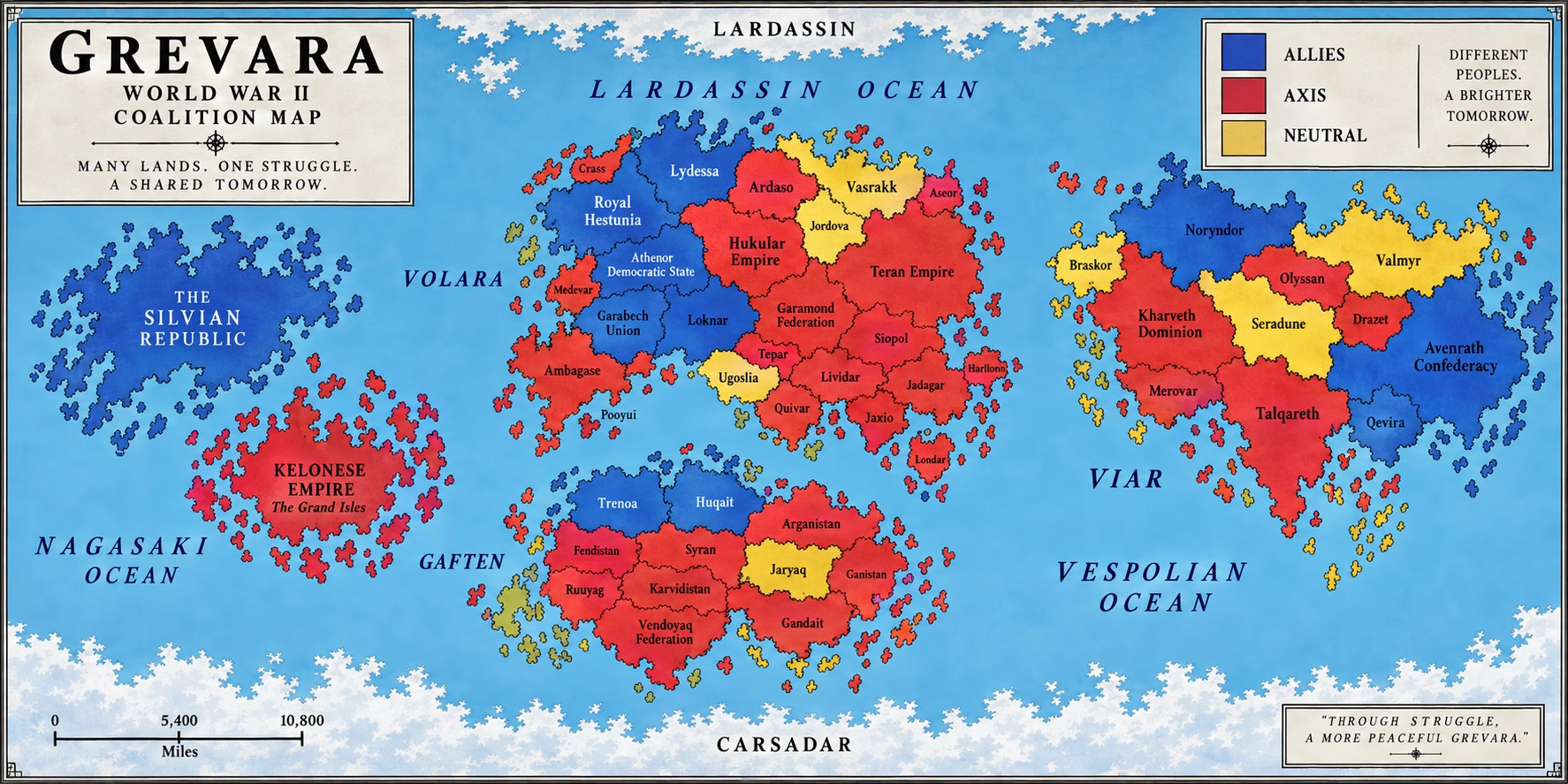
● Axis ● Allied ● Neutral · Zoom reveals cities, engagements and local positions. Drag to pan; use +/− or Ctrl+scroll to zoom. Hold over a marker for 5 seconds; click, tap or press Enter for immediate details.
Battle reference table
| Reference | Record |
|---|---|
| Dates | 1223-06-08 — 1223-06-08 |
| Participants | Kelonese Empire; Silvian Republic |
| Scale | Major |
| Status | Canon |
Commands & participating forces
Named operational commanders and supporting force groupings below are proposed additions unless explicitly marked creator-established. They are not a recovered order of battle or a claim of precise unit strength.
| Nation | Commander | Status | Forces |
|---|---|---|---|
| Kelonese Empire | Kezan Morai | Proposed operational commander | Imperial naval forces, naval infantry, island garrisons and dispersed coastal transport defend bases while competing for fuel, repair capacity and trained crews. |
| Silvian Republic | Lord Lorx Juji Wodro | Creator-established head of state and commander in chief | Permanent divisions operate within mission-based field armies. Specialist brigades, Logistics Divisions and Security Divisions provide distinct support roles; the original formation documents govern their organization. |
Fighting, tactics & logistics
Established facts: the stated dead include 327,000 sailors, 18,000 Marines and 42,000 civilians. The fleet loses 182 warships sunk and 65 crippled. The newspapers document rescue, declaration and mobilization. A precise minute-by-minute attack plan, individual target assignments and complete enemy order of battle are not supplied here.
Civilian consequences
Civilian deaths are part of the stated toll, not an incidental footnote. Rescue, identification, housing and medical care remain urgent after the attack ends. Military reorganization competes with these immediate needs.
Outcome & wider significance
A devastating Kelonese attack produces Silvian entry into the war. It does not imply that the destroyed ships are instantly replaced or that the Republic immediately lands millions overseas.
Developed battle history
The battle in detail
Expanded Grevara lore: new events, characters and in-world accounts developed for this archive. Supplied historical quotations retain their source links.
The objective: disable a fleet at its base
The Kelonese attack on Kandar Harbor was intended to destroy more than ships at anchor. The attacking command sought to break a concentration of Silvian naval power before that power could be organized for a sustained war against the Empire. Warships, naval aviation and shore installations formed parts of the same military system. Damaging them together offered a larger immediate result than fighting the fleet after it had dispersed and entered operations.
Within the expanded history, the Kelonese planning group called the harbor complex the Iron Basin. This was a staff expression for the target system, not Kandar’s official name. The planners treated the ships and supporting facilities as mutually dependent objectives: a vessel that survived without fuel handling, servicing or a usable route out might remain unavailable even if its hull was intact.
The attack also rested on a political gamble. Silvia was neutral. Destroying its forces might reduce the danger of future intervention, but attacking the Republic could produce the very national commitment the Empire feared. The Kelonese command accepted that risk without possessing a reliable way to measure how quickly the Republic could rebuild, how its political institutions would respond or how its eventual participation would change the broader coalition war.
Three immediate military effects dominated the operation’s planning: - Inflict losses on the concentrated fleet. - Suppress the aviation capable of contesting the attack. - Disrupt the harbor functions needed to turn surviving ships into usable naval strength.
These objectives explain the attack’s concentration. They do not establish that the planners controlled everything that followed. The destruction of a major military base also reached civilians gathered near it, giving the operation consequences far beyond an exchange between aircraft and warships.
The Kelonese command makes its wager
The expanded account introduces Rear Admiral Keshun Var as a Kelonese officer responsible for coordinating the striking force’s immediate naval arrangements. Var is a newly written character within the Empire’s wartime command, not a replacement for its national leadership. His role joins the requirements of the air attack to the movement and protection of the force supporting it.
The planning debate divides between officers who emphasize destruction inside Kandar and officers concerned with preserving the attacking force after the strike. The first group sees a concentrated opportunity that may never recur. The second recognizes that successful aircraft attacks do not automatically secure a safe return or eliminate every surviving Silvian force elsewhere.
Var’s decision favors a powerful initial commitment while retaining enough organizational control to recover surviving aircraft and move the force afterward. The history does not assign an unsupported number of carriers or aircraft to that decision. Its importance is the relationship between ambition and endurance: the Empire wants a decisive blow without consuming the naval instrument needed to continue the war.
A newly written line attributed to Var in the archive’s fictional staff account captures that tension:
“A harbor can be struck in a morning. The enemy it creates may have to be fought for years.”
— Rear Admiral Keshun Var, newly created in-world account
The remark is not a recovered quotation. It gives a voice to the strategic disagreement inside this expanded lore. Var recognizes the possibility of a long war, but recognition does not prevent him from participating in the decision that helps bring it about.
The approach and the defenders’ incomplete picture
The attackers approach a harbor whose defenders do not share one complete picture of the threat. Observation, local reports and command decisions move through separate channels. A watch station can identify something requiring attention without knowing its place in a larger operation; a headquarters can receive several reports without immediately understanding how they fit together.
The combat narrative follows Lieutenant Commander Soren Vel, a fictional Silvian officer serving aboard the destroyer Resolute Current. The ship is an invented participant in the established harbor disaster, and its story does not alter the supplied totals. Vel’s initial information is local: changing activity overhead, interrupted instructions and preparations aboard nearby vessels. He cannot see the attacking plan or know which installations have already been struck elsewhere.
The first unmistakable signs of attack compress the defenders’ decision time. Stations that might normally verify a report before changing their posture must now act while communications are becoming less reliable. Sailors move to duties, officers attempt to establish the condition of neighboring ships and shore commands try to determine which parts of the harbor remain connected.
The Republic’s neutrality has not made its military installations civilian spaces, but it has shaped the political environment in which the attack begins. The sudden transition from peace to combat is therefore both institutional and personal. For Vel’s crew, the immediate question is no longer whether a wider crisis may become war. It is whether their ship can organize effective resistance while the base around them is being attacked.
The first attacks inside the anchorage
The opening attacks strike a concentration in which ships have limited room to respond independently. Neighboring hulls, piers and the harbor’s own movement arrangements complicate attempts to change position. A captain cannot treat the anchorage as open sea, and the condition of a nearby ship can immediately affect what another vessel is able to do.
On Resolute Current, Vel receives reports from several stations before he can reconcile them. One concerns weapons ready for action, another a damaged connection, and another uncertainty about movement orders. He gives priority to keeping the ship’s immediate command functioning. That choice does not prevent damage, but it allows the crew to respond as an organized formation rather than as isolated parties reacting to whatever they can see.
A nearby vessel is struck and loses the ability to complete its intended movement. The obstruction changes the local situation for several ships at once. Signals requesting clearance compete with reports of further attack, while smoke makes visual interpretation more difficult. Vel’s destroyer remains in a position its officers would not have chosen if they had possessed freedom of movement.
The episode explains why the harbor’s concentration magnifies the attack’s effect. Each damaged vessel is an individual loss, but it can also change the choices available to others. The developing disaster is therefore not simply a sum of unrelated hits. It is a sequence in which damage to one part of the base alters the behavior and vulnerability of adjacent parts.
The anti-aircraft stations fight separately
Silvian anti-aircraft resistance develops under conditions that make coordination difficult. Some positions retain useful communications; others act primarily on what their crews can observe. Damaged power, interrupted reporting and obscured views prevent the defense from functioning as one perfectly synchronized system.
The expanded narrative follows Petty Officer Nara Ves at a shipboard defensive station. Her crew’s immediate task is to keep its equipment operating and maintain contact with the ship’s command while the situation around them changes. The account does not invent a technical firing procedure or claim that her station determines the result of the whole raid. It gives the defense a human scale without substituting one fictional crew for the entire naval garrison.
Ves sees aircraft pass through parts of the harbor where smoke conceals their later movement. Reports of apparent hits are difficult to verify. Officers collecting information after the attack must distinguish a crew’s reasonable battlefield impression from a confirmed loss. The chapter therefore does not create a precise Kelonese casualty tally from the viewpoint of one station.
Some defensive positions continue fighting despite damage nearby. Others fall silent because their equipment, communications or crews have been hit. From an attacking aircraft, those changes may look like the systematic elimination of the defense; from the defenders’ perspective, they are local events unfolding at different speeds. The resistance remains real even though it cannot prevent catastrophe. Its limits should not be mistaken for the absence of armed engagement.
The naval aviation grounds
The attack also reaches the aviation system associated with Kandar. The established record gives 800 fighters and twelve bombers destroyed. Those figures are retained as the event’s supplied aircraft losses rather than converted into an invented account of exactly where every aircraft stood or which attacking formation destroyed it.
The new narrative concentrates on a fictional servicing area known as South Apron. Flight Lieutenant Daren Hol arrives there during the attack and discovers that the distinction between aircraft present and aircraft usable has become urgent. Some machines are damaged; others cannot be moved through the available space; still others lack the personnel or servicing needed for immediate employment.
Hol’s account is a combat history of a military installation under attack, not a claim that the entire air response occurred at this one location. Personnel attempt to keep functioning aircraft and essential equipment separated from spreading damage while defensive stations continue engaging the attackers. Movement that appears simple on a peacetime diagram becomes difficult when access points are obstructed and instructions arrive through interrupted channels.
The destruction of aviation has consequences beyond the aircraft themselves. Technical crews, stores, equipment and communications form the system through which aircraft become operational force. The chapter distinguishes that military effect from the later recovery story. During the attack, the immediate contest concerns whether the defenders can continue resisting and preserve any usable capacity; repair and reconstruction belong to the separate operations account.
Shore installations under direct attack
The harbor’s shore installations connect the fleet to the industrial and logistical services that support it. The attackers’ pressure on those facilities turns the shoreline into an active military target area. Workshops, handling points and naval offices suffer damage that interrupts the flow of information and resources while ships are still fighting nearby.
A fictional shore-command officer, Commander Elvan Rusk, attempts to maintain a working picture from a secondary communications room. Reports arrive with different levels of precision. One identifies a destroyed facility; another says only that contact has been lost. Treating those reports as equivalent would cause the command to assume damage it has not confirmed, while waiting for perfect verification would make the information useless to ships needing an immediate decision.
Rusk’s staff therefore marks what is known, what is inferred and what remains unanswered. The distinction helps preserve some command coherence, but it cannot prevent the attack from overtaking the reporting system. A route described as available can become blocked before the message reaches the vessel intending to use it.
The combat value of shore command lies in reducing that uncertainty enough for useful action. It cannot restore destroyed facilities during the raid or guarantee that every instruction will remain valid. The account presents command under attack as a continuing effort to preserve relationships among damaged elements, rather than a single headquarters issuing flawless orders while everything else burns.
A destroyer’s attempt to regain movement
Vel’s destroyer eventually receives an opportunity to change position, but the movement cannot be understood as a simple escape from danger. The ship must account for nearby damaged vessels, uncertain clearance and the possibility that the route ahead has changed since it was last reported. Moving also affects what its defensive stations can see and how the crew handles existing damage.
The attempt proceeds in stages. A local obstruction forces a pause, and an instruction from shore arrives after the situation it describes has already changed. Vel relies on the ship’s immediate observations while seeking confirmation from surviving communications. The resulting movement is slower than the crew hopes and more exposed than the original harbor arrangement would have permitted.
Another attack reaches the area before the destroyer has fully cleared it. The ship takes damage that reduces its usefulness even though it remains afloat. The episode deliberately avoids the easy division between sunk ships and untouched survivors. A vessel can survive the attack while losing much of its immediate combat value.
The established figure of sixty-five crippled warships gives that distinction strategic weight. The story of Resolute Current represents one invented example of a broader category, not an additional ship added outside the tally. Its crew has fought and preserved the vessel from sinking, yet the Republic cannot simply count it as available strength for an immediate retaliatory operation. Survival and readiness have become separate outcomes.
Kelonese aircrews and the changing target
For Kelonese aircrews, Kandar changes appearance during the attack. Smoke and damage obscure features used to understand the harbor, while ships that have moved or become disabled alter the local arrangement. The target is no longer identical to the preattack picture carried into the operation.
Wing commander Ishen Koru, an invented officer in the striking force, receives reports that suggest both great destruction and continuing resistance. Some crews believe particular facilities have been eliminated; others describe fire from areas thought suppressed. Koru must distinguish information useful for the remaining operation from impressions produced by brief and dangerous observation.
The attack’s apparent success also creates pressure to claim completeness. A burning vessel is visible; its eventual military status is not always clear. A damaged installation may look destroyed from the air while retaining some function, or appear intact while its internal systems have failed. The narrative does not give the attacking command an impossible ability to know Kandar’s final losses while the engagement is still underway.
Koru’s later fictional account describes the gap between what crews witnessed and what headquarters wanted to conclude:
“We brought back descriptions of fires. The staff wanted a list of things that would never sail again.”
— Ishen Koru, newly created in-world account
The line places uncertainty inside the victorious force. The Kelonese command has inflicted a disaster, but it still has to interpret that disaster before deciding what the strike has achieved and what dangers remain.
The attack ends before the consequences do
The transition out of the main attack does not occur as one universally recognized instant across Kandar. Different stations experience the reduction in pressure at different times. Some remain ready for another attack, while others are occupied by the immediate condition of their ships and positions. The absence of a visible aircraft overhead is not enough to establish that the whole harbor is secure.
Silvian commands begin collecting the first more coherent accounts of the engagement. Reports describe destroyed ships, crippled vessels, damaged aviation facilities and broken shore functions. The scale is already unmistakable, but the final casualty picture is not yet available to everyone involved. Immediate decisions must therefore use partial information without pretending that the later aggregate totals were known throughout the day.
The Kelonese force turns to the condition of its own returning units and its next movement. Tactical success does not eliminate the need to preserve the force or consider surviving Silvian capabilities outside the harbor. Var’s staff now faces the difference between inflicting a major blow and managing the war that follows it.
At this point the battle account hands the extended work of rescue, casualty registration, salvage and recovery to its companion operation. Those activities are essential consequences of the attack, but they are not additional phases of an armed engagement merely because they occur near the same wreckage. The distinction keeps the battle focused on opposing forces, military decisions, resistance and the immediate result of the strike.
The last firing positions
Along the South Apron, Lieutenant Dalen Kest’s Marine detachment fought a different engagement from the destroyers in the channel. Its guns could not follow every aircraft across the basin. Warehouse roofs cut the view into narrow sectors, while smoke occasionally hid aircraft until they had already crossed the waterfront. Kest moved two observation parties onto opposite ends of the apron and required them to report direction before estimated aircraft numbers. A warning that identified the next exposed sector was more useful than a confident count shouted too late.
An attacking section descended along the warehouses during the final sustained pass. Kest’s northern gun opened first, followed by a second position beside the pier gate. The first burst fell behind the aircraft; the second forced the trailing machine upward, interrupting its approach. An aircraft dropped its weapons before reaching the intended line of ships. Those weapons still struck the harbor district, but the change in approach spared the small fuel transfer station the detachment had been ordered to defend. This was a local defensive success inside an overwhelming defeat, not evidence that the air attack had been repulsed.
The northern position then lost its power supply. Its crew continued by manual operation, accepting slower traverse and a narrower effective arc. Kest rejected a suggestion to move the gun during the attack: the equipment could be displaced, but the exposed road offered no protected firing position and moving it would leave the waterfront without cover. Instead, the crew shifted ammunition from the damaged supply point by hand while the second gun covered the approach.
After the aircraft withdrew, Kest ordered the crews to remain at their weapons. Observers were exhausted, communications were uncertain, and nobody on the apron could establish whether another wave was approaching. Their continued readiness mattered because the battle did not end for defenders at the instant the last visible aircraft disappeared. Only when reports from several sectors agreed did the detachment release part of its strength to carry wounded comrades away from the positions. The newly developed episode gives the shore defense its own combat sequence while leaving the separate rescue history to follow its own chronology.
The military balance after Kandar
Kandar gives the Kelonese Empire an extraordinary immediate success against a concentrated naval base. The supplied losses of 182 warships sunk, sixty-five crippled and additional damaged vessels establish the scale without requiring an invented ship-by-ship roll. The destruction of aviation and supporting facilities deepens the effect because surviving naval units cannot operate independently of all the services around them.
The Republic’s losses in trained personnel make the result more severe than a matériel inventory alone can express. Crews, specialists and officers embody experience that cannot be reproduced merely by launching another hull. Even where replacement equipment becomes available, the organization needed to use it must be rebuilt or drawn from elsewhere.
Yet the attack does not establish that the Kelonese Empire has destroyed every Silvian military resource or prevented a national response. Silvia is a state with institutions, population, industry and forces beyond the immediate harbor. The strike cripples an important concentration while also transforming the political conditions under which the Republic will use what remains.
The distinction between tactical destruction and strategic decision defines the battle’s place in the war. The attackers achieve the former on a catastrophic scale. They do not secure the latter in their favor. The declaration of war and the Republic’s subsequent mobilization turn the victory at Kandar into the opening of a much larger struggle whose outcome the attacking command cannot control.
The battle’s legacy within the larger war
Kandar ends Silvian neutrality on 8 June 1223. That political consequence is not a minor annotation to the casualty figures; it changes the coalition war itself. The Republic enters a conflict that other nations have already endured for fifteen years, bringing both powerful resources and the burden of an immense recent loss.
The battle also creates competing military lessons. One emphasizes the danger of concentrated assets exposed to a sudden attack. Another emphasizes the limits of measuring victory through destruction at a single base. A third concerns the resilience of command and defensive organization under rapidly changing conditions. None of those lessons cancels the others.
For Vel, Ves, Hol and Rusk, the immediate experience has been local and incomplete. Their newly written stories give the attack several perspectives without claiming that any one of them explains every loss. For Var and Koru, the strike’s apparent success becomes inseparable from the long war it helps produce. The opposing accounts can therefore share one event without sharing one understanding of what it means.
The later Grand Isles campaign will demonstrate why Kandar cannot be treated as the war’s final naval verdict. The Empire has inflicted devastating damage, but the Republic remains capable of rebuilding, adapting and fighting. The battle’s historical importance lies in that combination: a severe Silvian military defeat that produces an enduring commitment to a war the Kelonese Empire ultimately loses. Rescue and remembrance belong beside this account, but the armed engagement stands on its own as the violent turning point between neutrality and war.
Full campaign dossier
Each chapter below identifies its evidence status. Source-grounded analysis interprets the cited record; proposed chapters develop additional history for creator review.
Chapter 1 · Source-grounded analysis
The harbor before the attack
Kandar was more than a collection of anchored warships. The emergency newspaper describes the destruction of docks, shore installations and the waterfront, as well as the fleet itself. That distinction explains why the attack could cripple immediate naval activity even where individual ships survived. A fleet needs fuel handling, ammunition transfer, electrical power, workshops, transport connections and people who understand those systems. Destroying several of those functions at once makes the consequences larger than a simple count of hulls.
The civilian parade placed a substantial nonmilitary population close to the destruction. The source attributes civilian losses to the nearby parade and the spreading waterfront devastation. It does not supply a parade itinerary, exact crowd distribution or a complete harbor plan. Those missing details should not be filled with a claim that the entire city was an intended target, or that every civilian death occurred in one place. The established fact is the scale of civilian loss and the proximity of the parade to the harbor disaster.
Chapter 2 · Creator canon and source record
What the casualty figures mean
The reported dead comprise 327,000 sailors, 18,000 Marines and 42,000 civilians. These three categories total 387,000 people. That sum is a transparent calculation from the supplied figures; it is not a fourth independent casualty estimate. The source does not provide an equally reliable total for wounded, missing or people who later died of injuries. Those categories therefore remain unquantified.
The ship figures also require separation. The 182 warships sunk are not interchangeable with the 65 crippled. A crippled ship might eventually return to service, be used for parts, or become a constructive loss, but the initial description does not settle its later fate. Additional damaged ships are described only as dozens. The newspaper lists 800 fighters and 12 bombers destroyed. That produces 812 aircraft from the stated categories, while Wodro’s speech uses the looser phrase almost a thousand. The speech’s rhetoric should not replace the detailed tally.
The enormous sailor death toll should not be divided by 182 to invent an average ship complement. Sailors could have died aboard crippled or damaged vessels, in shore installations, or elsewhere around the harbor. The source reports categories of people and categories of matériel; it does not supply a one-to-one allocation between them.
Chapter 3 · Source record
Silence, the emergency session and the declaration
The emergency edition closes before Wodro issues a statement. It places him with senators while rescue continues and the Republic awaits word. The declaration edition then records his announcement that a state of war exists with the Kelonese Empire. These are successive publications, not contradictory claims about whether he spoke at all.
The supplied declaration identifies the attack as the act bringing the Republic into war. Its dramatic punctuation and repeated exclamations belong to the uploaded text. The archive retains that language in the guided class rather than replacing it with a newly composed speech that merely sounds plausible. The declaration is political and constitutional communication, not a complete operational directive. It does not establish a sailing schedule, a target list, or the immediate readiness of every formation.
The printed speech refers to Congress, while the government document describes the Senate. The correct editorial treatment is to preserve the quotation and explain the discrepancy. Quietly changing the word inside quotation marks would misrepresent the supplied source; building a second legislature from that single word would overinterpret it.
Chapter 4 · Historical interpretation
Strategic effect and the limits of the victory
The Kelonese attack achieves catastrophic immediate destruction. Its strategic consequences are different: the Silvian Republic enters the war, mobilizes its state and economy, and eventually becomes the dominant opponent in the Grand Isles. Neither conclusion cancels the other. Calling the attack an eventual strategic mistake should not diminish the scale of its immediate success; calling it a devastating victory should not imply that it achieved a secure long-term settlement.
The interval between Kandar in 1223 and the end of the war in 1233 is essential. Ten further years allow for rebuilding, failed operations, training, coalition negotiations and repeated adjustments. The Western Line does not open until July 1224, and Dask’s Fifth Army deployment is reported in November 1226. Those dates prevent the history from compressing the Republic’s eventual power into the first days after the attack.
Kandar changes who will fight and what resources may ultimately become available. It does not, by itself, settle how those resources will be transported, commanded or used. The remainder of the war is the history of those problems being solved imperfectly under pressure.