Proposed canon. Dates, tactical sequences and local positions are newly developed unless the text explicitly identifies a creator or source anchor. Related images document the wider war; they are not photographs of this proposed battle.
Strategic objective
Hukular seeks to force a major Allied retreat before Silvia's later intervention can reshape the coalition. Hestunia must protect the receiving areas sustaining exiled armies.
Ground & operational constraints
The proposed front runs through existing Hestunian and occupied Athenorian approaches. Crass pressure is a separate northern threat, not an invented adjacent attack route.
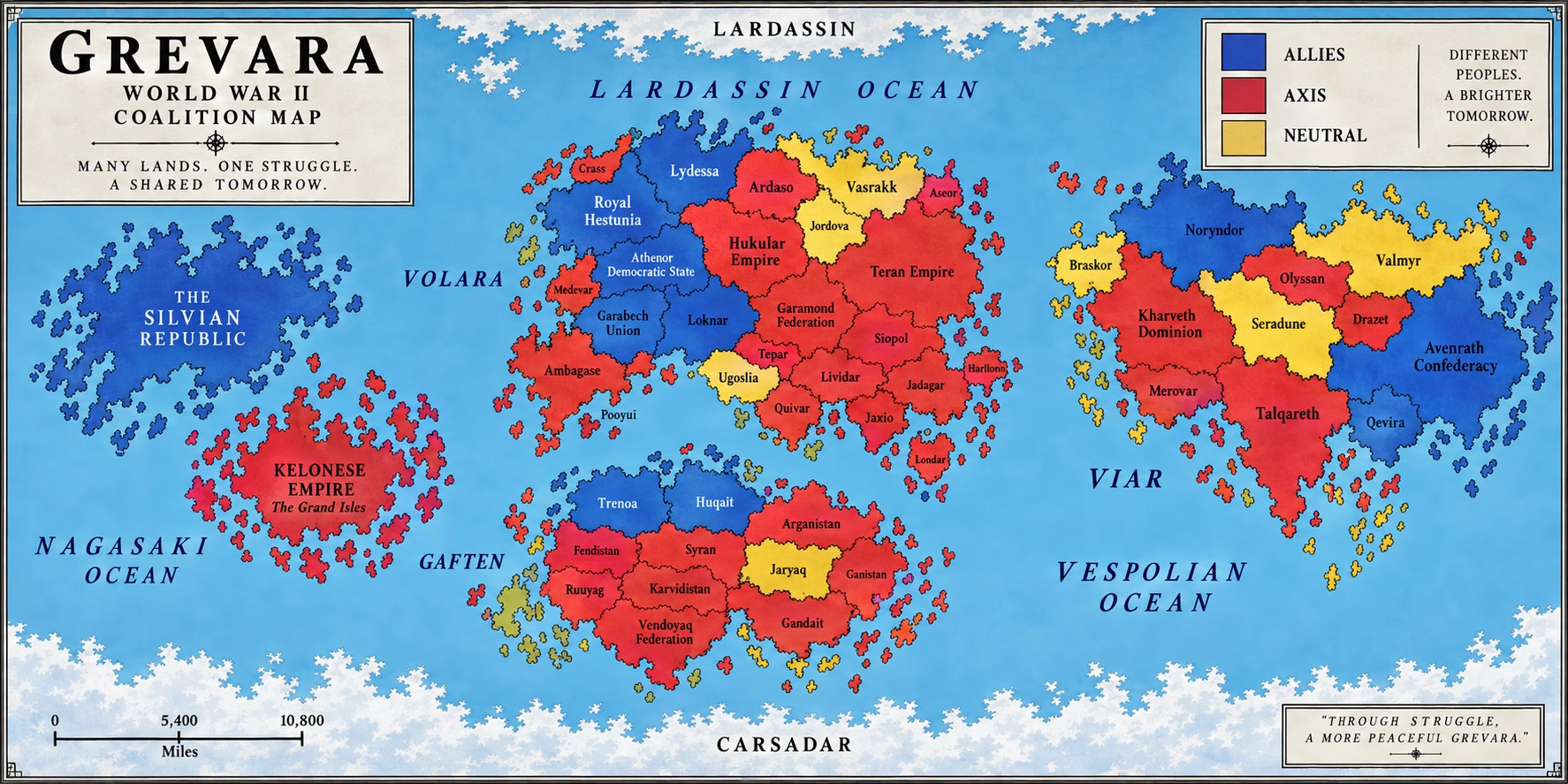
● Axis ● Allied ● Neutral · Zoom reveals cities, engagements and local positions. Drag to pan; use +/− or Ctrl+scroll to zoom. Hold over a marker for 5 seconds; click, tap or press Enter for immediate details.
Battle reference table
| Reference | Record |
|---|---|
| Dates | 1223-01-12 — 1224-05-17 |
| Participants | Hukular; Crass; Royal Hestunia; Athenor; Lydessa |
| Scale | Colossal |
| Status | Proposed canon |
Commands & participating forces
Named operational commanders and supporting force groupings below are proposed additions unless explicitly marked creator-established. They are not a recovered order of battle or a claim of precise unit strength.
| Nation | Commander | Status | Forces |
|---|---|---|---|
| Hukular | Marvek Doran | Proposed operational commander | A central assault group with concentrated artillery, engineer columns and infantry reserves; its effectiveness depends on rail delivery and the protection of its flanks. |
| Crass | Carven Tress | Proposed operational commander | Coastal batteries, frontier infantry and raid detachments pressure Hestunia while relying on external support for a prolonged major offensive. |
| Royal Hestunia | Oren Valcrest | Proposed operational commander | County-raised infantry, assault engineers, artillery and transport units sustain the front. Royal and coalition authorities retain separate responsibilities. |
| Athenor | Ilyan Theron | Proposed operational commander | Citizen infantry formations, municipal engineer detachments and a field-artillery reserve operate under a common campaign command; later exile units use Allied liaison staffs. |
| Lydessa | Maren Eldwick | Proposed operational commander | District infantry regiments and railway engineers protect successive defensive lines. Exile formations retain national records while relying on Hestunian supply. |
Fighting, tactics & logistics
The Axis opens with sustained pressure on transport and artillery positions. Hestunian command rotates exhausted battalions while Athenorian and Lydessan units hold assigned sectors. After Kandar, coalition planning changes, but immediate reinforcement remains limited by shipping and training. A spring counterstroke restores depth to the Allied defense.
Civilian consequences
Hospitals receive casualties alongside refugees from renewed attacks. Food allocation becomes a public issue, and royal ministers face demands to explain continued requisition.
Outcome & wider significance
The Allies hold. This fifth proposed colossal battle still in progress at Kandar ends before the documented Silvian Western Line opens on 3 July 1224.