Proposed canon. Dates, tactical sequences and local positions are newly developed unless the text explicitly identifies a creator or source anchor. Related images document the wider war; they are not photographs of this proposed battle.
Strategic objective
Trenoa, Huqait and Silvia seek to reduce the remaining Axis capacity for major operations in Gaften while restoring dependable access to threatened Allied districts.
Ground & operational constraints
Desert roads, mountain approaches and receiving points constrain a broad campaign. Neutral Jaryaq remains outside the belligerent coalition and cannot be used as an assumed shortcut.
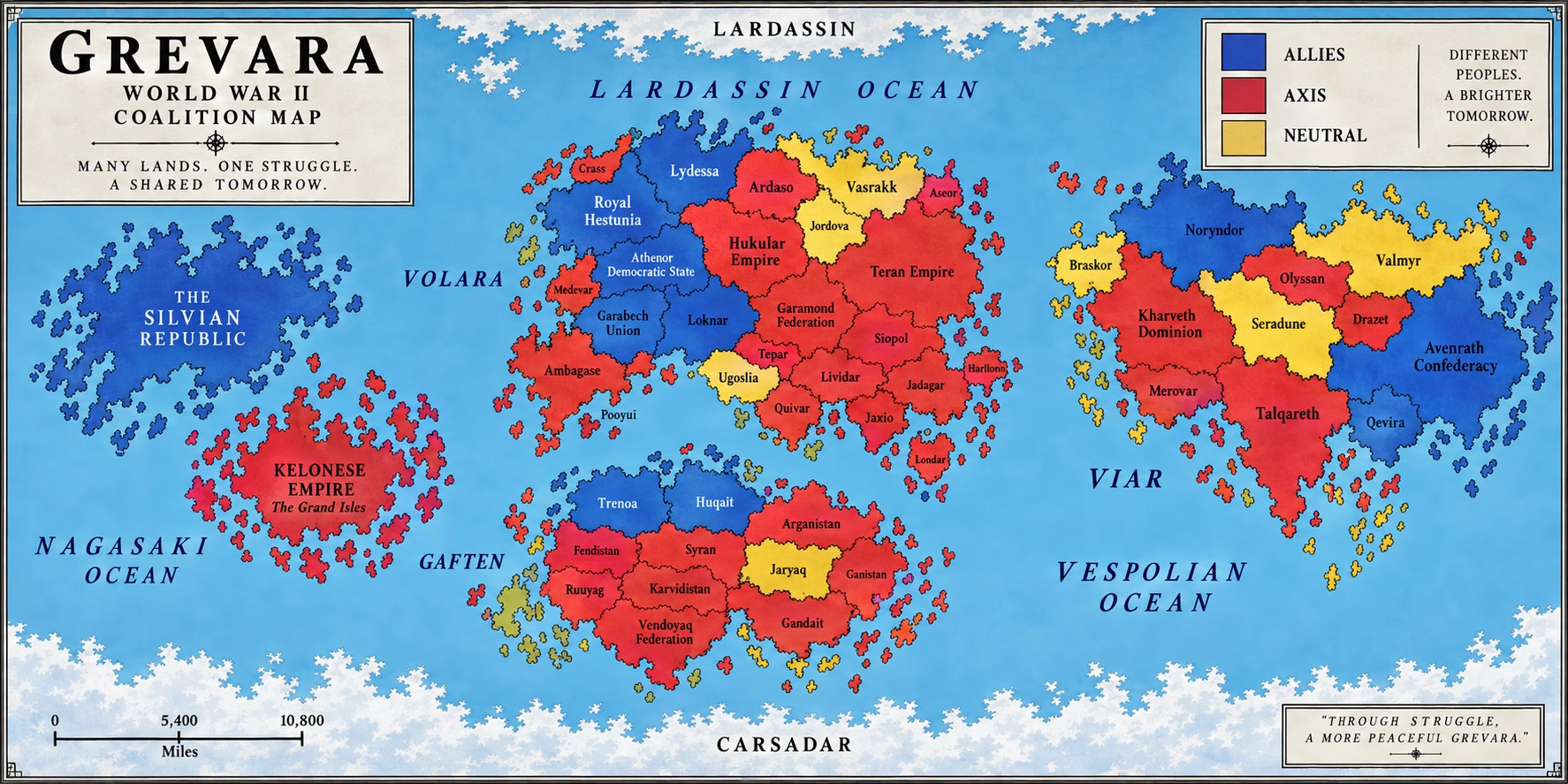
● Axis ● Allied ● Neutral · Zoom reveals cities, engagements and local positions. Drag to pan; use +/− or Ctrl+scroll to zoom. Hold over a marker for 5 seconds; click, tap or press Enter for immediate details.
Battle reference table
| Reference | Record |
|---|---|
| Dates | 1229-04-17 — 1230-06-09 |
| Participants | Trenoa; Huqait; Silvian Republic; Syran; Fendistan; Karvidistan; Arganistan; Ruuyag; Vendoyaq Federation; Gandait; Ganistan |
| Scale | Major |
| Status | Proposed canon |
Commands & participating forces
Named operational commanders and supporting force groupings below are proposed additions unless explicitly marked creator-established. They are not a recovered order of battle or a claim of precise unit strength.
| Nation | Commander | Status | Forces |
|---|---|---|---|
| Trenoa | Samir Naref | Proposed operational commander | Sultanate infantry, mobile patrols, water columns and road-repair units sustain desert operations and the Huqait assistance service. |
| Huqait | Harun Vaqir | Proposed operational commander | Mountain infantry, pack artillery, demolition teams and local carrying services defend pass systems and secondary tracks. |
| Silvian Republic | High General Arven Dask | Creator-established Fifth Army commander | Permanent divisions operate within mission-based field armies. Specialist brigades, Logistics Divisions and Security Divisions provide distinct support roles; the original formation documents govern their organization. |
| Syran | Rashad Kassem | Proposed operational commander | Mobile infantry columns operate with towed artillery, reconnaissance patrols, tankers and recovery detachments; water and workshop capacity govern their reach. |
| Fendistan | Jamal Ravid | Proposed operational commander | Southern offensive groups combine infantry and road-bound support with access facilities used by Syran formations. |
| Karvidistan | Karim Vardan | Proposed operational commander | Mobile raiding groups, infantry follow-up and repair detachments target the southern Allied transport system. |
| Arganistan | Arman Qadir | Proposed operational commander | Highland infantry and carrying columns operate from fortified staging depots, with limited artillery movement over difficult roads. |
| Ruuyag | Ruven Yagar | Proposed operational commander | Border infantry, patrol detachments and protected staging services maintain a western connection with the Vendoyaq Federation. |
| Vendoyaq Federation | Vendar Yaqim | Proposed operational commander | Provincial infantry formations retain tactical command while a federal transport office pools roads, vehicles and replacement stores. |
| Gandait | Garen Dait | Proposed operational commander | Infantry security, engineer groups and vehicle-recovery workshops protect and sustain the southern Allied connection. |
Fighting, tactics & logistics
The Allied plan begins by defining several connected but distinct tasks. Trenoan forces seek secure southern approaches, Huqaiti commands prioritize their mountain connections, and Silvian formations contribute mobile strength and support. A shared objective does not erase national responsibility for local administration or the future of liberated districts.
Axis resistance includes Syran, Fendistan, Karvidistan and Arganistan, with Ruuyag, Vendoyaq, Gandait and Ganistan contributing within the corrected coalition. Their different systems create uneven support arrangements. Some sectors hold because local roads remain usable, while others become difficult to sustain despite intact combat formations.
The decisive later question is whether Allied advances can be maintained without outrunning water, maintenance and medical capacity. Commands postpone some objectives while consolidating receiving areas and restoring essential roads. The proposed campaign reduces the Axis’s freedom to organize large offensives but leaves separate local negotiations and reconstruction problems. It does not turn the whole continent into one administrative occupation zone.
Civilian consequences
The return of access allows relief to expand, but damaged agriculture, displacement and requisition claims persist. Neutral Jaryaq’s refugee and border policies remain separate from Allied military government.
Outcome & wider significance
The revised campaign gives the Gaften Allies a stronger regional position while preserving the corrected Axis membership of the southern and eastern states. Exact late-war settlements remain proposed.