Proposed canon. Dates, tactical sequences and local positions are newly developed unless the text explicitly identifies a creator or source anchor. Related images document the wider war; they are not photographs of this proposed battle.
Strategic objective
High General Arven Dask's Desert Rats build the capacity to fight alongside established Trenoan and Huqaiti forces. Their advantage must be converted into sustained delivery across difficult routes.
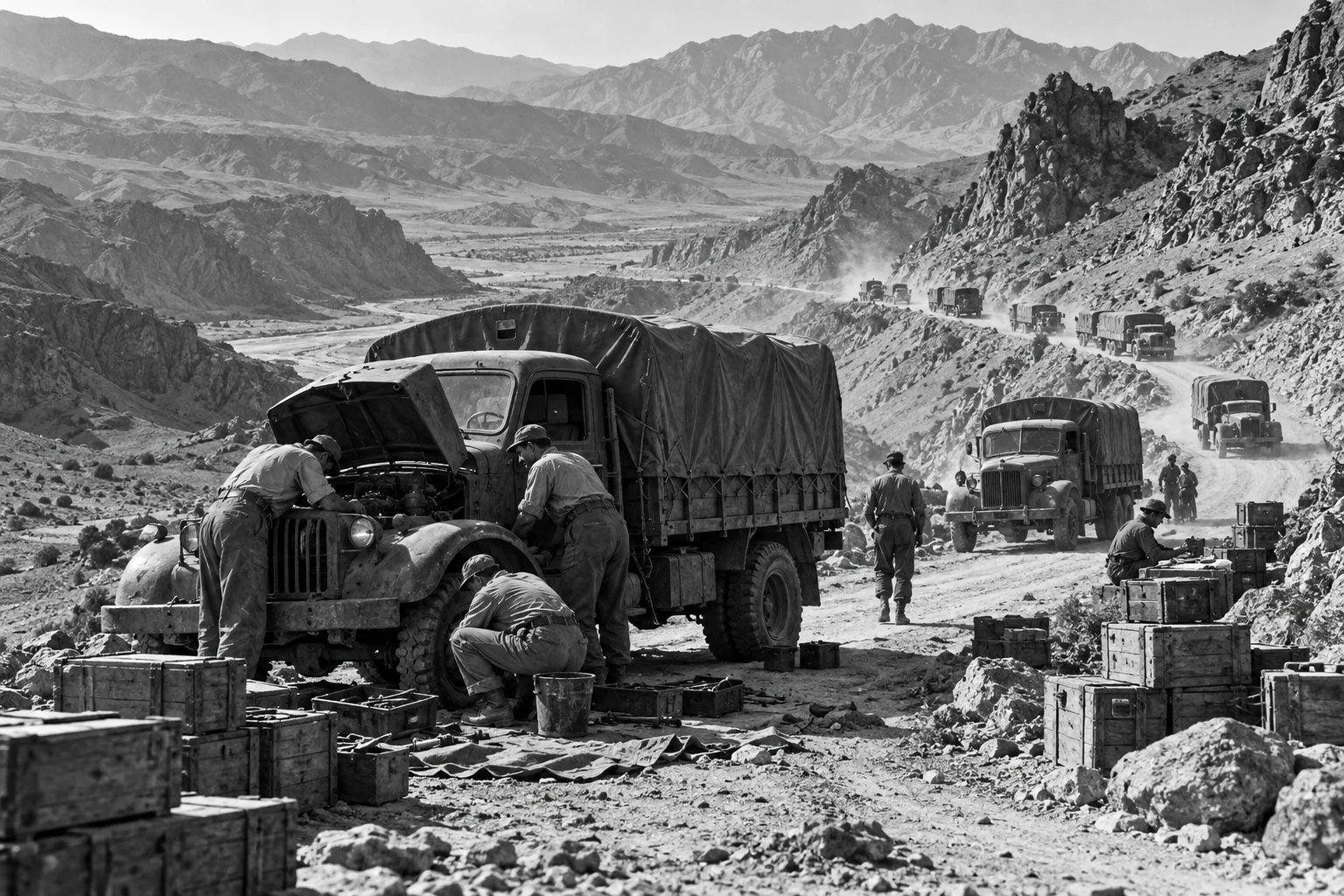
Ground & operational constraints
Water, dust, distance and maintenance shape the campaign. The supplied Narash and Huqait references ground the theater; the sequence and dates in this article are proposed.
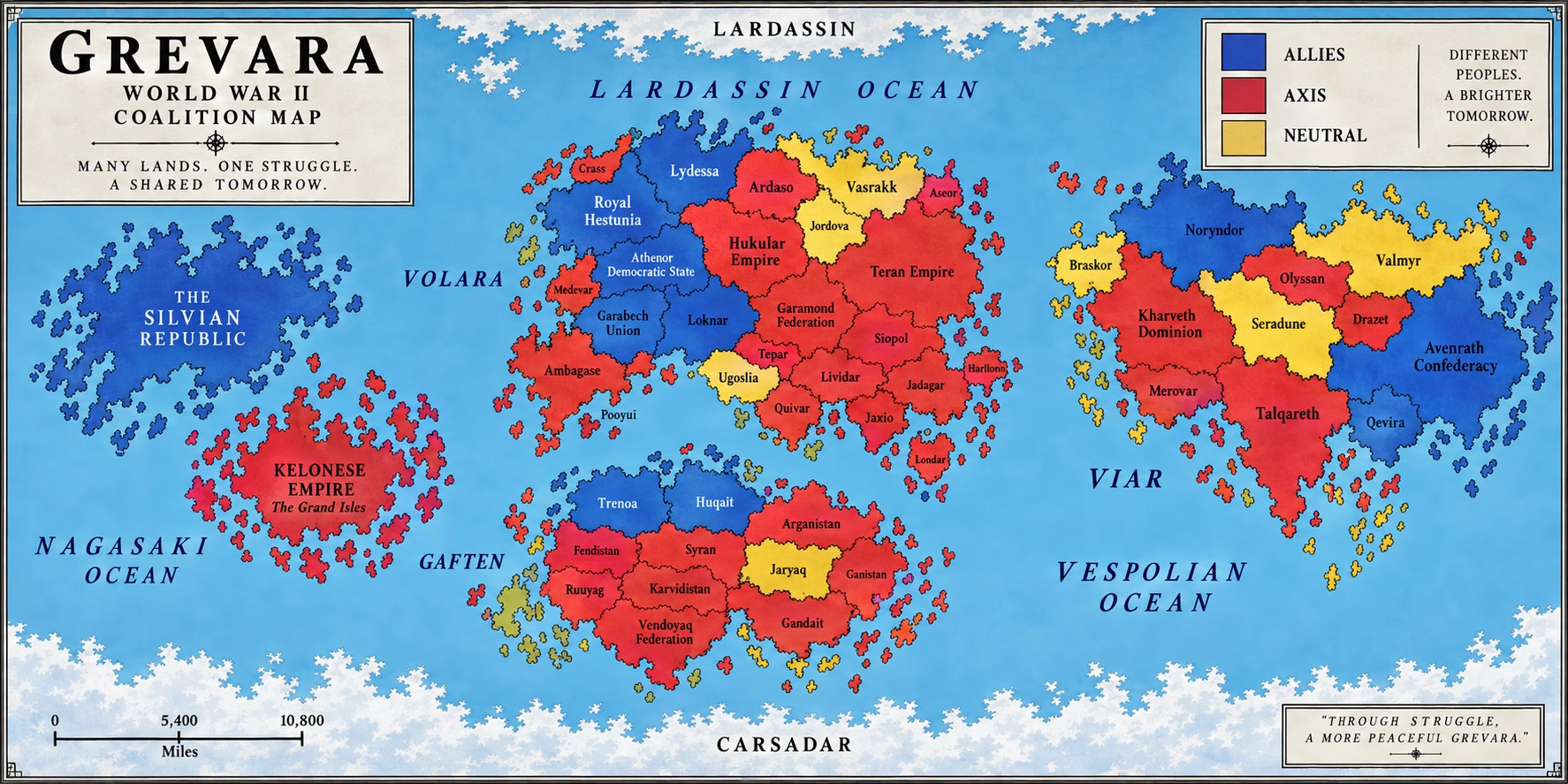
● Axis ● Allied ● Neutral · Zoom reveals cities, engagements and local positions. Drag to pan; use +/− or Ctrl+scroll to zoom. Hold over a marker for 5 seconds; click, tap or press Enter for immediate details.
Battle reference table
| Reference | Record |
|---|---|
| Dates | 1226-11-05 — 1227-06-30 |
| Participants | Silvian Republic; Trenoa; Huqait; Syran; Fendistan |
| Scale | Major |
| Status | Canon + proposed detail |
Commands & participating forces
Named operational commanders and supporting force groupings below are proposed additions unless explicitly marked creator-established. They are not a recovered order of battle or a claim of precise unit strength.
| Nation | Commander | Status | Forces |
|---|---|---|---|
| Silvian Republic | High General Arven Dask | Creator-established Fifth Army commander | Permanent divisions operate within mission-based field armies. Specialist brigades, Logistics Divisions and Security Divisions provide distinct support roles; the original formation documents govern their organization. |
| Trenoa | Samir Naref | Proposed operational commander | Sultanate infantry, mobile patrols, water columns and road-repair units sustain desert operations and the Huqait assistance service. |
| Huqait | Harun Vaqir | Proposed operational commander | Mountain infantry, pack artillery, demolition teams and local carrying services defend pass systems and secondary tracks. |
| Syran | Rashad Kassem | Proposed operational commander | Mobile infantry columns operate with towed artillery, reconnaissance patrols, tankers and recovery detachments; water and workshop capacity govern their reach. |
| Fendistan | Jamal Ravid | Proposed operational commander | Southern offensive groups combine infantry and road-bound support with access facilities used by Syran formations. |
Fighting, tactics & logistics
The Fifth Army's documented structure includes 13 infantry, 12 mechanized, three armored and three logistical divisions with an attached air wing. Proposed operations sequence route repair before concentration. Trenoan liaison teams coordinate local supply knowledge, while Huqaiti units guide mountain approaches. Syran counterattacks exploit temporary gaps created when mobile forces outpace repair teams.
Civilian consequences
Water allocation becomes a joint military and civil problem. Mobile medical services must treat heat and disease without abandoning battle casualties or nearby displaced families.
Outcome & wider significance
The proposed deployment sequence develops a sustainable Allied desert effort before the source-established Narash fighting of 1227. No invented triumph erases Syran's continuing organized resistance.
Developed battle history
The battle in detail
Expanded Grevara lore: new events, characters and in-world accounts developed for this archive. Supplied historical quotations retain their source links.
An army arrives in somebody else’s war
The arrival of the Fifth Army on 5 November 1226 changes the scale of the Allied effort in Gaften, but not its ownership. Trenoa and Huqait have been fighting since long before Silvia entered the war. Their officers know which roads have been repaired repeatedly, which districts have supplied recruits for years and which agreements with local communities are already strained. High General Arven Dask brings a powerful field army into that accumulated history.
The new narrative follows a reception district called Teren Wells, a fictional grouping of road facilities and military receiving areas behind the established front. It is not a newly discovered capital or a precise location on the political map. Its significance comes from the traffic passing through it: personnel arriving from overseas, vehicles awaiting inspection, stores being sorted and local liaison parties trying to explain the existing system to the newcomers.
Dask’s first review exposes the danger of measuring readiness only by arrivals. A division’s personnel may have reached the receiving district while important equipment remains elsewhere in the transport chain. A vehicle can be unloaded without having passed inspection. Supplies can appear in a dispatch return without being accessible to the formation expected to use them. These are ordinary consequences of moving a large army, not evidence that the deployment has failed.
The Fifth Army consequently enters the campaign by stages. Units ready for useful employment take on limited responsibilities while others complete preparation. This gives the established Allies immediate help without pretending that every arriving formation is available for a single grand offensive. It also requires Dask to resist pressure to demonstrate the army’s strength through a movement larger than its support system can yet sustain.
The liaison conference at Teren Wells
A Trenoan staff officer, Colonel Ravet Hamin, joins the developed history as Dask’s principal liaison at Teren Wells. Hamin is an invented local figure, not a replacement for a creator-established national commander. He arrives with road reports, existing supply agreements and a list of unresolved claims from districts already supporting the Allied armies. His contribution is knowledge that cannot be replaced by another shipment of vehicles.
The first conference reveals different assumptions about what a usable route means. Silvian staff initially classify roads by the movement their own formations require. Trenoan reports distinguish routes according to local maintenance arrangements, existing traffic and the condition of particular receiving points. Both systems describe real constraints, but their categories do not align automatically.
Hamin’s Huqaiti counterpart, Major Neral Suf, raises another problem. A route that works across open country may become unsuitable when it reaches a mountain approach. Loads must be reorganized, vehicles turned around and responsibility transferred to people familiar with the next section. A single line on a campaign map conceals several changes of method and authority.
The resulting liaison arrangement places officers where decisions about movement and supply are actually made. It does not create a fictional unified Allied government for Gaften. Trenoan and Huqaiti commands retain their national responsibilities, while Dask accepts that coordination involves negotiation rather than merely issuing instructions in a louder voice. The conference’s importance appears later, when a local interruption can be explained quickly enough for the army to adapt.
The first extension of the road screen
The Fifth Army’s first developed combat episode concerns a limited extension of the Allied road screen beyond Teren Wells. A mechanized detachment is assigned to occupy a set of previously contested approaches and establish contact with a Trenoan position farther forward. The operation is smaller than the army’s eventual ambitions, but it provides an immediate test of movement, liaison and recovery under opposition.
Captain Osven Dar, a fictional Silvian officer, reaches the outer approach with less of his supporting traffic than expected. A delay behind him has not stopped his leading elements, but it has changed what they can safely maintain. He occupies a defensible local position and sends a revised report rather than claiming completion of the entire assignment because the first vehicles have arrived.
Syran forces contest the connecting ground. Their response is purposeful: they seek to prevent the new position from becoming a reliable link in the Allied network. Dar’s detachment must maintain contact with the Trenoan force while dealing with pressure from a different direction. The local fight becomes an argument over whether the road can be used repeatedly, not simply over which flag is present beside it at one moment.
The Allies retain the near approach but postpone movement to the farther objective. The partial result disappoints officers who expected the arriving army to transform the front immediately. For Dask, it provides a more useful lesson. The detachment’s limits have become visible before a larger commitment depends on the same assumptions. The next effort will require a more dependable relationship between the forward element and the services behind it.
Water beyond the nearest well
At Teren Wells, the name suggests abundance that the actual facilities cannot provide under unlimited demand. Civilian use, medical needs and military distribution already share the local system before the Fifth Army begins expanding through it. Concentrating additional formations nearby creates pressure faster than it creates new capacity.
The developed account follows Lema Vadir, a civilian water-office supervisor who keeps records of distribution to surrounding communities. Vadir’s authority is local. She cannot overrule a field army, but her records reveal which households and workshops depend on particular collection periods. Without that information, a seemingly efficient military allocation could make the surrounding district unable to support itself.
Hamin brings the dispute into the liaison system rather than allowing it to remain a confrontation at a collection point. Dask’s staff separates immediate military requirements from requests based on future concentration plans. Some units are held farther back until distribution can be expanded. That decision slows their arrival near the front but avoids creating a shortage that would affect soldiers and civilians together.
The arrangement remains imperfect. Delayed deliveries force changes, and local officials complain when promised access is interrupted. The narrative does not turn one meeting into the permanent solution of desert logistics. It shows an army learning that water is a continuing allocation problem with political consequences. The usefulness of a source depends on its equipment, access, distribution and relationship with the people already living around it.
The recovery yard fills
The Fifth Army’s vehicle strength begins to tell two different stories. One is visible in the columns moving forward; the other appears in the recovery yard behind Teren Wells. Vehicles arrive there with damage, wear and faults that do not make dramatic battle reports but still reduce what their formations can do. A machine awaiting a particular component is absent from the front regardless of how minor the repair appears on paper.
Warrant Officer Ilen Torsk, an invented workshop coordinator, organizes the yard around work that can actually be completed with the available staff and parts. He distinguishes quick local repairs from tasks requiring a different facility. That sorting is not glamorous, but it prevents the entire yard from becoming a collection of disabled vehicles waiting on the same impossible promise.
A dispute develops when a forward commander requests the immediate return of every vehicle assigned to his formation. Torsk’s assessment shows that some can return soon, while others would consume resources needed to restore a larger number elsewhere. Dask’s staff has to decide between satisfying a unit’s ownership claim and improving the army’s wider usable strength.
The eventual arrangement keeps records of transfers and deferred repairs so that temporary practical decisions do not become unexplained losses in national accounting. It also reveals the value of the Fifth Army’s dedicated logistical formations. Their contribution is not an abstract tail following a combat force; it is the repeated conversion of damaged equipment, scattered stores and difficult journeys into another period in which the army can operate.
The attached air wing takes its place
The attached air wing gives the Fifth Army another means of observing and supporting the campaign, but it arrives with requirements of its own. Aircraft need operating facilities, servicing, fuel, communications and personnel able to coordinate with ground commands. Their presence on a force list does not eliminate the time required to make those relationships dependable.
A fictional liaison officer, Flight Captain Meran Tave, works between the air wing and Dask’s staff. Ground reports identify places by roads, settlements and local military names, while air reports may describe the same area through different visual references. Tave’s task is to make the reports mutually intelligible before commanders base important decisions on them.
During the renewed effort beyond Teren Wells, observation identifies movement that the ground command has not yet confirmed. The information improves the army’s understanding but does not tell it everything about the opposing formation’s purpose or strength. Dask’s staff treats the report as evidence to be combined with other accounts rather than as an infallible view of the battlefield.
Weather, servicing and competing demands limit what the wing can provide at any particular time. Some requests must wait. The developed narrative therefore avoids presenting aviation as a device that resolves every difficulty created by distance. Its real contribution lies in a growing system of reconnaissance, reporting and support that gives the field army more choices while also requiring resources and disciplined coordination.
A Syran counterstroke interrupts the timetable
By the early part of 1227, the developing Allied screen has become useful enough for Syran commanders to challenge it more forcefully. The proposed counterstroke concentrates on the connection between Dar’s forward sector and a neighboring Trenoan position. Its purpose is to force the Allies back into separate local defenses and make their new road arrangements unreliable.
The initial pressure creates confusion over which command is responsible for a threatened stretch of connecting ground. Dar’s reports describe the danger from his own frontage, while the Trenoan unit reports movement relative to different landmarks. Hamin’s liaison staff resolves the mismatch before it becomes an assumption that the other formation has abandoned its responsibility.
The fighting produces a temporary loss of access to an exposed receiving point. Stores have to be redirected, casualty transport takes a longer route and a planned relief is delayed. Those consequences are significant even though the counterstroke does not destroy a major Allied formation. The event forces Dask to acknowledge that a support arrangement working yesterday may not remain available tomorrow.
The Allied response restores contact and retains the nearer road system, but Dask postpones a further advance. The decision disappoints some officers and reassures others who have watched the recovery yard fill. Syran forces withdraw from their most exposed positions while preserving the ability to apply pressure again. The episode ends with both sides still organized, and with the Fifth Army’s timetable altered by an opponent capable of making its strength expensive to use.
A district carries the cost of the army
The expanding Allied presence brings work and disruption to the communities behind the front. Drivers, laborers and repair specialists may find employment, while farmers lose access to land and households experience higher demand for scarce goods. The same road improvement that helps deliveries can increase military traffic through a settlement that was previously peripheral to the campaign.
Vadir’s water-office records become part of a wider local account of the army’s impact. Municipal representatives collect complaints about damaged surfaces, requisitioned vehicles and interrupted access. Some claims are straightforward; others concern losses caused by several overlapping events and cannot be assigned to one unit. The civilian history becomes an administrative struggle as well as a story of endurance.
The proposed liaison system issues receipts and preserves disputed claims for review. That does not mean compensation arrives immediately or that every resident trusts the process. It means that local authorities have a record with which to challenge an unexplained demand. Hamin insists that these questions remain visible to military staff because an exhausted district cannot indefinitely supply labor, services and political cooperation.
Civilian movement also complicates the front. Displaced families use roads needed by the army, and rumors about improving security can encourage premature returns. Dask’s staff coordinates movement information with local authorities instead of treating every civilian presence as an obstacle to be cleared. The arrangement remains uneven, reflecting the difficulty of administering a large military effort inside a region with its own needs and institutions.
The approach to the next campaign
By the later part of the expansion period, the Fifth Army has a more reliable understanding of what its formations can accomplish in Gaften. The change is not simply that more vehicles and personnel have arrived. Liaison works more consistently, road reports are more useful, repair priorities are clearer and the relationship between receiving areas and forward units has been tested under pressure.
Dask’s staff begins preparing for the operations that will follow, including the later Narash fighting. This account ends before converting those later newspaper events into actions that occurred during the initial deployment. The distinction preserves the sequence from the November 1226 arrival through the expansion period and into the subsequent campaign.
Dar’s detachment is relieved after its extended work on the road screen. Some personnel remain temporarily to brief the incoming unit, while vehicles requiring attention move through the recovery system. The transfer is less dramatic than an attack but reveals whether the position has become an enduring part of the Allied network or remains dependent on one exhausted group that knows its local difficulties.
Torsk’s workshop records and Tave’s liaison reports now contribute to planning before another major movement begins. Their information does not remove uncertainty, but it gives headquarters a better basis for distinguishing possible action from an attractive timetable. The army has learned to describe readiness through usable relationships among formations and services, rather than the appearance of strength at a receiving port.
Why the Desert Rats’ arrival mattered
The Fifth Army’s expansion matters because it adds a large, adaptable force to an existing Allied theater without making the earlier Trenoan and Huqaiti war disappear. Its strength includes the stated mixture of infantry, mechanized, armored and logistical divisions, supported by the air wing. Its effectiveness emerges through the slower work of fitting those capabilities to Gaften’s conditions.
The developed local episodes give Dask a command history defined by choices rather than an uninterrupted procession of victories. He accepts partial results, postpones movements when support cannot sustain them and uses allied knowledge to revise assumptions. Those decisions do not make him immune to error. They show how a powerful army can preserve its usefulness while learning inside an active war.
The opposing side also retains agency. Syran forces contest connections and alter the Allied timetable; other Axis states remain part of Gaften’s wider military geography. Neutral Jaryaq is not silently transformed into an Allied corridor, and the corrected red states are not recruited into the coalition because doing so would simplify the story.
By the end of the expansion, the Desert Rats have become more than arriving columns. They are a field army with working relationships across national commands, support services and local communities. That achievement provides the foundation for later operations while leaving their outcomes to be explained in their own histories. The initial deployment is therefore neither an administrative footnote nor the whole desert war, but the difficult process by which a new concentration of force becomes a sustained participant in it.
Full campaign dossier
Each chapter below identifies its evidence status. Source-grounded analysis interprets the cited record; proposed chapters develop additional history for creator review.
Chapter 1 · Source record
The deployment belongs to November 1226
The supplied Fifth Army report is dated 5 November 1226. It states that the Desert Rats join the Allied desert effort under High General Arven Dask as their columns arrive in the western desert. The previous draft’s 1225 deployment was not supported by that report and has been corrected.
The distinction does not move the beginning of Gaften’s war. Trenoa and Huqait have already fought for years, and the Syran and Fendistani threats are established long before Dask arrives. Silvia reinforces an existing theater whose roads, damaged infrastructure and coalition relationships already have a history. The army’s entry should therefore begin with assessment and liaison rather than a claim that the Republic has discovered an empty battlefield.
Chapter 2 · Source record with limits
The Fifth Army’s reported establishment
The newspaper lists 13 infantry divisions, 12 mechanized divisions, three armored divisions and three logistical divisions, with an attached Silvian Air Force wing. It describes the force as well over 200,000 men. That phrase is a lower-bound characterization, not a precise total that can safely be divided among the listed divisions.
The supplied formation documents provide much more detailed establishment structures. Combining them requires care about attached personnel, counted and uncounted crews, and the difference between authorized organization and actual deployed strength. The article preserves both the newspaper’s wording and the formation documents rather than inventing a reconciliation by silently shrinking divisions.
The composition itself is informative. Three logistical divisions are an explicit part of the field army’s design, and the attached air wing adds requirements for fuel, maintenance, communications and airfield work. Support is not an afterthought added to an otherwise self-sufficient mass of combat divisions.
Chapter 3 · Proposed canon
What Dask must know before advancing
The proposed arrival assessment maps water sources, road bearing capacity, workshop locations and the time needed to move casualties to treatment. It distinguishes what exists on a map from what works under military demand. A well that sustains a village may not supply a large concentration of troops and vehicles. A road that takes a small convoy may fail under repeated heavy traffic.
Trenoan liaison personnel explain the existing supply agreements and which local authorities control stores. Huqaiti officers identify mountain approaches and carrying practices. Silvian staff translate that knowledge into their own schedules and requisition system. This is a reciprocal process: the arriving army contributes capacity, while established allies provide information and access that capacity alone cannot create.
Dask’s initial choice is to build a force that can remain in action. A spectacular movement unsupported by water, recovery and maintenance would consume vehicles and prestige without creating lasting Allied strength.
Chapter 4 · Proposed canon
Water as an operational allocation
The proposed water service uses separate accounting for human consumption, medical use, vehicle servicing and reserve stocks. It tests sources before concentrating units around them and protects pumping equipment as carefully as a military depot. Distribution includes return journeys and delays, rather than calculating only the outward delivery distance.
Civilian access is negotiated explicitly. A military order that takes all available water may create immediate hardship, displace labor and undermine the same local transport system the army needs. The proposed arrangement assigns guaranteed civilian collection periods at shared points and uses military tankers to reduce pressure where possible. Failures are reported as supply incidents rather than dismissed as complaints unrelated to operations.
The resulting constraints influence the sequence of advances. Capturing ground is not enough; the army must either repair its water system or bring enough carrying capacity to sustain the force occupying it.
Chapter 5 · Proposed analysis
Mechanized mobility and the recovery burden
The later Narash imagery shows infantry riding S-102 halftracks beside Trenoan formations. Mechanization helps move troops and equipment, but difficult ground, dust and long distances increase servicing demands. A disabled vehicle can become a road obstacle, a recovery task and a drain on spare parts at the same time.
The proposed Fifth Army recovery service places repair teams at intervals matched to actual route use. Crews carry out work close to the point of failure when possible; vehicles requiring major repair are evacuated to workshops without interrupting every forward convoy. Repairable vehicles are distinguished from those best used as sources of components. These decisions determine how much nominal strength remains available over a prolonged campaign.
Dask’s armored reserve is therefore managed through both tactical readiness and maintenance condition. A formation can be present in the theater yet unable to conduct an extended movement until its transport and recovery system catches up.
Chapter 6 · Source-grounded premise; proposed organization
The air wing ashore
The source establishes an attached Silvian Air Force wing, but does not make aircraft independent of the ground campaign. Airfield repair, fuel storage, ammunition handling, spare parts and maintenance shelters all compete for transport and engineer capacity. Forward basing can shorten flight time while increasing the vulnerability and logistical burden of the support system.
The proposed deployment introduces reconnaissance and local support in stages. Airfields are assessed for drainage, repair requirements and the safety of their approaches. Fuel is dispersed to reduce the chance that a single attack interrupts all operations. Communications teams establish procedures for identifying friendly formations and reporting usable landing conditions.
The wing’s contribution includes information. Knowing where a convoy is delayed, which route is being repaired, or whether Syran forces are concentrating can matter as much as the immediate effect of a strike. The detailed history should connect that information to Dask’s decisions rather than merely count aircraft overhead.
Chapter 7 · Historical interpretation and proposed liaison
Trenoan and Huqaiti priorities
Trenoa must consider the defense of its own routes and the accumulated burden of supporting Huqait. Huqait needs access through difficult approaches and relief for troops whose war began with invasion years earlier. Silvia’s arrival does not make these priorities identical, even when all three governments seek victory over the Axis.
The proposed coalition conference assigns operations according to both military capability and political responsibility. Huqaiti units retain an important role in their own territory. Trenoan transport authorities help set sustainable road priorities. Dask’s staff coordinates the additional Silvian capacity without claiming unlimited authority over allied administrations.
Disagreements are recorded as real operational questions: whether to reopen a threatened route first, support an exposed front, or prepare a broader offensive. Giving each partner a coherent reason for its position makes cooperation more meaningful than a generic statement that the Allies act together.
Chapter 8 · Proposed enemy perspective
Syran’s opportunity during the buildup
The arriving army is strongest once its systems are connected and weakest where deployment creates temporary concentrations. Syran commanders can attack unloading points, road junctions, workshops and water equipment before the new force gains freedom of movement. Such operations need not seek a decisive battle against the entire Fifth Army.
The proposed response combines reconnaissance with limited counterattacks. Syran formations identify where Silvian movement depends on a single route and try to make that route unreliable. Dask must protect it without dispersing every combat unit into escort duties. Security and logistical formations have specific roles, while maneuver units remain available for the principal front.
This contest explains why the buildup is itself a campaign phase. The enemy does not wait politely until an arriving army declares its preparations complete. It also explains the later newspaper’s insistence that Syran forces retain organized defenses and continue counterattacking around Narash.
Chapter 9 · Source record
Narash and the evidence of July 1227
By the report of 26 July 1227, the Fifth Army holds Narash Junction, supports the Huqait approaches and presses along the eastern road beside Trenoan formations. The source describes an active campaign with improved Allied positions, not a completed desert victory. Dask’s next operations must balance advance against the strain on personnel, vehicles and supply.
The junction is valuable because it connects movement. An army can occupy its central buildings while still being unable to use the surrounding roads safely. The source’s continued Syran counterattacks mean that protection, repair and traffic control remain important after possession changes hands.
The earlier proposed Narash struggle on the site has been revised to keep Trenoan and Huqaiti forces responsible for its pre-1226 phases. It is a separate proposed antecedent, not evidence that Dask’s Fifth Army was already present years before its documented deployment.
Chapter 10 · Proposed canon
Medicine, replacements and endurance
The proposed medical system separates immediate collection, stabilization and longer-distance evacuation. Heat, dehydration, infection and ordinary illness compete with combat wounds for medical capacity. Evacuation plans include mechanical failure and route closure, because a casualty vehicle delayed in extreme conditions can become an additional emergency.
Replacement personnel receive local preparation before joining formations. A trained soldier unfamiliar with water discipline, dust, road procedures and identification signals can impose avoidable burdens on an experienced unit. The army therefore uses receiving camps to introduce theater practices, while specialists are matched to vacancies that require their actual skills.
Endurance emerges from these repeated systems. The Fifth Army’s size gives it options, but sustainable combat power depends on the number of people and vehicles that remain supplied, maintained, medically supported and organized after weeks of operations.