Proposed canon. Dates, tactical sequences and local positions are newly developed unless the text explicitly identifies a creator or source anchor. Related images document the wider war; they are not photographs of this proposed battle.
Strategic objective
Athenorian signal detachments delay the loss of frontier reporting stations.
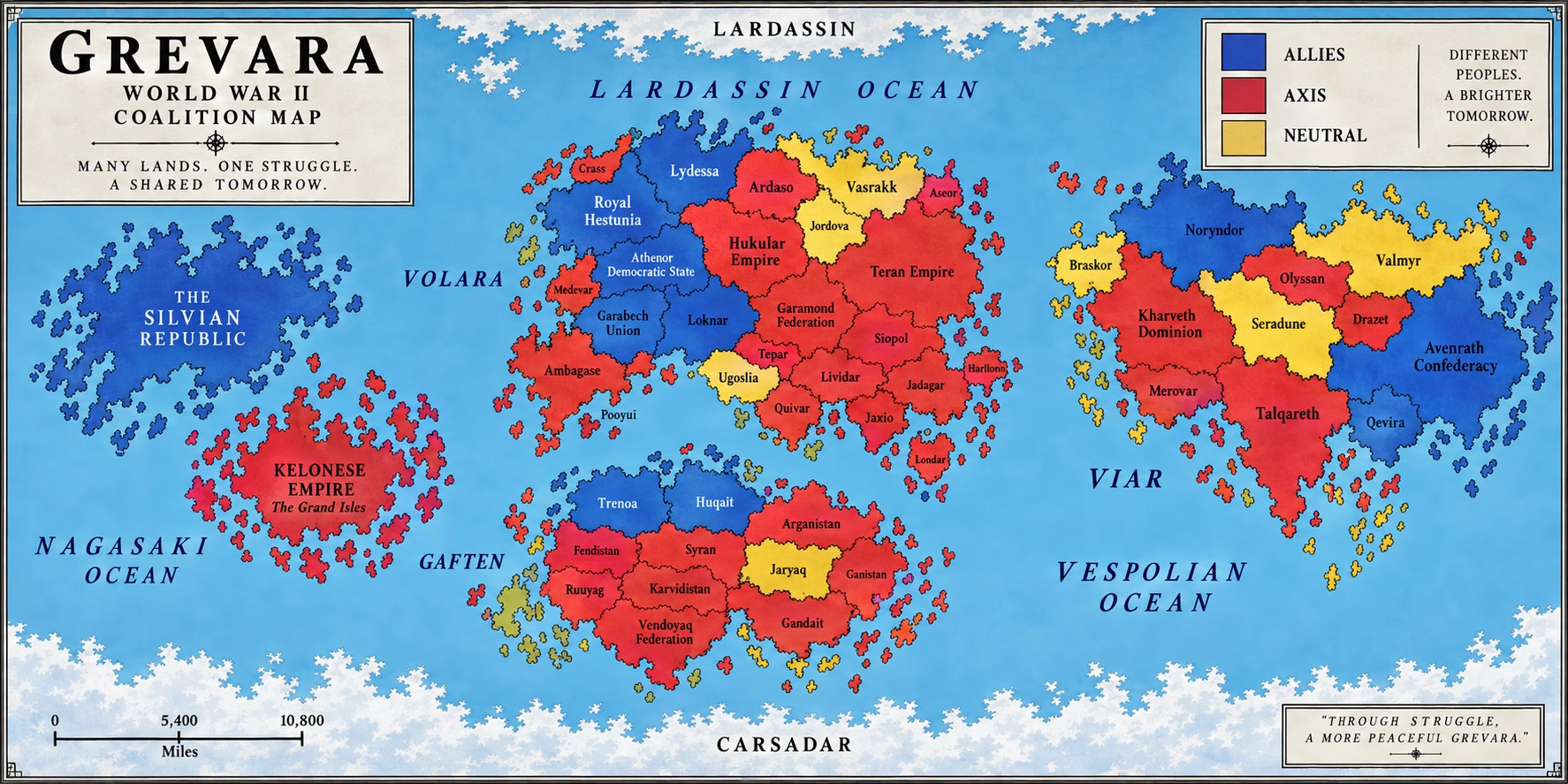
● Axis ● Allied ● Neutral · Zoom reveals cities, engagements and local positions. Drag to pan; use +/− or Ctrl+scroll to zoom. Hold over a marker for 5 seconds; click, tap or press Enter for immediate details.
Battle reference table
| Reference | Record |
|---|---|
| Dates | 1208-05-10 — 1208-05-13 |
| Participants | Hukular; Athenor |
| Scale | Moderate |
| Status | Proposed canon |
Fighting, tactics & logistics
Hukular captures the main station, but couriers remove mobilization records through farm lanes. The defenders lose communications equipment while retaining enough warning time to disperse reserve assembly points.
Civilian consequences
Station workers evacuate dependents before cutting the final wires.
Outcome & wider significance
The defenders lose communications equipment while retaining enough warning time to disperse reserve assembly points.
Developed battle history
The battle in detail
Expanded Grevara lore: new events, characters and in-world accounts developed for this archive. Supplied historical quotations retain their source links.
The morning after the invasion
By the morning of 10 May 1208, the Athenorian frontier reporting network was carrying more uncertainty than information. Hukular’s invasion had begun the previous day. Stations received reports of enemy movement, requests for orders and warnings that neighboring positions had already withdrawn. Some messages described events several hours old. Others reached the network without a clear indication of where the sender had been when the observation was made.
The main station at Veyr Crossing served three smaller posts and a road leading toward the interior. Its military importance came from that connection rather than from the equipment inside any single building. While the station remained usable, headquarters could compare reports from several approaches and direct reserve assembly away from threatened locations. Once it fell, the same work would depend on couriers moving along roads whose condition was increasingly uncertain.
Lieutenant Saren Iven commanded the Athenorian detachment assigned to protect the station. His original orders concerned security: prevent interference, preserve the equipment and keep the reporting staff working. The invasion changed the task without providing a clean replacement order. He now had to defend a position that had never been prepared for a sustained battle, while the staff continued handling messages whose importance might exceed the value of the building itself.
Captain Orvek Tal led the approaching Hukular force. His immediate objective was to capture the station and sever the reporting junction before Athenor could disperse its mobilization arrangements. He did not need to occupy every nearby farm or village. He needed to reach the node quickly enough that the defenders could not complete the administrative and military movements the warning network made possible.
The station compound
Veyr Crossing consisted of the main telegraph building, a maintenance shed, a small receiving yard and several staff houses beside the road. A drainage channel ran behind the compound, separating it from cultivated ground. The front of the station faced the most convenient approach, but the rear channel offered a concealed route for small groups willing to move on foot. Iven recognized that a defense concentrated solely on the road would leave the building vulnerable from behind.
He placed one group near the yard entrance and another behind the maintenance shed, with observers watching the channel. A small reserve remained inside the compound. The arrangement spread his detachment thinly, yet it gave him a chance to identify the direction of an attack before committing everyone to the first reported threat.
Station supervisor Lera Daven objected when soldiers moved furniture and stored materials to improve cover. Some of the objects belonged to the working station rather than an abandoned building, and moving them interrupted operations. Iven and Daven negotiated a division of space: the principal operating room remained under the station staff’s control, while the outer rooms and yard were reorganized for defense.
The agreement mattered because neither task could be treated as secondary. A beautifully defended station that could no longer transmit would fail its purpose. A functioning operating room without protection would remain useful only until the enemy reached the door. The compound’s improvised layout embodied that tension, preserving a small working center inside a position being converted into a battlefield.
The first contact on the road
The first Hukular patrol appeared near the road before the main force reached the crossing. Its leading men halted after seeing movement at the yard entrance and attempted to observe the compound from behind a roadside wall. Iven’s forward group held fire briefly, trying to establish whether the patrol was alone or the leading element of a larger attack. The uncertainty ended when additional soldiers moved toward the wall and began spreading along it.
The exchange that followed was short. Athenorian fire checked the movement toward the entrance, while the patrol fired back from cover and withdrew part of its strength farther down the road. Iven prohibited pursuit. He had too few troops to defend the compound and chase a force whose full size he did not know.
Tal used the contact to confirm that the station was defended. His patrol reported positions near the entrance and movement beside the maintenance shed, but could not determine the strength inside. The information was enough to discourage a simple rush along the road. Tal sent another group toward the cultivated ground behind the compound and began preparing pressure from two directions.
Inside the station, Daven’s staff continued transmitting while the first firing occurred. One operator initially mistook the sound for fighting farther away and remained at a window until a soldier moved him back. The incident became part of the station’s later memory because it marked the moment when the network’s reports of invasion became an immediate physical danger. The battle was no longer something the operators described for others. It had reached the place from which they were trying to describe it.
The northern post falls silent
The smaller northern post stopped answering during the afternoon. Its last message reported enemy movement near the road and requested instructions about the reserve assembly papers held there. The silence that followed could indicate a cut connection, equipment failure, evacuation or capture. Daven refused to assume the worst immediately, while Iven treated the loss of contact as a warning that the compound’s northern approach might soon be exposed.
A courier sent toward the post returned before reaching it. He had encountered civilians moving away from the area and heard firing beyond a bend. Their accounts agreed that soldiers were present but differed about which force held the building. Iven sent a small reconnaissance group by a farm lane rather than repeating the direct approach.
The group found the post abandoned by its staff and occupied by Hukular troops. It exchanged fire with an outer sentry position and withdrew before a larger force could respond. The report established the post’s loss but could not determine whether the papers and equipment had been removed. That uncertainty became important later, when headquarters had to decide which mobilization arrangements might already be known to the enemy.
Tal’s force gained a useful observation point and a way to threaten the main station from the north. The captured post did not immediately restore its full reporting function for the attackers. Equipment condition, missing staff and unfamiliar procedures limited what could be exploited quickly. Its immediate military value lay in denying the Athenorians a connection and widening the directions from which pressure could be applied.
The fight behind the maintenance shed
The Hukular group moving through the cultivated ground reached the drainage channel late in the day. It advanced in small parties, using the bank to conceal movement until the last approach to the compound. An Athenorian observer saw one group crossing an exposed section and warned the position behind the maintenance shed. Iven moved part of his reserve toward the rear while keeping enough troops at the entrance to prevent the road pressure from becoming a direct assault.
The attackers reached the far bank of the channel and began firing into the rear of the compound. Their position threatened the route by which station staff might withdraw, making the engagement more dangerous than the first contact on the road. Iven ordered a local counterattack to push them away from the nearest crossing point.
Sergeant Nera Tavin led the counterattack from the shed’s corner. Her group advanced only far enough to secure a view along the channel, then engaged the attackers from a low boundary wall. The movement surprised the nearest Hukular party and forced it back, but another group farther along the bank continued firing. Tavin could not clear the whole channel with the troops available.
The defenders held the immediate crossing until darkness reduced observation. Iven then pulled Tavin’s group into a shorter line nearer the compound. The action preserved the rear route for the time being and demonstrated that the station could not be defended indefinitely by responding to each threat separately. Every local success required troops taken from another part of a perimeter already too large for the detachment.
The mobilization ledger
The most valuable papers in the station were not secret plans for the whole war. They were practical records: reserve assembly locations, contact details, transport arrangements and the sequence in which local messages were to be passed onward. Their value came from their immediate usefulness. A force capturing them intact might identify where men and equipment were expected to gather before the defenders could change those arrangements.
Daven divided the working records into material needed for continued transmission and material that could be sent away immediately. Clerk Oran Ves prepared duplicate summaries of the most urgent changes, reducing the chance that the loss of a single courier would erase the warning. The work was interrupted repeatedly as the staff answered new messages and checked uncertain reports from the surviving posts.
Iven assigned a small escort to the first courier party. The decision reduced the compound’s defensive strength, but delaying the dispatch would expose the records to a greater risk of capture. The party left through the rear route that Tavin’s counterattack had kept open and followed a farm lane toward the interior.
The movement was an administrative withdrawal conducted under the protection of an armed defense. Its success did not make the entire battle a rescue operation. The defenders were fighting to deny the enemy control of the compound and preserve a period in which warnings and records could move. Keeping those purposes distinct explains the engagement more clearly than counting every person who left the station as either a combatant or a casualty.
The staff houses
Before the first night ended, Daven arranged for dependents living in the staff houses to leave the compound. Their departure was not a separate military assault or a new battle. It was one of the consequences of turning a working communications station into a defended position. The families had remained nearby because the station was their workplace and home; the invasion erased the ordinary distinction between those roles.
The movement required choices about what could be carried. Clothing, food and personal papers competed for space with the equipment station workers had been asked to save. One family returned briefly for a missing child who had gone to a neighboring house when the firing began. The delay forced the escort to wait in a place its commander considered increasingly exposed. The child was found, and the group departed before the rear channel came under the next attack.
Those events affected the defenders without determining the tactics of the engagement. Soldiers knew that movement behind their positions included people with no role in the fighting, and the staff knew that an order to continue operating extended the danger to colleagues whose families had only just left. Iven’s decisions therefore carried consequences that could not be captured by the condition of the perimeter alone. The station’s defense remained an armed engagement, while the civilian departure formed part of the human history around it.
A night of incomplete reports
The night brought neither a complete pause nor a clear view of the surrounding ground. Hukular patrols tested the approaches, and the defenders answered movement they could identify with sufficient confidence. Iven warned his troops against firing at every sound, both to conserve ammunition and to avoid striking couriers or civilians approaching from unexpected directions. The warning was easier to issue than to follow after a day of close pressure.
Inside the operating room, messages continued to arrive from stations farther away. Some had not yet learned that the northern post was lost. Others asked Veyr Crossing to relay information through a connection that no longer existed. Daven’s staff annotated the changing network by hand, crossing out failed routes and marking alternatives whose reliability remained uncertain.
A message from the interior instructed Iven to preserve the reporting function as long as practical while avoiding the loss of the entire detachment. The order expressed the command’s priorities without resolving the decision he faced. Practical endurance could be judged only by the officer at the station, and withdrawal would itself require time during which the perimeter had to remain intact.
Iven used the remaining darkness to shorten exposed positions and prepare an exit through the rear lanes. He did not order immediate abandonment because the station was still carrying warnings that could affect reserve movement. He did order the staff to prepare for a departure that might have to occur with little additional notice. The battle’s second day would begin with the compound still defended, but with its commander increasingly focused on how to end that defense without allowing it to become an encirclement.
Tal’s second approach
Tal renewed pressure on 11 May after receiving reinforcements. He assigned one group to maintain fire toward the road entrance while another advanced against the rear channel. A third remained available to exploit whichever approach first showed signs of weakening. The plan sought to force Iven to commit his small reserve before the decisive movement began.
The road group attacked more strongly than on the previous day, reaching the outer edge of the receiving yard. Athenorian defenders withdrew from an exposed forward position and concentrated their fire from the compound buildings. The movement gave Tal evidence that the perimeter was contracting, although he could not know whether it reflected losses, a planned adjustment or preparations to leave.
At the rear, the attackers encountered Tavin’s shorter line. They gained positions along the channel but failed to cross in enough strength to enter the compound immediately. Tal directed his reserve toward that approach, judging it more likely to cut off the defenders than another push through the yard.
Iven saw the increased pressure and released the next group of station staff through an alternate lane farther south. The escort had to move around fighting near the usual route, slowing its departure. The decision preserved people and records while leaving fewer personnel to maintain the station’s work. By afternoon, Daven could continue only the most urgent transmissions. The compound remained in Athenorian hands, but the useful reporting window was closing even before the buildings themselves were lost.
The receiving yard changes hands
The Hukular road group entered the receiving yard after a renewed exchange forced the defenders away from its outer wall. The attackers used the stored materials and damaged carts for cover, gradually establishing positions from which they could fire toward the main building. Their gain brought the fighting closer to the operating room and made movement between the station and maintenance shed increasingly dangerous.
Iven ordered a counterattack before the attackers could consolidate fully. He could not allow the yard to become a protected assembly area immediately outside the remaining defense. Tavin shifted part of her group from the rear and joined troops from the main building in a short attack across the yard’s inner edge.
The counterattack drove the nearest Hukular soldiers back toward the outer wall but did not clear the entire space. Fire from positions along the road prevented the defenders from advancing farther without exposing themselves. Tavin halted her group behind a row of stored beams, where it could deny easy movement across the yard while remaining connected to the building.
For several hours the yard became a contested space neither side could use freely. That condition favored the defenders in the immediate sense because it prevented a rapid assault on the main building. It favored the attackers over time because the Athenorians had committed troops they could no longer spare elsewhere. Tal maintained pressure without ordering every available man forward, allowing the compound’s shrinking defense to bear the cost of holding the contested line.
The last working connection
By the evening of 11 May, only one of the station’s original outward connections remained dependable. It carried reports toward the interior through a smaller post that had escaped the main advance. Daven restricted its use to messages affecting immediate military and civilian movement. Routine inquiries accumulated unanswered, a visible sign that the station’s ordinary administrative role had been suspended by the battle.
Operator Eren Val stayed at the equipment while another clerk prepared messages in a shortened sequence agreed with the receiving post. The change reduced the time spent clarifying routine identifiers, but it did not remove the need to verify that a message had been received correctly. Under pressure, a transmitted warning could be mistaken for a completed task even when the acknowledgment had not returned.
One message concerned a reserve assembly point believed to be threatened by movement from the captured northern post. Its first acknowledgment was incomplete. Val repeated the essential instruction and waited until the receiving operator confirmed the change. That delay frustrated an officer who wanted the staff to leave immediately, but it ensured that the warning had become usable information rather than merely a signal sent into uncertainty.
The connection failed later after damage outside the compound. Daven’s staff could not determine the exact point of failure from inside the station. Restoring it would require personnel to move into ground increasingly controlled by the enemy. Iven declined that attempt. With the principal reporting function lost, continued defense of the buildings could no longer be justified on the same terms. The question became how much time was needed to withdraw the remaining staff and detachment.
The withdrawal order
Iven issued the withdrawal order during the night, dividing the movement into staff, wounded personnel, stores that could be carried and the final covering groups. The sequence was practical rather than ceremonial. People who could not move quickly needed to leave before the rear route came under renewed pressure. The covering groups needed enough ammunition and space to disengage without finding their exit blocked by loads that should have departed earlier.
Not everything could be removed. Equipment too heavy or too closely integrated into the building had to be left behind. Daven argued for recovering additional components, warning that the surviving network would need replacements. Iven accepted a limited further effort while refusing to delay the entire movement. Their disagreement reflected two legitimate views of the station: one as a threatened position, the other as part of a system that would still have to work after the position was lost.
The final records party carried the remaining mobilization papers by a southern farm lane. Its escort was instructed to avoid the principal road and report at an interior receiving point rather than seek out whichever headquarters seemed nearest. That instruction preserved a destination for the information even if military units along the route had moved.
The covering detachment remained in the compound until the movement was well underway. Iven did not announce the withdrawal by immediately abandoning every forward position. He kept enough resistance at the yard and channel to prevent the attackers from recognizing how much of the station had already emptied. The deception could last only briefly, but a brief interval was the resource the defense had been created to provide.
The rear lane under fire
The withdrawal did not proceed without contact. A Hukular patrol reached a position overlooking part of the southern lane and opened fire as an Athenorian group crossed an exposed section. The group took cover behind a field boundary, interrupting the movement behind it. For a few minutes the lane risked becoming the congestion point Iven had tried to avoid.
Tavin moved forward with part of the covering force and engaged the patrol from a position that drew its attention away from the crossing. She did not attempt a prolonged pursuit. Her immediate purpose was to create enough freedom of movement for the stalled group to continue. Once it had crossed, she withdrew her own men in pairs toward the next boundary.
The patrol followed cautiously and renewed fire when the defenders moved again. The action became a series of short exchanges rather than one continuous engagement. Each side had incomplete information about the strength beyond the next field, and neither wished to expose itself to a larger force it could not see. The terrain that had concealed the withdrawal also prevented the defenders from knowing whether the patrol was the beginning of a broader interception.
Iven redirected the remaining groups through a second lane, accepting a longer route to avoid feeding more people into the same contact. The change separated parts of his detachment temporarily, complicating the later accounting of who had reached the receiving point. It also prevented one enemy patrol from closing the whole withdrawal. The battle’s final defensive task was thus fought beyond the station walls, along the route that connected the lost position to the continuing Athenorian campaign.
The main station is taken
Hukular troops entered the main building after the final Athenorian covering group withdrew. The compound showed the effects of several days of fighting: damaged walls, displaced equipment, abandoned stores and firing positions improvised from the station’s ordinary contents. Tal secured the buildings and sent patrols after the withdrawing defenders, but he did not assume that occupying the station meant capturing the information he had hoped to obtain.
His staff examined the records left behind and compared them with material recovered at the northern post. Some documents were useful for understanding the local reporting network. Others described arrangements that might already have been changed. Without knowing which warnings had reached the interior, the attackers could not safely treat every location in an abandoned ledger as a current target.
The equipment also required assessment before it could be used. Damage, missing components and the absence of experienced local operators limited the station’s immediate value as a functioning communications center. Tal had achieved the denial objective: the Athenorians could no longer use the junction. Exploiting it for Hukular’s own reporting would take additional work.
The capture was therefore a real tactical success with a smaller immediate intelligence return than the original plan anticipated. The defenders had lost the compound and much of its equipment. They had also removed enough records and transmitted enough warnings to prevent the loss from freezing the mobilization system in the form in which the attackers first encountered it. Both facts belong in the outcome; neither cancels the other.
The reserve points move
The warnings from Veyr Crossing reached the interior unevenly. Some reserve authorities received direct messages before the last connection failed. Others learned of the changed situation through couriers carrying summaries and amended instructions. The result was not a perfectly synchronized dispersal, but a series of local adjustments that reduced the concentration of men and records at the most exposed assembly points.
Captain Daven Iral, working within the wider Athenorian frontier defense, received one of the summaries after his own arrangements had already begun to change. He used it to confirm that a northern approach could no longer be treated as secure. Other officers used similar information to redirect arriving reservists, move stores or establish alternate reporting destinations.
These actions did not halt the Hukular invasion. They prevented the capture of the telegraph junction from producing an immediate administrative collapse across every district it had served. A warning’s value lay in the decision it enabled, and those decisions varied according to what each receiving authority could still do. Some had transport available. Others could move only personnel and papers, leaving equipment behind.
The dispersal also imposed costs. Reservists sent to new locations could become separated from expected supplies or commanders. Families seeking information found that familiar offices no longer held current lists. The defense had exchanged the vulnerability of concentration for the difficulties of dispersion. In the circumstances, that exchange preserved more options than leaving the original arrangements intact, but it remained a disruptive wartime measure rather than an uncomplicated administrative success.
The detachment counted again
On 13 May, the surviving members of Iven’s detachment assembled at an interior receiving point. They arrived in separate groups, some with station personnel and others after moving around enemy patrols. The first strength report was necessarily provisional. A soldier absent from one group might be with another, wounded at a different post or still making his way through the lanes.
Iven delayed issuing a final list until the principal receiving locations had exchanged information. The decision frustrated families and officers who wanted immediate answers, but a premature list would have converted uncertainty into errors difficult to correct later. Daven helped identify station staff and couriers whose movements did not appear in the military detachment’s original records.
The survivors were not immediately ready to repeat the defense elsewhere. They had lost equipment, sleep and contact with parts of their command. Reorganization required more than assigning them another position. Weapons and ammunition had to be checked, groups reassembled and new reporting arrangements explained before the detachment could function reliably again.
“The station was gone. The warning was not.”
— Lera Daven, newly written in-world recollection of the withdrawal.
The sentence became the account’s simplest expression of the result, but it should not obscure the armed engagement that made the warning’s survival possible. The defenders fought at the road entrance, maintenance shed, receiving yard and rear lane. Their resistance did not save the telegraph buildings. It preserved a limited interval in which the wider Athenorian defense could adapt to the loss. That interval was the battle’s achievement, purchased through a local defeat that still contributed to the longer campaign.