Proposed canon. Dates, tactical sequences and local positions are newly developed unless the text explicitly identifies a creator or source anchor. Related images document the wider war; they are not photographs of this proposed battle.
Strategic objective
The established ending is the fall of the Kelonese Empire in 1233 after Silvian domination of the Grand Isles. This article proposes a connecting final campaign, not a newly authenticated surrender calendar.
Ground & operational constraints
The existing archipelago governs the theater. Individual landing sites and command centers are proposed and remain explicitly approximate.
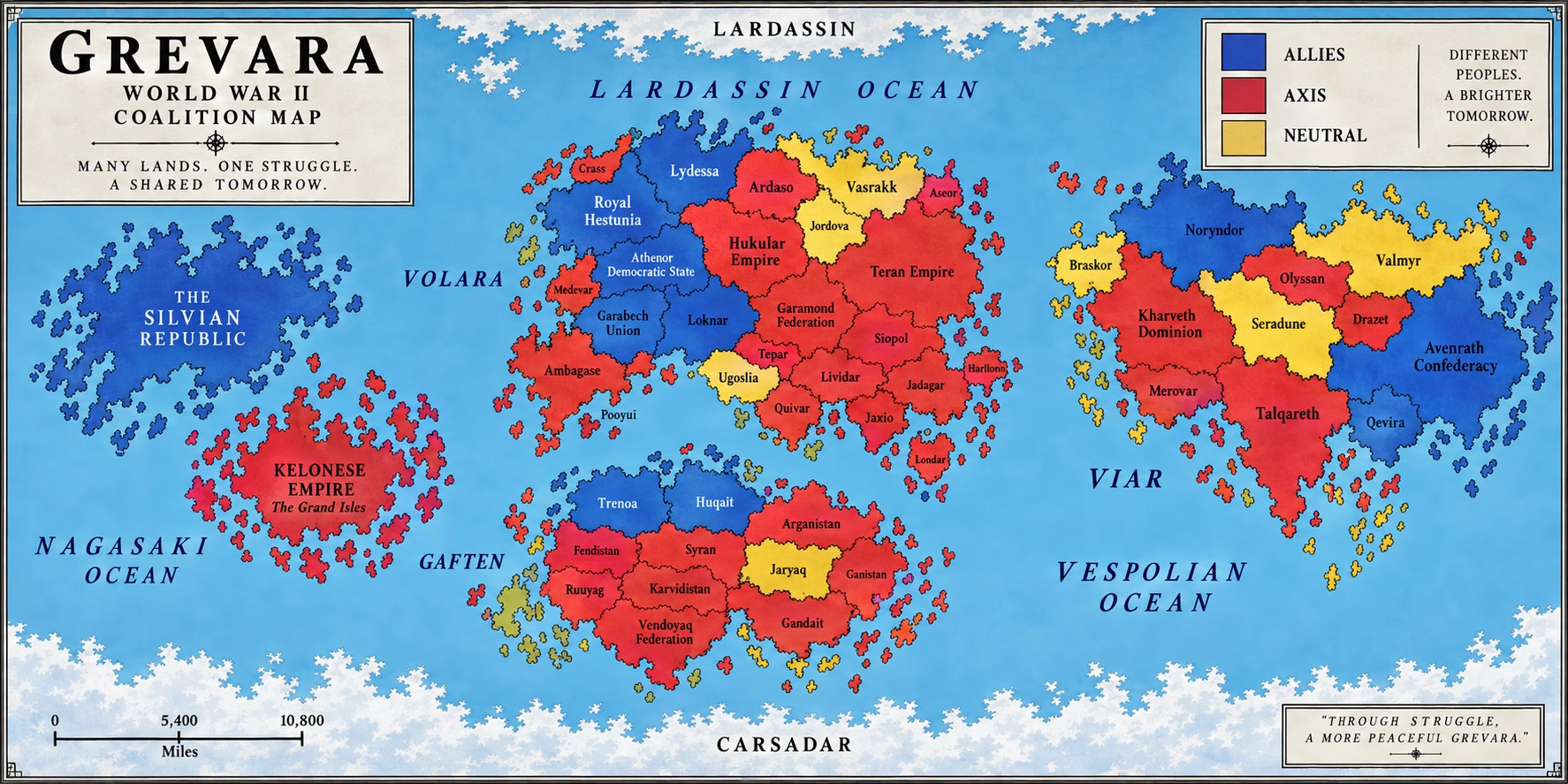
● Axis ● Allied ● Neutral · Zoom reveals cities, engagements and local positions. Drag to pan; use +/− or Ctrl+scroll to zoom. Hold over a marker for 5 seconds; click, tap or press Enter for immediate details.
Battle reference table
| Reference | Record |
|---|---|
| Dates | 1233-01-08 — 1233-10-22 |
| Participants | Silvian Republic; Kelonese Empire |
| Scale | Major |
| Status | Canon + proposed detail |
Commands & participating forces
Named operational commanders and supporting force groupings below are proposed additions unless explicitly marked creator-established. They are not a recovered order of battle or a claim of precise unit strength.
| Nation | Commander | Status | Forces |
|---|---|---|---|
| Silvian Republic | Naval commander Selvar Ren | Proposed operational commander | Permanent divisions operate within mission-based field armies. Specialist brigades, Logistics Divisions and Security Divisions provide distinct support roles; the original formation documents govern their organization. |
| Kelonese Empire | Kezan Morai | Proposed operational commander | Imperial naval forces, naval infantry, island garrisons and dispersed coastal transport defend bases while competing for fuel, repair capacity and trained crews. |
Fighting, tactics & logistics
The proposed opening combines isolation with offers for local surrender where organized resistance no longer serves an operational purpose. Major assaults target still-functioning command and supply centers. Kelonese resistance remains uneven: some formations withdraw, some negotiate and others continue fighting. Silvian forces separate disarmament, relief and the search for missing personnel into distinct tasks.
Civilian consequences
Military victory leaves hunger, displacement and damaged institutions. Relief and accounting for the dead continue beyond the declared end of hostilities.
Outcome & wider significance
Canon: the Kelonese Empire falls and the war ends in 1233. The January–October boundaries and operational phases are proposed; no exact final surrender day is claimed as supplied canon.
Developed battle history
The battle in detail
Expanded Grevara lore: new events, characters and in-world accounts developed for this archive. Supplied historical quotations retain their source links.
The winter chart room
On 8 January 1233, Admiral Selvar Ren ordered the western chart room to remove the colored pins that marked islands merely sighted, shelled or passed. The remaining pins represented places the Republic could actually use: anchorages with inspected entrances, airstrips with fuel on hand, workshops with working machinery, and piers where cargo could be landed without first rebuilding the approach. The difference was sobering. Years of fighting had given the Silvians a wide operating area, but their dependable bases formed a narrower chain inside it.
Ren’s immediate opponent was Admiral Keshun Var, whose surviving imperial command operated from the Rensai anchorage. Var had returned from earlier appointments to find a fleet that existed in several different senses. Some vessels were ready for sea. Others had crews and guns but no reliable propulsion. Still others appeared in headquarters totals although their machinery had been removed to keep sister ships operating. His first conference ended with an argument over whether such ships should count as reserves. Var settled the issue by asking which could leave before dawn. The answer shaped his campaign more than the official total.
The Silvian plan consequently began with connections rather than territorial coverage. Rensai depended on a northern channel, a southern repair inlet and an inland communications station. Each could be attacked separately, but attacking all three at once would spread the available landing craft and escorts dangerously thin. Ren chose to close the northern channel first, draw out the imperial mobile reserve, and only then assault the repair inlet. The sequence made the opening weeks appear restrained. It was designed to prevent an early victory from leaving the next operation without the means to exploit it.
The fighting at Varo Sound
Varo Sound narrowed between a wooded island and a low coastal shelf. Its navigable water did not follow the visually obvious middle of the passage; ships entering from the west had to turn toward the shelf before swinging back into deeper water. The imperial battery above the shelf had rehearsed that turn as its principal engagement point. Commander Ishen Tavel, commanding the coastal sector, rejected a subordinate’s proposal to fire at the first distant silhouettes. He wanted the lead ship committed to the channel before revealing the battery.
The first Silvian attempt therefore met a prepared defense. A screening vessel turned away after being hit near its forward fittings, and the following ships reduced speed while observers tried to distinguish the firing position from several empty emplacements. Lieutenant Meral Doss, aboard the lead reconnaissance craft, reported that the apparent flash on the upper ridge was reflected light. The actual gun position lay lower, beneath an overhanging rock face. His correction arrived after the initial supporting fire had already struck the wrong slope.
Ren did not repeat the passage that afternoon. During the night, a small landing force crossed to the wooded island and established observation positions facing the shelf. At first light, these observers guided fire against the lower emplacement while a second group engaged imperial lookouts closer to the water. Tavel’s crews shifted between protected recesses and the gun platforms, keeping one weapon in action after the others had fallen silent. Their persistence delayed the passage long enough for two imperial supply vessels to escape eastward. By evening the Silvians controlled the western entrance, but the engagement had demonstrated that an apparently minor coastal position could alter the whole campaign’s timetable.
A victory that needed a second morning
The capture of the western entrance did not open Varo Sound automatically. The landing force held its observation ridge, but imperial infantry still occupied a village overlooking the inland path. Captain Elven Marr advanced toward the village before dawn with orders to secure the path and establish a defensible connection to the beach. His leading platoon entered an abandoned garden enclosure and discovered that the walls concealed lateral passages between houses. The defenders used those passages to change firing positions without crossing the exposed street.
Marr halted the advance rather than sending successive squads into the same opening. A supporting section moved along the edge of a drainage channel while another maintained pressure on the houses facing the enclosure. The maneuver was slow because the channel repeatedly disappeared under fallen masonry. When the supporting section reached a side lane, the imperial defenders withdrew toward a school building farther inland. They left behind a small rearguard that continued firing long enough to conceal the main withdrawal.
The Silvians secured the village during the afternoon, after a separate exchange around the school boundary. Marr’s report identified the result carefully: the path was open to organized movement, but the surrounding scrub had not been cleared and movement after dark still required protection. That qualification mattered. Headquarters had already begun allocating the path to ammunition parties and signal crews on the assumption that the village’s capture made it safe. Marr refused to remove the escort requirement until patrols established where the withdrawing defenders had gone.
The second morning thus converted a naval access gain into a usable foothold. Without it, the Republic would have possessed an observation point that could be isolated by a short counterattack. The fighting also consumed the reserve company intended for the next landing. Ren postponed that landing, accepting a delay rather than replacing a tested formation with one that had not rehearsed the operation.
Var commits the floating reserve
Var understood that the northern channel was being closed in stages. He could still interfere before the Silvians established a permanent supporting network, but waiting for a complete picture would surrender the opportunity. He assembled his remaining mobile group from vessels whose readiness differed sharply. A fast escort could make the passage independently; a heavier ship needed a cautious machinery schedule; two small craft carried crews drawn partly from shore establishments. The force could deliver a sudden blow, but it was poorly suited to a prolonged pursuit or a running battle beyond its supply radius.
Its objective was the Silvian unloading area west of the sound. Var did not expect to destroy the whole expedition. He intended to damage enough landing craft and stores to force Ren to suspend the next operation. The distinction influenced his instructions: the group was to strike the anchorage, avoid being drawn into distant combat, and withdraw before daylight exposed its route home.
The attack reached the outer screen in darkness. Silvian lookouts first reported unidentified vessels crossing an expected coastal silhouette, and the recognition exchange failed amid conflicting radio traffic. Gunfire followed before either commander possessed a reliable view of the opposing formation. One imperial vessel turned toward the flashes, mistaking a screen ship for a transport; another continued toward the unloading area and came under fire from two directions. The divergence broke the concentration on which Var’s plan depended.
The imperial group damaged the outer anchorage and forced a temporary halt in unloading, but failed to reach the densest transport concentration. Its withdrawal was more costly than its approach. A disabled craft slowed the eastern group, and the attempt to cover it exposed the heavier ship to additional fire. By morning Var had preserved part of his reserve, yet the force no longer had the cohesion needed to repeat the attack immediately. The Silvians repaired their schedule more quickly than the Empire could repair its striking force.
The southern inlet assault
With the northern route restricted, Ren turned toward the southern repair inlet. Its workshops were valuable precisely because they could restore machinery that the remaining imperial bases could no longer service reliably. Colonel Naren Issa, commanding the inlet’s defense, placed his strongest infantry positions on the ridges behind the waterfront rather than directly among the sheds. He expected the Silvians to hesitate before destroying equipment they hoped to capture. The ridges allowed his troops to fire into the approaches while keeping much of the repair complex outside their own defensive line.
The opening Silvian bombardment struck the known ridge positions and the inlet’s outer gun emplacements. It did not silence every weapon. A concealed position above the eastern road fired after the first landing wave began moving inland, forcing two groups to shelter behind a low stone embankment. Major Lera Voss, directing the left landing sector, redirected her reserve toward the road instead of reinforcing the waterfront. Her decision separated the immediate problem of surviving on the beach from the larger requirement to get off it.
Fighting along the road developed into a sequence of short advances between cuts in the hillside. The defenders fell back from one bend to the next, using the intervening ground to break the attackers’ view. Voss’s troops eventually reached the rear of the concealed gun position, but only after an imperial counterattack struck their own connection to the beach. The reserve platoon assigned to protect that connection held a culvert through repeated exchanges and prevented the forward companies from being isolated.
By nightfall the Republic controlled the waterfront and the road’s lower section. Issa retained the inland ridge and continued to direct fire toward the workshops. The inlet had been entered, not secured. Its machinery would remain unusable until the ridge fighting ended, illustrating again why capturing a place and gaining its military function were different achievements.
The ridge above the machinery
Issa attempted to recover the inlet before dawn. His counterattack approached along two covered gullies, with the western group ordered to draw the Silvian reserve while the eastern group reached the workshops. The arrangement relied on both groups maintaining their schedules despite poor communications. In the western gully, fallen trees and a damaged retaining wall delayed the leading company. The eastern group continued on time and emerged without the diversion intended to protect it.
Silvian defenders at the upper workshop yard heard movement before they could identify its source. They held fire until the first imperial soldiers crossed a gap between storage buildings, then engaged from several prepared positions. The attackers briefly occupied a loading platform and threatened the route linking the waterfront to Voss’s forward companies. A Silvian counterattack restored the route, but the yard remained contested until daylight.
The western imperial group finally reached its objective after the main opportunity had passed. Its commander faced a choice between attacking an alerted defense or withdrawing across ground now exposed to observation. He attacked far enough to establish a temporary firing line, then used that pressure to cover a staged retreat. Issa’s report described the effort as a successful extraction of the mobile reserve. It was also the failure of his last organized attempt to retake the inlet.
The Republic advanced onto the ridge over the following days. Engineers accompanied the infantry because blocked paths repeatedly prevented supporting equipment from moving forward. Several positions were abandoned after neighboring strongpoints fell; others required direct assault. When the final ridge post withdrew, the workshops below were damaged but still useful. Their recovery shortened the Republic’s repair cycle and removed one of the Empire’s remaining reasons to believe that time would improve its position.
The communications station at Haren Fold
The next objective was Haren Fold, an inland communications station linked to Rensai by road and relay posts. Its importance was organizational. It received reports from scattered garrisons, assembled transport requests and transmitted instructions to formations whose local commanders could no longer reach the central naval staff reliably. Destroying the station outright would disrupt the Empire, but capturing its records could also help identify formations that had become isolated from any functioning command.
Major Oren Savel led the Silvian advance from the southern inlet. The road climbed through a series of folds in the ground, allowing defenders to conceal successive positions from observers below. Savel divided the advance into mutually supporting groups and imposed strict limits on pursuit. A withdrawing enemy section might be retreating in disorder, but it might also be drawing the leading company beyond the next group’s support. The distinction could not be settled by enthusiasm.
At the second relay post, imperial troops held a stone utility building after the surrounding positions had withdrawn. Their continued resistance interrupted the road movement long enough for records and equipment to be removed from the main station. Savel brought supporting fire onto the building’s approaches and offered the defenders a chance to surrender. They refused the first demand. After further fighting damaged the building and severed its remaining connection uphill, the surviving detachment laid down its weapons.
Haren Fold fell later, after its command staff evacuated toward Rensai. The documents left behind were incomplete but revealing: duplicate requests for fuel, unanswered repair messages and contradictory instructions to garrisons that had already changed commanders. The station’s loss did not cause every outlying unit to stop fighting. It made coherent resistance across the archipelago harder to organize, reducing the Empire’s ability to turn separate local forces into a common campaign.
Rensai’s narrowing perimeter
By the later stages of the campaign, Rensai’s defenders occupied a perimeter shaped by earlier losses. The northern channel could no longer support dependable replenishment. The southern workshops were serving the enemy. Haren Fold’s relay network had fragmented. Var still possessed armed ships, shore batteries and infantry, but their combined strength was less than the sum of the surviving weapons because the connections between them were failing.
Ren refused an immediate frontal assault on the entire anchorage. He selected the western battery belt and the road junction behind it as the first objectives. The battery belt threatened the approach; the junction allowed the defenders to move reserves between sectors. Silvian infantry attacked the junction while supporting forces engaged the batteries from positions established during previous operations. Neither effort could succeed cleanly without the other, and the timetable was adjusted repeatedly as local resistance changed the pace.
The junction fighting was particularly severe. Imperial troops counterattacked from a customs compound and regained part of the road during the afternoon. Captain Marr, transferred into the advancing formation after Varo Sound, organized a defense around a stone maintenance building. Its walls offered protection, but its position also made it an obvious target. He moved ammunition and wounded personnel out through a rear entrance before the next attack, reducing the congestion that had made the first defense nearly collapse.
The second imperial counterattack failed to dislodge his company. During the night, neighboring Silvian units reached the road beyond the compound, forcing the defenders to withdraw or risk encirclement. The battery belt then lost the route needed to sustain it. Several gun positions continued firing independently, but the perimeter could no longer be restored as a continuous system.
The final orders
Var’s last conference did not produce a single dramatic order accepted everywhere. Some commanders argued for concentrating the remaining personnel around the anchorage headquarters. Others wanted permission to withdraw into the interior, where they believed local resistance could continue. Issa, whose troops had fought through the southern inlet campaign, challenged both proposals. Concentration would expose units without giving them food or transport; dispersal would preserve armed groups while removing any practical means to support them.
The discussion ended with authority for sector commanders to negotiate local cessation of fighting when continued resistance had no achievable military objective. The instruction was deliberately narrower than a universal surrender, but its political meaning was unmistakable. Central command could no longer promise that obedience would lead to a coordinated result. It was transferring the decision to the officers who confronted the consequences directly.
“An order is not a bridge merely because it tells men to cross.”
— Colonel Naren Issa, newly written in-world account of the final conference.
Silvian forces continued to encounter armed resistance after the instruction circulated. Some units had not received it; others disputed its authenticity or believed that neighboring sectors were still preparing a counterattack. Ren required commanders to distinguish those situations when arranging local ceasefires, while maintaining their defenses against forces that continued fighting. The resulting end was uneven and geographically dispersed. A battery might fall silent while a road position several miles away still exchanged fire.
The proposed campaign closes on 22 October with the remaining organized resistance around Rensai brought to an end. That date belongs to this developed narrative. The larger established outcome is the fall of the Kelonese Empire in 1233. The military explanation lies in the preceding sequence: the Republic captured or denied the connections that allowed imperial forces to operate together, then defeated the remaining concentration when it could no longer restore those connections.
Full campaign dossier
Each chapter below identifies its evidence status. Source-grounded analysis interprets the cited record; proposed chapters develop additional history for creator review.
Chapter 1 · Creator canon and editorial boundary
The ending that is established and the sequence that is proposed
The creator establishes that the war ends in 1233, when the Kelonese Empire falls after the Silvian Republic dominates the Grand Isles. That is the fixed endpoint. The precise January–October dates used for this proposed campaign, the sequence of operations, local surrender arrangements and the locations of final command centers are additions for review.
Maintaining that distinction permits a complete narrative without falsely claiming that the uploaded newspapers document a final surrender day. The article explains how domination could become imperial collapse. It does not replace the creator’s ending with a new one, nor does it imply that every island changes hands through an identical assault.
The map remains the geographical authority. The Grand Isles are an archipelago whose routes, anchorages and repair facilities connect separate military concentrations. Control of that connecting system can matter more than the possession of every piece of land.
Chapter 2 · Source-grounded context
The inheritance of ten years of war
The island newspapers describe a war of footholds, counterattacks, ridges, airstrips, convoys and damaged harbors. They do not support a picture in which the Republic moves effortlessly from Kandar to final victory. The title A Thousand Islands, No Easy Victory captures an important limitation: tactical success in one place does not remove the problems of reaching, supplying and exploiting another.
By the proposed final campaign, the Silvian force has accumulated experience, infrastructure and a more favorable maritime position. The Kelonese system has endured losses and disruption, but its surviving formations still possess weapons, local knowledge and incentives to resist. The final year therefore begins with an unequal contest, not an empty theater.
The Republic’s advantage is most convincing when described as a set of capabilities: more reliable movement, better repair access, stronger reconnaissance and the ability to choose selected objectives. These advantages help explain victory without making every local fight predictable.
Chapter 3 · Proposed canon
The imperial military system under strain
The proposed late-war Kelonese problem is the separation of garrisons from dependable transport and repair. Some formations retain substantial ammunition but lack replacement parts or medical evacuation. Others have personnel and positions but cannot obtain enough food or fuel to conduct mobile operations. A single aggregate statement that the Empire has supplies would conceal these unequal local conditions.
Imperial commanders attempt to disperse movement into smaller loads and exploit weather, darkness and local routes. This can preserve some delivery, but smaller movements are harder to coordinate and may carry less heavy equipment. Repair facilities become strategic assets because they determine whether damaged craft return to use or accumulate as unusable hulls.
The proposed history does not assume every local commander receives or accepts the same order. Communications can be delayed, incomplete or disputed. These conditions create varied final outcomes: continued organized resistance, attempted evacuation, negotiation and isolated fighting after larger formations cease operations.
Chapter 4 · Proposed canon
Silvian objectives for the final year
The proposed Silvian plan ranks objectives by their function in the remaining imperial system. A command center matters if it still directs forces and communicates effectively. An anchorage matters if it enables repair, refueling or transfer. A defended island whose garrison is already isolated may require containment rather than immediate assault, provided that containment does not ignore the civilians dependent on the same routes.
The plan therefore combines maritime control, selected ground operations and local surrender arrangements. It aims to remove the Empire’s capacity to coordinate and sustain resistance rather than count captured islands as an end in itself. Each major operation is linked to a reason: securing a usable port, stopping a remaining transport connection, protecting an Allied route or compelling a command with real authority to cease fighting.
This prioritization creates opportunities to preserve forces for the objectives that remain necessary. It does not guarantee low casualties, because a strategically isolated defender can still inflict severe losses in a local battle.
Chapter 5 · Proposed canon
Reconnaissance and deciding what to bypass
Before bypassing a defended position, Silvian planners need to understand what it can still do. A garrison may threaten a route with coastal guns, small craft or observation even when it cannot mount a large offensive. Its effect also depends on the geography of nearby traffic and the availability of alternative approaches.
The proposed reconnaissance system combines aerial observation, naval patrol reporting and information from previously occupied areas. Reports distinguish confirmed activity from inferred readiness. Silence is not automatically interpreted as surrender or incapacity. Where information remains poor, commanders use limited probes and surveillance before committing a major assault or rerouting an entire supply system.
The resulting decisions are revisited as conditions change. A position safely contained in January may become important if the Republic later moves a repair base or opens a new route nearby. The final campaign is therefore a changing network of priorities rather than a fixed checklist drawn at the start of the year.
Chapter 6 · Proposed canon
Preparing a major assault in the final campaign
A selected assault begins with a clear statement of what must be usable afterward. If the objective is a repair anchorage, indiscriminate destruction of its service facilities can defeat part of the operation’s purpose. Fire planning therefore distinguishes essential defenses from infrastructure whose preservation would shorten the later Allied buildup, while accepting that combat may still cause extensive damage.
The landing force includes engineer, communications, medical and traffic-control elements early enough to affect the foothold. Combat troops secure unloading ground and exits; engineers assess access; naval support responds to identified threats; and a reserve remains available for counterattacks against vulnerable parts of the perimeter. The plan assumes that some communications will fail and includes local coordination procedures.
The operation’s first success is not simply that troops reach land. It is that they can remain supplied, evacuate wounded and expand the position without their own traffic blocking the routes they have captured.
Chapter 7 · Proposed enemy perspective
The Kelonese counterstroke
The proposed defender uses its remaining mobility against the points where the landing force is most dependent: unloading, water, repair work and narrow exits. It may allow the attackers into exposed ground before counterattacking the connection behind them. Local success is measured by interruption and delay as well as recovered territory.
Imperial command also has to conserve irreplaceable strength. A large counterattack might temporarily threaten the beach but consume the last mobile reserve. Holding that reserve indefinitely might allow the Silvians to consolidate until no useful opportunity remains. The choice depends on the local command’s information, supply and expectation of relief.
The narrative should allow competent defensive decisions even when the Empire ultimately loses. A collapsing strategic position does not make every commander foolish or every soldier ineffective. That distinction gives the final campaign tension and explains why victory still requires difficult work.
Chapter 8 · Proposed canon
Negotiation, local surrender and authority
A local surrender is useful only if the person agreeing to it has sufficient authority and means to implement it. Silvian negotiators need to identify which units are covered, where weapons will be collected, how personnel will move and what happens to detached formations that have not received the order. A signature without those arrangements may not stop shooting.
The proposed process uses written terms and repeated communication through more than one channel. Ceasefire boundaries and movement routes are explained to both sides. Disarmament points are separated from civilian relief areas where possible, reducing confusion between military custody and ordinary assistance. Medical treatment for wounded personnel begins according to need rather than waiting for every administrative detail to be settled.
This account describes a proposed military procedure. It does not invent a canonical treaty title, final imperial signature or named peace conference. Those decisions remain available to the creator rather than being silently fixed by the website.
Chapter 9 · Proposed civilian reconstruction
Civilians inside an isolated archipelago
The same maritime connections that carry military cargo may also carry food, medicine, workers and family members. The interruption of imperial logistics therefore has civilian consequences that cannot be assumed away because the military strategy is successful. Some communities lose imports; others lose the ability to move their own produce to markets or treatment centers.
The proposed relief system surveys local needs before treating every island as having the same shortage. Water systems, medical capacity, crop conditions and available transport differ. Military landing schedules reserve space for relief cargo as areas become accessible. Distribution uses local knowledge while recording what is delivered, to reduce diversion and prevent the strongest local group from absorbing all assistance.
These measures do not make the campaign bloodless or erase the effects of prolonged isolation. They make civilian survival an explicit part of the operational aftermath rather than a closing sentence added after the military victory.
Chapter 10 · Proposed canon
Disarmament and the danger of administrative collapse
The fall of imperial authority can remove institutions that still perform necessary everyday functions. Local transport offices, water services, hospitals and food distribution may depend on personnel employed by the old state. Replacing military control does not automatically supply a functioning civil administration.
The proposed Allied policy distinguishes immediate disarmament from the continued operation of essential services under supervision. Records are secured before offices are dismantled. Civil personnel are identified and assigned responsibilities, while allegations of abuse are investigated through documented procedures rather than improvised collective punishment. The design aims to prevent a military success from producing avoidable administrative chaos.
The policy is contested. Some communities demand rapid removal of officials associated with occupation or repression; others fear losing the people who know how to operate remaining services. The detailed postwar history should follow those disputes instead of presenting reconstruction as an automatic consequence of victory.
Chapter 11 · Proposed canon
Prisoners, missing personnel and family records
The proposed disarmament system records identity, unit, place of capture or surrender, medical condition and subsequent movement. These records serve both immediate control and later family notification. A person listed as missing by one side may already be receiving treatment elsewhere, while damaged or incomplete unit rolls complicate identification.
Separate teams examine abandoned hospitals, wreck sites and former holding areas for information about people whose fate remains unknown. The work continues after organized fighting ends. It should not be replaced by an invented final casualty total that appears comprehensive merely because it is precise.
For families across the Grand Isles and Silvia, the end of the war can therefore be both relief and the beginning of another uncertain period. Demobilization, return and confirmation of loss proceed at different speeds. A historical archive benefits from following those processes rather than closing every personal story on the same surrender date.
Chapter 12 · Historical interpretation
What it means for an empire to fall
The canonical fall of the Kelonese Empire implies more than the loss of a final battlefield. An imperial system must be unable to maintain the authority, military coordination and external position that defined it. The precise constitutional replacement and settlement remain open in this proposed continuation unless the creator establishes them separately.
Silvian domination of the Grand Isles explains how that result becomes possible. The Republic can sustain selected operations and interrupt the connections on which imperial resistance depends. Local defenders may remain dangerous, yet their actions no longer combine into a strategy capable of restoring the Empire’s position.
The ending is therefore a change in the structure of the war, not a claim that every weapon becomes silent at once. Remaining security, relief and accountability tasks persist beyond the victory. The year 1233 closes the world war in the creator’s chronology while opening a distinct history of recovery and political reconstruction.