Proposed canon. Dates, tactical sequences and local positions are newly developed unless the text explicitly identifies a creator or source anchor. Related images document the wider war; they are not photographs of this proposed battle.
Strategic objective
Axis forces seek to reduce Trenoa’s ability to sustain dispersed positions by contesting water and servicing points. Trenoa aims to preserve dependable movement between its front and rear.
Ground & operational constraints
Long road intervals and limited water distribution make vehicle endurance and route timing central. Ruuyag participates on the Axis side; the earlier Allied assignment is superseded.
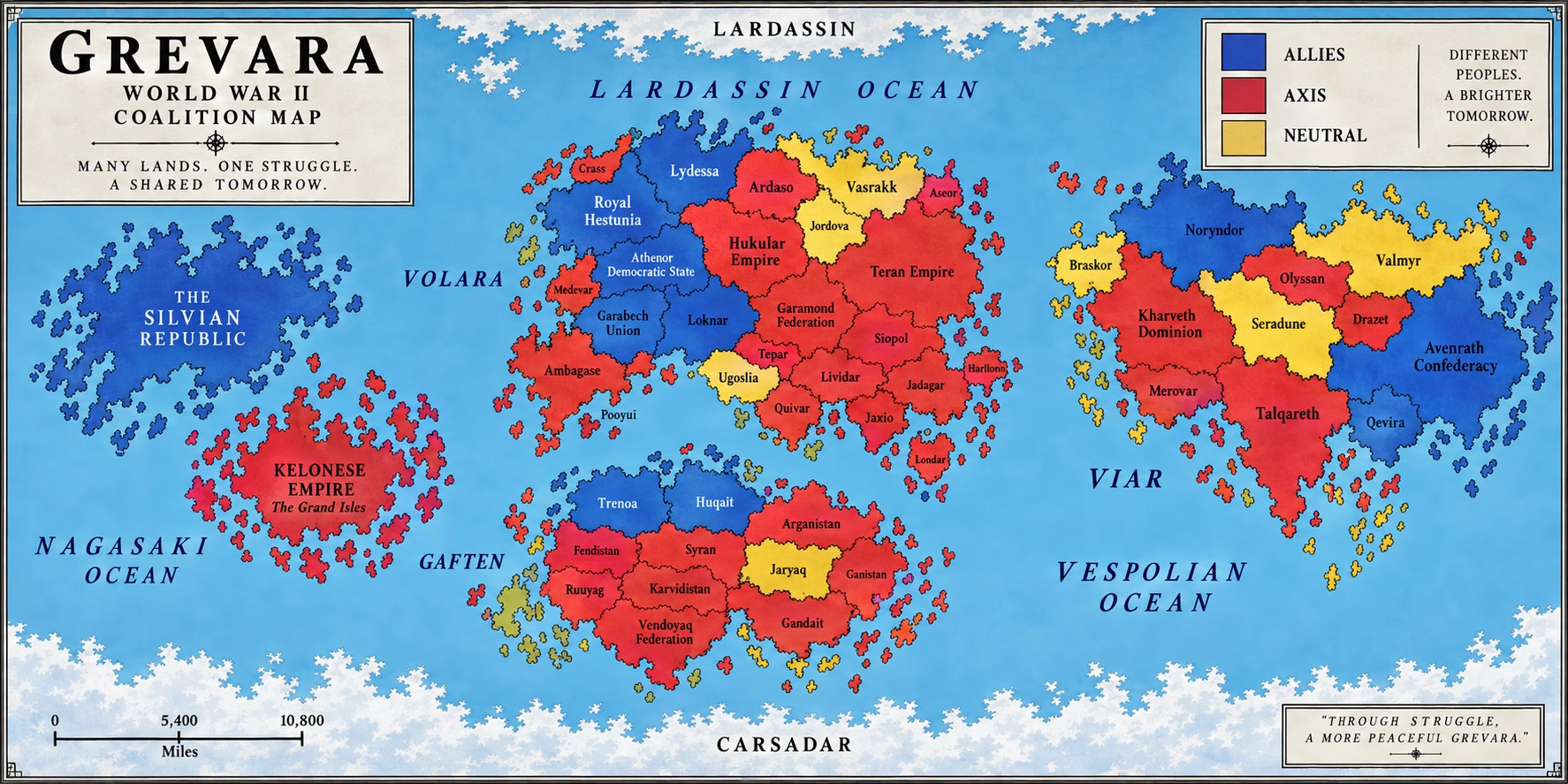
● Axis ● Allied ● Neutral · Zoom reveals cities, engagements and local positions. Drag to pan; use +/− or Ctrl+scroll to zoom. Hold over a marker for 5 seconds; click, tap or press Enter for immediate details.
Battle reference table
| Reference | Record |
|---|---|
| Dates | 1216-04-19 — 1217-01-30 |
| Participants | Syran; Fendistan; Ruuyag; Trenoa |
| Scale | Colossal |
| Status | Proposed canon |
Commands & participating forces
Named operational commanders and supporting force groupings below are proposed additions unless explicitly marked creator-established. They are not a recovered order of battle or a claim of precise unit strength.
| Nation | Commander | Status | Forces |
|---|---|---|---|
| Syran | Rashad Kassem | Proposed operational commander | Mobile infantry columns operate with towed artillery, reconnaissance patrols, tankers and recovery detachments; water and workshop capacity govern their reach. |
| Fendistan | Jamal Ravid | Proposed operational commander | Southern offensive groups combine infantry and road-bound support with access facilities used by Syran formations. |
| Ruuyag | Ruven Yagar | Proposed operational commander | Border infantry, patrol detachments and protected staging services maintain a western connection with the Vendoyaq Federation. |
| Trenoa | Samir Naref | Proposed operational commander | Sultanate infantry, mobile patrols, water columns and road-repair units sustain desert operations and the Huqait assistance service. |
Fighting, tactics & logistics
The Axis first attempts to make a set of forward servicing points too dangerous for routine Trenoan use. Local seizure alone does not guarantee success: a damaged pump or blocked approach can make the position useless to its captor as well. Syran, Fendistan and Ruuyag must decide whether their immediate purpose is denial or incorporation into their own support network.
Trenoa responds by separating some maintenance tasks from water collection and by reorganizing delivery schedules. This reduces congestion at individual points but increases the number of places requiring protection. The campaign consequently consumes security and transport manpower that might otherwise reinforce the front.
Later fighting turns on which side can sustain its forward effort without exhausting its support vehicles. Trenoan commanders shorten certain positions and preserve the equipment needed for future operations. Axis forces retain the ability to disrupt movement but cannot make every alternate route unusable at once. The campaign produces an uneven network rather than a simple line drawn across empty desert.
Civilian consequences
Wells support households and agriculture as well as armies. Requisition and damaged access can drive displacement even where no large town changes hands. Exact civilian losses and daily water requirements remain unspecified.
Outcome & wider significance
Trenoa retains a restricted supply network at the cost of reduced operational freedom. The Axis imposes recurring delays but does not eliminate Trenoan resistance.