Proposed canon. Dates, tactical sequences and local positions are newly developed unless the text explicitly identifies a creator or source anchor. Related images document the wider war; they are not photographs of this proposed battle.
Strategic objective
Trenoa seeks to regain operational room on its southern front. The Axis intends to contain the advance and preserve the roads sustaining its own pressure.
Ground & operational constraints
The proposed advance crosses a patchwork of defended approaches and transport junctions. Ground gained beyond the capacity of the Trenoan support system cannot be retained indefinitely.
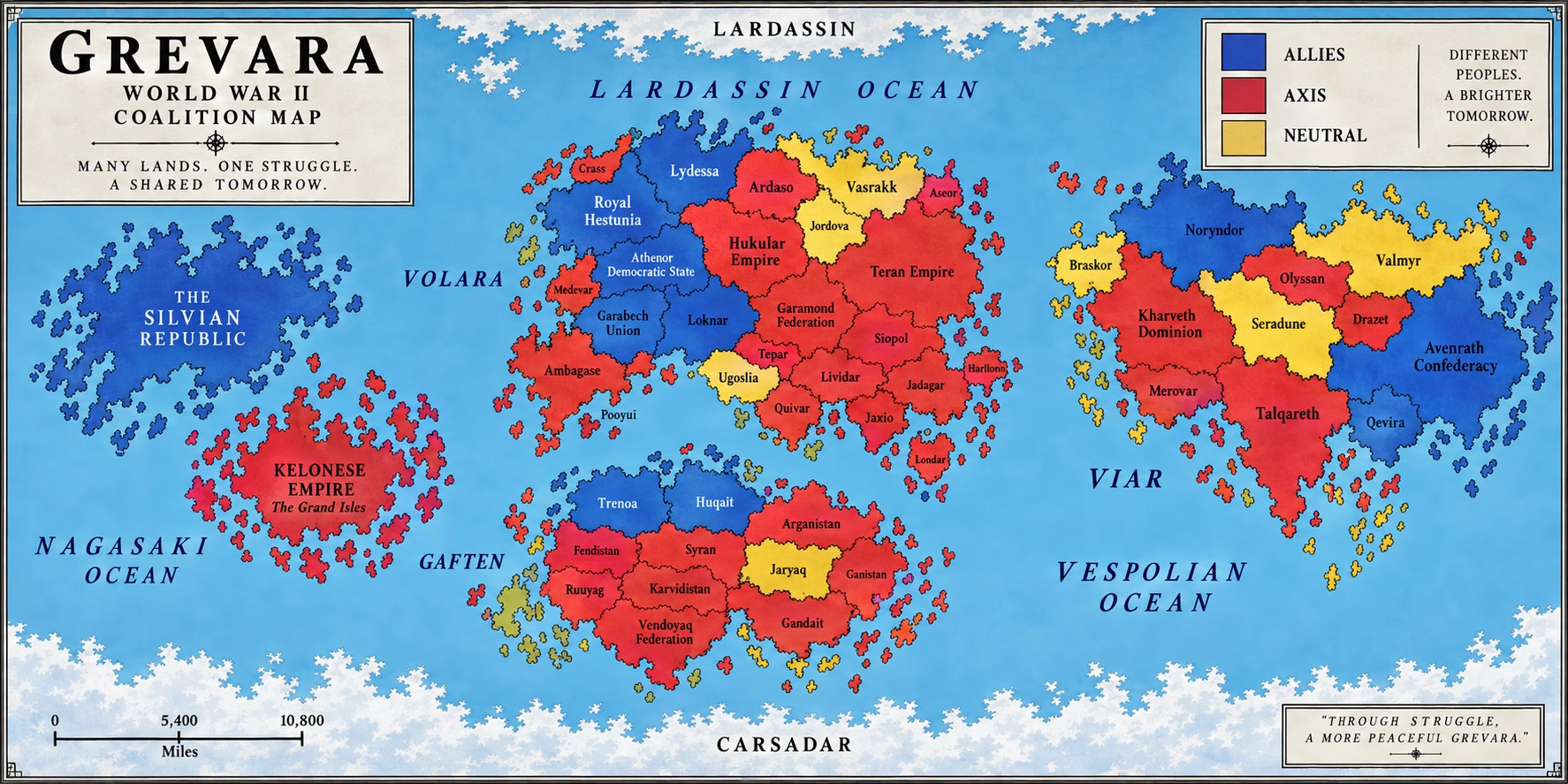
● Axis ● Allied ● Neutral · Zoom reveals cities, engagements and local positions. Drag to pan; use +/− or Ctrl+scroll to zoom. Hold over a marker for 5 seconds; click, tap or press Enter for immediate details.
Battle reference table
| Reference | Record |
|---|---|
| Dates | 1220-04-13 — 1221-03-09 |
| Participants | Fendistan; Syran; Ruuyag; Trenoa |
| Scale | Colossal |
| Status | Proposed canon |
Commands & participating forces
Named operational commanders and supporting force groupings below are proposed additions unless explicitly marked creator-established. They are not a recovered order of battle or a claim of precise unit strength.
| Nation | Commander | Status | Forces |
|---|---|---|---|
| Fendistan | Jamal Ravid | Proposed operational commander | Southern offensive groups combine infantry and road-bound support with access facilities used by Syran formations. |
| Syran | Rashad Kassem | Proposed operational commander | Mobile infantry columns operate with towed artillery, reconnaissance patrols, tankers and recovery detachments; water and workshop capacity govern their reach. |
| Ruuyag | Ruven Yagar | Proposed operational commander | Border infantry, patrol detachments and protected staging services maintain a western connection with the Vendoyaq Federation. |
| Trenoa | Samir Naref | Proposed operational commander | Sultanate infantry, mobile patrols, water columns and road-repair units sustain desert operations and the Huqait assistance service. |
Fighting, tactics & logistics
Trenoa opens with limited objectives intended to improve its road connections rather than recover every lost district at once. Units receive separate tasks for holding newly accessible junctions and protecting the movement behind them. This distinction keeps the campaign from becoming a single unsupported arrow toward the south.
Ruuyag supports the Axis defense alongside Fendistan and Syran. Local counterpressure seeks to divert Trenoan reserves before the new positions become secure. Trenoan commanders must decide whether to reinforce the forward effort or preserve transport and repair capacity for the next stage. Their solution is a pause in the most exposed sector while other connections are consolidated.
The campaign’s later phase replaces rapid movement with a struggle over reliable access. Repaired roads allow some forward formations to remain, while other gains are abandoned because they cannot be supplied at acceptable cost. The resulting front is more favorable to Trenoa, but the Axis retains organized forces and the capacity for renewed pressure.
Civilian consequences
Returning authorities face damaged services and competing claims over requisitioned property. Military reoccupation does not instantly restore harvests, housing or local administration.
Outcome & wider significance
Trenoa achieves a limited recovery of initiative and a stronger support position. The revised account treats Ruuyag as an Axis opponent rather than an Allied partner.