Proposed canon. Dates, tactical sequences and local positions are newly developed unless the text explicitly identifies a creator or source anchor. Related images document the wider war; they are not photographs of this proposed battle.
Strategic objective
Hukular seeks to turn its documented invasion into a quick destruction of Athenor's field army. Athenor must preserve forces long enough for Hestunian assistance to become effective.
Ground & operational constraints
Border roads converge through cultivated country on a few administrative towns. The proposed battle zone lies inside Athenor; its individual crossings are not fixed on the source map.
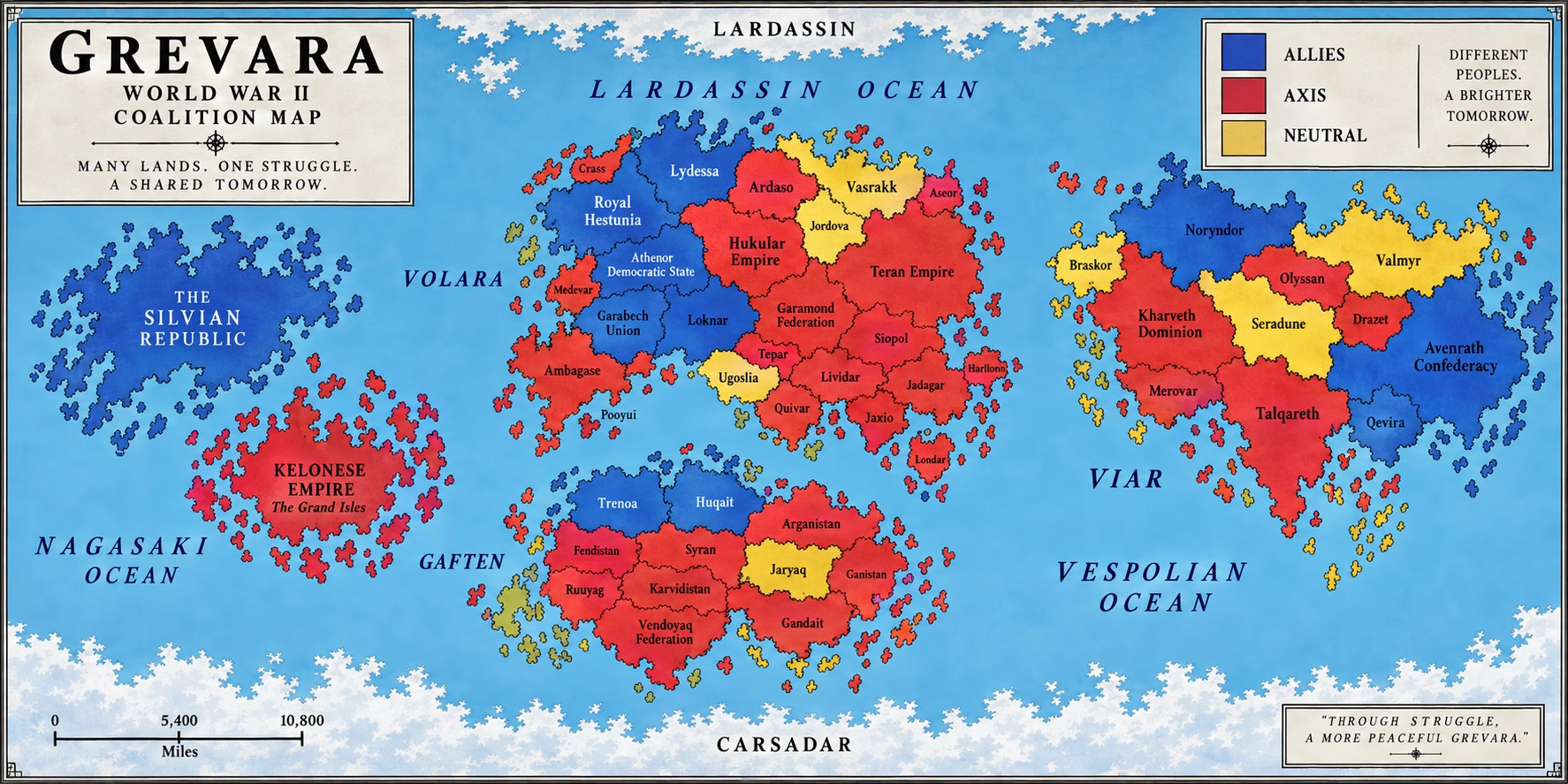
● Axis ● Allied ● Neutral · Zoom reveals cities, engagements and local positions. Drag to pan; use +/− or Ctrl+scroll to zoom. Hold over a marker for 5 seconds; click, tap or press Enter for immediate details.
Battle reference table
| Reference | Record |
|---|---|
| Dates | 1208-05-09 — 1208-10-24 |
| Participants | Hukular; Athenor; Royal Hestunia |
| Scale | Colossal |
| Status | Proposed canon |
Commands & participating forces
Named operational commanders and supporting force groupings below are proposed additions unless explicitly marked creator-established. They are not a recovered order of battle or a claim of precise unit strength.
| Nation | Commander | Status | Forces |
|---|---|---|---|
| Hukular | Marvek Doran | Proposed operational commander | A central assault group with concentrated artillery, engineer columns and infantry reserves; its effectiveness depends on rail delivery and the protection of its flanks. |
| Athenor | Ilyan Theron | Proposed operational commander | Citizen infantry formations, municipal engineer detachments and a field-artillery reserve operate under a common campaign command; later exile units use Allied liaison staffs. |
| Royal Hestunia | Oren Valcrest | Proposed operational commander | County-raised infantry, assault engineers, artillery and transport units sustain the front. Royal and coalition authorities retain separate responsibilities. |
Fighting, tactics & logistics
Hukular's forward columns rupture frontier posts, but their transport crowds the same roads needed by heavy artillery. Athenorian commanders withdraw guns by successive bounds while local infantry covers farm lanes. Hestunian formations arrive piecemeal and establish a reserve behind the second defensive belt. An Axis attempt to envelop that belt captures stores but fails to close the western escape routes.
Civilian consequences
Harvest requisition competes with army transport. Municipal councils move grain before evacuating hospitals, leaving late-departing families exposed to the changing front.
Outcome & wider significance
Axis territorial victory, without the intended annihilation. The surviving Allied army makes the struggle for Athenor a campaign of years. The invasion date is a creator/source anchor; the battle's end date and phases are proposed.
Developed battle history
The battle in detail
Expanded Grevara lore: new events, characters and in-world accounts developed for this archive. Supplied historical quotations retain their source links.
The frontier before 9 May
The frontier campaign begins with a political refusal. Athenor has rejected Hukular’s demands for transit rights and restrictions on its foreign agreements. Accepting those terms would have given the neighboring empire influence over decisions that the Athenorian government considers its own. The disagreement therefore concerns sovereignty before it becomes a question of defensive positions and marching columns.
The developed local history centers on Orven Market, a fictional administrative town behind the eastern frontier. Roads from farming districts converge there before continuing toward the interior. The town’s importance is practical rather than ceremonial: it contains receiving offices, grain stores, a hospital and workshops used by civilian transport. Military planners see a movement node; residents see the institutions through which their ordinary lives operate.
Athenorian Captain Daven Iral commands a frontier detachment in this reconstruction. His prewar reports concern small movements, local crossings and changes in the neighboring military presence. He has enough information to understand that tension is increasing, but not the authority to decide national policy or the resources to prepare every possible approach. His orders require vigilance while the government continues treating the crisis as a matter in which political choices still exist.
At Orven Market, municipal secretary Liora Vesk begins preparing copies of essential records. The work appears cautious rather than heroic. Tax rolls, hospital registers and transport claims are not usually considered the central objects of a national crisis. Once movement begins, however, those documents will help determine where supplies belong, who has been displaced and which local authority can continue acting after its office is no longer usable.
The invasion reaches the border posts
On 9 May 1208, Hukular invades. The established date anchors the campaign, while the events around Iral’s detachment supply a newly developed local sequence. The frontier posts encounter an attack whose scale exceeds the routine incidents for which their daily arrangements have been designed. Reports move inward as different positions discover that the pressure is not confined to their own crossing.
Iral’s first decision concerns what can be preserved. Remaining indefinitely at an exposed post would satisfy the appearance of holding the border while risking the loss of personnel needed farther back. Withdrawal, however, creates a gap through which the invading columns can move. He attempts to maintain contact with neighboring detachments while sending usable equipment toward the next receiving position.
The movement is uneven. Some parties reach the designated route in order; others arrive with incomplete information about what has happened beside them. Local civilians enter the same roads, bringing carts, animals and possessions that cannot be moved at military speed. The resulting congestion changes the timetable for both soldiers and residents.
Hukular’s leading units gain ground and capture several abandoned facilities, but their success also draws more traffic onto the approaches. Following artillery, stores and administrative elements need the roads already occupied by forward columns. The offensive’s strength produces its own coordination problem. A border rupture is not yet the destruction of Athenor’s field army, and the invading command must decide how quickly it can press inward without separating its leading forces from support.
Orven Market becomes a receiving town
As the frontier reports arrive, Orven Market changes function faster than its institutions can adapt. The grain stores become military supply points, the hospital receives casualties from outside its normal district and the administrative offices fill with people seeking instructions. Vesk’s records staff tries to preserve ordinary services while answering demands that were not part of its previous work.
A dispute develops over transport. Military authorities want to move grain before the roads become less reliable. Hospital staff want vehicles reserved for patients who cannot travel independently. Both needs are real, but the first schedule favors the stores, leaving some medical movement dangerously late. The episode develops the original proposal’s tension between harvest requisition and evacuation rather than presenting local administration as uniformly competent.
Vesk records the decisions and the names of officials issuing them. That does not rescue the people who are forced to wait, but it prevents the later account from describing the outcome as an anonymous accident. The civilian history includes responsibility, disputed priorities and the difficulty of correcting a decision after the movement system has already been committed.
Iral’s withdrawing soldiers pass through the town without being able to resolve every request directed at them. Some residents interpret their movement as abandonment; others understand that the detachment is trying to reach another line from which it can continue fighting. The town becomes a place where the difference between national strategy and immediate local loss is impossible to ignore.
The second defensive belt
Athenorian commanders establish a second belt behind the broken frontier, using the roads and settlements that still connect their formations. It is not an uninterrupted wall. Some positions are prepared more thoroughly than others, and communication between sectors depends on people and facilities already strained by retreat.
Iral’s detachment joins a formation responsible for an approach west of Orven Market. Its personnel bring recent knowledge of the enemy’s movement but also fatigue and missing equipment. The receiving command has to decide whether to keep them together as an experienced local group or distribute them among units with immediate shortages. The reconstruction preserves part of their cohesion while assigning specialists where they are most needed.
Hukular’s command seeks to prevent this line from becoming a durable obstacle. An early effort gains access to a local road junction but does not cut every connection behind the Athenorian positions. The defenders respond by shortening an exposed section and concentrating support around the routes still available. That movement sacrifices ground without conceding the entire belt.
The fighting changes the character of the invasion. The first days’ frontier rupture gives way to a contest in which both commands must sustain repeated effort. Athenor’s losses are serious, and Hukular retains the initiative, but the defender is still making choices. The continued existence of organized resistance matters because it creates time in which Hestunian assistance can become more than a diplomatic possibility.
Hestunia enters the war
Royal Hestunia enters the conflict on 2 June 1208. That date separates the Athenorians’ first weeks of fighting from the period in which Hestunian military assistance becomes part of the developing campaign. The reconstruction does not place a Hestunian rescue army on the frontier before its established entry into the war.
The first arriving formations do not solve every problem by their presence alone. They need receiving areas, routes, reports and a relationship with the forces they are supporting. Hestunian Major Keran Dovel, an invented liaison officer, reaches the second belt with instructions to identify where reinforcement will preserve the Allied position most effectively.
Dovel encounters an understandable Athenorian priority: units under immediate pressure want the newcomers beside them now. Hestunian commanders also want a reserve from which they can respond to a larger threat. Assigning every arriving element directly to the front would reduce the ability to deal with an unexpected development, while keeping too much back would leave exhausted Athenorian formations carrying the burden alone.
The resulting arrangement distributes some assistance to threatened sectors and retains a limited supporting concentration behind the belt. The compromise produces complaints on both sides, but it gives the defense another set of choices. Hestunia’s contribution is significant precisely because it becomes part of an existing Athenorian effort, rather than replacing that effort in a story where the smaller state has already ceased to act.
The attempt to close the western roads
Hukular’s next developed effort aims beyond another local penetration. The invading command seeks to close the western routes through which the Athenorian forces can withdraw, reorganize and receive assistance. If those routes are severed while the defenders remain committed to the second belt, the territorial campaign could become the destruction of a substantial part of the Allied army.
A fictional Hukular staff officer, Colonel Varnek Hol, coordinates reports from the advancing formations. His maps show opportunities that the actual traffic system makes difficult to exploit at the same pace. Units requesting more supplies use routes already needed by formations moving toward the western approaches. The command must choose which movement takes priority rather than assuming that every apparent opening can be used simultaneously.
The offensive captures stores and forces the Allies to abandon an exposed receiving area. Iral’s formation loses some of the equipment it expected to recover and must continue with a reduced local support system. The setback is not minimized. It increases the cost of holding the remaining position and makes further withdrawal more likely.
Yet the western routes do not all close. Athenorian units, supported by the Hestunian reserve, preserve enough movement space for other formations to disengage. Hol’s command has achieved a meaningful territorial success without producing the intended comprehensive encirclement. The distinction shapes the rest of the war in Athenor: an army that escapes with damage can still fight, while one destroyed in place cannot be restored merely by announcing continued national resistance.
A withdrawal that remains a military action
The Allied withdrawal is neither a clean procession nor an uncontrolled disappearance. Different formations leave under different conditions. Some can move supporting equipment; others must prioritize personnel and abandon material that cannot be recovered without endangering the whole movement. Maintaining contact becomes as important as the distance covered.
Iral’s detachment takes responsibility for a local connection during one stage of the withdrawal. Its task is to keep neighboring movements from losing their relationship while the receiving line changes behind them. The work is exhausting because the detachment must understand both the pressure in front and the timetable of forces it cannot always see.
Dovel’s liaison staff helps assign arriving Hestunian support to the new arrangement. Their information is not perfect, but it reduces the danger that a unit will report to a position no longer occupied by the formation it expects to find. The value of the reserve appears in several such local corrections rather than one theatrical arrival that resolves the entire campaign.
Behind the military movement, Vesk’s municipal staff tries to keep displaced residents informed about usable routes and receiving places. Some people choose to remain; others cannot leave without assistance. The army’s successful disengagement therefore does not mean that every civilian has escaped the advancing occupation. The developed history keeps those outcomes separate, allowing a military action to preserve forces while still leaving communities exposed to severe loss.
Occupation begins before the campaign is over
In the districts Hukular occupies, military control arrives before any stable account of the campaign exists. Residents encounter new movement restrictions, requisition demands and changes in local authority while fighting continues elsewhere. The front’s movement does not create an immediate, uniform occupation system in every town.
At Orven Market, surviving officials face pressure to keep basic services operating under conditions they did not choose. Some records have been evacuated, others remain, and parts of the population have left without a clear destination. The new authorities want stores and transport, but the district’s capacity has already been damaged by the fighting and earlier military demands.
The narrative follows a fictional hospital orderly, Renna Kes, who remains with patients unable to travel. Her work is not described as a political endorsement of the occupation. Continuing to care for people inside controlled territory can be necessary even when the responsible institutions oppose the occupying state. The distinction prevents a simplistic division between everyone who left as loyal and everyone who remained as collaborators.
Reports of coercion and deprivation begin reaching the surviving Allied authorities through displaced people and incomplete communications. Those reports influence the war’s political meaning as well as its military conduct. The regime’s established supremacist ideology gives particular weight to fears about occupation, but individual incidents still require careful attribution. Newly developed episodes are not presented as recovered witness statements or invented quotations from authentic survivors.
October’s result and the longer struggle
The proposed end of this frontier battle on 24 October 1208 marks a change in the campaign’s phase, not the end of Athenor’s war. Hukular has gained territory and inflicted serious damage. It has not achieved the quick destruction of the Athenorian field army envisioned at the opening. The surviving Allied forces remain capable of opposing further advances.
For Iral, the result is measured in a detachment that has lost familiar personnel and equipment but still belongs to an organized command. For Vesk, it is a municipal administration operating away from part of the population it once served. For Dovel, it is the beginning of a sustained Hestunian commitment whose costs extend beyond the first reinforcement movement. Hol’s command must now support a longer campaign rather than simply exploit the expectation of rapid collapse.
The fall of Athenor’s capital in May 1210 belongs to a later stage and must not be folded backward into the frontier fighting of 1208. The distinction gives the intervening resistance historical weight. A country whose capital eventually falls can still force its invader to spend years, resources and political effort reaching that result.
The frontier campaign establishes several patterns that recur across Grevara: the difference between territorial success and destruction of an army, the importance of coalition assistance arriving in usable form, and the persistence of civilian institutions after their original locations are lost. Its place at the beginning of the war matters because these problems exist long before Silvia’s entry in 1223. Athenor’s struggle is not merely a preface to another nation’s later intervention.
Full campaign dossier
Each chapter below identifies its evidence status. Source-grounded analysis interprets the cited record; proposed chapters develop additional history for creator review.
Chapter 1 · Source-grounded context
The dispute before the shooting
Athenor’s refusal of Hukular’s demands precedes the invasion. The demands concern military access and restrictions on foreign agreements, making the crisis a question of whether Athenor can act as an independent state. Athenorian resistance therefore begins with a political choice, not simply an army finding itself unexpectedly in battle.
Military access would affect roads, depots, communications and the movement of armed forces through national territory. Restrictions on foreign agreements would weaken Athenor’s ability to obtain assistance. Taken together, the demands would reduce the practical value of sovereignty even if the state retained its formal name and offices. This is the strategic background to the documented invasion of 9 May 1208.
The proposed frontier battle must preserve that sequence. It should not invent an Athenorian first strike to create artificial symmetry, or treat the invasion as an isolated border misunderstanding detached from Hukular’s wider coalition and ideology.
Chapter 2 · Proposed constitutional application
A democratic state under emergency pressure
Athenor’s ancient-Athens-inspired democracy gives its wartime decision-making a character different from a hereditary monarchy or centralized dictatorship. In the proposed constitutional arrangement, the citizen assembly authorizes the emergency commitment, while elected military officials receive defined operational responsibilities. A smaller continuing council handles business that cannot wait for a full assembly meeting. These details are proposed institutional elaborations, not a claim that the map supplies a complete constitution.
The central problem is delegation. A field commander needs enough freedom to withdraw from an untenable position without seeking a new vote for each movement. Citizens also need means to examine procurement, mobilization and the use of emergency powers. The proposed solution separates immediate operational authority from later public accounting, preserving records of orders and expenditure even when sensitive details cannot be released during fighting.
This arrangement creates real friction. A retreat that makes military sense can appear to abandon the communities that supplied the army. The government has to explain why preserving an organized force may protect the state better than losing it in a symbolic frontier stand.
Chapter 3 · Proposed reconstruction within the canonical invasion
Hukular’s opening operational purpose
The proposed Hukular plan seeks a decision before external assistance can make the defense sustainable. Its main targets are mobilization centers and the routes connecting the frontier to the interior. Capturing border ground is useful insofar as it enables that larger result. The opening army therefore includes engineers and transport personnel close enough behind the assault to turn local gains into continued movement.
The plan’s risk is that several functions depend on the same roads. Assault formations want to move forward, artillery needs room to deploy, trucks must deliver ammunition, and wounded personnel need to move back. Rapid success can create congestion as surely as enemy action. If the forward force advances faster than the road system can support, Athenor gains opportunities to delay it without defeating every leading unit.
The proposed objective is not a recovered secret order. It is a coherent explanation for an aggressive power attempting to convert the documented invasion into a short campaign, and it supplies a standard against which the battle’s incomplete result can be judged.
Chapter 4 · Proposed canon
Athenor’s opening defensive choices
The proposed defense begins with frontier covering forces tasked to report, delay and preserve crossings for the main army’s use. They are not expected to defeat Hukular’s entire invasion at the border. Mobilizing formations assemble farther back, where they can be supplied and assigned to sectors without mixing directly with the first refugee flows.
Athenorian commanders identify successive positions rather than one final line. Guns are withdrawn by bounds so that some remain able to cover the next movement. Engineers prepare obstacles with clear release authority: destroying a crossing too soon could strand friendly troops, while waiting too long could deliver it intact to the attacker. Communications failure therefore has immediate physical consequences.
The political cost is visible from the first days. Border communities see the army withdrawing even when it is following a deliberate plan. The state’s ability to maintain trust depends partly on organizing evacuation and relief, rather than asking civilians to interpret every retreat as an invisible strategic success.
Chapter 5 · Proposed tactical sequence
Phase one: the frontier rupture
In the proposed opening phase, Hukular concentrates against selected posts and road approaches instead of applying equal strength along the entire border. Athenorian units on the threatened axes lose communications with some neighboring positions. Local commanders begin the planned withdrawal but encounter civilian traffic and damaged vehicles on the same roads.
The decisive actions are small enough to be intelligible within the large campaign: a covering company holds a junction until artillery clears; an engineer party delays demolition while a missing unit passes; a signal detachment carries records out after its station becomes unusable. Such episodes explain how an army can lose ground without immediately losing organization.
Hukular’s forward troops seize abandoned stores and several local administrative centers. The gains shorten the distance to the interior but also create responsibilities for guarding routes and handling prisoners. The invasion’s leading edge and its supporting system begin to separate in pace, creating the first opportunity for a more coherent Athenorian defense.
Chapter 6 · Proposed tactical sequence
Phase two: the second defensive belt
The proposed second belt is selected for access to lateral roads and supply, not simply because it lies a convenient distance behind the border. Athenor gathers formations that have completed enough mobilization to operate coherently and incorporates withdrawing frontier troops according to their condition. Exhausted units are not automatically treated as full-strength reinforcements.
Hukular attacks before all of its heavy support has caught up, seeking to prevent the line from consolidating. Athenorian artillery concentrates on the approaches where enemy deployment is most constrained. The defenders avoid using their entire reserve to retake every lost forward post. They retain enough strength to respond when the attacker attempts to turn the main position.
This phase gives the battle its central uncertainty. The defense is stronger than the scattered frontier screen but remains vulnerable to a coordinated attack once Hukular restores supply and observation. Holding for several days is useful only if that time produces additional organization, external support or a better withdrawal option.
Chapter 7 · Source anchor with proposed deployment detail
Hestunian entry and the limits of immediate help
Hestunia’s entry into the war on 2 June 1208 changes Athenor’s strategic prospects, but the appearance of an ally on the diplomatic ledger does not place a complete army on the threatened front. Troops require transport, reception, liaison and supply arrangements. The proposed sequence introduces Hestunian assistance through organized receiving points, with units assigned only after their capabilities and readiness are understood.
Early Hestunian contributions include liaison staff, transport coordination and selected fighting formations. Athenorian authorities remain responsible for local administration and evacuation. This division avoids making assistance look like the automatic replacement of the ally’s government and army.
The first common operational objective is to keep a western connection open. That connection permits reinforcement, withdrawal and the movement of wounded. Its survival matters even if the Allies cannot immediately recover the frontier. A campaign can therefore contain serious territorial defeat and a consequential coalition success at the same time.
Chapter 8 · Proposed canon
Coalition communications and ammunition
The proposed liaison system begins with simple, shared procedures: the location of neighboring units, the meaning of signal messages, the identification of routes and the schedule for supply handover. It does not assume that the two armies possess identical radios, maps or ammunition. Staff officers maintain conversion notes where terminology differs, and liaison teams accompany the units most likely to operate together.
Ammunition compatibility is treated as a practical inventory question. Deliveries are labeled by the weapons they support, and stores are not counted as available merely because they have reached an Allied depot. Incompatible matériel may still be valuable, but only after allocation to units that can use it or transfer to a suitable receiving organization.
These details make the coalition more than an extra colored arrow on a campaign map. They also explain why the first arrival of external strength may produce less immediate effect than a later, smaller reinforcement entering an established system.
Chapter 9 · Proposed canon
The proposed encirclement attempt
Hukular’s next major effort tries to turn the second belt and close the routes behind it. The operation combines pressure against the front with a movement aimed at the defender’s western communications. Its success would be measured by the isolation of Athenorian formations, not merely the capture of another town.
The Allied response uses a reserve held behind the threatened connection. Hestunian and Athenorian commanders agree to protect the exit before attempting a broader counterattack. Engineers repair a secondary route and establish traffic priorities. Forward formations withdraw in sequence, leaving rear guards to delay pursuit without remaining until they are surrounded.
The Axis captures stores and additional territory, but the proposed encirclement fails to close completely. The surviving army can continue the defense of Athenor. This is the battle’s operational result: an Axis advance whose intended destruction of the defender remains incomplete.
Chapter 10 · Proposed civilian reconstruction
Agriculture, evacuation and the food problem
The frontier campaign takes place across inhabited and cultivated territory. Military requisition removes animals, carts and food at the same time that households need them for evacuation and harvest work. A government can possess adequate national grain on paper while specific districts lose the means to move or process it.
The proposed civil response prioritizes dispersed food stores and reception areas away from the principal military roads. Local councils record requisitions, even when payment must be delayed, so that emergency use does not become untraceable seizure. Families are given destinations where possible rather than simply ordered to leave. The plan is imperfect: changing fronts, broken communications and limited transport cause separations and uneven access to aid.
Occupation adds a different set of pressures for those who remain. The archive does not assume a single uniform experience in every captured town, but it does recognize the insecurity created by military searches, interrupted trade and uncertain local authority.
Chapter 11 · Editorial assessment
Losses, surviving forces and what is not known
The source anchor establishes invasion, while the detailed frontier battle and its October conclusion are proposed. No verified casualty total, prisoner count or complete equipment return has been supplied for this reconstructed campaign. The dossier therefore avoids presenting precise losses as though they came from a staff record.
The result can still be assessed operationally. Hukular gains territory and forces the Allies to abandon successive positions. Athenor preserves enough organized strength and an external connection to continue the war. These are different measures of outcome. The defender has not won simply because it survives, and the attacker has not achieved every objective simply because it advances.
Future canon development could add unit returns, regional losses and named local actions. Those additions should be checked against the later siege and exile chronology, so that the same formations are not destroyed in one article and inexplicably reappear intact in another.
Chapter 12 · Historical interpretation
From frontier defeat to a longer national war
The frontier battle’s importance lies in the time it creates and the institutions it preserves. Athenor’s later capital campaign, the fall of the government district in May 1210 and the establishment of an exile administration all require a history of surviving personnel, records and external relationships. The proposed frontier withdrawal supplies part of that connection without pretending to prove every later event.
Hukular’s failure to end the war quickly also enlarges its obligations. Occupied territory has to be guarded and supplied; damaged routes require repair; forces used to contain surviving defenders are unavailable elsewhere. Expansion changes the attacker’s military problem rather than permanently simplifying it.
For Athenor, the decision to fight becomes a prolonged commitment with costs far beyond the opening front. The detailed history should follow that transformation: a state resisting coercive demands becomes a country defending successive positions, then a population divided among occupation, evacuation and exile. That progression gives the early war an identity of its own.