1223 — Kandar Harbor and the declaration
January 8–February 2: The last broad proposal
Lord Lorx Juji Wodro entered 1223 still seeking an agreement with the Kelonese Empire. The effort was not based on the belief that relations had improved. It reflected the judgment that a bad diplomatic position did not become better merely because negotiations were abandoned. A working channel could secure the release of a vessel, establish responsibility for an incident, or prevent a local confrontation from being mistaken for a national decision.
The High Secretary delivered a final broad proposal on January 18. It offered regular contact, prompt exchange of information about specific disputes, and reciprocal procedures for notices affecting commercial movement. It rejected open-ended access to Silvian military facilities and any presumption that the empire could decide unilaterally whether the republic's defensive measures were acceptable.
Kelonese officials received the proposal without accepting its governing principle. Their replies continued to treat imperial wartime requirements as a reason for exceptions broad enough to absorb the rules. Silvian representatives asked what action would demonstrate compliance once a vessel or facility had answered a particular allegation. The empire would not provide a binding answer that limited its future discretion.
The negotiations therefore remained active in form while their capacity to resolve the dispute diminished. Wodro instructed the delegation to preserve an accurate record rather than manufacture a reassuring announcement. Citizens deserved to know that peace continued without being told that the sources of danger had disappeared. The government still had choices, but fewer of them depended on obtaining a shared interpretation from the other side.
February 7–March 4: Military plans enter the political argument
Kelonese naval planners presented more developed assessments of operations against Silvian maritime capacity during February. The planning examined what damage might be inflicted and how long selected facilities might remain impaired. It could not establish how the Silvian government and population would respond politically. That second question belonged to ministers and the imperial leadership, whose assumptions increasingly favored the outcome they wanted.
Advocates argued that a severe but bounded attack might force Silvia to accept restrictions before it could organize a broader response. They treated the republic's commitment to neutrality as evidence that its leaders feared war more than they resisted coercion. Critics answered that an attack could remove the very restraint on which the proposal depended. A neutral government debating how much pressure to tolerate was not necessarily a government willing to tolerate the bombing of its own territory.
Seko participated in the military discussions and understood the distinction. His assessments addressed the possibility of an effective strike, the demands it would place on naval forces, and the uncertainty of the consequences. He did not possess the authority to make political risk disappear by describing an operation as feasible. The later attack was not the accidental act of an isolated pilot or captain. It emerged from decisions made within the imperial government and command system.
No corresponding Silvian offensive alliance existed to justify the claim that the empire was merely answering an attack already underway. Wodro had refused covert participation in Allied operations. His government's defenses and protective patrols were real. So was its continued neutrality.
March 12–31: Wodro's statement on independence
On March 12, Wodro addressed the republic's worsening relations with the empire. He reaffirmed that Silvia sought no place in the existing war and would not allow another state to determine the terms of its sovereignty. The statement distinguished negotiations about practical conduct from a demand that Silvian institutions surrender their final responsibility to Silvian citizens.
The Senate debated the statement and the associated appropriations. Some members urged a sharper warning; others feared that public language might make a compromise more difficult. Wodro's ministers answered that the government had already offered bounded cooperation repeatedly. A peaceful agreement remained possible if it recognized that both parties possessed authority the other could not simply override.
The statement did not set a deadline after which Silvia would attack. Nor did it announce a Silvian blockade, an expedition, or a secret military commitment. It clarified what the republic would defend while keeping the initiative for a new war with the government that chose to use force. That clarity would later be important to the national understanding of June 8.
Imperial advocates of stronger action read the statement as defiance. Some concluded that further negotiation would only give Silvia time to improve its position. Their interpretation transformed the republic's refusal to surrender independent decision-making into evidence of hostile intent. The empire was approaching a choice in which it would punish the absence of submission by creating the state of war it claimed to fear.
April 9–23: Kandar is selected
The final imperial deliberations selected Kandar Harbor for a major air attack. Its combination of naval, repair, communications, and commercial importance made it attractive to planners seeking a conspicuous disruption. Kandar's North Basin held naval facilities; Eastbank contained the principal repair yards, and South Basin served commercial traffic. Rear Admiral Ceren Halst commanded the harbor's naval establishment. The forces involved depended on the empire's developed shipborne aviation and supporting naval organization.
The political case claimed that damage at Kandar would reduce Silvian freedom of action and compel a settlement favorable to the empire. It assumed that the republic would separate the losses from the decision that caused them and prefer accommodation to a prolonged war. That was the crucial gamble. Even a militarily effective attack could fail politically if it unified the people and institutions it was intended to intimidate.
Opposition inside the imperial leadership emphasized that risk. Silvia retained resources beyond one harbor. Its government was elected and accountable to bodies whose response could not be controlled by a private understanding with one foreign minister. A strike that killed Silvian citizens would change the argument inside the republic. The debate would no longer concern whether to join someone else's war; it would concern how to answer an attack on Silvia itself.
The attack received final political authorization on April 23. Preparations proceeded under military command. The empire had not been compelled by a Silvian opening offensive, and the decision was not made by the accident of one dangerous encounter at sea. It was a deliberate choice to replace coercive pressure with a use of force against a state still outside the war.
May 1–25: Preparations on both sides
Kelonese preparations involved the practical work required to make an authorized operation executable. Crews trained, equipment was maintained, support was arranged, and commands received instructions. The history does not require a reconstruction of routes or attack techniques to establish responsibility. The essential fact is that resources were knowingly assembled for an attack on Kandar Harbor after the government had approved it.
Silvian officials observed a wider pattern of military activity and continued reviewing readiness. They did not receive an authenticated copy of the imperial decision. Some reports were reliable but incomplete; others reflected routine movement or rumor. Analysts could warn that danger was increasing without specifying with certainty which exercise, departure, or communication belonged to the coming operation.
At Kandar, authorities continued improving warning, repair, medical, and emergency arrangements. Some measures had been completed after the 1222 reviews; others remained unfinished. The harbor also continued functioning. Merchant vessels arrived, maintenance proceeded, and civilian workers reported for ordinary duties. A government could raise readiness without evacuating every important facility indefinitely whenever a hostile state acquired the ability to attack it.
Wodro received assessments that acknowledged uncertainty. He maintained defensive preparations and the diplomatic channel. That decision would later be scrutinized, as any decision preceding a national disaster should be. It cannot be assessed honestly by granting him knowledge of the attack date that the narrative possesses only after the event. Preparation was incomplete; an exact warning was absent; the decision to attack remained the empire's.
May 29–June 7: The last days of neutrality
The final exchanges with Kelonese representatives gave no assurance sufficient to end the dispute and no formal notification that the empire intended to attack Kandar. Silvian diplomats continued pressing for limits on interference. They also prepared instructions for protecting citizens abroad if relations deteriorated further. Those precautions were not a declaration that war had already begun.
Tessa Maren's merchant vessel was among the civilian traffic using Kandar during the final days before the bombing. Its presence connected the long shipping dispute to the people who would experience its violent outcome. Maren and the crew had learned to expect delays, disputed signals, and intrusive demands. They had not been assigned a military mission or incorporated into an Allied convoy. They were conducting a voyage under Silvian authority in a harbor belonging to their own republic.
On June 7, workers completed ordinary tasks, ships adjusted schedules, and medical personnel prepared for the demands expected on the next day. Some members of the harbor community were anxious about foreign relations. Others had lived with official warnings long enough that danger remained an abstraction beside immediate responsibilities. Neither reaction made them responsible for what would follow.
Silvia remained neutral as the day ended. Wodro had made no secret decision to enter the world war. The Senate had authorized preparedness and oversight, not an undisclosed offensive. The empire's forces were approaching the point at which their own orders would end that neutrality by force.
June 8, shortly after dawn: The bombing begins
Kelonese aircraft attacked Kandar Harbor on June 8, 1223. The first explosions struck a functioning Silvian harbor in which naval and civilian activity stood close to one another. Ships, repair facilities, communications, and surrounding work areas were hit. Fires and blast damage spread beyond the places described in imperial planning as military objectives. The presence of military installations did not make the people living and working nearby disappear.
The attack achieved surprise at important points without making every Silvian observer blind or every defense inactive. Some warnings were transmitted, some reached their recipients late, and some local personnel acted before receiving a complete account from higher command. Noise, smoke, interrupted communications, and conflicting reports made it difficult to distinguish the scale of the attack during its first minutes.
Defensive forces responded against the attacking aircraft. This was immediate defense of Silvian territory, not participation in an Allied operation begun secretly before the bombing. The republic's neutrality ended with the empire's attack. The formal national declaration would follow later that day, after the government established the circumstances and involved the Senate.
At the civilian berths, Maren ordered attention to the injured and to the safety of people whose normal route ashore had become dangerous. Commercial equipment and crew labor were used for emergency tasks under local direction. No single vessel or individual could comprehend the whole harbor's condition. People acted within what they could see: a damaged passage, someone in the water, a spreading fire, an injured worker unable to move.
The opening attack destroyed ordinary expectations more quickly than it destroyed every means of response. Facilities burned while neighboring offices continued transmitting. People died while others organized rescue. Kandar was badly hurt, but it did not become an empty symbol or an entirely silent ruin. Its surviving institutions and inhabitants began the work of keeping one another alive before the national government could describe what had happened.
Early morning: Rescue before an accurate total
Medical teams received casualties without dependable information about how many more would arrive. Some buildings lost power or access; others had to accept patients for services they had not normally provided. Earlier exercises helped personnel identify responsibilities, but real conditions broke assumptions about routes, communications, and available space. Plans supplied a beginning rather than a complete answer.
Harbor workers and emergency crews tried to prevent fires from consuming additional facilities. Damaged vessels required assistance, and rescuers had to avoid creating further casualties in unstable areas. Decisions were made with incomplete information. A route that appeared open could close, and a report of safety could become obsolete before another group arrived. The day would produce acts of courage and mistakes without requiring either to be exaggerated into an account of perfect national coordination.
Civilian reception points began registering survivors and requests for missing relatives. The systems developed for ordinary port administration were not designed for the sudden disappearance of familiar landmarks and working places. Some people were reported missing when they had reached another aid station. Others were identified only through colleagues or surviving papers. Officials resisted pressure to convert every unconfirmed absence immediately into a death.
Initial casualty figures were therefore provisional. They established serious loss of life and a large burden of wounded people before they could establish a final count. Wodro would speak that evening knowing that many families still lacked answers. A responsible declaration did not require inventing a complete casualty ledger before the fires were out.
Morning: The first reports reach Wodro
The first national messages described an attack and incomplete damage. They did not all agree on the number of aircraft, the condition of particular ships, or whether further attacks were underway. Wodro called the responsible civilian and military authorities together and required reports to identify what had been directly confirmed. He did not delay immediate defense or rescue while waiting for a perfect picture.
Orders authorized the protection of threatened Silvian territory, assistance to Kandar, and the preservation of communications. Wider offensive decisions were held for national consideration rather than delegated through anger or rumor. A commander defending a harbor could act against attackers; that necessity did not automatically decide every future campaign the republic might undertake.
Wodro also directed the High Secretary to contact Kelonese representatives and secure the accounts already available through diplomatic channels. He wanted the government to establish responsibility in a form that could be presented to the Senate and the public. The aircraft identifications, observed conduct, and independent reports increasingly pointed to the Kelonese Empire. An unsupported assumption was giving way to a corroborated account of a deliberate attack.
The Lord's immediate task combined decisions often described separately: save lives, defend the republic, establish facts, preserve lawful authority, and avoid promises whose execution had not been considered. None could simply wait until the others were complete. The government had to act while acknowledging what it still did not know.
Later morning: The attack's purpose meets its first result
The damage at Kandar was severe enough to interrupt important activities and require prolonged repair. It did not abolish Silvian government, erase the republic's resources, or destroy every national military capability. Imperial planners had sought a shock that would narrow Silvia's choices. The first political effect was to change which choice Silvian citizens believed had already been made for them.
Arguments about the desirability of joining the distant world war no longer described the immediate situation. Kelonese forces had attacked Silvian territory. Citizens who had opposed intervention could condemn the attack without admitting that all their earlier concerns had been mistaken. Citizens who had urged stronger preparation could demand action without possessing a monopoly on patriotism. The government's task was to build a lawful national response across those previous disagreements.
Reports from Kandar reached communities through incomplete bulletins, personal messages, and rumor. Officials corrected claims that the entire harbor or fleet had been destroyed where those claims exceeded the evidence. They also refused to minimize the deaths and damage merely to maintain confidence. An honest account could be alarming without being a declaration of helplessness.
Foreign observers began to recognize that the imperial gamble might have failed at its most important point. A military blow could disable facilities. It could not ensure that the attacked republic would interpret submission as the best way to recover them. By making the danger immediate and unmistakable, the attack was creating the political conditions for a response larger than the dispute over inspection had produced.
Late morning: The people behind the first reports
Maren carried a partial crew list to a reception point after the immediate danger around her vessel had eased. Several names could be marked present. Others belonged to people sent ashore before the attack or moved during the rescue without a record of their destination. The list was ordinary commercial paperwork, altered in a few hours into a document through which families would seek news. An empty space beside a name could mean several different things, and she refused to let a clerk turn uncertainty into a confirmed death.
Around the reception point, people brought fragments of information that did not yet form a coherent account. A worker had seen a colleague carried toward one building; a driver believed the same person had later been taken elsewhere. Clothing and possessions arrived without their owners. Some injured survivors could give their names clearly, while others could identify only a workplace or a relative. The people assembling the lists had to listen carefully while facing demands for answers they could not responsibly provide.
A damaged office reopened with borrowed supplies and staff drawn from neighboring services. Its achievement was modest: information could be received in one place and compared with information arriving from another. That work would never appear in the same terms as the harbor's military defense, yet it was part of the republic's survival as a functioning community. Government existed there as someone willing to preserve a name, correct an error, and keep looking.
These conditions shaped the reports reaching Wodro. The harbor was not merely a collection of installations whose losses could be added together before an address. It was a place where ordinary responsibilities had been violently interrupted and then resumed under terrible conditions. His declaration would speak for people still carrying out those responsibilities, many of whom would hear only later what had been said in their name.
Midday: Evidence and the Senate
Wodro requested an emergency Senate sitting and the preparation of a resolution addressing the state of war created by the attack. The process recognized the legislature's place in the republic's war authority. It did not give individual senators operational command over the forces defending Kandar. Nor did it turn the Lord into an unrestricted sovereign whose announcement alone displaced the institutions of the republic.
The government's presentation separated established findings from unresolved details. Kandar Harbor had been attacked by Kelonese forces. Silvian personnel and civilians had been killed and wounded. Facilities had suffered serious damage. Silvia had not opened hostilities against the empire or secretly made the harbor an Allied base. Exact losses and the full sequence of events remained under investigation.
Senators questioned ministers about the certainty of attribution, the immediate defense, and the authority requested. The questioning did not imply indifference to the attack. It established a public basis for committing the republic and reduced the possibility that a moment of justified anger would authorize measures unrelated to national defense. The decision was grave precisely because it would endure beyond the day on which it was made.
The later 1580 constitutional reference supplies detailed institutions and limits that are not mechanically imposed on this earlier sitting. This reconstruction preserves the central relationship: civilian command under the Lord, legislative involvement in formal war, and public authority exercised through the republic's institutions. No unsupported seat total or inherited later voting threshold is required to make that relationship clear.
Afternoon: The imperial explanation is rejected
Kelonese representatives attempted to characterize the attack as a security measure intended to prevent a greater danger. Their account relied on the same expansion of suspicion that had shaped the preceding demands. Silvian preparedness and refusal of unrestricted inspection were presented as evidence that the empire could not safely wait. The explanation did not identify a Silvian attack that had compelled the bombing of Kandar.
The High Secretary answered that the empire could not create its own justification by treating another state's independent defense as an offense. Disputes over commerce and inspections had remained subjects of negotiation. The decision to replace those negotiations with bombing belonged to the imperial government. Calling the operation limited did not limit the rights or responsibilities of the state attacked.
Wodro declined proposals for an immediate ultimatum offering to restore the previous relationship if the empire apologized. An apology might become relevant to a future settlement. It could not reverse the fact that organized force had been used against the republic and that the government now had to secure it against further attack. The question before Silvia was no longer whether the earlier pattern of interference should be tolerated.
Diplomatic arrangements were made for the proper treatment of foreign representatives and the protection of Silvian citizens abroad. The decision for war did not authorize violence against people merely because of their nationality. The distinction guided the diplomatic arrangements: the republic’s response was directed against the imperial government’s attack rather than against every person associated with the Kelonese world.
Late afternoon: The national authority is assembled
The Senate adopted the war resolution after hearing the government's evidence and debating its terms. This was not a declaration against every Axis state by automatic association. The immediate decision concerned the Kelonese Empire, whose forces had attacked Kandar Harbor. Relationships with other governments and future military agreements would require their own decisions rather than being silently settled in the same act.
The resolution provided legislative concurrence for the formal state of war and the necessary immediate public measures. Operational command remained with the lawful executive and professional military chain. Oversight remained part of the republic's authority. Wodro accepted the resolution as the basis for the declaration he would make that evening, rather than presenting the legislature's action as a ceremony without consequence.
Allied representatives offered condolences and assistance. Their messages did not create an instant combined army or dictate Silvian strategy. The republic was entering war because it had been attacked. Its eventual cooperation with the Allied coalition would develop through decisions beyond this volume's ending. The battered Allied fronts elsewhere did not suddenly recover because the Silvian Senate had voted.
At Kandar, rescue and medical work continued. A declaration could establish the national response; it could not repair the harbor or answer every family's search. The government prepared Wodro's address while officials maintained the flow of verified reports and corrected errors. The statement would have to speak with determination without claiming that the day's uncertainty, grief, and practical labor had ended.
Evening, June 8: Lord Lorx Juji Wodro addresses the republic
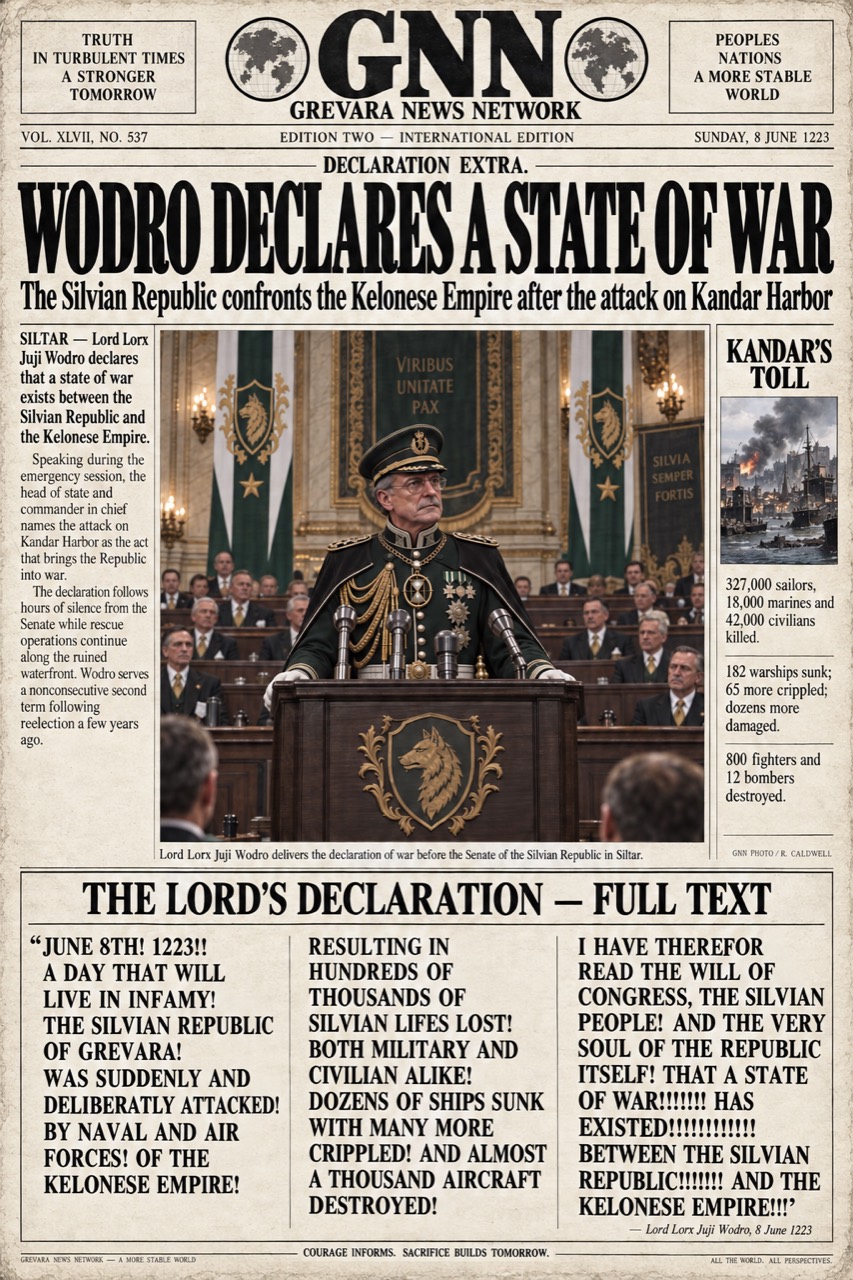
On Sunday, June 8, 1223, Lord Lorx Juji Wodro delivered the declaration before the Senate in Siltar. He spoke as head of state and commander in chief. His address was transmitted to the public after the Senate's decision and printed in GNN's international declaration extra. He spoke as an elected Lord of the Republic, supported by the constitutional action taken that day, and directed the declaration specifically against the Kelonese Empire.
JUNE 8TH! 1223!! A DAY THAT WILL LIVE IN INFAMY! THE SILVIAN REPUBLIC OF GREVARA! WAS SUDDENLY AND DELIBERATELY ATTACKED! BY NAVAL AND AIR FORCES! OF THE KELONESE EMPIRE!
RESULTING IN HUNDREDS OF THOUSANDS OF SILVIAN LIVES LOST! BOTH MILITARY AND CIVILIAN ALIKE! DOZENS OF SHIPS SUNK WITH MANY MORE CRIPPLED! AND ALMOST A THOUSAND AIRCRAFT DESTROYED!
I HAVE THEREFOR READ THE WILL OF CONGRESS, THE SILVIAN PEOPLE! AND THE VERY SOUL OF THE REPUBLIC ITSELF! THAT A STATE OF WAR!!!!!!! HAS EXISTED!!!!!!!!!!!!! BETWEEN THE SILVIAN REPUBLIC!!!!!!! AND THE KELONESE EMPIRE!!!
Original illustrations for this source record
Original archive artwork and captions are preserved. Dates, labels and claims printed within inherited images belong to the previous edition; the revised text governs the current history.