1208 — The invasion of Ravell
January–February: A continent prepared for the wrong timetable
By January 1208, Hukular's military expansion had passed from a conspicuous policy into a permanent system. Factories worked against multiyear orders; reserve districts maintained current registers; railway officers attended military conferences as a routine duty. The regime's assurances that preparation served peace had become less persuasive with each renewal of compulsory service. Imperial Director Darek Voss still described the buildup as a response to foreign interference. Marshal Ilyan Rauk's staff now possessed the means to give that explanation an offensive consequence.
The preceding years had given the crisis a durable structure. Reciprocal arms talks failed in September 1202, and Hestunia concluded its limited defensive guarantee to Ravell on May 16, 1203. Customs pressure, preferential contracts, and readiness programs then deepened the division without resolving access. Quorin progressively restricted military transit associated with the guarantee. In July 1207, Hukular publicly demanded that Ravell withdraw designated foreign military advisers and accept a frontier commission dominated by the empire. Ravell offered balanced procedures instead. The year ended without agreement, leaving a stronger defensive relationship, a more capable Hukular army, and an unresolved dispute over who would control Ravell's independent decisions.
Ravell's prime minister, Sera Danic, entered the year attempting to preserve independence without provoking an attack her army could not defeat alone. Mobilization would disrupt the planting season and might furnish Hukular with a pretext. Delaying mobilization risked leaving reserve formations scattered when the frontier closed. On January 18, her cabinet authorized concealed preparatory measures: railway leave was curtailed, medical stores redistributed, and reservists asked to confirm their addresses. The measures improved readiness but could not remain invisible in a country where military and civilian transport shared stations.
Hestunia faced a different timing problem. Its guarantee was stronger than the assurances of 1199, but geography had not changed. A Hestunian army could not march directly into Hukular. The shortest practical approaches to Ravell crossed states increasingly hostile to Hestunia. Havera and Pavren offered cooperation; Quorin denied the necessary continuation. The southern alternatives through Branor, Cestia, and Iskell were no more dependable. First Minister Mara Vey could promise resistance to aggression more readily than she could promise immediate relief of the country first attacked.
March 4–April 21: The frontier commission fails
Negotiations resumed on March 4 under a proposal for reciprocal inspection. Ravell offered access to disputed customs posts if Hukular accepted comparable scrutiny of nearby military preparations. Hukular demanded that inspections begin inside Ravell before any decision about reciprocity. Accepting that sequence would allow Hukular to collect information and then declare the experiment unsatisfactory. Danic therefore offered simultaneous visits by mixed delegations, including neutral observers. Voss rejected the arrangement as outside interference in a bilateral matter.
The negotiations were not wholly theatrical. Some Hukular commercial officials feared that invasion would destroy profitable relationships and produce a wider conflict. Ravell's exporters pressed Danic to find language that would let both sides claim a concession. The final compromise draft would have suspended selected exercises while inspectors reviewed specific allegations. Rauk opposed any suspension that exposed his preparations without securing Ravell's political submission. Imperial authorization went to the more coercive course.
On April 21, Hukular withdrew its delegation. Its public explanation accused Ravell of concealing a foreign offensive base. No Hestunian field army was stationed in Ravell. The allegation converted a defensive relationship and small advisory presence into an imagined imminent attack. In Hukular, censorship prevented a sustained public challenge to that transformation. In Ravell, the failed talks triggered the release of emergency funds that Danic had hoped not to use.
May 8–13: The ultimatum
Hukular delivered its ultimatum on May 8. Ravell was ordered to dismiss designated security officials, admit Hukular inspection detachments to strategic transport facilities, and suspend its military agreements with Hestunia. The proposed inspection detachments would have authority to remain until Hukular certified compliance. There was no independent mechanism for compelling their departure. Acceptance would leave Ravell nominally sovereign while placing its capacity to resist under foreign supervision.
Danic convened the cabinet, parliamentary leaders, and Crown representatives. They disagreed about how long resistance could last but found no majority for accepting the ultimatum intact. On May 11, Ravell offered immediate neutral inspection and arbitration of documented frontier incidents. Hestunia endorsed the counterproposal and warned that an invasion would activate its guarantee. Quorin announced restrictions on military freight, preventing any assumption that a diplomatic warning could quickly become an army on Ravell's western approaches.
On May 13, Ravell ordered general mobilization. The order came late enough that some formations would assemble under attack. It came early enough to preserve parts of the army that otherwise would have been taken in barracks. Families queued outside municipal offices for allowances and travel documents. Railway workers separated evacuation trains from reserve movements with whatever flexibility remained. The last ordinary passenger services crossed the Hukular frontier under inspection and did not return on their normal schedules.
May 14–21: The first week
Hukular invaded before dawn on May 14, 1208. Artillery struck frontier positions and transport approaches while aircraft attacked selected communications sites. The opening bombardment was concentrated rather than omnipotent. Some telephone circuits failed; others survived because Ravell had installed alternate links. Several border units received their first reliable notice from retreating police rather than headquarters. The invasion's decisive initial advantage was the combination of surprise at particular points, prepared transport, and a government willing to initiate violence without further negotiation.
Rauk committed three main operational groupings along Ravell's eastern frontier. Their objectives were to disorganize mobilization, seize the principal railway intersections, and prevent an orderly withdrawal toward Serin. Motorized detachments advanced quickly where roads remained clear, but much of the army still depended on rail supply and slower transport. Broken bridges and abandoned vehicles created delays that propaganda reports omitted. Ravell's resistance was uneven: some isolated posts surrendered, while others held long enough for reserve units to escape encirclement.
On May 16, Danic's government rejected Hukular's claim that its forces were conducting a temporary security intervention. Ravell was at war and requested the assistance promised by its partners. Hestunia demanded withdrawal and began mobilizing the formations intended for eastern operations. When the withdrawal deadline expired, Hestunia declared war on Hukular on May 20. The declaration fulfilled a political obligation; it did not instantly remove the hostile territory between Hestunian forces and Ravell.
Civilian losses mounted through displacement as well as bombardment. Municipal hospitals received wounded soldiers alongside people injured in station crushes and road accidents. Some farmers remained to protect livestock, believing the fighting would pass quickly. Others fled after rumors that proved false, only to find their return road under actual attack. Danic instructed officials to preserve identity and property records wherever possible. Those records would later determine whether displaced families could claim wages, land, pensions, or even recognition of relatives missing in the retreat.
May 22–June 30: War spreads through the corridors
Quorin entered the war on Hukular's side on May 22, converting restrictions on transit into military cooperation. Havera and Pavren declared war against the attacking combination that same day and authorized Hestunian deployment within their territory. Their consent opened a western defensive system, but Ravell remained beyond the hostile Quorin corridor. Serin entered against Hukular on May 25 after fighting and border incursions made its own security inseparable from Ravell's survival.
The Battle of the Three Junctions, fought from June 2 to June 18, determined the first campaign's direction. The name refers to three Ravell railway intersections. Ravell held the westernmost junction long enough to withdraw hospital trains and a portion of its ammunition reserves. Hukular captured the other two, separating formations that had expected to mobilize on a continuous rail network. The result was a major operational defeat without the complete destruction Rauk had sought.
Ravell's command abandoned the attempt to defend every district equally. Units with intact transport withdrew toward the southern route into Serin, while smaller formations covered crossings and dispersed stores. Local officials interpreted withdrawal orders differently. Some evacuated early and were accused of panic; others waited for written confirmation and were trapped. Danic refused a proposal to announce that every retreat was temporary. Such assurances would have encouraged civilians to stay in places the army could no longer protect.
June 24–29: The last hospital trains
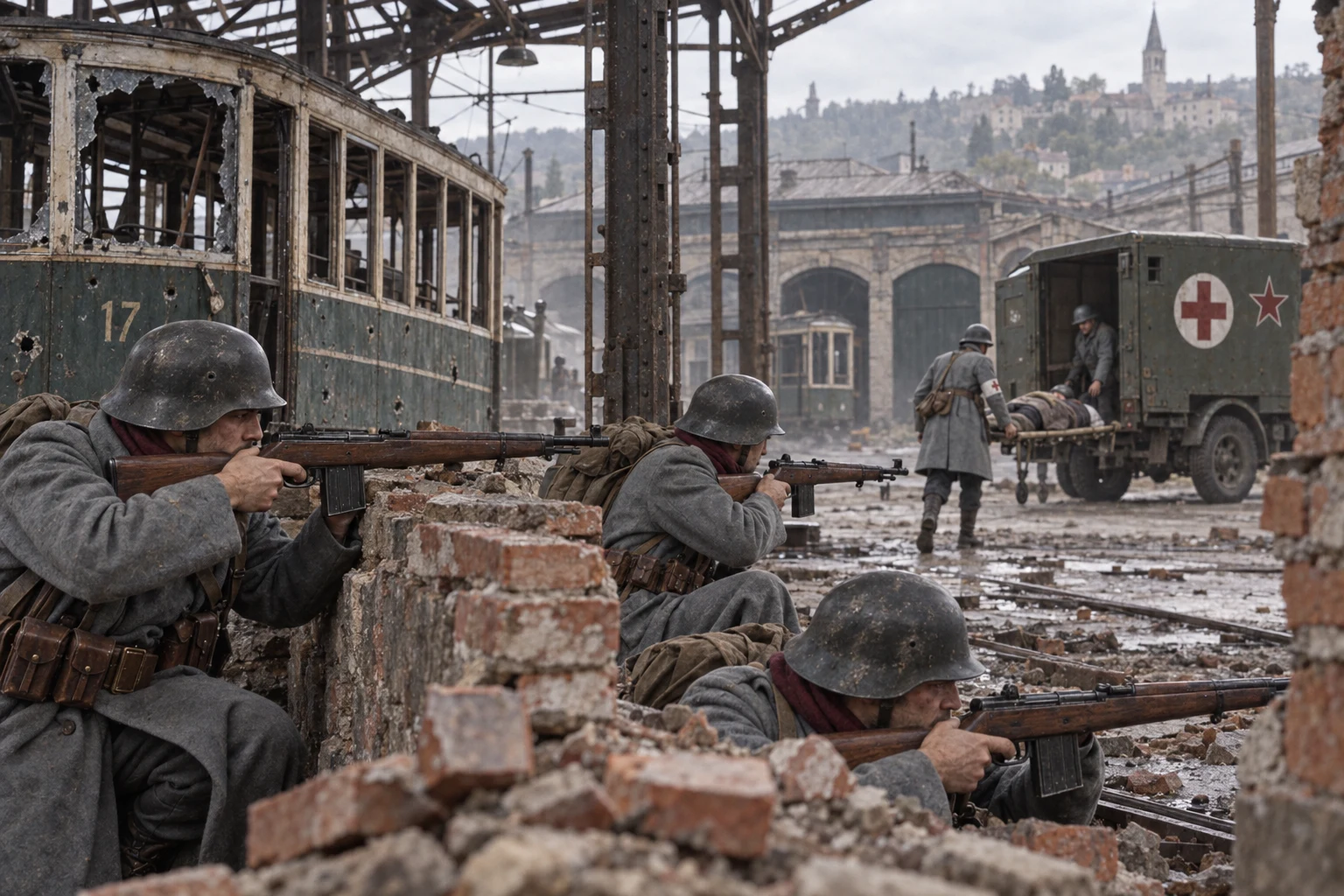
The retreat after the Three Junctions battle exposed a problem the mobilization plans had treated too neatly. A hospital train was supposed to move from a functioning collection point to a receiving facility along an assigned route. In late June, collection points shifted, routes closed, and the receiving hospitals acquired wounded faster than they could discharge them. Medical officials had to decide whether a train should wait for patients still approaching or leave before the track became unusable. Neither choice protected everyone.
Ravell medical officer Dr. Lena Oric, a commander of one such evacuation unit, organized three successive departures between June 24 and June 27. Her immediate dispute was with a transport officer who wanted to combine patients and military stores in order to save scarce train paths. Oric argued that mixing urgent surgical cases with cargo awaiting unloading would delay treatment at the destination. The eventual compromise separated the most critical patients and permitted less urgent cases to travel in a later mixed movement. It was a limited solution to a shortage, not a universally applicable procedure.
The first departure reached its assigned reception area. The second was diverted after damage farther along the route, forcing receiving officials to improvise treatment in buildings not prepared for that number of patients. The third left with incomplete manifests because clerks were still trying to identify soldiers separated from their units. For families, the missing paperwork could be as consequential as the diversion itself. A survivor might spend months untraced because the record of the journey remained at a station later occupied by Hukular.
On June 28, Danic's cabinet ordered duplicate patient lists to be sent through a separate administrative channel wherever circumstances allowed. The decision did not create reliable communications where none existed. It acknowledged that moving a person and preserving evidence of that person's survival were separate tasks. Clerks, nurses, and railway workers all became responsible for parts of the same chain. An apparently small omission could later affect a pension, a marriage record, or a family's decision to leave the country.
The episode also changed relations between the army and municipal hospitals. Local doctors objected to being told that the arrival of military patients automatically displaced every civilian case. Soldiers wounded at the frontier required care, but so did women in labor, injured railway workers, and children whose ordinary treatment had been interrupted. The government authorized emergency use of additional public buildings and sought voluntary civilian assistance. Where resources remained insufficient, officials had to record what they could not provide instead of hiding the shortfall behind a nominal hospital capacity.
These evacuations preserved lives and a portion of Ravell's medical establishment. They also demonstrated why its defeat could not be measured only by formations lost or territory occupied. The retreat scattered professional networks and records that had taken years to build. When the exile administration later attempted to reconstruct the nation's civilian condition, it depended on people like Oric and on lists carried out by clerks whose names never appeared in military communiqués. The survival of the state began to mean the survival of information as well as armed force.
July 3–August 31: A regional war becomes a global arms race
The Garabech Union, Lydessa, and Vajoi entered the conflict on the Allied side on July 3, declaring war on Hukular and Quorin. Their immediate contributions differed. Garabech organized industrial orders and expeditionary preparation. Lydessa provided maritime support and a western diplomatic center. Vajoi's position made the security of the central approaches especially urgent. None of these governments could simply transfer its entire army to Ravell, and their entry did not mean that every eventual Allied nation had become a belligerent.
The invasion nevertheless transformed procurement worldwide. Governments that had previously postponed major contracts now sought aircraft engines, communications equipment, artillery, ammunition, and shipping at the same time. Prices rose, delivery queues lengthened, and exporters demanded guarantees. The global arms race emerged from this collision of national programs. It extended beyond the states already fighting. Neutral governments bought defensive equipment, while future coalition members sought capacity they hoped would deter attack or improve their position when they entered.
The Teran Empire entered against Hestunia, Garabech, and Vajoi on August 18, presenting the western coalition's mobilization as a threat to the central Volaran order. Branor, Cestia, and Iskell followed as active Axis belligerents on August 19. The war now possessed connected but distinct fronts. Hestunia had to guard its approaches through neighboring territory; Garabech and Vajoi faced pressure from the central system; Ravell continued fighting for survival. An Allied commander could no longer assume that concentrating everything against Hukular would leave the rest of Volara quiet.
September 1–October 12: The fall of Ravell's capital
Hukular resumed its main offensive in early September after repairing transport routes and accumulating supplies. On September 19, its forces occupied Ravell's capital. Ravessa was the kingdom's administrative and royal capital. Danic's cabinet and the Crown had departed before the final closure, first moving within Ravell and then separating to preserve continuity. Danic ultimately reached Hestunia by a staged military air evacuation; the principal surviving field formations withdrew into Serin.
The evacuation preserved a government but left accusations that its leaders had abandoned the population. Danic addressed those accusations by refusing to declare the occupied country politically extinguished. Ravell's exile administration would maintain records, support the surviving army, and contest Hukular's attempt to install compliant authorities. It possessed little direct power over occupied districts. Its legitimacy depended on continued recognition and practical assistance, not simply the possession of a seal.
Hukular divided military occupation from political supervision on paper, then allowed the two to overlap. Officers wanted working railways and regular food deliveries. Security officials demanded arrests, loyalty classifications, and the removal of suspected opponents. Requisitions burdened civilians even where fighting had ended. Collective punishments and discriminatory measures were abuses committed by the occupier, not legitimate consequences of Ravell's resistance. By October 12, organized conventional resistance inside most of Ravell had contracted sharply, but fugitives, hidden stores, and surviving municipal networks prevented occupation from becoming secure consent.
November–December: No short victory
Hukular had won territory and failed to end the war. Hestunia remained in the field; Serin sheltered Ravell's survivors; the western Allies were converting economic strength into sustained military programs. Ravell's fall discredited Vey's handling of the guarantee even among people who accepted that geography had constrained her. She resigned in December. Tomas Arven formed a broader wartime ministry, retaining Oren Tal in foreign affairs to preserve diplomatic continuity. The change of government did not undo Hestunia's commitments.
Silvia remained neutral. It issued rules distinguishing ordinary private commerce from public military support, applied port restrictions without offering belligerent bases, and permitted humanitarian activity under neutral supervision. Its eventual Allied membership did not authorize an early intervention. The Lord of the Republic did not send forces to rescue Ravell, and no covert Silvian army entered the war under another flag.
At year's end, the Kelonese Empire was expanding preparations but had not yet entered this chronology as an active belligerent. Gaften, Viar, Larvan, and the ocean states were experiencing the procurement shock and choosing among cooperation, preparation, and continued neutrality. The world war had begun with an invasion in northern Volara. Its first global effect was a rush to acquire the means of fighting before the widening conflict decided who could still buy them.
Original illustrations for this source record
Original archive artwork and captions are preserved. Dates, labels and claims printed within inherited images belong to the previous edition; the revised text governs the current history.