Grevara: World War II, 1224–1226
1224 — The army that the islands broke
January: A declaration had not made an expeditionary army
The first Silvian soldiers to reach the Grand Isles brought new equipment, full establishments, and expectations that their Allies had largely abandoned. They had heard the speeches after Kandar Harbor. They had watched shipyards work through the night and seen recruiting offices fill. Their officers could point to the republic's size, its factories, and its expanding navy. None of those advantages told a young infantryman how long a flooded jungle track would take to cross, or how a company would function after its experienced sergeants were gone.
The seven months after Lord Lorx Juji Wodro's declaration on June 8, 1223 had been consumed by mobilization. Kandar's damaged facilities were repaired in stages; surviving naval establishments elsewhere took work they had not been designed to handle. Silvia concluded wartime access agreements with Motari, Kavea, and surviving Allied authorities in the western islands. The government joined Allied consultation against the Kelonese Empire without treating the declaration of June 8 as a retrospective declaration against every Axis state. Soldiers embarked late in the year. Few had practiced with the particular ships, boats, and naval staffs that would carry them into battle.
This brief interval explained why the republic entered 1224 with growing strength but uneven readiness. Its commercial fleet and the defensive naval construction begun during the long international arms race provided a foundation. Emergency orders expanded that foundation. They did not instantly produce practiced landing formations, trained carrier air groups, or officers who understood one another's procedures. The fleet sailed with a mixture of peacetime professionals, hastily expanded crews, and civilian specialists still learning military routines.
The Allied island forces received them with relief and apprehension. Naviri and Taluma had fought since 1210. Kalanu's government remained abroad after the local armistice of 1219, with surviving forces still under arms. Motari and Kavea had spent years repairing ships, housing refugees, and sustaining routes the empire repeatedly tried to cut. To these nations, Silvia's arrival was an enormous opportunity. It was also a new burden if inexperienced commanders insisted on learning every lesson through their own casualties.
An expeditionary headquarters was established under General Mira Dalen, a wartime commander appointed during the mobilization. Admiral Oren Vask coordinated the accompanying Silvian naval forces. Their working relationship began badly. Dalen believed that naval delays repeatedly surrendered opportunities; Vask believed that army timetables treated weather, damaged ships, and enemy aviation as administrative inconveniences. The disagreement was deeper than personality. The republic had sent its services to fight together before it had built a reliable way for them to make decisions together.
February 12–19: The landing at Orava
The first great setback came at Orava, an island in the contested Taluman approaches. The island was chosen because its recovery appeared to promise a useful anchorage and a short advance inland. Silvian planners expected determined resistance near the coast followed by a relatively rapid occupation. Taluman officers warned that the landscape concealed more depth than the sketches suggested. Their warning reached the conference record without materially changing the schedule.
The landing on February 12 put substantial numbers ashore. Reports reaching Silvia that evening announced a beachhead and described progress as satisfactory. On the island, units had already become separated from equipment and from one another. Supplies accumulated where they were easiest to unload rather than where exhausted soldiers needed them. Some formations possessed abundant ammunition but little medical support; others had food behind them that could not be carried forward quickly enough. Communications connected headquarters to an optimistic picture that was several hours out of date.
Kelonese defenders surrendered ground selectively and struck the exposed formations beyond it. The Silvians discovered that a company shown on a map as holding a stretch of jungle might in practice consist of disconnected groups struggling to find their neighbors. Artillery and naval support inflicted damage, but neither could provide knowledge that the troops and their commanders lacked. An advance announced as completed in the morning had to be attempted again in the afternoon because the survivors had withdrawn without their message reaching headquarters.
By February 16, parts of the expedition were fighting primarily to hold together. Wounded men waited in improvised shelters while stretcher parties worked through mud and damaged tracks. A battalion commander continued reporting an organized line after most of its junior leaders were casualties. Another officer abandoned an untenable position and was initially accused of panic; the inquiry later found that staying would probably have destroyed the unit. These distinctions were invisible in the first public accounts, which searched for a single explanation and a single person to blame.
Vask and Dalen agreed to evacuate the unsupported lodgments. The withdrawal ended on February 19. Some coastal ground had been held long enough to land troops, but the operation's intended position had not been secured. Soldiers and sailors saved many of the wounded and brought away battered units under attack. Heavy equipment was lost, boats were destroyed, and men remained missing. Orava was a Silvian defeat. Calling the evacuation skillful could acknowledge the courage of its participants without transforming the campaign into a victory.
March–April: The jungle takes its share
The next commitment placed Silvian formations alongside Naviri troops in a contested forest belt. Here the republic's soldiers could begin from an existing Allied position, and commanders believed this would avoid the confusion of Orava. It removed one difficulty while leaving many others intact. The men still lacked experience of the terrain. Clothing deteriorated, machinery failed, and sickness reduced units that had suffered relatively few combat casualties. A formation could remain on the official strength return while much of it was physically incapable of marching.
In March, the army began recording illness separately from wounds with greater consistency. The distinction improved its information but exposed how incomplete earlier reports had been. Medical officers were not discovering a new enemy; they were gaining the authority to describe an existing problem. Hospitals filled with men whom recruiting statistics still counted as available soldiers. Replacements arrived with the same shortcomings as the men they were replacing, and overworked units had little time to teach them before the next assignment.
One of the new arrivals was Lieutenant Eran Vale, a Silvian infantry officer whose company entered the forest in April. Vale had performed well in training and expected competence to mean steadiness under fire. Within weeks he learned that competence also meant admitting he did not know where a neighboring unit was, listening to local soldiers, and refusing to report a road usable because an order required it to be usable. His company lost men in combat, to sickness, and to accidents during evacuation. None of those losses made it wiser automatically.
Naviri guides and infantry instructors became essential. Some Silvian officers accepted their advice readily; others treated them as auxiliaries to an army with better equipment. The latter attitude proved expensive. Nera Venn, whose civilian evacuation work had begun during the first Kelonese invasion, helped local authorities document the movement of displaced families near the fighting. Her records exposed another failure of the expedition's planning: a locality marked as a military objective might still contain people whose homes, wells, and paths were indispensable to surviving the campaign.
The attempted forest offensive in April ended without the intended breakthrough. Several Silvian battalions emerged too depleted to continue as effective formations. Kelonese troops retained the stronger inland positions and announced that the newcomers had proved no more capable than the Allies they had come to rescue. Imperial propaganda exaggerated, but it did not have to invent the sight of abandoned equipment or the lengthening Silvian casualty lists. The republic had entered a war already old enough to punish beginners without mercy.
May–June: The price reaches Silvia
At home, the early expectation of a short punitive war collapsed. Families who had endured Kandar now received notices from places they could not find on familiar maps. Newspapers published accounts of heroism beside questions about equipment, command, and medical provision. Wodro could promise continued effort; he could no longer credibly promise that national resources alone would settle the struggle quickly. In May he acknowledged that the first operations had failed to achieve their principal objectives.
The Senate's inquiry did not attempt to direct battles. It investigated the decisions that had sent underprepared formations into them. Surviving officers described contradictory timetables, inadequate common training, and a tendency to turn uncertain estimates into definite assurances as reports moved upward. Medical witnesses challenged the assumption that sickness was simply an unavoidable subtraction from manpower. Manufacturers disputed claims that every shortage originated in production: some equipment existed but had been ordered in unsuitable forms or shipped without the supporting items needed to use it.
Dalen remained in command under revised arrangements. Several subordinate commanders were replaced, but Wodro rejected a purge that would have removed experience merely because it had been acquired in defeat. Officers who concealed losses or repeatedly misrepresented readiness were treated differently from those who reported setbacks honestly. The distinction was politically difficult. It mattered because a military organization that punished bad news would produce attractive reports long after it had ceased producing effective formations.
In June, joint army and navy training establishments began receiving survivors from the first campaigns. They brought Taluman and Naviri instructors into the teaching staff. Medical services, transport units, engineers, and shore personnel gained a larger place in preparation. The changes were practical and uneven. Some new courses were still taught with too little equipment; instructors were recalled because the front needed them. Nevertheless, the republic had begun to preserve lessons in institutions rather than leaving them in the memories of a shrinking number of veterans.
July 9–August 3: Red Mangrove
The summer operation known as Red Mangrove took place on occupied Allied islands east of the principal Kelonese positions. Its name was a campaign designation, not a sovereign territory. The Silvians went ashore with improved coordination and stronger expectations of delay. Initial landings were more coherent than at Orava. That improvement encouraged headquarters to extend the operation before all of its supporting arrangements were secure.
Kelonese resistance then turned the advance into a succession of small, costly struggles. A village could be occupied while the routes beyond it remained unusable; a shoreline could be held while unloading remained vulnerable to air and naval attack. Rain interrupted work and movement without conveniently interrupting enemy pressure. The troops increasingly understood the conditions around them, but knowledge did not make their bodies less vulnerable or replace the men already lost.
Vale's company took part in the later phase. Its surviving veterans were now recognizable by what they asked before an operation: where casualties would go, whether an adjacent formation had actually arrived, and whether a promised supply delivery had departed rather than merely been approved. These were not signs of timidity. They were questions produced by watching men die between an order being issued and the means of carrying it out appearing.
The operation ended on August 3 with a retained coastal foothold and an abandoned timetable. Silvia had avoided another complete evacuation, but several assault formations required rebuilding. The ground gained did not justify describing the army as victorious across the theater. Kelonese forces still controlled the principal contested inland approaches. For the second time in a year, the republic's public had to distinguish between soldiers' extraordinary effort and the failure of an operation's larger promises.
September–October: The sea is part of the battlefield
Naval losses reinforced the same lesson. Supporting an island campaign tied ships to repeated duties over long periods. Kelonese carrier aircraft, other naval forces, and attacks on shipping made the approaches dangerous even after the first landing. A transport reaching harbor was the end of one hazardous passage and the beginning of unloading, repair, and another passage. Ships lost at sea took trained personnel with them and reduced the army's ability to replace equipment on land.
Tessa Maren, the merchant master who had survived the Kandar attack, now carried military and relief cargo under wartime arrangements. She remained a civilian mariner operating within the supply system, rather than becoming an instant naval commander. In September her ship brought returning wounded and damaged equipment away from an island anchorage. Many of the soldiers had crossed the same ocean earlier in the year convinced that their destination would be temporary. Maren recognized the difference between their first embarkation and their silent return.
The navy's expansion gathered pace. Ships ordered before the republic entered the war now reached completion beside wartime construction and conversions. Existing battle formations supplied experienced personnel to new commands at a cost to their own cohesion. Yard capacity expanded, but engines, skilled workers, naval aviators, and escort crews remained constraints. Wodro's government accepted that a vast carrier fleet required an equally serious investment in aircraft maintenance, replenishment, repair, and training. A carrier without a functioning air group could not be counted as the promised increase in fighting power.
The developing program was immense by the standards of the earlier Silvian fleet. Its scale would become visible in 1226. In 1224, the public mostly saw appropriations, unfinished hulls, and exhausting demands on labor. The government financed the work through taxation, borrowing, and the redirection of civilian production. Families endured shortages while military departments argued over the same transport and industrial resources. The fleet that would eventually cross two oceans was being built inside a society already paying for an army's defeats.
November–December: Survival becomes a profession
The final operations of 1224 were deliberately more limited. Silvian troops helped secure and improve positions already held by Allied forces rather than attempting another immediate leap into the imperial defensive system. Some units rotated away from the front. Others remained because replacements were not ready. The difference between a planned rotation and an actual relief became another measure of whether headquarters' promises could be trusted.
The army had been mauled. Some formations had lost so many experienced officers and soldiers that their old names concealed essentially new units. Others retained enough continuity to become schools for the men who joined them. The most useful survivors were not always those with the longest list of engagements; they were often those able to explain a mistake without turning its casualties into a story of personal glory.
Elsewhere, the war did not wait for Silvia's education. Hukular maintained its pressure against the surviving Volaran fronts. Havera remained battered but undefeated in its western territories; the occupied lands of Pavren, Ravell, and Serin did not become free because the republic had entered the war. In Gaften and Viar, Allied governments welcomed future Silvian assistance while continuing to fight with what they already possessed. The Kelonese Empire could still claim that its principal defensive positions had survived the first year of major Silvian campaigning.
By December, however, the republic had stopped assuming that every setback could be repaired by sending more unprepared men. It was beginning to build an army that could carry its support with it, cooperate with the navy, and learn from Allied forces who knew the islands. That transformation remained incomplete. The year closed with crowded hospitals, unfinished ships, and a hard-earned foothold rather than a sweeping victory. The next campaigns would test whether the lessons of 1224 had changed the institution or merely the language of its reports.
1225 — Learning to stay ashore
January–February: Rebuilding the survivors
At the start of 1225, the Silvian army possessed something its mobilization had not supplied: a growing body of people who knew what a failed island campaign looked like from inside it. They were scattered among hospitals, training establishments, headquarters, and formations still in the Grand Isles. Bringing their experience into a common system became the year's central military work. The republic could recruit another soldier more quickly than it could replace the judgment of a good company commander or a senior medical orderly.
General Mira Dalen ordered reorganized formations to train as complete groups before returning to combat. This was less dramatic than announcing new divisions, and it delayed several proposed operations. It also meant that infantry, engineers, transport personnel, medical detachments, and the naval organizations supporting them had some familiarity with one another before they met under fire. The training exposed shortages that earlier practice had hidden until embarkation. A formation lacking essential support could no longer claim readiness simply because its infantry ranks were full.
Allied instructors gained permanent appointments in these establishments. Naviri officers taught alongside Silvians; Taluman and Kalanu veterans explained the campaigns that had preceded the republic's arrival. Motari and Kavean authorities arranged training access under agreements that preserved their own control of land and facilities. The republic's army learned that its growing strength did not relieve it of the need for consent. Its bases occupied other people's communities, whose workers and supplies had already supported a long war.
There was resistance inside the army. Some commanders considered the changes excessive preparation for battles whose essentials were courage and numbers. Others feared that surrendering men to instructor assignments would weaken their units beyond recovery. Both concerns had practical force, especially while Kelonese operations continued. The answer was not to remove every veteran from the front. The army distributed experience among active units, replacement organizations, and schools, accepting a slower expansion in exchange for a force that could retain what it had learned.
Eran Vale returned to duty after a period of treatment and instruction. His new company contained a small surviving core from the previous year's fighting and many men who had never heard enemy fire. He no longer expected them to acquire judgment merely by imitating veterans. He spent time explaining why ordinary reports mattered, why sick men should not be hidden from medical returns, and why a local Allied sergeant might understand a situation better than a newly arrived Silvian officer. The company's experience had become something that could be taught, though never perfectly transferred.
March 18–April 7: The return to Orava
The decision to return to Orava carried political danger. Some supporters wanted to erase the humiliation of February 1224; some opponents believed any renewed attack would become an exercise in defending the government's reputation. Dalen insisted on a narrower purpose: recover the anchorage and establish a position that could be maintained. The operation would be judged by whether troops, supplies, and ships could continue using it after the first reports of success had been sent home.
The landing began on March 18. It was still violent and costly. Kelonese defenders had not spent the intervening year waiting passively, and several Silvian units lost men before they could establish themselves. Boats were damaged, communications failed in places, and parts of the initial plan became unusable. The difference was that such failures no longer left the entire force without a common understanding of who could change the schedule and how those changes would be reported.
The fighting inland lasted longer than the optimistic forecasts offered by commentators in Silvia. The troops encountered positions they had not identified beforehand and communities more damaged than reports had conveyed. Taluman representatives accompanied the military authorities so that the island's recovery would restore Allied civil administration rather than simply replace one foreign military presence with another. Relief work competed with military unloading for space, labor, and transport. Neither could be postponed indefinitely without undermining the position the army had come to establish.
By April 7, the anchorage and the ground necessary for its continued use were held securely enough for the operation's purpose to be declared achieved. Combat continued beyond that area. The island was not suddenly peaceful, nor had the entire western chain been recovered. Nevertheless, the returning supply ships, functioning medical facilities, and organized relief of exhausted troops gave Orava a meaning that the first landing had never obtained. The Silvians had taken a difficult position and demonstrated that they could remain there.
The cost discouraged any honest claim that the army had become invulnerable. Families received new casualty notices from the same island whose name had already entered the republic's memory as a disaster. Survivors of the first operation found no simple consolation in the second. A better result could validate changes in command and preparation; it could not make the earlier dead a necessary payment for knowledge that might have been acquired less expensively.
May–June: The Naviri forest battles
The spring's success encouraged demands for an immediate advance on every island front. Wodro and the Allied commanders instead faced a familiar problem: the army had improved, but its transport and trained support could not sustain every desirable operation at once. In May, Silvian formations returned to the contested Naviri forest belt beside the local forces who had borne the war there for years. The purpose was to relieve pressure on threatened settlements and improve the existing Allied position.
The Kelonese army remained a formidable opponent. Its veterans understood the terrain and had absorbed lessons from fighting the Silvians. They changed positions, shifted reserves, and imposed losses even when they could not prevent an Allied advance. The campaign produced no sequence of effortless victories. Some Silvian battalions achieved their tasks; others were stopped or forced back. Improved organization made these setbacks less likely to destroy an entire operation, but it did not remove them from war.
During the fighting around the Lethan forest district, Vale's company lost its second senior officer within a month. Men who had recently learned to trust a new leader had to accept another. The unit continued functioning because experienced noncommissioned officers and familiar procedures connected its surviving sections. That continuity was the most important difference from 1224. The company could be badly hurt without every loss of a leader becoming a new beginning.
Medical evacuation remained punishing work. The army's improved arrangements reduced preventable delays, but men still endured long journeys before reaching full treatment. Nera Venn's civilian teams helped register displaced households and locate separated children as fighting moved through inhabited areas. Their work also restrained military claims. A village occupied by Allied troops could not be described as restored merely because its occupants were now permitted to return to houses that no longer stood.
The forest campaign ended in June with limited Allied gains and a better defended Naviri position. It did not liberate all occupied territory or open a direct road to the Kelonese imperial center. Silvian forces had again suffered heavily. This time, however, much of the damage could be absorbed through organized replacement, medical recovery, and relief rather than the dissolution of shattered units. The army was becoming experienced in the practical sense: it could fight, recover, and fight again without forgetting everything between campaigns.
July: The war broadens for Silvia
Success in the islands made the question of Silvia's wider role unavoidable. Hestunian First Minister Tomas Arven asked Wodro for a commitment to the Volaran war. Governments in Gaften and Viar made similar appeals. They did not regard the defeat of the Kelonese Empire as irrelevant; its maritime power affected them all. They nevertheless feared that an army gaining experience in one theater would remain there while their own exhausted fronts continued consuming the same shrinking reserves.
Wodro could not simply order divisions against states with which Silvia had not yet formally entered war. The June 1223 declaration had named the Kelonese Empire. During 1224 and early 1225, the republic had increasingly cooperated with the Allies, and Axis governments had increasingly treated its shipping and overseas support as part of the wider coalition struggle. During this period, attacks on Silvian supply traffic supporting recognized Allied positions produced a series of diplomatic ruptures in the first half of 1225.
On July 16, with Senate concurrence, Silvia formally extended its war to Hukular, the Teran Empire, Ruuyaq, Rostan, and Novren. Related declarations and acknowledgments of belligerency followed during the second half of the year with Axis partners directly involved in the relevant campaigns. These were separate decisions, not an assertion that every one of the 107 eventual Axis nations had automatically become a Silvian enemy in June 1223. The new acts established a political basis for the continental commitments now under discussion.
The republic's participation in Allied strategic consultation became broader and more regular. It brought resources that could change the coalition's prospects, but its representatives encountered states with their own histories of sacrifice and their own plans. Danic's Ravell government in exile sought liberation without being reduced to a ceremonial observer. Kalanu's representatives insisted that their surviving national forces and rights could not be absorbed into a Silvian administrative convenience. Wodro accepted that leadership in a coalition required arrangements its members could live with after the fighting.
No continental army sailed as a result of the July decisions alone. Staff missions, port agreements, communications arrangements, and estimates of actual transport capacity came first. The scale being discussed already exceeded a succession of independent island expeditions. Silvia was beginning to plan for armies that would land, remain supplied, and operate beside established Allied forces on several continents at the same time.
August–September: The carrier war grows
The expanding naval war gave those plans a dangerous foundation. The republic could build an army able to operate overseas and still lose the ships needed to carry it. Kelonese Admiral Taren Seko therefore regarded Silvian shipping and naval aviation as connected threats. Imperial forces sought opportunities to damage the growing fleet while it was still combining new hulls, new air groups, and commands of uneven experience.
The August battles of the western island approaches became the year's clearest demonstration. Successive carrier engagements, surface actions, and attacks on support shipping extended over weeks. There was no single instant in which every fleet met or the ocean acquired a permanent owner. Silvian formations protected some movements, suffered serious losses in others, and forced the empire to expend aircraft and trained personnel it could not replace without strain. Both sides' public accounts emphasized enemy ships damaged while obscuring how much of their own strength had temporarily disappeared into repair yards.
Admiral Oren Vask's headquarters began treating the availability of trained air groups and support ships as central measures of naval strength. Fleet numbers alone could conceal damaged carriers, exhausted pilots, and escorts overdue for work. The rapidly expanding construction program included purpose-built carriers of different sizes, cruisers and destroyers, and the less celebrated vessels that kept them functioning. Conversion programs added capacity where hulls could genuinely support it; painted flight decks did not turn every merchant ship into a battle carrier.
Industrial standardization shortened construction and repair, but it came with compromises. Some ships entered service with limitations crews had to understand. New aviators needed time at sea before they could use their training reliably. Experienced personnel were repeatedly redistributed, creating friction between established fleets and newly commissioned ones. Silvia paid for expansion with risk as well as money. Its naval establishment grew by accepting that many crews would become veterans while already under combat orders.
The enormous late-war fleet would not consist solely of vessels laid down after Kandar. Prewar defensive orders and construction during the 1221–1223 crisis now combined with emergency wartime programs. Silvia's many maritime establishments spread work across the republic, while Allied facilities supplied additional repair and staging capacity by agreement. This was the industrial bridge between the navy of the first expeditions and the dozens of carrier battle fleets that would be fighting in 1226.
October 2–November 11: A chain, not a single landing
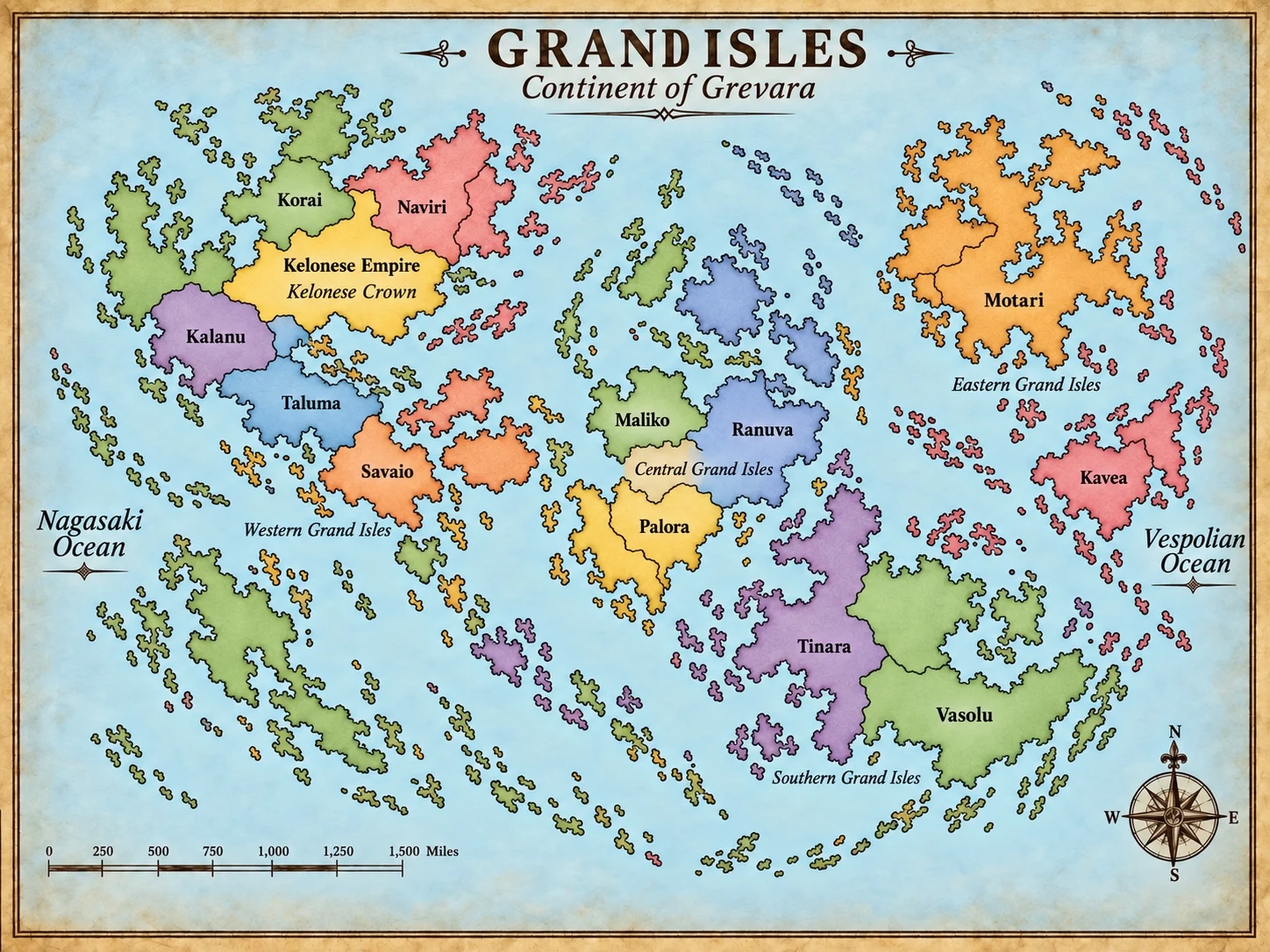
The autumn Ranuvan relief campaign tested whether the army could repeat its success across a sequence of operations. Ranuva remained an Allied state; the campaign concerned contested islands and approaches under Kelonese pressure, not an invasion of an enemy country bearing its name. Maliko's Axis alignment made the central Grand Isles particularly difficult, while nearby neutral jurisdictions retained their own rights and did not become automatic Allied transit grounds.
The operations began on October 2 and proceeded more slowly than the preliminary political expectations. Some landings met lighter resistance than feared; others developed into prolonged battles. The expedition needed repairs and replacement personnel before every objective had been reached. Commanders who had once treated such interruptions as proof of failure now recognized that continuing without them could destroy the force required for the next operation.
The Silvians and their partners secured several useful positions and reduced the immediate threat to an Allied route. They also abandoned one proposed advance when its costs and supporting requirements exceeded what could be sustained. This decision drew criticism in Silvia, where the scale of mobilization encouraged expectations of uninterrupted progress. Dalen defended it on the ground that an expeditionary army existed to achieve military purposes, not to provide a favorable daily rhythm for newspapers.
By November 11, the campaign had delivered a stronger Allied position in part of the central chain. It had not dislodged the Kelonese Empire from every occupied island, defeated Maliko, or ended the threat to shipping. Its importance lay in repeated performance. Silvian formations had undertaken several demanding operations, suffered losses, reorganized, and continued as recognizable fighting units. The republic now possessed more than the survivors of one successful landing.
December: The beginning of a veteran army
The army that entered December was still full of recruits. A rapidly expanding force could never consist entirely of men who had served since the first expeditions. Its veteran character came from the proportion of experienced leaders, the continuity of formations, the authority of instructors, and the ability to train replacements within a functioning organization. The lessons of Orava and the forest battles were increasingly present in the way ordinary work was done.
Veterans brought burdens as well as knowledge. Some could not sleep; others struggled with repeated losses or with injuries that had not fully healed. A man competent in battle might need rest and treatment before he could teach anyone else. Medical services began paying more consistent attention to those cases, though resources and understanding remained limited. The army's new reputation did not mean that endurance had become limitless.
Wodro's government continued the costly expansion while negotiating the larger deployment. Arven's officials prepared for Silvian arrivals in Volara, and Gaften and Viar representatives did the same. The planning papers increasingly divided the army into continental commitments rather than a single expanding Grand Isles force. Navy staffs warned that such a distribution would have meaning only if shipping, escorts, repair facilities, and sustained supplies were assigned alongside it.
The Axis still held much of the ground won during the long attritional years. Hukular had not been driven from Ravell or the occupied portions of Pavren; Serin's former front had not miraculously reappeared. In the Grand Isles, the empire had lost useful positions and suffered mounting naval costs, but its forces remained capable of inflicting severe defeats. What changed in 1225 was the quality of the opponent it faced. The Silvians were no longer newcomers expecting their resources to excuse inexperience. They were becoming an amphibious force that could turn those resources into sustained operations, and their government was preparing to send that experience far beyond the islands.
1226 — A veteran army, a war across two oceans
January–February: Experience becomes an army-wide strength
By January 1226, the Silvian army's most important change was visible before an operation began. Senior officers expected naval representatives, engineers, medical personnel, and supply officials to take part in decisions that had once been treated as the infantry commander's business. A division reported what it could sustain as well as how many soldiers it possessed. Units arrived with an understanding of the organizations supporting them. These improvements were imperfect and sometimes ignored, but they were no longer exceptional practices attached to a few unusually capable leaders.
The republic had paid for this change in the jungles and island chains of the Grand Isles. The failed Orava landing, the Naviri forest losses, and the costly footholds of 1224 remained part of every formation's account of the war. The successful return to Orava and the repeated campaigns of 1225 had added confidence without erasing those failures. Veterans knew that a landing could succeed while the campaign beyond it failed, and that a position could be taken only to become an intolerable demand on shipping and replacements.
General Mira Dalen now commanded an expeditionary system rather than a collection of newly arrived units. Its schools, replacement organizations, hospitals, and supporting services mattered as much as the headquarters on the islands. Experienced personnel moved between them under arrangements designed to preserve continuity. New recruits could enter a veteran formation without forcing it to begin again. The republic still had inexperienced soldiers, but it increasingly possessed experienced institutions.
That distinction became apparent during the year's first limited operations. Units encountered unexpected resistance, suffered casualties, and altered their plans without dissolving into isolated parties. Some commanders still made poor judgments. The army's improved organization made it more likely that those judgments would be recognized and corrected before they destroyed an entire force. The transformation was not an exemption from defeat; it was a greater ability to survive contact with events that plans had failed to predict.
Allied officers were central to the achievement. Taluman and Naviri veterans had helped teach the early arrivals. Motari, Kavea, Ranuva, and the surviving Kalanu institutions had provided access, local knowledge, and forces of their own. As the Silvian army's reputation grew, those governments insisted that the history not be rewritten as a rescue performed by outsiders for passive island populations. Dalen supported joint recognition in official accounts. It was a practical matter of maintaining the coalition as well as an honest description of how the new army had been formed.
March 6–April 28: The western chains campaign
The western chains campaign began on March 6. Its limited purpose was to strengthen Allied access to contested Naviri and Taluman positions and reduce the pressure on the routes connecting them to supporting bases. It did not promise an immediate conquest of the Kelonese imperial center. The force included veteran Silvian formations, newly integrated replacements, and Allied units whose experience reached back much further than Silvia's entry into the war.
The first successes encouraged optimism, but the campaign soon met the resistance that had defined the theater. Kelonese troops held difficult inland positions and contested approaches the Allied fleet needed repeatedly. Several Silvian units suffered heavy casualties during fighting beyond the initial landing areas. Weather and damage interrupted deliveries. A transport loss meant that a formation had to wait for equipment while its neighboring unit was already engaged. The campaign remained a struggle among connected activities, any one of which could limit all the others.
Vale, now leading a larger body of troops after wartime promotion, saw how far the army had changed when one of its local attacks failed. Wounded men were recovered through an established organization; surviving companies received clear orders; the command admitted the reverse without disguising it as an achieved objective. Reinforcements were not immediately thrown into the same task merely to preserve the appearance of momentum. The troops regrouped and continued contributing to the wider campaign. Their losses remained severe, but the formation survived as a formation.
Naval and land operations also worked together more reliably. Admiral Oren Vask's staffs could discuss the army's requirements with officers who understood why ships needed replenishment and repair. Army headquarters could challenge schedules that gave landing troops impressive initial support without adequate provision for the weeks afterward. Neither service ceased defending its priorities. They had learned enough of one another's work to make disagreement useful rather than simply divisive.
By April 28, the Allies had secured additional positions and improved access to parts of the western island front. Kelonese forces withdrew from some exposed locations while retaining formidable areas of resistance. The gains did not liberate all Kalanu, restore every displaced community, or decide the imperial war. They did establish that Silvian amphibious strength could produce repeated, sustained results against a capable enemy. The army that had been mauled in 1224 could now absorb hard fighting without surrendering the purpose of its campaign.
May–June: The ocean becomes a continuous battlefield
The land successes made the struggle at sea more intense. The Kelonese Empire had to protect the movement of its own troops and supplies while attempting to prevent Silvia from concentrating strength elsewhere. Seko argued that the republic's growing naval establishment must be damaged wherever it entered combat, before completed training and additional production made the imbalance worse. Imperial industry and recruitment were therefore directed toward replacing naval losses and maintaining the ability to strike the expanding Allied system.
In the Nagasaki Ocean, this produced a succession of campaigns rather than a single decisive encounter. Carrier battles, surface actions, attacks on military supply shipping, submarine operations, and the defense of threatened bases overlapped. A fleet could finish one demanding operation and return to find that losses elsewhere had already changed its next assignment. Repair yards functioned as extensions of the battle area: damage that could be repaired quickly returned fighting power to sea, while a ship waiting months for work represented a prolonged strategic loss.
The designation carrier battle fleet now had a definite place in Silvian organization. It meant a separately commanded fighting fleet built around operational carriers and their embarked air groups, with screening warships and assigned logistical support. Major formations commonly contained multiple carriers, though their composition varied with damage and reassignment. A lone escort vessel, a transport convoy, or an administrative headquarters without operational ships did not qualify. This distinction mattered as the republic announced a fleet strength on a scale that would have seemed extraordinary to the men who had departed for Orava.
The expansion rested on years of naval construction, completed prewar orders, accelerated wartime building, and extensive training. Industrial yards standardized work across many facilities. Older establishments concentrated on difficult machinery and major repairs while newer sites handled work they could perform reliably. Aircraft production expanded alongside spare parts, maintenance training, and aircrew replacement. The navy also built the replenishment and repair organizations needed to keep fighting ships away from home for extended periods.
These measures did not remove the costs of speed. Some new ships experienced defects, and inexperienced crews made mistakes under pressure. The republic had to withhold formations whose nominal strength exceeded their actual readiness. Wodro resisted political pressure to count an unfinished hull as a deployed carrier. The eventual total would represent commissioned, equipped combat fleets with crews and air groups, supported by a much larger system of ships and people whose names rarely appeared in the headlines.
July 22: The four-theater decision
While the Nagasaki battles expanded, the Allied governments reached the most consequential Silvian deployment agreement of the war so far. The long attritional fronts in Volara, Gaften, and Viar needed substantial reinforcement. Continued concentration of the entire Silvian army in the Grand Isles would leave those governments dependent on promises even as the republic's capacity grew. Yet withdrawing every experienced formation from the islands would endanger the gains that had made wider intervention possible.
On July 22, Wodro approved the Four-Theater Allocation after consultation with the Senate and the Allied governments concerned. The Silvian army would be divided into six equal shares for theater assignment. Two shares, or one-third, would go to Volara. Two shares, or one-third, would go to Gaften. One share, or one-sixth, would go to Viar. The remaining share, or one-sixth, would serve in the Grand Isles. The fractions described army strength, including the supporting formations assigned with it, rather than a count of divisions assumed to be identical in size.
The allocation covered the army as a whole. Headquarters, replacement organizations, and personnel temporarily in training or recovery were charged to the four theater establishments rather than concealed in an additional unallocated share. Army units awaiting embarkation remained assigned to their destination. Territorial defense services, the navy, and other separately organized forces retained responsibilities at home. The decision therefore did not mean that every military member in Silvia departed or that naval crews were included in the army's fractions.
Equal shares on a planning return did not mean that six identical bodies would depart on one day. Ships, reception facilities, unit readiness, and the fighting already in progress required successive movements. Some formations would leave directly from island bases; others would assemble or refit in Silvia before sailing. The government made the destination commitments binding while allowing the sequence of departure to reflect what could actually be transported and supported.
The army's veteran character was to be distributed with its numbers. Each theater command would receive experienced formations and supporting personnel, not a veteran contingent in one destination and untrained masses in the others. The Grand Isles sixth retained a substantial body of seasoned troops, supported by island Allies and the powerful naval presence. It was not an abandoned rear guard. The republic was spreading a military system that could operate across water, rather than simply exporting infantry who had survived an island battle.
August–September: Preparing the continental armies
Volara received the first great commitment. Agreements with Lydessa and the Garabech Union provided reception and staging under Allied sovereignty. Movement toward the Hestunian and Havera fronts required further negotiated arrangements within friendly territory. The Silvians did not arrive on a common border between Hestunia and Hukular, nor did occupied Pavren become an unobstructed transit route. The front they were reinforcing remained shaped by years of Axis gains.
Arven welcomed the allocation without promising an immediate general offensive. The new formations needed to learn local conditions, coordinate with the Allied command, and connect their supply arrangements to a war already in progress. Silvian veterans brought valuable experience of movement, communications, and sustaining a force after a landing. Continental campaigning would impose additional demands. An army skilled in the Grand Isles could not assume that every lesson applied unchanged to Volara's distances, settlements, and entrenched fronts.
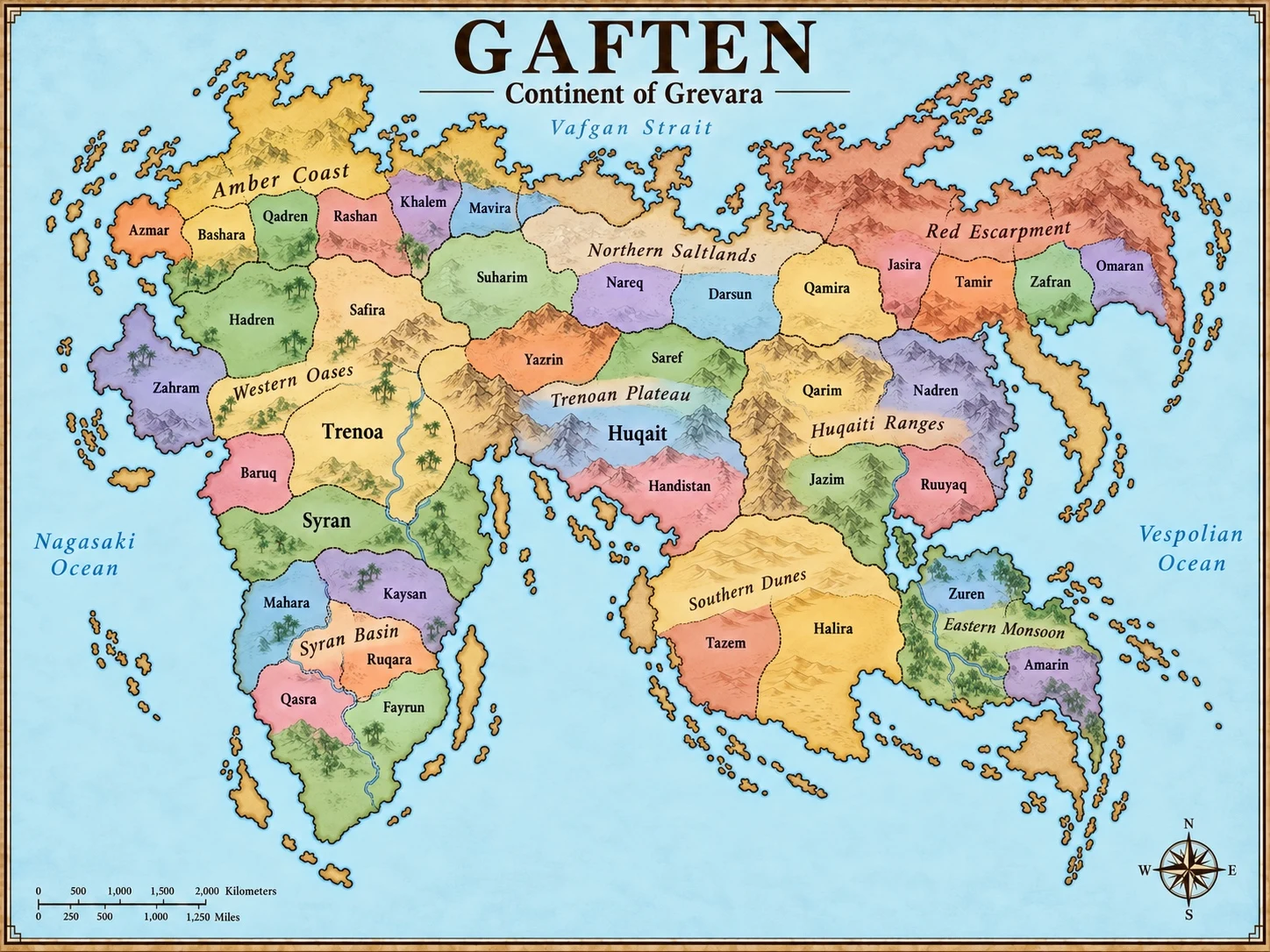
Gaften received an equal one-third. Trenoan and Huqaiti authorities negotiated receiving facilities and arrangements for onward movement, with the existing Allied governments retaining responsibility for their own territories. The initial commitment would reinforce the struggle against Ruuyaq and associated Axis forces through established Allied positions. It did not assume a direct Ruuyaq–Handistan border or grant the Silvians free passage through neutral states. Access, storage, medical support, and local transport had to be organized as carefully as embarkation.
Gaften's commands wanted engineers, medical personnel, transport, and replacement capacity alongside combat troops. Silvia's earlier island defeats made its planners more receptive to those requests than they might once have been. The army had learned what happened when a division's infantry arrived before the means of keeping it effective. Adapting to Gaften's varied regions would still require training, and the scale of the commitment placed new pressure on receiving communities whose resources had already been heavily used.
Viar's one-sixth would arrive through agreed Allied facilities, including Erisia and Fujaro, before assignment to the wider theater. The commitment supported governments fighting the Rostan and Novren systems and their partners. Praxen's surviving administration remained active despite the loss of its principal center in 1219; a Silvian arrival did not retroactively erase that defeat. Viar's forces required coordination with an ally that possessed maritime reach but comparatively little experience of their land war.
The Grand Isles sixth remained engaged beside local Allied armies. Dalen's established headquarters supplied experience to the new continental commands while retaining enough continuity for ongoing operations. Some soldiers resented leaving formations with which they had survived two years of fighting. Others welcomed the possibility of a different theater without understanding how difficult it would prove. The army's professional adaptation was accompanied by the ordinary uncertainty of people being ordered into another part of an enormous war.
October: Thirty fleets in the Vespolian
The continental deployment required a second great maritime commitment. By October, the Silvian navy was sending 30 separately commanded fleets into the Vespolian Ocean. These formations included carrier-led forces, surface battle fleets, and fleets organized around the protection and support of military movement. They were not thirty individual warships or thirty temporary convoy names. Their strength and composition differed according to their assignments, and together they represented dozens of genuine naval commands with fighting vessels.
The Vespolian missions included contesting Axis naval activity, protecting the movement of troops and supplies, supporting Allied positions, and maintaining the routes needed to sustain the new continental armies. The navy could not simply escort the first transports and declare its work complete. Every army arriving overseas created a continuing demand for food, equipment, replacements, medical movement, and repair. The ocean commitment would grow more important after the soldiers landed.
Tessa Maren's vessel joined the enlarged movement system carrying equipment and stores for Viar. She encountered a navy very different from the force that had struggled to sustain the early island campaigns. There were more ships and clearer procedures, but also more destinations competing for protection. A delay could now affect a formation on a distant continent whose soldiers had never heard of her ship. The war had become larger without becoming less dependent on particular crews completing particular voyages.
Axis forces contested the Vespolian expansion. Naval attacks, losses, and interrupted movements made clear that Silvia had entered another active theater rather than opened a protected passage. Some fleets reached their stations after difficult voyages; others began fighting before their intended deployment was complete. The republic's naval commands had to support operations at widely separated points without pretending that a fleet assigned on paper could instantly appear wherever a crisis developed.
The Vespolian's 30 fleets were accounted for separately from the great carrier concentration in the Nagasaki. Transferring a command between oceans required an actual movement and a change in its assignment; it could not be claimed in both totals. The distinction mattered to the government because the army's new distribution depended on real protection in both oceans, not an impressive combined list that concealed the same ships under several headings.
November–December: Fifty-two carrier battle fleets in the Nagasaki
By the final months of 1226, 52 Silvian carrier battle fleets were committed to active war in the Nagasaki Ocean. The figure exceeded forty-eight and referred to carrier battle fleets, not individual carriers. Each counted formation had operational carriers, embarked combat aviation, fighting escorts, command personnel, and assigned support. Training commands, empty fleet headquarters, and unfinished ships were excluded. Allied fleets operating alongside Silvia added further strength beyond that Silvian total.
They fought across a vast theater in overlapping campaigns. Some supported the Grand Isles front; others contested imperial naval movements or defended the maritime connections on which the whole Allied position depended. Fleets rotated through replenishment and repair as the fighting required. This did not place all 52 at a single point in one enormous formation, but neither were they merely a future construction program. They were serving combat fleets whose losses, operational reports, and demands on support establishments formed part of the continuing naval war.
The Kelonese Empire responded with its own concentrated effort. It committed experienced naval forces, accelerated replacement programs, and drew more heavily on its maritime partners. Seko's commanders inflicted serious losses in individual engagements even as they faced a broader contest that had become increasingly difficult to manage. Silvian numerical strength could create opportunities and sustain pressure; it could not prevent a badly handled operation from ending in burning ships and missing aircrew.
The Nagasaki struggle had become naval total war. Shipbuilding, aircraft production, fuel, repair capacity, merchant crews, naval training, and the allocation of national labor were all directed toward sustaining the contest. The losses extended beyond celebrated battle fleets to the supporting vessels that made operations possible. Dock workers repaired damaged ships while replacements arrived for crews that had sailed only months earlier. Families endured rationing and increasingly frequent casualty lists as the ocean war consumed the products of the industrial expansion.
This total commitment did not make every neutral ship an enemy or every island population a military target. Neutral governments continued to protest infringements of their jurisdiction, and the Allied agreements still recognized the sovereignty of the territories supporting the fleets. Wodro's earlier insistence that war did not abolish lawful restraint remained government policy. The scale of destruction made that obligation harder to maintain, not irrelevant.
The carrier battles of November and December brought victories, reverses, and losses neither side could dismiss. Silvia could replace equipment on an enormous scale, but veteran pilots and experienced ship crews remained difficult to replace. The empire could still concentrate strength and make a local battle extremely costly. By the year's end, the Nagasaki was an active struggle for maritime power, with dozens of carrier battle fleets fighting over the conditions under which the wider war would continue.
December 31: The army departs the islands as a veteran force
The year ended with the continental deployments under way. Advance organizations and initial formations were already arriving in Allied receiving areas; further contingents were at sea, assembling, or awaiting their scheduled lift. The army's four allocations were in force: one-third Volara, one-third Gaften, one-sixth Viar, one-sixth Grand Isles. This was an active movement and sustained commitment, not a claim that every allocated soldier had reached a new front by the last day of December.
Wodro's government now carried obligations far beyond the response first announced after Kandar. It had to maintain the army in four theaters, support 30 fleets in the Vespolian, and sustain 52 carrier battle fleets in the Nagasaki. The material scale was immense. So was the possibility of failure if shipping, repair, training, or political cooperation broke down. The republic had gained the power to influence the world war without gaining the power to dictate its outcome alone.
For the soldiers, the transformation was less abstract. Men departing from the Grand Isles remembered their first landings, the companions lost in forests, the hospitals, and the boats that had carried them away from failed positions. They now belonged to formations capable of landing, maintaining themselves, and continuing a campaign through severe losses. New recruits learned among veterans who could explain why the army worked as it did. The institution carried an experience that had once existed only in scattered survivors.
The Axis remained dangerous. Much of its occupied territory remained under its control, and none of the new deployments automatically liberated Ravell, Pavren, Serin, Garamond, or Kalanu. The Allied governments still faced years of war. Yet the strategic situation had changed: the Silvian army was no longer being held entirely within the costly apprenticeship of the islands, and the Kelonese navy faced a naval opponent able to sustain total war on an unprecedented scale.
At the close of 1226, transports were carrying the lessons of the Grand Isles toward Volara, Gaften, and Viar. A veteran sixth remained in the island theater, while the fleets fought across the Nagasaki and the Vespolian. The men who had arrived expecting a short campaign had become the experienced core of a global amphibious army. Their victories had not erased the mauling that formed them. They were taking its lessons, and its scars, into the next stage of the war.
Dated timeline
| Date | Development |
|---|---|
| January 1224 | Silvian forces assemble with Allied consent; Dalen and Vask struggle to coordinate the expedition. |
| February 12–19, 1224 | The first Orava landing fails; the Silvians evacuate battered formations. |
| March–April 1224 | Naviri jungle fighting and sickness maul the expedition; the intended breakthrough fails. |
| May–June 1224 | Public inquiry and new joint training begin to turn battlefield lessons into institutional changes. |
| July 9–August 3, 1224 | Red Mangrove secures a limited foothold at heavy cost; the larger timetable is abandoned. |
| Late 1224 | Medical, replacement, naval training, and shipbuilding systems expand; the Axis remains strong. |
| January–February 1225 | Complete formations train together with permanent Allied instructor participation. |
| March 18–April 7, 1225 | The return to Orava secures a sustainable anchorage, despite heavy losses. |
| May–June 1225 | The Lethan forest fighting produces limited Allied gains and tests the rebuilt formations. |
| July 16, 1225 | Silvia formally extends war to Hukular, the Teran Empire, Ruuyaq, Rostan, and Novren. |
| August–September 1225 | Carrier and shipping battles expose both the strength and the costs of naval expansion. |
| October 2–November 11, 1225 | The Ranuvan relief campaign secures useful positions through repeated amphibious operations. |
| March 6–April 28, 1226 | The western chains campaign demonstrates sustained veteran performance against hard resistance. |
| May–June 1226 | The Nagasaki becomes a continuous naval battlefield as both sides commit industry and manpower. |
| July 22, 1226 | The Four-Theater Allocation establishes the exact one-third, one-third, one-sixth, one-sixth army division. |
| August–September 1226 | Reception and movement arrangements develop for Volara, Gaften, and Viar. |
| October 1226 | 30 Silvian fleets deploy into active service in the Vespolian. |
| November–December 1226 | 52 operational Silvian carrier battle fleets fight across the Nagasaki theater. |
| December 31, 1226 | Continental army movements are under way; a veteran sixth remains committed to the Grand Isles. |
The army and navy at the end of 1226
| Army destination | Share of the army | Deployment and purpose |
|---|---|---|
| Volara | 1/3 | Reinforce the Allied continental war; receiving arrangements through Lydessa and the Garabech Union, with negotiated onward access. |
| Gaften | 1/3 | Reinforce Allied forces against Ruuyaq and partners; receiving arrangements with Trenoa and Huqait. |
| Viar | 1/6 | Reinforce the Viaran Allied war; agreed receiving facilities include Erisia and Fujaro. |
| Grand Isles | 1/6 | Retain a veteran amphibious force alongside the island Allies against the Kelonese Empire. |
| Total | 1 | All army theater assignments, including support and assigned replacement establishments. |
The allocation is exact; the voyage schedule is phased. Army personnel still in training, recovery, or transit remain charged to their assigned theater. Landing experience must be adapted to continental conditions.
| Naval theater | Silvian commitment | What the count means |
|---|---|---|
| Vespolian Ocean | 30 fleets | Separately commanded carrier-led, surface battle, and movement-protection fleets; not thirty ships. |
| Nagasaki Ocean | 52 carrier battle fleets | Operational carriers, combat air groups, escorts, command, and assigned support; more than 48 fleets, not 52 individual carriers. |
These are distinct assignments without counting the same fleet in both oceans. The Nagasaki fleets fight across the theater in overlapping operations and replenishment cycles rather than assembling in one simultaneous battle. Naval total war means the sustained commitment of fleets, shipyards, aviation, shipping, repair capacity, and national resources to the ocean struggle.
People and continuity
| Person | Role |
|---|---|
| Lord Lorx Juji Wodro | Silvian leader; oversees reform, wider belligerency, and the four-theater commitment. |
| General Mira Dalen | commander of the Silvian expeditionary army; remains responsible through defeat and reform. |
| Admiral Oren Vask | Silvian naval commander coordinating the island expedition and expanding fleet operations. |
| Eran Vale | Silvian infantry officer; survives early losses and helps carry experience into rebuilt formations. |
| Tessa Maren | merchant master from the Kandar volume; carries supplies and returning wounded. |
| Nera Venn | Naviri civilian organizer, introduced in 1210; supports displaced communities. |
| Taren Seko | Kelonese admiral confronting the growing Silvian maritime commitment. |
| Tomas Arven and Sera Danic | Continuing Hestunian first minister and Ravell exile leader; pursue continental relief and eventual liberation. |
Occupied Ravell, much of Pavren, Serin, and Garamond remain unresolved. Havera and the surviving Praxen administration continue resisting. Kalanu's local armistice did not end the Allied affiliation of its national government and surviving forces. The new Silvian deployments do not overwrite those earlier outcomes.
Eventual national alignments
The national registry lists all 232 nations: 88 Allied, 107 Axis, and 37 neutral or non-belligerent. The illustrated edition includes the full expandable roster. Eventual alignment does not establish a common date of entry into war.
Map atlas
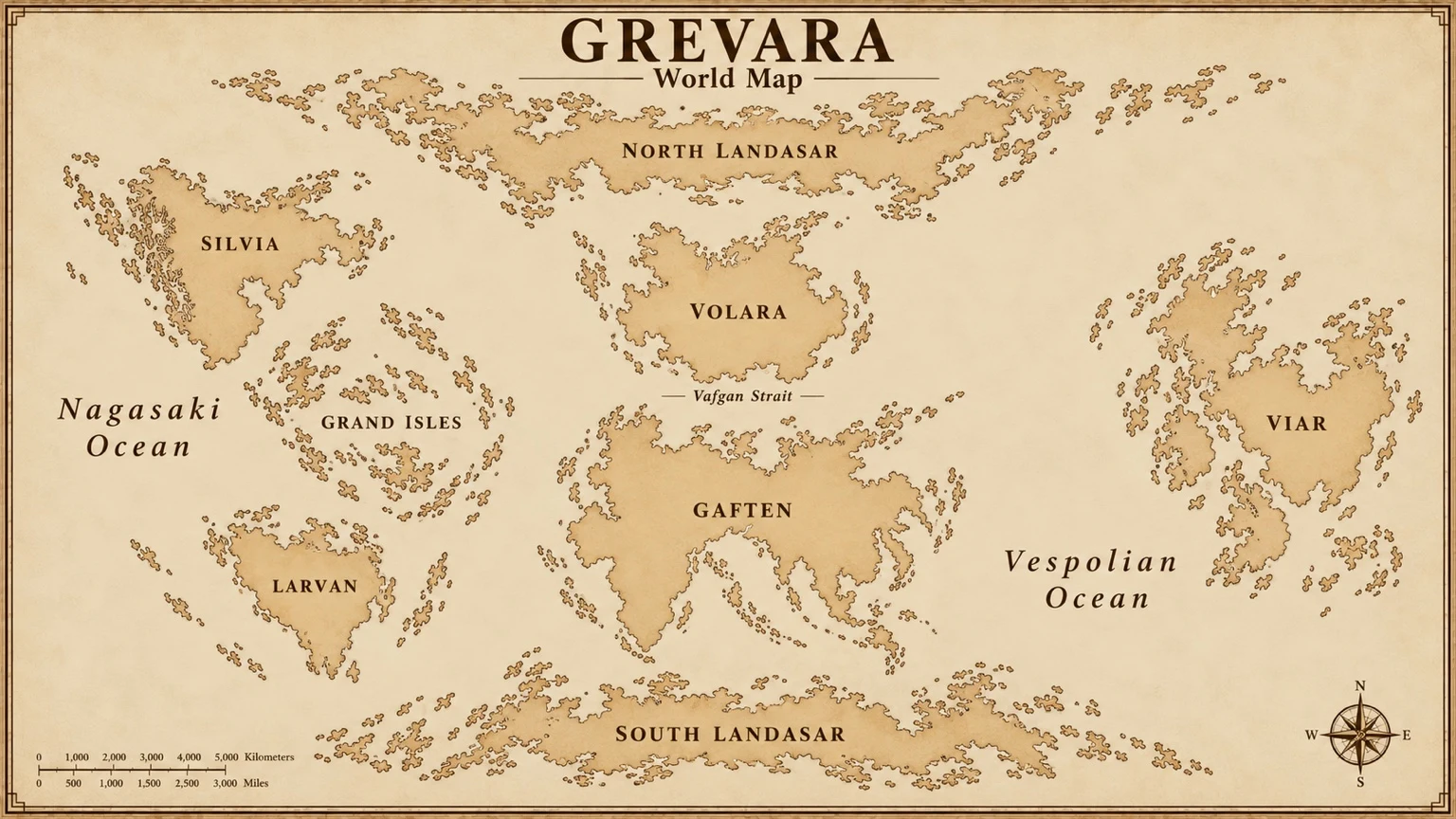
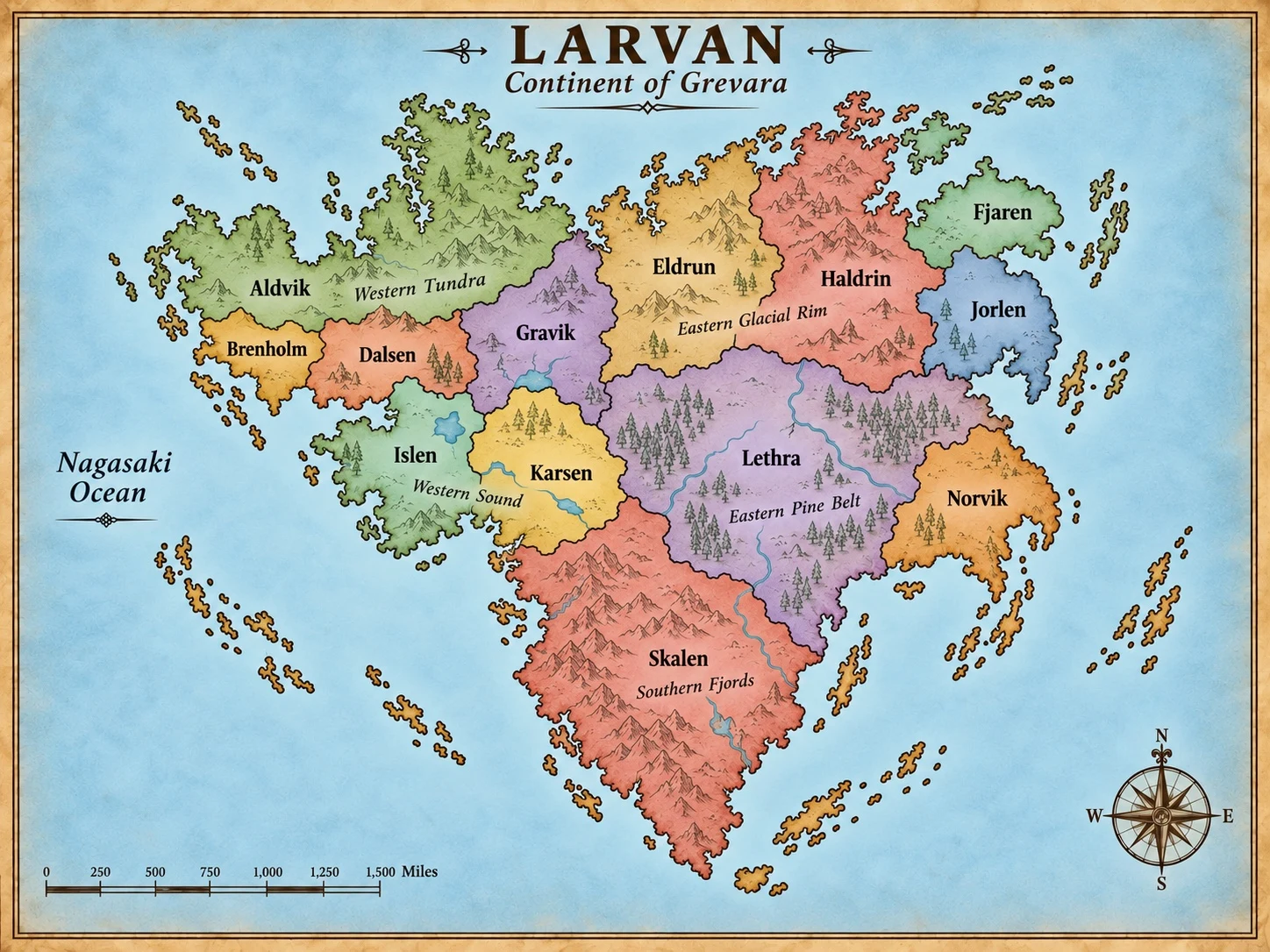
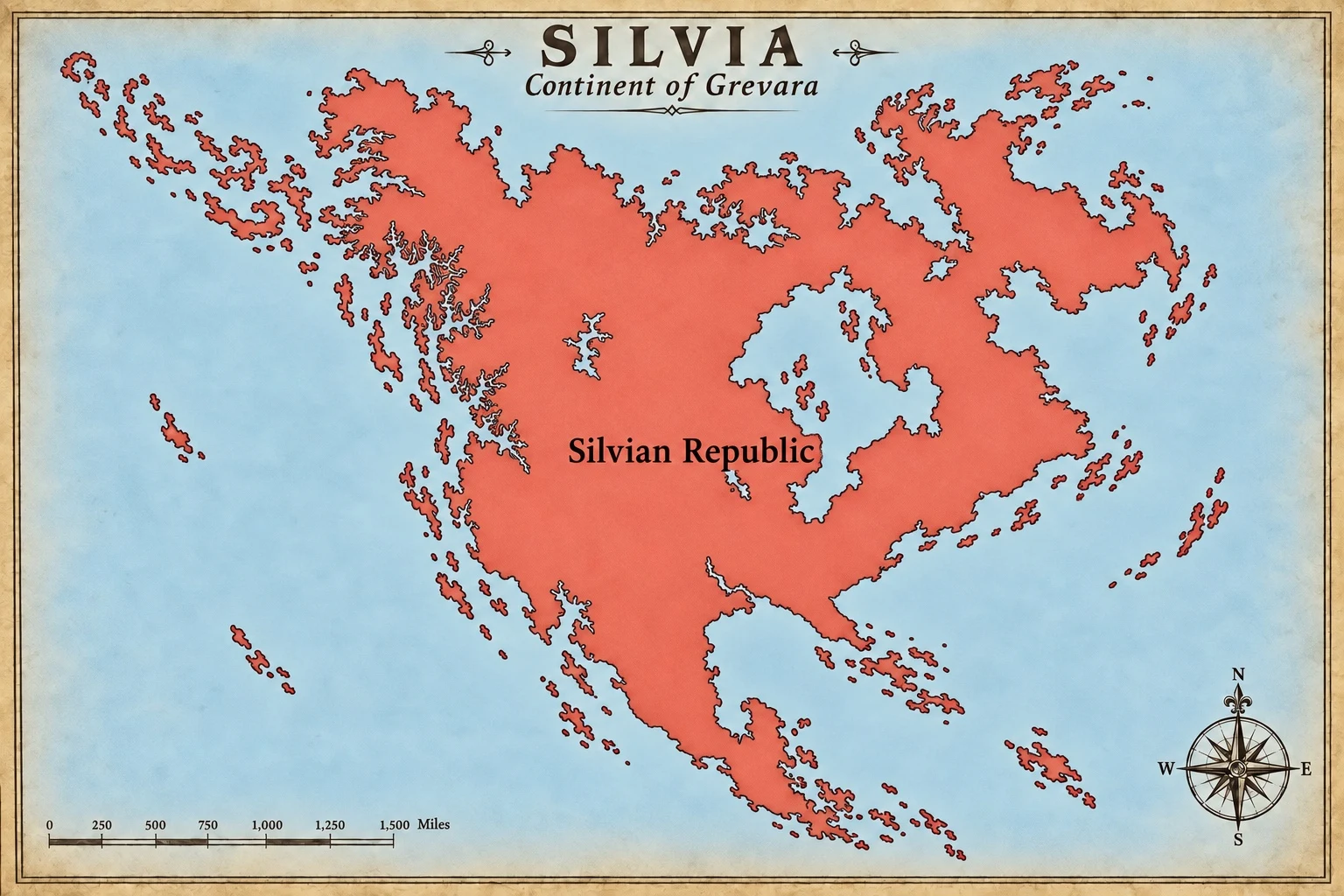
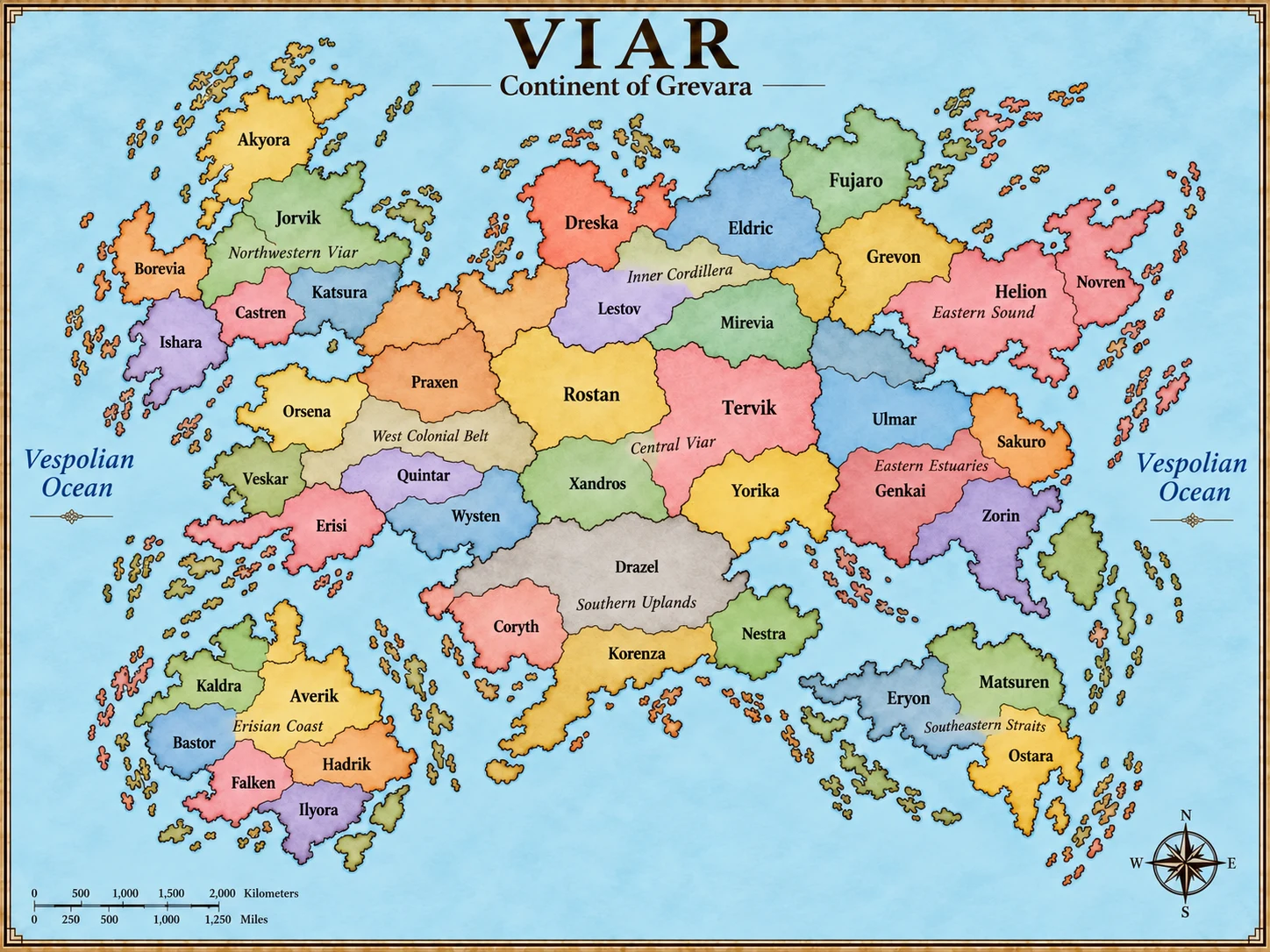
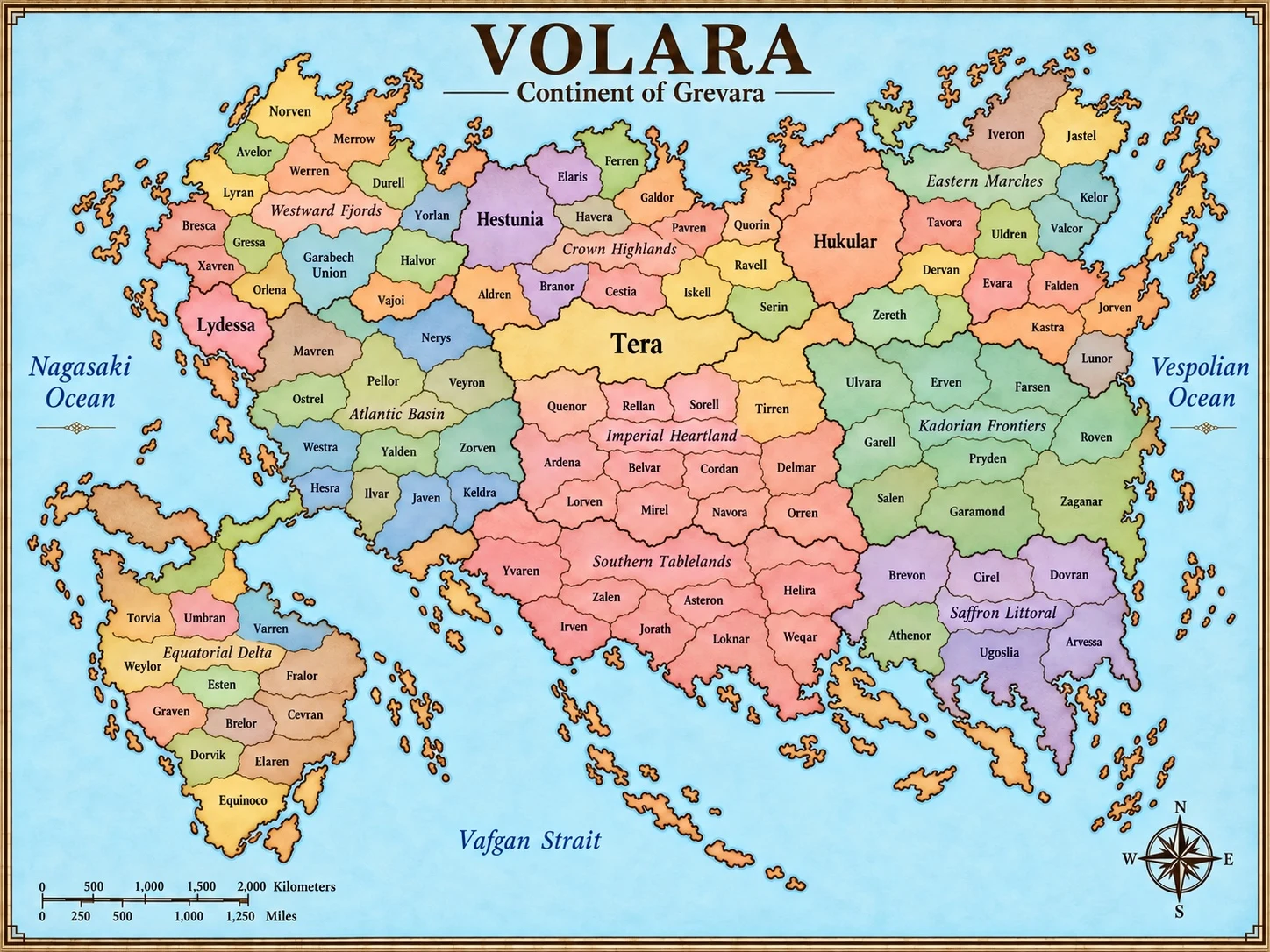
Original geographic references, not updated occupation maps. Colors do not encode coalitions.
Grevara — world map
Grand Isles
Silvia
Volara
Gaften
Viar
Larvan
Original illustrations for this source record
Original archive artwork and captions are preserved. Dates, labels and claims printed within inherited images belong to the previous edition; the revised text governs the current history.