Grevara: World War II, 1216–1220
1216 — The arithmetic of endurance
The failure of Hukular's great offensive in 1215 did not produce a return to peace. It produced a different method of fighting. General Soren Kast inherited armies still capable of advancing, but no longer trusted the promise that one concentrated blow would dissolve the Allied coalition. His aim was to make the defenders spend more than they could replace: experienced soldiers, working locomotives, productive districts, public credit, and the willingness of small states to endure another year. Ground mattered because of what losing it forced an opponent to do next.
The Allies entered 1216 with stronger common institutions than they had possessed in 1208. Those institutions could allocate resources more intelligently without making the resources sufficient everywhere. Garabech might increase production while Pavren lost the people needed to use its deliveries. A convoy might reach the Grand Isles while Kalanu's hospitals filled faster than they could discharge patients. Attrition was becoming a contest between whole societies, but it was decided through particular shortages in particular places. The side with the larger aggregate account could still lose the next indispensable position.
January 5–21: Kast abandons the promised decisive battle
Kast's January directive divided the northern front into a sequence of bounded objectives. An attack would be judged by whether the captured position could be supplied and whether the defender had been forced to commit reserves, rather than by whether a communiqué could claim the beginning of final victory. Larger formations would rotate through preparation, attack, and repair. That discipline was imperfectly enforced, but it gave the army a practical alternative to repeating Rauk's costly pursuit of a political collapse.
Imperial Director Darek Voss supported the method privately and disliked its public appearance. After years of promises, an announcement that the empire intended to win through further years of pressure was not attractive. Official propaganda therefore described each limited operation as another stage of an approaching decision. The army was asked to plan patiently while the population was encouraged to expect resolution. The contradiction would gradually damage confidence, but in 1216 it did not prevent the concentration of resources on selected sectors.
Kast also stopped treating every Allied counterattack as an opportunity for immediate pursuit. Some positions were held mainly to force the enemy to spend strength recovering them. Others were abandoned once they became expensive liabilities. Hukular's methods remained aggressive and its occupations coercive; improved military judgment did not moderate its political objectives. It made those objectives more dangerous by reducing the frequency with which the army exhausted itself trying to accomplish everything at once.
January 24–February 9: A new Gaften corridor
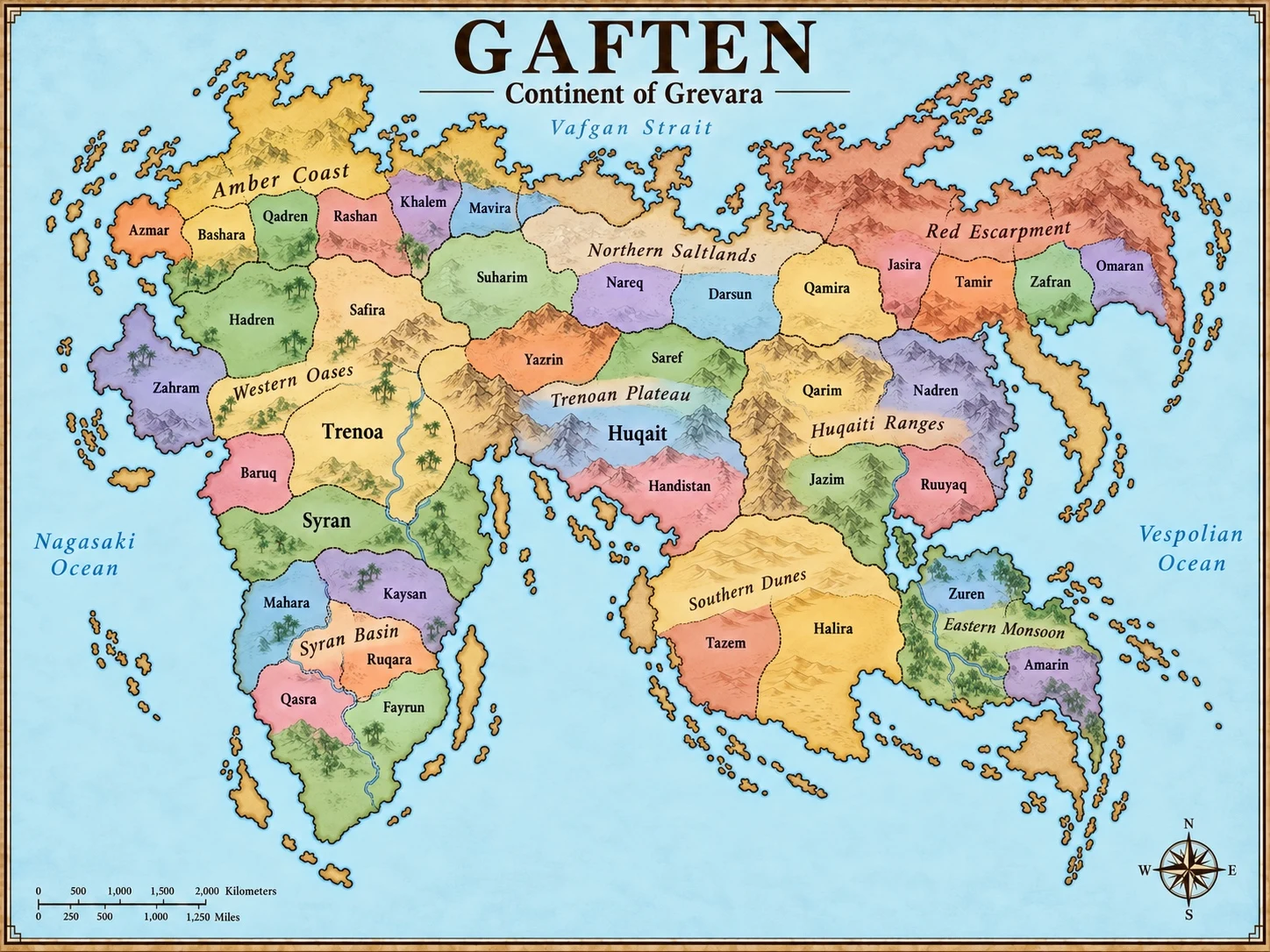
Jazim became an open military participant alongside Ruuyaq on January 24, replacing earlier limited access arrangements with acknowledged co-belligerency. This gave the southern Axis grouping more dependable use of partner territory. Geography remained important: Ruuyaq did not possess a direct frontier with Handistan. Its pressure in that theater depended on coastal movement, agreements, and contested corridors through intervening territory, rather than troops stepping across an imaginary common border.
Qarim entered active war on February 2 after Ruuyaqi and Jazimi forces attacked its southeastern approaches. Qarim's position made the fighting consequential beyond the immediate ground taken. Its territory stood between important parts of the eastern and central Gaften system. A successful Axis advance could narrow the routes available to Huqait and increase pressure toward Handistan. The opening attacks gained limited positions and did not immediately open an unrestricted corridor.
Huqait sent assistance according to arrangements accepted by Qarim's government, while Trenoan and Syran planners reassessed supply priorities. The new front competed with existing requirements. Guns promised to one district were not available to another merely because both governments now described their danger as urgent. The Axis had not won a major campaign, but it had forced another Allied partner to consume its reserves and expanded the range of obligations the coalition had to meet.
February 14–March 12: The Pavren counting stations
Pavren's army began a review of available strength on February 14. The initial returns appeared reassuring because regimental establishments remained close to their authorized size. Physical inspection produced a different picture. Men in hospitals, training detachments, transport duties, and temporary administrative assignments had been included in figures that politicians understood as troops immediately available for battle. These were not all fraudulent reports. Several offices had simply continued using categories no longer suited to the demands placed on them.
The revised account distinguished authorized, present, and immediately effective strength. A formation could exist, draw supplies, and perform useful service while lacking enough trained personnel for the attack expected of it. Publishing that distinction reduced the country's apparent military contribution. Pavren's delegates feared that larger allies would interpret the lower figure as reluctance. Their officers feared that concealing it would result in orders the army could not fulfill.
The review also showed a disproportionate loss of experienced junior leaders. Replacement recruits could fill ranks more quickly than the army could produce people able to guide them through confusion under fire. Training establishments shortened courses and drew instructors back toward the front, sacrificing future quality to immediate survival. Pavren still fought effectively in some sectors. Its problem was that every difficult operation spent knowledge it had increasingly little time to rebuild.
March 13–17: The locomotives in the ledger
A Pavren transport inspection on March 13 found a revealing difference between ownership and availability. Of ten locomotives assigned to one military distribution group, only four were ready for immediate service. Three required repairs, two were awaiting components, and one had been diverted to an emergency civilian movement. All ten remained accurately listed as government property. A planning officer reading that total as ten available engines would nevertheless build an impossible schedule.
The inspection did not uncover a single dramatic conspiracy. Several departments had recorded different aspects of the same fleet, and headquarters had combined them without preserving the distinctions. Transport officials corrected the returns and asked for fewer simultaneous tasks. Commanders replied that the tasks reflected real needs. Neither answer made the six unavailable engines appear at the station.
The immediate solution postponed some movements and kept serviceable engines working longer between maintenance periods. That increased current capacity at the expense of reliability later. Civilian deliveries also waited, including supplies intended for districts sheltering displaced families. The small transport group illustrated the larger process by which a state could meet today's emergency by making tomorrow's more likely. Hukular's next attack would fall on a system already borrowing time from itself, even before enemy action damaged another rail or workshop.
March 18–April 7: The first pressure battles
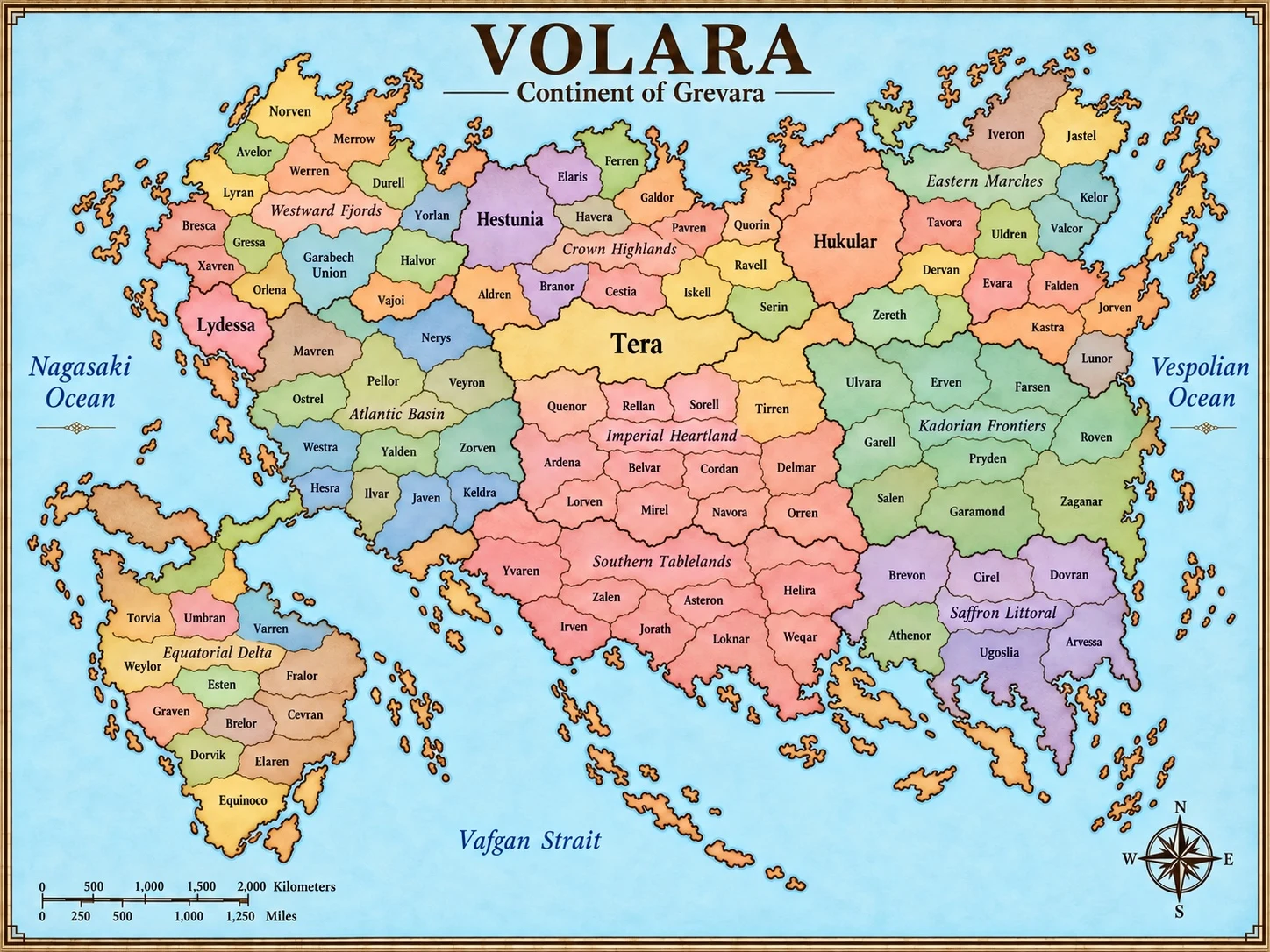
Hukular's spring operations began on March 18 against selected Pavren positions. The attacks were narrower than those of 1215 and followed periods of preparation that allowed repair and supply work to catch up. Quorin's formations held adjacent sectors and provided part of the transport support. Kast did not expect the opening operation to carry the army into Hestunia. He wanted to oblige Pavren and Havera to keep reserves close to the threatened area and repeatedly commit them.
The Allies defeated several attacks and lost other positions. Each individual result could be presented as evidence that the front was holding. Taken together, the fighting shortened the distance between Axis guns and transport facilities the defenders needed. A reserve battalion might enter one sector, suffer losses, leave for reorganization, and return elsewhere before its replacements had learned to work with the survivors. The cumulative damage was not visible in a simple comparison of the front at the beginning and end of a week.
On April 7, Kast halted the main effort after capturing two useful local positions. The pause surprised Allied officers expecting the usual extension of an offensive beyond its supply. It also denied them an exposed advance against which to deliver a large counterstroke. The northern war was becoming less dramatic and more relentless. Hukular could declare a victory, repair its formations, and prepare another attack while Pavren remained responsible for restoring the line it had lost.
April 11–30: The shells that did not restore the army
An Allied ammunition delivery reached the northern depots in April and produced a brief increase in confidence. The shipment was substantial, correctly documented, and largely usable. It did not solve the other shortages that determined how much fire support the army could deliver. Worn weapons required repair. Transport had to move the ammunition forward. Observers and communications personnel had to remain alive and functioning. A large stock at a depot was only one part of effective strength.
Pavren's finance officials had hoped the delivery would allow a reduction in emergency purchases at high prices. Commanders instead requested funds for repairs and replacements. Civilians reading reports of Allied abundance found these requests difficult to understand. Some accused the government of concealing supplies; others suspected that foreign partners had sent inferior equipment. The actual problem was more ordinary and less easily blamed on one decision: prolonged use consumed entire systems, not just the materials most readily counted.
Havera's repair shops absorbed some of the work. Their managers warned that taking additional military orders would delay civilian machinery needed for food distribution and power. Hestunia provided technical assistance, but experienced personnel were already in demand throughout the coalition. The April shipment mattered. It prevented immediate restrictions from becoming worse. Its failure to restore the army to an imagined earlier condition marked the growing distance between replenishment and recovery.
May 6–28: Kalanu's shrinking margin
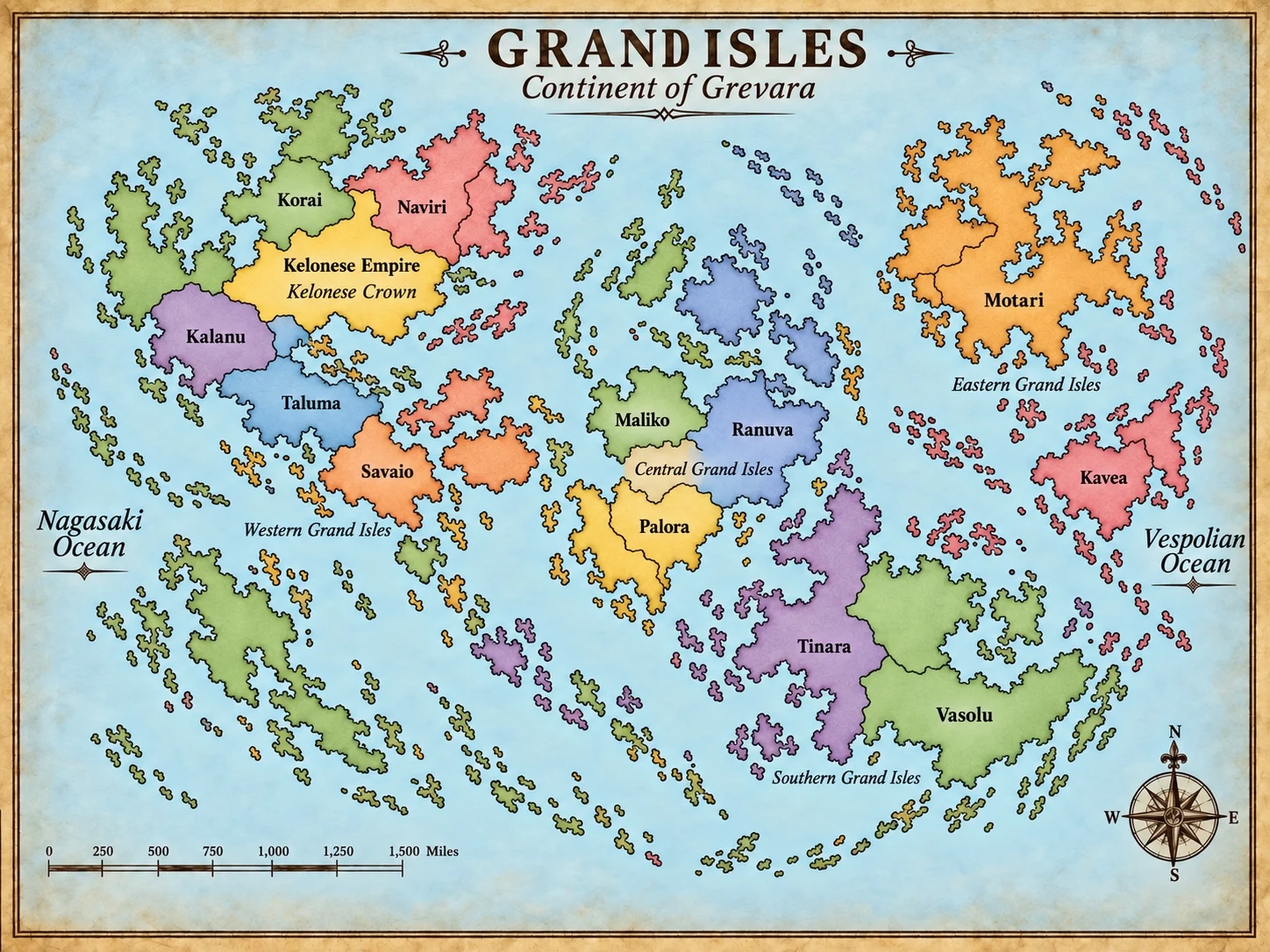
In the Grand Isles, the Kelonese command shifted toward persistent pressure on Kalanu's remaining transport and administrative connections. The empire already possessed nearby bases and occupied positions established in earlier campaigns. It did not need to undertake an immense new expedition to make the defender's situation more difficult. Local attacks, interrupted movement, and repeated damage forced Kalanu to repair the same limited system again and again.
On May 17, Kelonese forces captured an approach serving one of Kalanu's remaining major receiving districts. The capture did not close every route or cause immediate surrender. It increased the cost and uncertainty of deliveries that had already become difficult. Smaller movements continued, often arriving at places with less capacity to unload and distribute their cargo. The loss transformed a military position into a national economic problem.
Kalanu's government reduced ordinary consumption while protecting front-line allocations. That choice preserved resistance in the short term and spread exhaustion into households. Teachers reported children too tired to complete a normal school day. Civilian doctors asked whether the military priority system had accounted for the workers expected to keep facilities operating. Ranuva and Motari increased promised assistance, but the question was increasingly whether sufficient cargo could arrive in usable form before the recipient's institutions deteriorated further.
June 3–29: Praxen loses workshops
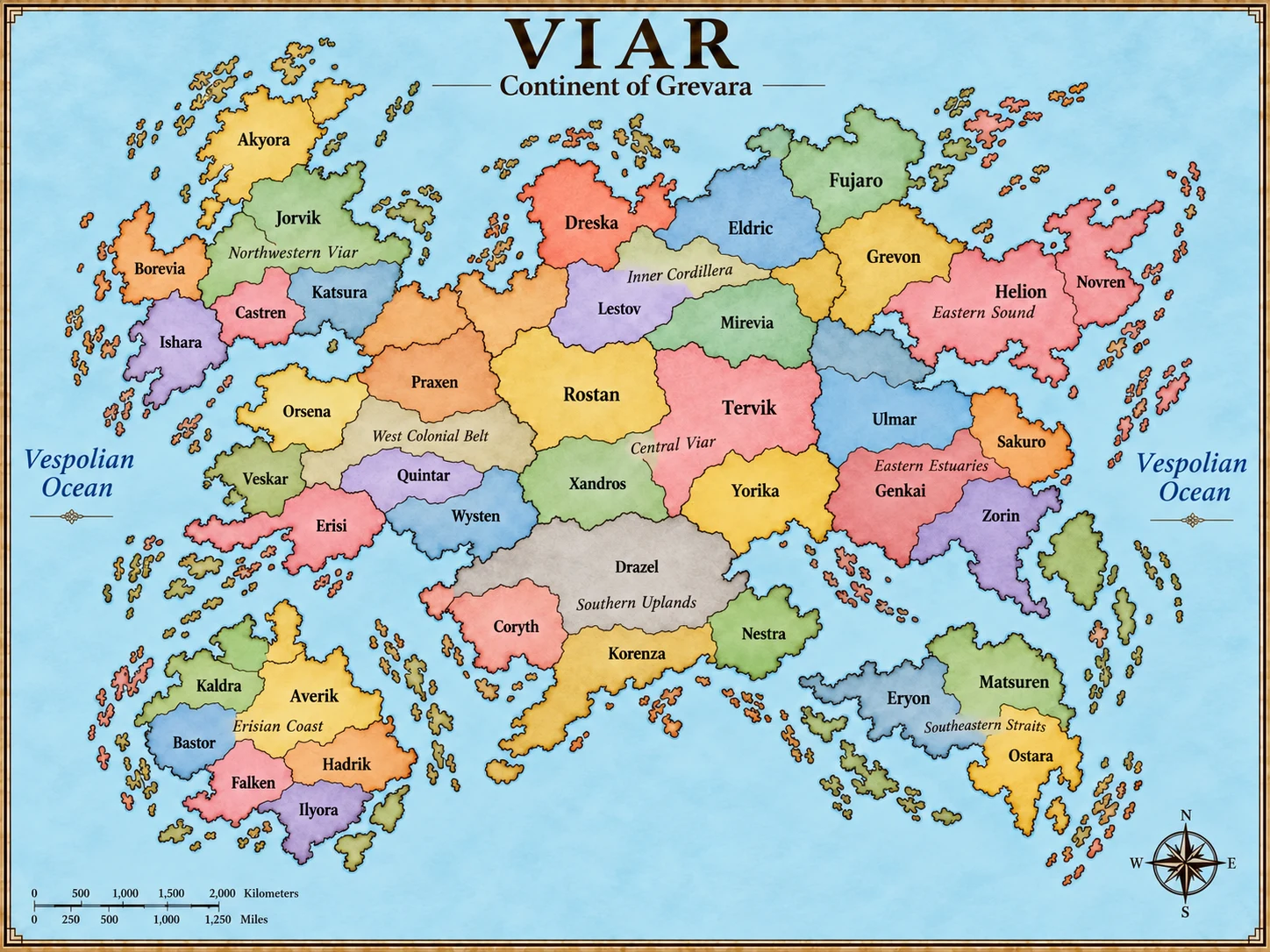
Rostan's June attacks in Viar sought a belt of Praxen workshops and transport installations rather than immediate occupation of the national administrative center. By June 29, the Axis controlled part of the targeted district. Praxen's forces had withdrawn personnel and some portable equipment, but much heavy machinery remained behind or had been disabled during retreat. Replacing it required time and space that the reduced state could not easily supply.
The loss mattered because those workshops had repaired civilian and military equipment. Their removal increased reliance on partners already serving several fronts. Erisia offered machinery and technical support; moving and installing those resources could not recreate an established skilled workforce overnight. Families displaced from the district were dispersed among reception areas, separating workers whose cooperation had made the facilities productive.
Praxen's directorial government debated concentrating remaining capacity under stronger emergency administration. Supporters argued that fragmented authority wasted time. Critics feared that officials would use the emergency to shield failed decisions from scrutiny. The compromise centralized selected military repair orders while preserving civilian review of labor and housing provisions. It improved coordination without restoring the lost workshops. Rostan had captured more than a patch of ground: it had increased the defender's dependence and reduced the rate at which damaged forces could return to service.
July 4–25: Hestunia's replacement bargain
Tomas Arven's government faced a renewed demand for personnel during July. Hestunia remained stronger than several front-line partners, but its resources were not untouched. Experienced workers were needed by factories, farms, railways, hospitals, and the military at the same time. Expanding one category by decree often reduced another. The cabinet rejected a single undifferentiated call-up and instead revised service obligations by age, occupation, and the demonstrated need of particular units.
The revision produced anger in communities that believed they had already contributed more than their share. Rural representatives pointed to families with several members in service. Industrial districts argued that military exemption did not mean comfort when workers endured long shifts and repeated price increases. Women carrying additional paid and unpaid work demanded recognition in relief and employment policy. The wartime bargain required more than asking everyone to make an equal sacrifice that was impossible to define.
Arven secured the program on July 25 after adding support for dependents and a review mechanism for disputed occupational classifications. The army gained replacements over subsequent months. It did not gain fully experienced formations instantly. Hestunia was still able to make such a bargain because its core territory and institutions remained intact. Pavren and Kalanu, losing productive ground and displaced populations, had fewer choices available even when they adopted similar language about shared duty.
August 8–31: A railway yard falls
Hukular's next northern operation began on August 8 and culminated in the loss of a Pavren repair and sorting yard on August 26. The facility had been evacuated in stages, yet the final removal of equipment was interrupted by fighting. Several locomotives were disabled rather than carried away. The government later faced criticism for leaving the evacuation so late; moving everything earlier would itself have reduced the capacity supplying the front. There had been no cost-free moment at which to act.
Axis engineers could not immediately use the damaged facility at its former capacity. That did not cancel the advantage. Pavren had lost a place where vehicles were repaired and cargo reorganized, while Hukular could gradually incorporate the site into its own system. The attack therefore imposed a longer disruption on the defender than the temporary pause experienced by the attacker. Kast considered this kind of asymmetry more valuable than an impressive advance that could not be maintained.
The Allied response recovered a nearby position but not the yard. Official accounts celebrated the successful local counterattack, and soldiers involved had reason to value it. The larger balance remained adverse. By August 31, more of Pavren's traffic had been diverted onto fewer functioning routes. Journeys took longer, maintenance intervals were stretched, and commanders had to plan around uncertainties that had previously been exceptions.
September 6–27: Quorin presents its bill
The Axis advances also consumed Quorin. Its transport system bore heavy military demand, and its civilian economy had become dependent on contracts shaped by Hukular's priorities. On September 6, Quorin's government requested compensation for infrastructure wear and more reliable delivery of civilian necessities. It did not threaten to join the Allies. It warned that the services on which the northern campaign depended would deteriorate if military access continued to be treated as an unlimited entitlement.
Voss's negotiators offered credits and selective priority. Quorin officials objected that credit could not replace goods unavailable at the approved prices. The disagreement revealed that Axis partners could exhaust one another while advancing together. Hukular gained from concentrating force; Quorin paid part of the less visible cost in worn equipment and interrupted ordinary trade. Remaining in the coalition did not make those burdens disappear.
The September 27 settlement provided immediate deliveries in several categories and deferred the wider financial dispute. It kept the offensive system working through the winter. Hukular accepted concessions because Quorin's cooperation was more useful than a crisis over payment. The agreement shows why exhaustion did not produce automatic collapse on either side. Governments could bargain, improvise, and transfer costs, often extending a strained system for another year without making it healthy.
October 3–24: The enclosed army in Serin
Serin's position was deteriorating more quietly than Pavren's. The country was inland, bordered by Axis territory or Hukular-occupied Ravell. Its own production, stored matériel, captured supplies, and limited external assistance had sustained resistance. There was no dependable, high-volume Allied sea route into a coast Serin did not possess. Limited deliveries and intermittent arrangements could preserve particular functions without meeting the full needs of an army and civilian population.
During October, commanders tightened ammunition and fuel allocations. Ravell formations serving beside Serin's forces received the same restrictions, provoking concern that the national army preserved since 1208 was becoming too weak to play a future role in liberation. Sera Danic sought additional assistance and resisted proposals that would disguise the shortage in public reports. She also had to confront a painful fact: the host country was bearing costs for an occupied ally while its own capacity to continue was shrinking.
Joint officers reduced offensive activity and concentrated on essential defense. Training suffered because material used to prepare replacements was also material required at the front. Civilian transport lost access to fuel and repair work. The army was still present, its flags still flew, and its government still issued orders. The gap between those visible signs and the resources behind them was widening.
November 2–December 31: Winter without restoration
The winter did not bring the recovery earlier war plans had assumed. A formation withdrawn for rest still required replacements, equipment, and instructors. A displaced district still required food and accommodation. Factories increased output in some categories while their machines and workers accumulated wear. The cycle continued because neither coalition could secure acceptable peace and neither had exhausted every means of continuing.
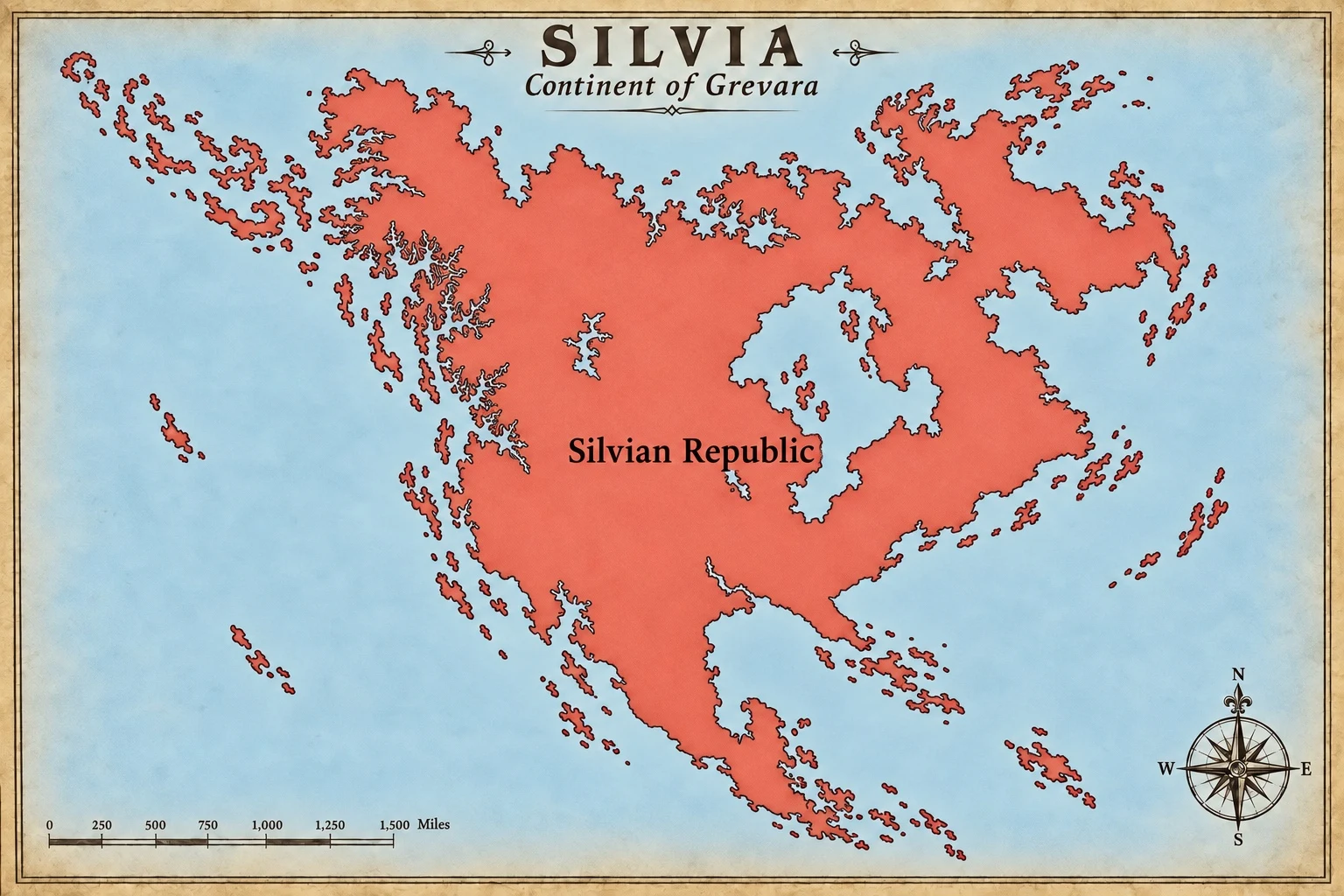
Silvia remained neutral. Its commercial restrictions and civilian humanitarian activity were subjects of fierce domestic argument, but they did not become a covert military alliance. Kandar Harbor was not attacked. Silvian leaders could observe the growing exhaustion abroad without knowing that the specific Kelonese bombing of June 8, 1223 would end their country's neutrality.
At the end of 1216, the Axis had achieved no spectacular decision. It held additional useful ground in Pavren, had narrowed Kalanu's margin, and had taken productive facilities from Praxen. Qarim now faced active fighting, and Serin's reserves were running lower. These changes could look modest when drawn on a world map. They were substantial when measured as repairs not completed, men not trained, meals reduced, and fewer alternatives available when the next attack came. The war of attrition had begun to favor the coalition able to make the next demand before its opponents had recovered from the last.
1217 — The nations that could no longer recover
By the beginning of 1217, the war's most important distinction was increasingly between states that could repair damage and states forced to live permanently with it. Hestunia and Garabech could still move resources among functioning institutions. Pavren had to administer a shrinking territory whose remaining transport served an army, refugees, and ordinary commerce simultaneously. Kalanu could receive a useful convoy and remain worse supplied than before the previous month's fighting. Serin could preserve a line by spending matériel it no longer expected to replace.
The Axis did not escape the same pressures. Quorin's infrastructure was overworked, Hukular's labor system concealed shortages, and the Kelonese navy faced growing maintenance demands. The difference was local and immediate. The aggressors retained enough freedom to select places where a further expenditure would impose a greater burden on the defender. Their advances were slow because resistance remained real. They continued because the defenders' exhaustion was becoming more consequential than their own.
January 9–31: The relief lists
Pavren's winter relief program began with a dispute about which people still counted as residents of which district. Families displaced several times appeared on overlapping lists or none at all. Some municipal offices continued requesting allocations for people who had left, while reception towns lacked records authorizing support for those who had arrived. Fraud occurred, but confusion and destroyed records accounted for much of the discrepancy. Treating every irregularity as deception would have denied food to people already harmed by the war.
The government created temporary shared registers on January 16. Local officials could confirm presence and need while ownership and permanent residence remained unsettled. The arrangement improved distribution but exposed the scale of displacement more clearly than earlier official summaries. Districts still described as functioning on national reports had lost much of their population or productive activity. The administrative map was lagging behind the social reality.
Havera accepted additional refugees under a negotiated allocation of costs. Its communities were already hosting soldiers, repair work, and people displaced by earlier campaigns. Some residents welcomed the arrivals; others feared shortages and the loss of housing. Authorities prohibited the army from solving accommodation problems simply by displacing existing tenants without process. That protection was difficult to enforce, but abandoning it would have converted one population's emergency into another's resentment.
The relief lists became military evidence as well as welfare records. They showed where labor had disappeared, where road traffic would increase, and which districts could no longer support nearby forces. Pavren's officers asked for access; civilian administrators demanded limits on how the information would be used. A state struggling to survive still needed to distinguish assistance from surveillance and a household's need for food from its availability for another compulsory obligation.
February 5–March 8: Attacks without a season of rest
Kast resumed pressure on February 5 rather than waiting for a single grand spring opening. Operations remained limited enough to support with available transport, and pauses were used to prepare the next attack. The approach kept Pavren's reserves uncertain about where they would be required. Even units not fighting at a particular moment remained close to danger, unable to undertake the extended rebuilding their losses demanded.
Pavren's army shortened several positions during February. The withdrawals preserved forces but brought fighting nearer to districts that had previously served as reception and supply areas. Every move required more than drawing a new line. Stores had to be moved, hospitals reassigned, civilian warnings issued, and units informed of routes that might already be crowded. A successful military withdrawal could still produce a humanitarian emergency.
Hestunian support prevented several local reverses from becoming larger breaks. It also revealed the limits of rescue by stronger partners. Hestunian formations required their own support and could not be inserted indefinitely into a shrinking Pavren system without increasing congestion. Havera's government requested clearer notice of movements passing through its territory. Allied cooperation continued, but each improvement in military concentration imposed another negotiation about the use of a smaller nation's remaining resources.
By March 8, the Axis had gained a succession of positions with no single dramatic encirclement. The cumulative effect was to make the surviving front more dependent on a secondary rail connection farther west. Its loss would not instantly destroy the army. It would remove the flexibility that had allowed it to recover from earlier interruptions.
March 13–April 4: A strike in the Garabech workshops
The Garabech Union faced a major industrial dispute when workers in several linked workshops refused further compulsory overtime on March 13. The dispute arose from accumulated fatigue, uneven pay adjustments, and rising living costs. Government officials warned that interrupted deliveries would hurt front-line partners. Workers' representatives answered that broken machinery and injured personnel were already interrupting production, even when official schedules recorded full shifts.
Union authorities negotiated with constituent governments because the affected facilities lay under different local arrangements. A single national order could authorize spending without resolving housing, transport, or workplace enforcement. The resulting process was slower than military purchasers wanted. It also provided information showing where additional money would actually improve output. Some shortages came from component delays rather than insufficient labor hours.
The April 4 settlement revised overtime obligations, increased support for dependents, and committed funds to maintenance. Deliveries temporarily fell below the optimistic schedule and then became more dependable. The strike did not remove Garabech from the war or transfer its allegiance. It demonstrated an exhaustion that could still be addressed through bargaining because the state's industrial territory and political institutions remained intact.
Pavren's representatives watched with mixed feelings. They understood the workers' claims and feared the consequences of delay. A larger partner could invest in making continued production sustainable; a front-line state might lose its next position while waiting for the investment to take effect. Coalition solidarity required acknowledging both realities rather than accusing either soldiers or workers of insufficient sacrifice.
April 9–30: Handistan gives up an exposed belt
In Gaften, Ruuyaqi and Jazimi pressure through the contested eastern approaches forced Handistan to withdraw from an exposed belt of settlements during April. The campaign remained dependent on geography and partner access. It did not imply a direct Ruuyaq–Handistan border or unrestricted use of neutral territory. Operations around Qarim constrained the routes available and required the Axis to commit forces to holding what it had gained.
The withdrawal shortened Handistan's line and displaced communities whose labor had sustained local agriculture and transport. Huqait offered assistance while defending its own positions. Trenoan and Syran deliveries helped replace immediate losses but did not restore the abandoned land or eliminate the pressure on remaining districts. A country could receive more foreign assistance each year and still become materially weaker if each year's destruction exceeded the aid.
Handistani authorities ordered records of abandoned public property to be preserved where possible. Local officers resisted spending transport space on files while wounded people and supplies also needed movement. The compromise prioritized records necessary to identify inhabitants and maintain claims, leaving other archives behind. Once again, retreat threatened to erase evidence of a society as well as its physical institutions.
The Axis advance was measured in a limited belt rather than the collapse of an entire state. For the people moved from it, the distinction offered little comfort. For Allied strategy, it meant another government requiring help simply to remain at the level from which its previous year's plans had begun.
May 6–27: Pavren's secondary railway is severed
Hukular's May operation targeted the secondary connection identified during the winter fighting. The railway's importance lay in its ability to redirect traffic when the principal routes were interrupted. Defending it required forces in positions that Kast could pressure repeatedly. Pavren committed reserves and requested additional support; the Allies could provide some reinforcements without removing the underlying transport vulnerability.
The connection was severed on May 21. Engineers restored limited movement briefly, but subsequent fighting made dependable service impossible. Supplies continued by other routes at lower volume and greater cost. The loss did not produce an immediate empty depot. It changed the rate at which depots were replenished, allowing shortages to emerge over the following weeks even while official statements accurately reported that deliveries had not ceased.
The army began consuming stocks intended for later operations. Civilian traffic received less space, and the movement of fuel and food became more irregular. Havera accepted additional repair and distribution work, spreading the consequences across the border. A tactical gain inside Pavren was becoming an economic burden on its neighbors.
Kast ended the main attack on May 27. He did not need to pursue every retreating unit to exploit the result. The disrupted connection would continue imposing costs after the guns in that sector fell quieter. Allied intelligence increasingly recognized the pattern: Hukular was using temporary concentrations to create continuing disadvantages, then moving its main effort before the defenders could assemble an equivalent response.
June 4–July 2: The relief offensive that came too late
The Allies attempted a limited relief offensive on June 4, seeking to recover positions necessary to make the damaged transport system dependable again. The plan was less ambitious than the failed operation of 1213, yet it faced a defender prepared for the likely objective. Hukular and Quorin had repaired their own approaches and established depth positions behind the recent gains. The time required for Allied approval and assembly had given them the opportunity.
Initial attacks recovered some ground and failed to restore the route as a secure, usable connection. Engineers could not work reliably under continuing fire, and the forces protecting them suffered losses that reduced the prospect of sustaining further attacks. Commanders requested another extension, arguing that abandoning the effort would leave Pavren in a progressively worse situation. Their argument was correct about the danger without proving that continuation would solve it.
Arven approved a final bounded effort and ended major attacks on July 2 after its failure. The decision preserved units that would otherwise have been spent against improving Axis defenses. It also acknowledged that Pavren would have to continue without the capacity the operation had been intended to recover. The coalition had avoided a larger military mistake and still suffered a strategic defeat.
Pavren's ministers sought an explanation they could present to their public. Saying that the operation had saved strength sounded to some listeners like saying that someone else's strength mattered more than Pavren's survival. Hestunian representatives emphasized that continued losses would reduce the ability to defend Havera and assist Pavren later. The disagreement did not break the alliance, but it exposed the resentment that arises when a smaller partner's present need becomes a larger partner's future calculation.
July 9–August 3: Kalanu's hospital census
Kalanu conducted a hospital census in July because nominal bed totals no longer described usable care. Some facilities had beds but lacked staff, medicines, clean water, or dependable power. Others treated patients in improvised buildings not included in official capacity. Naval and military authorities demanded enough reserved places for expected casualties, while civilian doctors warned that existing patients could not be made to disappear when a new operation was planned.
The census found that staff endurance was becoming as important as physical space. Experienced personnel had worked through repeated emergencies, and replacements required supervision that reduced the time available for treatment. Nera Venn, the civil administrator involved in the 1210 Naviri evacuation, assisted a shared island reception program and reported similar difficulties across receiving districts. Moving patients could relieve one locality while exhausting another.
Motari and Ranuva offered additional assistance. Shipping losses and delays meant that approval did not guarantee timely arrival. Kelonese pressure on Kalanu's approaches continued to reduce the margin between an adequate delivery and a serious shortfall. The empire was paying for its advances, but Kalanu was paying simultaneously in military losses and the deterioration of ordinary care.
On August 3, Kalanu's government restricted nonessential movement and postponed several military activities to protect remaining transport. The decision helped immediate distribution and signaled that the state could no longer sustain all the functions its earlier plans assumed. Proposals for local negotiations gained an audience among people who had previously opposed them. Exhaustion was beginning to change the range of policies that citizens considered imaginable.
August 4–10: The crews behind the Kelonese advance
Kelonese readiness reports in early August showed that some vessels had completed repairs faster than their crews had recovered. Men transferred repeatedly between assignments had accumulated long periods without dependable leave. New personnel could fill berths without immediately replacing the knowledge of experienced teams. Seko requested a more regular rotation, arguing that exhausted crews would eventually consume the advantage gained by repairing their ships.
The imperial government accepted part of the request and retained priority for pressure on Kalanu. This produced an uneven fleet: selected formations received adequate rest while others maintained less demanding duties under continued strain. Naval propagandists preferred to count available hulls. Commanders needed to know whether the people aboard them could perform reliably through another operation.
Kalanu did not benefit immediately from every Kelonese weakness. The empire could choose which rested forces to concentrate near established positions, while the defender had fewer options for relieving its own personnel. That unequal freedom was one source of the Axis advantage. Both sides were tired, but one could distribute some of its fatigue and the other had to carry it continuously at the point of danger. The August rotation dispute therefore slowed particular imperial commitments without removing the pressure that was exhausting the island state.
August 11–September 6: Serin rations training
Serin's military authorities reduced training expenditure again in August. Ammunition and fuel preserved for the front could not be used at the same rate in instruction. Simulated exercises and technical demonstrations substituted where possible, but substitutes had limits. Recruits entering units possessed less practical experience than their predecessors, increasing the burden on surviving veterans. The army was saving resources now by accepting a higher risk of waste and loss later.
The Ravell formations shared these conditions. Their officers resisted proposals to transfer every remaining specialist abroad, arguing that the army's national identity depended on a functioning presence beside Serin. Danic sought to preserve both the immediate force and a nucleus capable of rebuilding elsewhere if necessary. The resulting small evacuations of selected personnel were not a bulk airlift and did not solve the army's supply problem.
Serin's civilian economy was also reaching the limits of substitution. Equipment could be repaired repeatedly until the necessary parts were no longer available. Households could reduce consumption until reductions endangered health and productive work. Officials continued finding ingenious local solutions, but ingenuity could not indefinitely replace quantities of material that the country could neither produce nor reliably import.
Hukular did not need to launch an enormous offensive to benefit. Continued pressure and the absence of a dependable Allied corridor ensured that time itself damaged the enclosed defender. Serin still possessed courage, organization, and functioning authority. None of those qualities made its stocks inexhaustible.
September 12–October 24: Pressure in Viar and the littoral
Rostan continued limited operations against Praxen during September. The purpose was to make the reduced industrial system serve an increasingly crowded rear area. Praxen preserved its main command and lost additional local facilities. Erisian assistance sustained important functions, but the movement of displaced workers and families complicated installation of replacement machinery. A factory could be reconstructed in stages; an experienced community could not simply be ordered to reappear around it.
In eastern Viar, Novren maintained pressure against Helion without forcing a decisive collapse. Fujaro and Grevon supplied forces and matériel, preserving the front at a cost that limited what they could offer elsewhere. The relative stability of the line did not mean those partners were enjoying a quiet war. They were spending resources to prevent the kind of deterioration already visible in Praxen.
Athenor and Ugoslia likewise held their principal coastal positions while yielding some exposed ground to the Axis system around them. Maritime access remained their essential advantage over occupied Garamond. Protecting it required continued commitments by partners who were also being asked to relieve Kalanu and sustain distant fronts. Each theater could make a persuasive claim to priority. The coalition could not satisfy all of them at the same moment.
November 4–18: Pavren's capital falls
Hukular's November offensive struck a defender already weakened by the year's losses. Pavren's remaining regular formations resisted, and Hestunian support prevented parts of the withdrawal from becoming a rout. The army could no longer maintain the earlier breadth of defense. Positions covering the national administrative center were abandoned in stages as ammunition, transport, and available reserves became insufficient to hold them without risking a larger encirclement.
Axis forces entered Pavren's capital on November 18. Pavenor had housed the principal national ministries, archives, and railway administration. Its government had withdrawn into the remaining western territory, preserving records and part of the administrative apparatus. Loss of the capital did not constitute national surrender or a change of coalition. It deprived the state of another concentration of infrastructure and public confidence.
Residents who remained faced occupation, uncertainty, and competing instructions from military and local authorities. Some believed resistance would return quickly. Others had already experienced enough retreat to doubt official promises. Hukular's security system began registering people and replacing officials while military commands demanded restoration of services. The occupier acquired a damaged city and the defender lost facilities it had no time to replace.
For Havera, the fall was a strategic warning. The surviving Pavren zone still stood between parts of the Axis concentration and Havera's deeper positions, but that buffer was shrinking. Hestunia now had to plan for the possibility that assistance to Pavren would become the defense of Havera's own eastern territory.
December 1–31: Exhaustion becomes a policy argument
Pavren's remaining ministers faced petitions for negotiations alongside demands to continue fighting. Neither position belonged exclusively to cowards or patriots. A family that had lost its home twice could reasonably fear that another stand would destroy what remained. A soldier who had seen occupation abuses could reasonably fear that a ceasefire would exchange immediate danger for indefinite subordination. The government's problem was to choose under conditions where every available course carried serious harm.
The Allied conference promised continued assistance and could not promise restoration of the lost capital on a useful timetable. Kalanu considered restrictions on its commitments. Handistan sought more support to avoid further contraction. Serin tightened allocations again. The burden was becoming uneven enough that general declarations of coalition unity sounded detached from some members' daily conditions.
Silvia remained neutral through 1217. Neutral relief and private commerce did not become military participation, and Kandar Harbor remained unbombed. The Axis ended the year farther forward in several theaters, most visibly in Pavren, without having destroyed the Allied coalition. Its progress was not unstoppable. It was becoming harder to reverse because the nations expected to reverse it were spending their remaining strength simply to endure the next month.
1218 — The first exhausted front gives way
Pavren began 1218 without its capital, with a reduced western territory, and with an army whose survival depended increasingly on help arriving through Havera. It still possessed a recognized government and units willing to fight. It no longer possessed the depth of production, transport, and population that had allowed it to absorb earlier defeats. The distinction between continuing the national war and preserving a particular field army was about to become unavoidable.
The Axis advance during the year would not be a sweeping conquest of all northern Volara. It would be a sequence of local gains, interruptions, and political consequences. Kast's methods required time and expenditure, but they were operating against a defender with fewer reserves after each cycle. The Allies could prevent some disasters without preventing the overall deterioration. Their improved institutions now had to manage the failure of a partner they had not been able to save.
January 8–30: The western remnant of Pavren
Pavren's government moved essential offices closer to the Havera frontier in January. The relocation preserved activity and further crowded the remaining rear area. Civil servants, military depots, refugees, and medical facilities competed for buildings and transport. Some officials still possessed records from the capital; others worked from reconstructed lists and testimony. Issuing a national directive remained possible, but enforcing it across the diminished country required resources the government increasingly lacked.
The army consolidated depleted units. Maintaining every historic formation on paper had become less useful than combining surviving personnel into commands capable of functioning. The decision carried emotional weight. Unit identities connected soldiers to local communities and dead comrades. Their dissolution could feel like abandonment even when consolidation improved immediate effectiveness. Commanders retained records and honors while explaining that continuity of service mattered more than preserving empty establishments.
Hestunia and Havera sent assistance, but every delivery had to enter a crowded system close to the fighting. The remaining Pavren authorities could no longer distribute all supplies at the rate promised by national plans. Stores accumulated in some places while units elsewhere reported shortages. Foreign observers occasionally blamed local incompetence without recognizing that repeated destruction had removed the ordinary capacity through which competent administration worked.
By January 30, the government requested a coalition commitment to defend the western remnant as an integrated operation. Havera agreed to closer coordination and resisted surrendering authority over its own resources. Hestunia pledged forces already facing other responsibilities. The arrangement improved the chance of survival and did not recreate Pavren's lost strategic depth.
February 6–March 2: The Axis attacks the remaining choices
Kast's February operations targeted the positions necessary for Pavren to move between its surviving sectors. The objective was less to destroy every formation than to make separate formations unable to assist one another. Attacks forced repeated local adjustments, interrupting the delivery of supplies and the evacuation of wounded. Hukular suffered losses and replenished its attacking groupings in sequence. Pavren often had to return the same experienced survivors to another threatened position.
Quorin's participation remained important and contentious. Its officers wanted their formations used within plans that recognized their own casualties and supply needs. Hukular commanders pressed for steady support to maintain the offensive rhythm. The coalition resolved immediate disagreements through liaison and selective concessions. These negotiations consumed time, but the Axis still had enough margin to pause without relieving Pavren of its larger predicament.
By March 2, several western Pavren districts could communicate reliably only through routes more vulnerable than those they had lost. The army remained organized, but the government had fewer ways to move forces, protect civilians, and distribute supplies simultaneously. Every additional requirement displaced another. Military authorities asked civilians to stay off essential routes while municipal officials insisted that leaving people in threatened areas would produce a worse emergency later.
March 7–29: The bread debate in Havera
Havera's government confronted a domestic crisis over food prices and requisition during March. The country was supporting its own forces, foreign formations, and growing refugee populations while preparing for fighting inside its eastern districts. Merchants blamed controls for shortages; consumers blamed merchants for withholding goods; farmers complained that official purchase terms failed to cover rising costs. Each group could identify a real grievance, and none could solve the entire distribution problem alone.
The government revised staple allocations and increased subsidies on March 18. Funding the changes required borrowing and reductions elsewhere. Opposition figures argued that Havera was paying for decisions made by larger allies. Hestunian representatives offered additional support but requested access to records showing how it would be used. Some Haverans saw the scrutiny as necessary accounting; others saw it as the first step toward foreign control of domestic policy.
The settlement maintained Havera's war commitment and introduced joint verification limited to the assistance provided. It did not give Hestunia authority to govern Havera. The distinction mattered because defending an ally's independence would lose meaning if the defense itself absorbed that ally's sovereignty. Even under acute pressure, political consent remained part of military endurance.
The bread debate foreshadowed what would happen if the front moved farther west. Havera still had room to bargain and redistribute. Pavren's government had already lost much of that room. The difference between the two countries was narrowing as the demands of the shrinking Pavren front spilled across their border.
April 5–May 19: A shrinking field army
The fighting in April and May isolated parts of Pavren's remaining regular army. Some formations withdrew into positions connected with the broader Allied defense; others faced increasingly restricted movement. Commanders reported not simply a shortage of men, but a shortage of fit men with the equipment and training required for the tasks assigned. Hospitals returned some wounded to limited duties, freeing personnel elsewhere while increasing the complexity of unit organization.
The coalition attempted to move additional stores into the threatened area. Deliveries sustained resistance and could not reverse the cumulative loss of routes and facilities. A proposal for a major relieving attack was rejected because the forces required could not be assembled soon enough without exposing Havera. Pavren's officers were told to preserve as much of the army as circumstances allowed. For those in the most threatened positions, the instruction acknowledged that relief was no longer a reliable expectation.
On May 19, the national cabinet authorized further relocation of civilian offices and requested space in Hestunia for continuity operations. It did not authorize annexation, a change of alliance, or a national peace. The decision ensured that Pavren would retain a recognized government if organized resistance at home became impossible. It also strengthened accusations that politicians were arranging their escape while asking soldiers to hold.
Those accusations could not be answered by denying the imbalance. Ministers who left would be safer than many people remaining. Their argument was that capture of every national institution would give the occupier greater power to claim that resistance had ended. Preserving a government served a real purpose and did not spare its members the obligation to account for people they could not evacuate.
June 1–14: The Pavren field armistice
Local negotiations began on June 1 between Axis commanders and the command of Pavren's isolated western field grouping. The talks concerned cessation of fighting and the disposition of troops in a defined area. They were not negotiations by the recognized national government for a political peace. Pavren's cabinet, now operating through its remaining offices and arrangements in Hestunia, refused recognition of conquest and maintained its Allied commitment.
The isolated commander faced dwindling supplies, wounded personnel who could not be moved, and no credible prospect of timely relief. Continuing could inflict additional losses on the enemy, but it would also increase the deaths of people whose military situation was no longer improving. Some officers favored dispersal and continued resistance. Others argued that many troops were physically unable to undertake such a movement and that civilian concentrations would suffer in the attempt.
The Pavren field armistice was signed on June 14. It ended organized fighting by the specified grouping, required the surrender of its heavy equipment, and placed its personnel under Axis control pending further arrangements. Promised treatment and releases became subjects of later dispute; an agreement did not guarantee faithful implementation by every occupation or security authority. The armistice did not bind all Pavren forces abroad, extinguish the exile government, or convert Pavren into an Axis nation.
Other surviving units crossed into the Allied system where routes remained available. They formed the basis of continued Free Pavren service under national representation and allied operational arrangements. Their existence was militarily useful and politically important. It could not obscure the defeat at home. Most of the country had passed under Axis control, and a large part of its regular defense had ceased fighting because it lacked the means to continue.
June 18–July 12: The meaning of surrender
News of the armistice produced anger throughout the Allied coalition. Some newspapers called it betrayal before the military circumstances were known. Pavren's exile representatives demanded that critics distinguish a trapped command's surrender from a voluntary change of allegiance. Soldiers who had escaped defended comrades who had not, describing conditions that could not be understood from a map on which neighboring Allied territory appeared deceptively close.
The national government established a review of the command decisions. It sought evidence about supply, orders, and available alternatives rather than declaring every survivor guilty or every action justified. This was difficult while witnesses remained captive and records lay in occupied territory. Interim findings recognized the material exhaustion of the grouping and reserved judgment on disputed individual decisions. The refusal to deliver an immediate political verdict frustrated factions on both sides of the argument.
For families, the essential questions concerned captivity, food, and whether correspondence would be permitted. Humanitarian agencies attempted to register surrendered personnel before they were dispersed. Lists were incomplete. The notification procedures developed in 1213 helped match some identities and could not make inaccessible camps open their doors. Pavren had crossed from the problem of sustaining a field army to the problem of preserving a nation divided among occupation, captivity, exile, and continued service.
The wider coalition learned that alignment and effective participation were not identical. Its roster had not lost a nation, but its front had lost much of a nation's military capacity. Counting flags concealed the scale of the change. Plans for the remainder of 1218 had to account for units and facilities that no longer existed as usable contributions.
July 16–August 24: The occupied population pays twice
Hukular and its partners began incorporating the newly controlled Pavren districts into their military administration. They acquired damaged facilities, displaced inhabitants, and an economy already strained by years of war. Requisitions sought to make the occupation support itself. Security measures sought to prevent the population from supporting resistance. In practice, the combination frequently undermined the ordinary production on which the requisitions depended.
Residents who had surrendered goods to their own army now faced demands from the occupier. An earlier payment record did not protect a household from a new assessment. Local officials were pressed to provide information about absent people and property. Some complied to preserve basic services; others delayed or concealed records at considerable risk. Their choices took place under coercion and could not be judged as though they had enjoyed ordinary political freedom.
Kast's officers complained about security actions that disrupted transport or drove skilled workers into hiding. Such complaints did not amount to opposition to the occupation itself. They concerned the ability to exploit and administer the captured territory efficiently. The ruling system's ideological and coercive aims continued to interfere with its own material objectives, even while its armies advanced.
The Axis therefore gained territory more quickly than it gained the full productive benefit imagined in political announcements. That limitation slowed subsequent operations but did not give the Allies back the resources they had lost. A ruined workshop could be unavailable to both sides and still represent a severe net defeat for the state that had depended on it.
August 28–September 23: Kalanu argues about time
Kalanu's cabinet debated local negotiations during late August. Supporters argued that the state needed relief before its civilian institutions failed. Opponents warned that Kelonese terms would surrender control without guaranteeing enough food or medicine. Both sides agreed that existing conditions were becoming intolerable. They disagreed about whether negotiation would change those conditions or merely place the same exhausted society under a more powerful authority.
The government requested more definite delivery commitments from its partners. Motari and Ranuva offered additional support, and Kavea reinforced selected maritime responsibilities. Their assistance improved the immediate situation without restoring lost facilities or making every voyage safe. Kalanu remained in active resistance through the year. The debate itself showed that time was no longer regarded automatically as working for the Allies.
Admiral Seko favored pressure that would deepen those divisions without requiring an expensive attempt to capture every remaining position at once. The Kelonese leadership approved continued operations and refused several demands for a single spectacular assault. Like Hukular, the empire was learning that the defender's political and administrative exhaustion could become part of the campaign's result. The method required patience and continuing resources of its own, but Kalanu had less room for error.
September 24–October 3: Free Pavren returns to the line
Reorganized Pavren personnel returned to a defined sector of the Allied defense in late September. Their force was smaller than the army lost at home, and its officers were instructed not to preserve paper establishments that exceeded actual strength. The soldiers served under national identification within agreed operational arrangements. That combination allowed continued participation without pretending that the exile government could independently supply a large army.
Havera's authorities reviewed accommodation and requisition rules before the deployment. They welcomed the contribution and wanted assurance that newly arrived troops would not compete informally with civilians for already scarce goods. Pavren representatives accepted the conditions, recognizing that dependence on a host did not remove responsibility toward that host's inhabitants.
The deployment had a painful personal dimension. Some soldiers had relatives in newly occupied districts; others had comrades held under the June armistice. They were asked to defend a neighboring country while their own remained beyond immediate recovery. Their presence refuted the claim that Pavren had changed sides or vanished from the war. It did not make surrender, captivity, and occupation less real. The coalition gained a useful contribution and a visible symbol of continuity, but it could not honestly count that contribution as replacement for everything the nation had lost.
October 4–November 2: The front enters Havera
Axis forces entered Havera's eastern frontier districts on October 4 after consolidating their position through the occupied Pavren system. The advance was limited and contested. It did not place all Havera under occupation or create a direct Hukular–Hestunia frontier. It moved the fighting into a country whose previous contribution had depended partly on serving as a functioning rear area for others.
Havera's defenders and Hestunian formations held successive positions while evacuating selected facilities. Some preparations made before the attack worked well: duplicate records survived, medical reception areas opened, and alternate routes carried traffic. Others failed under pressure. Civilian movement exceeded estimates, and damage made some planned destinations unusable. The country now confronted conditions it had helped manage for refugees from elsewhere.
By November 2, the Axis held an eastern strip and several useful local approaches. Its own supply had to extend through damaged occupied territory, limiting the speed of further advance. The Allies had prevented a breakthrough and lost the protective distance Pavren had once provided. Arven's ministry could truthfully announce that Havera's government and main defenses remained intact. It also had to acknowledge that the war was moving closer to Hestunia.
November 7–December 31: A coalition with missing weight
The year-end Allied conference revised its planning assumptions. Pavren's exile forces were listed by actual strength rather than by the size of its prewar establishment. Havera requested assistance for its own civilian losses as well as military operations. Handistan and Qarim sought supplies for continuing pressure in Gaften. Praxen reported further industrial strain, and Serin warned that it could not indefinitely maintain its present forces with available resources.
Garabech and other larger partners increased selected commitments. The changes prevented immediate collapse in several places and did not reverse the year's strategic movement. Production growth was increasingly absorbed by replacing losses, sustaining displaced populations, and repairing damage. The coalition could be richer in total output while poorer in freedom to choose its next operation.
Silvia remained neutral. The fall of Pavren's field defense generated public outrage and relief efforts, not a Silvian declaration of war or covert intervention. Kandar Harbor remained unbombed. The fixed break in neutrality would still come with the Kelonese attack on June 8, 1223.
The Axis ended 1218 holding most of Pavren and part of eastern Havera. It had not destroyed Hestunia, broken the wider coalition, or ended resistance in other theaters. It had removed a substantial Allied field contribution and transferred the front into the next country's productive and inhabited territory. The war of attrition was now consuming nations in sequence: the exhaustion of one partner increased the demands on those immediately behind it.
1219 — The cost of one more year
The Allied coalition still possessed powerful armies, productive economies, and functioning governments in 1219. Its difficulty was that those strengths were distributed differently from the places suffering the greatest pressure. Hestunia could raise another loan while Serin lacked an adequate route for the supplies it needed. Erisia could manufacture replacements while Praxen struggled to keep facilities and trained workers together. Motari could promise assistance while Kalanu's remaining receiving system deteriorated under attack.
Axis commanders were learning to exploit those differences without demanding that every theater produce a rapid decision. They could accept a stable front in one region while gaining a useful district in another. The resulting map changed slowly. The political meaning of each change grew as exhausted states had fewer alternatives left. In 1219, the question in several capitals was no longer whether the next campaign would bring victory, but whether continuing at the present cost would leave a state capable of benefiting from victory at all.
January 6–February 3: Winter illness in the reception districts
Crowded reception districts experienced a serious increase in respiratory illness during January. The chronology does not assign a modern laboratory diagnosis unsupported by the setting's references. Physicians recognized that cold, poor nutrition, overcrowding, and interrupted care were making ordinary infection more dangerous. Families displaced from Pavren and eastern Havera were particularly vulnerable because many had already exhausted savings and relied on public accommodation.
The immediate response required fuel, space, food, and medical personnel rather than another promise of hospital beds on paper. Havera requested additional assistance from Hestunia, which faced rising demand in its own reception areas. Military authorities resisted diverting transport from the front until medical officers demonstrated that untreated illness was also affecting workers and soldiers. The division between civilian relief and military effectiveness had become increasingly artificial.
Local councils opened additional buildings and attempted to separate the sick from people not yet ill. Those measures improved conditions unevenly. Some districts possessed suitable facilities; others had already assigned nearly every usable building to housing, storage, or military purposes. Moving people could reduce crowding in one place and spread the problem elsewhere if reception arrangements were inadequate.
By February 3, the most acute surge was easing in several districts, but the episode left additional deaths, prolonged illness, and lost work. It did not require a new Axis offensive to weaken the defense. The accumulated consequences of earlier displacement had continued to consume Allied capacity through the winter. The war's destructive effects persisted after the immediate fighting moved away.
February 8–March 5: The price of Allied credit
Hestunia negotiated another common purchasing and credit arrangement in February. Its government could still borrow, tax, and organize production, but the terms reflected years of expenditure. Partners wanted clearer priorities and stronger assurance that assistance would sustain defensible positions rather than merely postpone unavoidable losses. Smaller states feared that financial scrutiny would become a mechanism through which larger contributors decided whose resistance was worth maintaining.
Arven supported a review of commitments while refusing the principle that a partner could be abandoned solely because its defense was expensive. The distinction left difficult cases unresolved. All defense had costs, and resources allocated to one exhausted state were unavailable elsewhere. The conference therefore required proposals to identify both the immediate benefit and the likely continuing obligation. A delivery that kept an isolated formation alive for a month might be worthwhile, but it had to be described honestly as a month's relief.
The March 5 agreement protected several essential programs and deferred others. It also transferred more risk to governments still capable of paying, increasing resentment among their taxpayers. Propaganda presented the arrangement as evidence of unity. The underlying record showed unity maintained through bargaining over scarcity, not through disappearance of national interests.
Credit preserved the coalition's ability to purchase and distribute resources. It could not recover a destroyed workshop, train an experienced officer instantly, or open a blocked land corridor. Those physical limits became harder to ignore as the financial totals grew. The Allies were spending more to preserve less freedom of action in their most threatened theaters.
March 11–April 9: Hukular advances inside Havera
Kast's spring operations concentrated on enlarging the eastern Havera position gained in 1218. The attacks sought connected ground that could be held and supplied, avoiding the promise of an immediate march into Hestunia. Hukular and Quorin forces advanced through a system that now included occupied Pavren's damaged infrastructure. Repair and security demands slowed movement, but the Axis had time to incorporate each useful gain before attempting the next.
Havera's defenders yielded several exposed localities and held others after costly fighting. Hestunian formations helped prevent a larger rupture. The front's survival was real, as was the loss of additional inhabited and productive ground. Refugees arriving farther west found that reception offices had become more experienced and their resources more strained. Administrative improvement could reduce confusion without producing enough housing for everyone.
On April 9, the Axis halted its main effort with an expanded eastern zone. The Allies had inflicted losses and failed to recover the positions immediately. A counterattack was considered and limited to objectives necessary to stabilize the defense. Arven's government had learned to avoid wasteful attempts at symbolic restoration. Havera's displaced citizens had to live with the consequence that their homes might remain occupied for an indefinite period.
April 14–May 12: The workers Hukular could not replace
The Axis advance concealed growing strain inside Hukular's production system. Skilled workers had been injured, conscripted, reassigned, or exhausted. Directed labor and coercive transfers increased the number of people available without ensuring that they possessed the necessary training or could work effectively under the conditions imposed. Factory managers reported nominal labor totals that obscured shortages in particular occupations.
An internal review in April found repeated repairs caused by rushed work and incompatible components. Some managers sought permission to slow production briefly and correct the underlying problems. Political supervisors feared that reduced output would damage their standing. The resulting compromises varied by facility. In some places, maintenance received priority; elsewhere, workers were pushed harder and the defect rate continued rising.
Hukular's security authorities treated some labor grievances as political offenses. Arrests intimidated complainants and removed additional experienced personnel. The coercive system could suppress an open dispute without making its material causes disappear. It also made reliable reporting more difficult when a production failure might be interpreted as sabotage. These practices imposed serious human costs and weakened the economy the regime sought to exploit.
The problems did not stop the army's advances in 1219. Hukular could concentrate available output on selected operations, draw on partners, and defer civilian needs. That ability explains the apparent contradiction of a strained aggressor continuing to gain ground. Its difficulties were real, but in the chosen sectors its opponents had reached more immediate limits. The balance favored the Axis locally without guaranteeing that its method could be sustained forever.
May 18–June 21: Kalanu's last dependable receiving district
Kelonese operations in May and June reduced the reliability of Kalanu's remaining principal receiving district. The empire did not close every beach, destroy every vessel, or control every movement. It made the movement of enough supplies to sustain organized national resistance increasingly uncertain. Deliveries continued in smaller quantities and through facilities less able to handle them. Some cargo reached the country and waited where local transport could not move it onward.
Kalanu's cabinet asked its allies to distinguish between assistance dispatched and assistance actually usable. Motari and Ranuva accepted more detailed reporting and attempted to redirect support. The changes helped particular sectors and could not restore the scale of the lost receiving system quickly enough. Medical services and military units competed for the same restricted transport. Civilians reduced consumption again, leaving less reserve against illness and interruption.
On June 21, the government began moving selected national records and representatives to Motari. The movement was an insurance measure rather than a declaration that the homeland had been abandoned. It allowed a recognized administration to continue if the remaining home institutions were captured. The decision also deepened suspicion among people who had no prospect of leaving.
Kalanu's ministers confronted the same obligation Pavren's leaders had faced: they had to explain how preserving political continuity served those remaining under threat. Promising eventual restoration was insufficient on its own. The government expanded arrangements for family tracing and relief claims, attempting to carry practical responsibilities into exile rather than treating possession of national symbols as the whole task.
June 26–July 19: Handistan's exhausted units
Handistan reorganized several depleted formations during July. The units had not all failed in battle; they had been worn down by repeated fighting, illness, interrupted leave, and the loss of trained replacements. Keeping each formation nominally independent required headquarters and services that consumed personnel needed elsewhere. Consolidation offered a smaller but more usable force.
The decision provoked concern that foreign partners would interpret reduced unit numbers as a reduced national commitment. Huqait's representatives urged honest reporting, recognizing similar pressures in their own system. Trenoan and Syran planners adjusted assistance to the reorganized force rather than continuing to supply establishments that existed mainly in accounts. The change improved the relationship between resources and actual needs.
Ruuyaqi and Jazimi forces gained additional local ground while the Allies reorganized, though they remained constrained by routes through contested territory and the need to secure their own rear. Qarim continued resisting and required assistance of its own. The Gaften front therefore moved in stages, with no single operation resolving the theater. Axis gains forced the Allies to defend from a narrower and more strained position.
Handistan remained in the war. Its exhaustion took the form of reduced ambitions and heavier dependence rather than surrender. The distinction matters: nations did not reach their limits in the same way or on the same date. A state could continue organized resistance after losing much of its capacity to choose where and when to fight.
July 20–23: Dr. Oric's hospital report
Dr. Lena Oric, the Ravell medical officer involved in the hospital-train evacuations of 1208, was now serving in the Serin reception system. Her July report described patients whose initial wounds were survivable but whose recovery was prolonged by interrupted supplies, poor nutrition, and repeated movement. The hospital's difficulty was no longer confined to the sudden arrival of casualties. It was the failure to restore people to health quickly enough to create space for the next arrivals.
Oric opposed recording patients as recovered merely because they were no longer in immediate danger. Some could leave a bed and still require care unavailable in the civilian accommodation to which they would be sent. Discharging them without support transferred the burden rather than resolving it. Military officials nevertheless needed usable capacity for the front's expected losses.
The compromise expanded supervised convalescent arrangements where buildings and staff could be found. It helped some patients and drew resources from an already constrained civilian system. Oric's report reached Danic's administration through the channels still operating. It supplied no dramatic new strategic solution. It documented the human mechanism of exhaustion: institutions kept functioning by handing unfinished needs to other institutions that were becoming equally unable to meet them. By the next winter, those accumulated needs would be part of the decision confronting Serin's final command.
July 24–August 16: Serin plans for a future it hopes to avoid
Serin's government authorized contingency arrangements in July for preserving representatives, records, and selected specialists outside the country. It continued to defend its territory and did not seek an immediate national peace. The authorization recognized that the surviving institutions might need a legal and administrative existence beyond the reach of an advancing enemy. Some officials resisted the plan because preparing for defeat could appear to invite it.
Danic participated in discussions concerning the Ravell formations serving in Serin. Their survival since 1208 had been one of the exile government's most important achievements. Removing selected officers and technicians could preserve the ability to rebuild abroad; removing too many would weaken comrades still holding the line. The eventual movements were small and selective. They did not carry whole divisions away, and they left most personnel facing the fate of the enclosed front.
External Allied assistance remained limited by access. It could sustain particular communications and medical functions without replacing the bulk supplies the defense consumed. There was no concealed seaport, new common border with a friendly state, or unlimited air bridge. The country's geography made the shortage progressively harder to escape.
By August 16, contingency offices existed abroad while Serin's main government and forces continued operating at home. Their establishment was a sign of foresight and of severe danger. It preserved choices for the nation after a possible military defeat while offering little immediate comfort to the people whose survival depended on the next month's fighting.
August 22–September 6: Praxen's administrative center falls
Rostan renewed its main pressure in late August after securing the facilities captured in earlier campaigns. Praxen's reduced industry, crowded rear area, and accumulated personnel losses limited its response. The defenders resisted and withdrew in stages rather than disappearing in a single collapse. The government moved offices westward as the threat to its principal administrative center became immediate.
Axis forces occupied that center on September 6. The loss removed another concentration of public services and transport from Praxen's control. Its directorial government survived in the remaining western territory, and national forces continued organized resistance. The event was therefore a serious defeat without being the surrender of the whole state. Praxen retained an active front, unlike the trapped Pavren grouping that had accepted an armistice in 1218.
Erisia increased selected assistance and accepted displaced personnel under agreed arrangements. Other Viaran partners faced demands on their own fronts. Fujaro and Grevon could not simply strip Helion's defense to reverse the loss elsewhere. The coalition's breadth helped Praxen continue and did not guarantee rapid restoration of what had fallen.
Rostan's occupation brought its own costs. Damaged facilities required repair, local services needed staffing, and security measures diverted troops. The full productive value advertised by Axis officials did not immediately appear. Nevertheless, Praxen had lost capacity it could not readily replace. As elsewhere, destruction that benefited neither side equally could still move the strategic balance toward the attacker.
September 11–October 22: Kalanu reaches an armistice
Negotiations concerning Kalanu's remaining principal home-territory garrisons began in September. The national cabinet, increasingly operating through its representatives in Motari, refused a political settlement accepting Kelonese domination. Local commanders nevertheless faced a deteriorating material situation and concentrations of civilians who could not be adequately supplied or moved. Authority to surrender particular positions under military necessity did not confer authority to change the nation's alliance.
The talks sought food access, medical arrangements, and defined conditions for stopping the fighting. Kelonese negotiators demanded disarmament and control of specified facilities. Their promises were not a guarantee that occupation would be benign or that all personnel would be released. Kalanu's local representatives understood that continued fighting also offered no reliable prospect of relief. The decision was between dangerous alternatives, not between a good outcome and a bad one.
The Kalanu local armistice took effect on October 22. The covered regular garrisons surrendered heavy equipment and ceased organized resistance. Other naval personnel, forces outside the covered area, and the recognized government continued the Allied war. Kalanu did not become an Axis nation. Its home defense had reached a point at which political commitment exceeded the means available to sustain it.
The Kelonese Empire gained facilities and reduced one immediate military burden. It also acquired responsibility for damaged communities and the task of controlling a population that had not freely accepted its rule. Those costs would matter later. In the immediate balance of 1219, the armistice was an Axis success and a major Allied loss. Surviving resistance could preserve national continuity without erasing the defeat.
October 27–November 20: The argument over whom to save
Kalanu's armistice and Praxen's loss intensified disputes in the Allied conference. Island representatives argued that the coalition had treated shipping as an indefinitely stretchable resource. Viaran delegates accused Volaran leaders of assuming their front always had first claim. Hestunia answered that a major northern collapse would endanger the core system sustaining assistance to everyone. Each argument identified a real strategic relationship and a national preference.
The conference rejected automatic withdrawal of support from exhausted states. It also refused to describe every request as equally attainable. Commitments were divided into immediate defense, preservation of essential institutions, and preparation for future operations. The categories helped clarify what assistance was supposed to achieve. They did not remove the anguish of telling a partner that the coalition could sustain its government abroad more readily than its position at home.
Danic and Pavren's exile representatives demanded that such assessments remain subject to national consultation. An occupied state should not be removed from planning because larger partners found its restoration inconvenient. Active governments accepted the principle while insisting that consultation could not create capacity. The coalition remained together through these disputes, but unity was increasingly maintained by negotiated limits rather than a shared expectation of near-term advance.
November 25–December 31: The Axis holds the initiative
At the end of 1219, the Axis had expanded its position in Havera, taken Praxen's principal administrative center, and obtained the surrender of Kalanu's covered home garrisons. Handistan's force had contracted, Qarim remained under pressure, and Serin was approaching a final material crisis. These gains did not occur everywhere or without reverses. They formed a consistent strategic direction across several theaters.
Axis governments also faced debt, fatigue, occupation costs, and shortages. Their methods sometimes worsened the conditions they needed to exploit. The fact that the aggressors were being strained did not mean the defenders were about to recover. In the threatened states, exhaustion had already removed options that could not be restored through declarations of resilience.
Silvia remained neutral. Debate over the suffering in Kalanu was fierce, and civilian relief continued under neutral arrangements. The republic did not dispatch combat forces, provide belligerent bases, or secretly join Allied command. Kandar Harbor remained unbombed; June 8, 1223 remained the fixed date of the Kelonese attack ending neutrality.
The war's center of gravity was shifting from the preservation of every original front to the preservation of enough functioning Allied power to prevent defeat from spreading without limit. That was a harsher objective than the liberation plans celebrated earlier in the decade. It was also the condition under which any future recovery would have to begin.
1220 — The coalition contracts, the war continues
The Allied position at the beginning of 1220 was worse than it had been five years earlier despite improvements in production and cooperation. Most of Pavren was occupied, Kalanu's principal home garrisons had ceased fighting, Praxen had lost its administrative center, and Havera was defending its own eastern territory. Ravell and Garamond remained occupied. Serin, long a refuge for Ravell's surviving army, was approaching the end of what its isolated economy could sustain.
The Axis had achieved these results through repeated expenditure rather than a single decisive campaign. Its governments had debts, weary populations, and armies requiring repair. They nevertheless retained the local initiative on several important fronts. Attrition had become a means of making one Allied state's exhaustion increase the burden on the next. The danger to the coalition lay in that sequence, not in the disappearance of all its strength at once.
January 4–23: Serin's final supply review
Serin's January supply review distinguished matériel physically available from stocks assigned on paper to formations that could no longer obtain them. The resulting account left little basis for the hope that administrative correction alone would restore capacity. Ammunition, fuel, medical provisions, and repair materials were all constrained. Civilian reserves had been reduced repeatedly, and further diversion threatened the health and work of the population sustaining the defense.
The country's leaders requested assistance and an assessment of possible relief. Their partners could offer selected deliveries, diplomatic pressure, and preparations to preserve national continuity. They could not create a dependable high-volume corridor in time. Serin's inland position, surrounded by hostile or occupied territory, remained the central fact. No unmentioned coastal route or limitless air transport appeared to solve a problem the preceding years had made more severe.
The Ravell formations serving in Serin confronted the same review. Their officers had preserved a national force through invasion, exile, reorganization, and years of restricted supply. Some argued that continued resistance had value even if defeat appeared likely. Others emphasized the wounded and civilians whose survival would be affected by the last operations. Danic, already outside the country, sought to preserve national service without issuing instructions that assumed resources the troops did not possess.
On January 23, Serin authorized its remaining command to prepare for the possible cessation of organized fighting in sectors where resistance could no longer protect a viable position. The authorization did not accept annexation or surrender the nation's political claims. It acknowledged a military reality that public announcements had previously avoided. Government representatives abroad were instructed to continue asserting Serin's Allied identity if the home front fell.
January 28–February 19: The last contraction
Hukular and associated Axis forces increased pressure against the reduced Serin defense at the end of January. The operations exploited shortages accumulated over years. They did not meet an army that had forgotten how to fight. Several positions resisted strongly, and local counteractions delayed the advance. Each delay consumed resources that could not be replaced at the rate required for another sustained defense.
Withdrawals brought troops, hospitals, civilian offices, and displaced families into a smaller area. Commanders could shorten the line while increasing congestion behind it. Some stores became inaccessible before they were exhausted; other formations remained organized but lacked the means to move. The relationship between territory and usable strength became painfully direct. A force might retain personnel and weapons yet be unable to bring them together where the next attack occurred.
Small numbers of selected personnel had left through earlier arrangements. These movements preserved specialists and continuity representatives but did not evacuate the field army. Most Ravell and Serin troops remained inside the contracting front. Claims that the Allies could simply fly them all out were rejected by officers familiar with the actual capacity and danger. An imagined rescue would have encouraged decisions based on a means that did not exist.
By February 19, the surviving command judged that further organized resistance would produce additional casualties without reopening a sustainable position. Not every officer accepted the judgment. Some wished to disperse into smaller groups, and some did so where conditions permitted. The majority of personnel, including many wounded and those responsible for civilian concentrations, could not be treated as an abstract pool free to disappear into the countryside.
February 20–27: Serin's field capitulation
Negotiations began on February 20. Serin's command sought recorded custody arrangements, access for medical personnel, and protection for civilians. Axis representatives demanded the cessation of organized resistance and surrender of equipment. The agreement could establish obligations and provide evidence for later claims; it could not guarantee that every military or security authority would obey them. The defenders entered the talks with little leverage beyond the cost of further fighting.
The Serin field capitulation took effect on February 27. It ended the coherent land front maintained by the remaining Serin command. Most Ravell personnel still serving within that front shared the fate of their hosts: captivity, disarmament, or separation from their formations. Limited groups outside the agreement's practical reach continued resistance or attempted escape. They did not constitute a hidden intact army capable of reversing the defeat immediately.
The recognized Serin government continued through its representatives abroad, maintaining the nation's Allied affiliation. Ravell's exile government likewise survived, along with personnel and formations already outside Serin and resistance inside occupied Ravell. Neither country became an Axis state because its conventional defense had been defeated. Their loss was nonetheless profound. A national flag abroad could preserve political identity while the ability to defend the homeland had been removed.
Danic faced renewed accusations that the coalition had allowed the Ravell army to spend itself in an isolated position. Her defenders answered that service beside Serin had preserved resistance for years and tied down Axis resources. Both arguments recognized a cost that could not now be recovered. The review would have to examine decisions made under changing conditions rather than pretend that the final outcome had been obvious at every earlier moment.
March 3–27: Captivity replaces a front
The collapse of Serin's organized defense shifted the immediate burden onto prisoner registration, medical care, civilian distribution, and occupation. Lists of surrendered personnel were incomplete. Units had been reorganized repeatedly, records lost, and people separated during retreat. Families in exile tried to determine whether silence meant death, captivity, or continued movement outside official channels.
Humanitarian organizations sought access and attempted to preserve the names recorded during the surrender. Earlier notification standards helped where authorities cooperated. Where access was denied, the standards could not compel compliance. Conditions varied, and reports distinguished direct observation from testimony received through intermediaries. Serious mistreatment was documented in some locations; uncertainty elsewhere did not justify assuming either safety or identical conditions everywhere.
Occupation officials demanded the restoration of food collection and transport. The surviving civilian institutions were expected to function after the war had consumed their reserves and removed many personnel. Local administrators were pressured to serve the new authorities while inhabitants looked to them for necessities. Maintaining water or medical services under occupation did not automatically imply free political consent to conquest.
The Axis victory also required resources. Troops guarded prisoners and facilities, engineers assessed damaged routes, and security authorities expanded their presence. Kast could plan eventual transfers from the former front, but those forces did not all become available on February 28. Victory created new obligations even while removing an enemy army. The immediate strategic gain was real; the full material dividend took time and proved smaller than the most triumphant announcements suggested.
April 2–29: Havera loses an industrial district
Hukular resumed pressure in Havera during April, drawing on preparations already made rather than an instantaneous transfer of every force released from Serin. The objective was an eastern industrial and transport district whose continued operation supported Havera's defense. The defenders had dispersed selected equipment, but the facilities' value depended partly on connections and workers that could not be moved as complete units.
Axis forces took the district's principal installations on April 24 after weeks of fighting. Havera and Hestunian formations withdrew to positions that preserved the wider defense. The government remained in control of its capital and substantial western territory. Hestunia had not been invaded in this sequence, and Hukular did not acquire a direct national frontier with it merely by advancing inside another country.
The loss increased the distance between Havera's needs and its domestic capacity. Repair work moved farther west or into partner countries. Civilians displaced from the district entered reception areas already strained by earlier arrivals. Some skilled workers accompanied evacuated machinery; others were trapped, missing, or occupied with keeping families alive. Recreating the facilities required social arrangements as well as equipment.
The Allies counterattacked locally and recovered a useful position without restoring the whole district. Public statements increasingly admitted this distinction. Preventing a broader rupture was an achievement, but it was not equivalent to reversing the Axis gain. By April 29, the northern front remained intact at a higher continuing cost to the coalition.
May 4–31: The burden moves into Hestunia
Hestunia's civilian economy absorbed more of the support previously provided by Havera. Additional repair orders, reception facilities, and transport commitments increased pressure on labor and budgets. Regions farther from the front objected to decisions they believed favored military districts at their expense. Communities closer to the danger argued that their ordinary services were supporting the security of the entire country and deserved national assistance.
Arven negotiated a revised allocation of costs in May. The program expanded support for affected municipalities and required ministries to identify which demands were temporary and which were likely to continue. Officials often could not answer confidently. Calling a camp temporary did not prevent families from spending years in it. Calling a repair contract exceptional did not stop it from becoming part of the ordinary industrial schedule.
Military authorities requested additional personnel, while production offices warned that removing experienced workers would reduce output needed by the same armed forces. The compromise preserved selected occupational exemptions and expanded training for replacements. It did not make the choice painless. Households compared service burdens and questioned whether influence determined who remained at home.
Hestunia retained the ability to tax, debate, and reorganize. That capacity distinguished it from the recently defeated Serin front. It also made Hestunia responsible for a larger share of sustaining partners whose own choices had narrowed. The coalition was not simply shrinking in membership; it was concentrating its practical burdens on the states still able to carry them.
June 1–5: The cost of keeping experienced cadres
The Allies reviewed their training establishments in early June because repeated emergencies had drawn instructors back toward active units. The decision was understandable each time it occurred. An experienced officer or mechanic could make an immediate difference at a threatened front. Repeating the decision reduced the ability to produce the next generation of capable personnel, leaving future formations dependent on an ever smaller core of veterans.
The revised policy protected a limited number of essential instructors from routine transfer while retaining exceptions for severe emergencies. Governments also sought to place specialists evacuated from defeated fronts where their knowledge could be preserved and taught. A Ravell technician or Pavren staff officer could contribute without being assigned immediately to another exhausted combat unit. The arrangement gave national services in exile a practical role beyond political representation.
The policy's benefits would emerge slowly. It did not produce a reserve army for a summer counteroffensive or restore the troops captured in Serin. Its significance was that the coalition was beginning to defend its future capacity as deliberately as its present positions. That decision itself revealed how attrition had changed the war. Maintaining the possibility of fighting effectively later now required refusing some plausible demands to commit every experienced person immediately.
June 6–27: A naval success with a smaller result
Allied maritime forces delivered an important protected movement to the surviving western Grand Isles positions in June. The operation demonstrated that the Kelonese Empire had not established complete control of the sea. Supplies reached Naviri and Taluma's continuing defenses through the facilities and arrangements still available. Repair and medical resources also supported people displaced from Kalanu.
The success did not undo Kalanu's armistice or remove the empire's occupied footholds. It sustained the remaining position and reduced the risk of another immediate collapse. Naval leaders emphasized the accomplishment, while island governments insisted that survival deliveries should not be presented as the beginning of liberation unless forces and transport existed for that purpose.
Seko's command continued facing maintenance and crew demands. Some ships required longer repair periods, and experienced personnel were increasingly difficult to replace. The empire could still concentrate pressure near its established positions. Its limitations prevented effortless domination without forcing it to surrender the initiative everywhere. As on land, both sides' exhaustion mattered through the particular balance at the place of contact.
Silvian warships did not participate. Neutral Silvia remained outside Allied command and did not make its ports available as belligerent bases. Civilian relief for displaced island populations continued under neutral rules. The Kelonese bombing of Kandar Harbor had not occurred, and the events of June 1220 did not substitute an earlier incident for the fixed attack of June 8, 1223.
July 3–24: The preservation strategy
The Allied strategic conference opened on July 3 with a harsher set of assumptions than those used in 1215. It could no longer count on an active Serin front or Kalanu's covered home garrisons. Pavren's contribution consisted of recognized exile institutions and surviving forces, not its prewar army. Praxen required assistance to preserve its remaining territory. Havera's lost facilities increased demands on Hestunia and other partners.
The conference adopted a strategy of preserving the coalition's functioning cores, dependable maritime access, experienced cadres, and political continuity. It did not renounce the restoration of occupied countries. It acknowledged that promising simultaneous liberation exceeded present means. Future offensives would require capacity beyond that needed to prevent the next loss, and the coalition had to stop treating that surplus as if it already existed.
Exile representatives challenged the language because preservation could become a respectable name for indefinite abandonment. Danic demanded continuing consultation and explicit accounting for occupied populations. Garamond's representatives argued that the loss of an active front must not remove a nation from the political objectives of the war. The final declaration retained restoration as a common aim while separating it from operations approved for immediate execution.
The July 24 settlement kept the coalition together. It gave military planners more realistic assumptions and gave exhausted populations fewer promises of near-term recovery. This was not a triumphant strategic turn. It was an attempt to prevent accumulated defeats from becoming a general collapse while retaining the institutions through which later recovery might be organized.
August 1–26: Smaller gains across the other fronts
In Viar, Rostan's forces continued pressing the reduced Praxen front, taking additional local ground without extinguishing the surviving government. Praxen maintained resistance through its own remaining capacity and partner support. The loss of its administrative center in 1219 had not ended the war, but its effects continued through displaced personnel, disrupted records, and the concentration of activity in a smaller area.
Helion and its partners held their main defense against Novren while yielding and recovering individual positions. The relative stability of that theater consumed resources that might otherwise have been transferred. Erisia, Fujaro, Grevon, and the other active Viaran Allies faced recurring arguments over whether preventing defeat counted as an adequate return on expenditure. Their officers understood that the absence of a collapse could itself be the result of sustained effort.
In Gaften, Handistan's reorganized formations defended a reduced set of objectives. Ruuyaqi and Jazimi forces gained selected positions through the contested eastern system, while Qarim continued resisting pressure. Trenoa, Huqait, and Syran supplied assistance and guarded their own commitments. No rapid conquest followed. Each Axis gain nevertheless required another adjustment in Allied transport, civilian administration, and force allocation.
These operations were individually smaller than the fall of a capital or a field capitulation. Together they prevented the coalition from concentrating its growing production into a decisive reserve. The war kept presenting immediate obligations faster than the most exhausted states could discharge them.
September 2–30: Axis partners demand an accounting
Quorin renewed its demands for compensation and civilian supply in September. Years of military traffic had worn its infrastructure, while the occupation of additional territory had not eliminated the northern campaign's dependence on its services. Hukular's negotiators sought to defer some obligations, arguing that victory required continued common sacrifice. Quorin's officials replied that sacrifice without material provision would eventually disable the system being asked to serve.
The Teran Empire also disputed allocations and the distribution of strategic attention. Its leaders did not accept that central operations existed only to support Hukular's chosen front. Kelonese representatives wanted assistance and recognition for gains in the Grand Isles, while continental governments emphasized the difficulty of delivering useful support at sea. Axis cooperation remained a network of unequal bargains rather than a single perfectly coordinated machine.
The September agreements settled selected immediate demands and left larger debts unresolved. They preserved the coalition's ability to continue advancing in limited operations. They also showed how success could generate claims among partners: governments that had paid for the war expected benefits, and governments holding new territory did not necessarily possess the cash, goods, or repaired capacity required to provide them.
None of these disputes produced a reversal of the year's military trend. They established limits and future vulnerabilities. An account of attrition must preserve both facts. The Axis was gaining ground, and the process of gaining it was consuming the people, systems, and relationships on which further gains depended.
October 5–November 18: Havera's second withdrawal
Autumn fighting forced Havera to relinquish additional eastern positions. The withdrawals were conducted under plans intended to preserve a coherent defense rather than hold every locality until encirclement. Hestunian support again helped prevent a larger rupture. The Axis advance remained incremental, checked by resistance, weather, repair demands, and the burden of supplying forces through damaged territory.
By November 18, Hukular held a larger eastern zone, including productive districts whose loss made Havera more dependent on its partners. Havera's capital, western administration, and principal surviving forces remained intact. The country had not capitulated. Hestunia remained behind an active allied front rather than being silently moved onto a nonexistent direct border with Hukular.
For inhabitants of the abandoned districts, the disciplined character of withdrawal did not reduce the loss of home and livelihood. Evacuation offices were more experienced than in 1208 and more exhausted than they had been in 1215. Families carried documents accumulated over several displacements. Some refused to leave again, accepting the risks of occupation rather than another uncertain journey. Authorities recorded those decisions without treating every person who stayed as a willing supporter of the enemy.
The Axis gained usable ground and a population requiring administration. The Allies preserved a front and lost more of the society supporting it. That combination captured the character of the five years: no universal collapse, no easy advance, and a persistent movement of burdens westward and inward through the threatened states.
November 23–December 31: The balance after thirteen years of war
At the end of 1220, the Axis held the cumulative advantage gained during the attritional phase. Most of Pavren was occupied and its trapped field grouping had ceased fighting. Kalanu's covered home garrisons had accepted an armistice, though its government and forces elsewhere remained Allied. Serin's coherent land front had ended, taking most Ravell personnel still inside it into captivity or disarmament. Praxen survived in reduced territory, and Havera had lost significant eastern districts while maintaining its government and main defense.
Hestunia, Garabech, Lydessa, Vajoi, the surviving island Allies, the active Gaften and Viaran partners, and participating Larvan and ocean states continued the war according to their established commitments. Their combined resources remained substantial. Their freedom to use those resources for recovery had narrowed because more was needed to sustain the survivors and preserve institutions displaced from defeated fronts.
The Axis had not achieved final victory. Occupied societies resisted, production systems wore out, partners demanded payment, and armies required trained replacements. Those burdens were accumulating behind the advances. They did not erase the advances or guarantee an imminent reversal. The war would continue beyond this volume toward 1235, and the people facing the winter of 1220 had no reliable knowledge of its eventual outcome.
Silvia remained neutral on December 31. Kandar Harbor had not been bombed; the republic had not joined the fighting openly or secretly. The Kelonese attack on June 8, 1223 remained the fixed future event ending that neutrality. The present volume ends before it, with the Allied coalition still resisting but increasingly dependent on states that had retained the capacity to make choices. Between 1216 and 1220, Axis armies had advanced slowly because the defenders fought, and advanced steadily because some defenders could no longer recover from the cost of fighting.
Dated reference timeline
| Date | Development |
|---|---|
| January 5–21, 1216 | Kast adopts sequential limited attacks intended to exhaust Allied reserves and support systems. |
| January 24–February 2, 1216 | Jazim becomes an open Axis co-belligerent; Qarim enters active resistance after attacks on its approaches. |
| May 17, 1216 | Kelonese forces capture an approach serving a major Kalanu receiving district. |
| June 29, 1216 | Rostan controls part of a Praxen workshop belt. |
| August 26, 1216 | Hukular takes a Pavren repair and sorting yard. |
| May 21, 1217 | Pavren's secondary rail connection is severed. |
| July 2, 1217 | The Allied relief offensive ends without restoring dependable use of that connection. |
| November 18, 1217 | Axis forces enter Pavren's capital; government and remaining forces withdraw west. |
| June 14, 1218 | An isolated Pavren field grouping accepts an armistice; exile government and surviving forces remain Allied. |
| September 24–October 3, 1218 | Reorganized Free Pavren personnel take a sector in the Allied defense. |
| October 4, 1218 | Axis forces enter Havera's eastern frontier districts. |
| April 9, 1219 | The Axis consolidates an expanded eastern Havera zone. |
| June 21, 1219 | Kalanu starts moving selected national records and representatives to Motari. |
| July 20–23, 1219 | Dr. Lena Oric's hospital report records the cumulative medical exhaustion in Serin. |
| September 6, 1219 | Rostan occupies Praxen's principal administrative center; its government survives in the west. |
| October 22, 1219 | Kalanu's local armistice ends resistance by the covered home garrisons; national Allied continuity survives abroad and outside that scope. |
| February 27, 1220 | Serin's field capitulation ends its coherent land front; most Ravell personnel still inside it share the defeat. |
| April 24, 1220 | Hukular captures key installations in an eastern Havera industrial district. |
| July 24, 1220 | The Allied conference prioritizes functioning cores, access, cadres, and national continuity while retaining restoration as an aim. |
| November 18, 1220 | The Axis holds a larger eastern Havera zone; the capital, western government, and principal surviving defenses remain Allied. |
| December 31, 1220 | The Axis holds the cumulative advantage, the Allied coalition still resists, and Silvia remains neutral. |
What exhaustion changed
| Nation or system | Main form of exhaustion | Result by the end of 1220 | Political status |
|---|---|---|---|
| Pavren | Loss of experienced personnel, railway capacity, territory, and civilian support systems. | Capital lost in 1217; isolated grouping accepts field armistice in 1218; most territory occupied. | Allied government in exile and Free Pavren forces continue. |
| Kalanu | Unreliable supply, reduced receiving capacity, hospital strain, and repeated local losses. | Covered home-territory garrisons accept local armistice in October 1219. | Recognized government abroad and forces outside the armistice remain Allied. |
| Serin | Inland isolation, shrinking stocks, training restrictions, civilian depletion, and no adequate relief corridor. | Coherent land front ends in February 1220. | Recognized national representatives abroad preserve Allied identity. |
| Ravell | Long occupation and the eventual defeat of most personnel still serving inside Serin. | Main surviving in-theater field contribution is lost; occupation continues. | Exile government, personnel already abroad, and resistance continue. |
| Praxen | Loss of workshops, trained communities, transport, and administrative capacity. | Administrative center falls in September 1219; reduced western state still fights. | Active Allied government and remaining national forces survive. |
| Havera | Displacement, loss of eastern facilities, and repeated defensive withdrawals. | Eastern zone expands under Axis control; capital and western government remain intact. | Active Allied belligerent; no national capitulation. |
| Handistan and Qarim | Repeated local losses, constrained routes, depleted formations, and rising dependence. | Reduced objectives and further local withdrawals; organized resistance continues. | Active Allied belligerents. |
| Hestunia and Garabech | Debt, contested labor allocation, dependents' needs, and increasing responsibility for partners. | Retain functioning national cores and sustain the wider defense at growing cost. | Active Allied belligerents. |
| Quorin | Transport wear, deferred compensation, and civilian supply demands. | Obtains selective concessions while continuing to support Axis advances. | Axis; no defection. |
| Hukular | Skilled-labor shortages, replacement demands, occupation costs, and distorted reporting. | Retains local initiative and cumulative territorial gains despite growing strain. | Axis aggressor and occupier. |
| Kelonese Empire | Crew fatigue, repair demands, and the cost of dispersed commitments. | Forces Kalanu's covered garrisons out of the fight; does not gain complete sea control. | Axis; still at peace with neutral Silvia in this period. |
| Silvia | External economic pressure, relief demands, and domestic debate about neutrality. | No military participation, belligerent basing, or Kandar Harbor attack in these years. | Neutral until June 8, 1223; eventual Allied roster membership is unchanged. |
Territorial and strategic balance on December 31, 1220
The Axis is farther forward than in 1215, particularly through Pavren into eastern Havera, against Kalanu's home defense, and against Serin and Praxen. These are cumulative, expensive gains rather than a sudden world-conquering breakthrough. The Allied coalition has lost major field capacity and productive territory while retaining functioning cores, maritime access, and political continuity.
Hestunia has not been invaded in this sequence. Havera retains its capital and western administration. Praxen retains a reduced active state. Naviri and Taluma continue resisting with support. Viar and Gaften remain contested. Serin's land capitulation does not revive or transfer Ravell's sovereignty. Garamond remains occupied as established in the preceding volume. Neutral jurisdictions retain their separate status and authority over military access.
Axis debts, labor problems, occupation burdens, and coalition disputes create vulnerabilities. They do not erase the gains already made or prove that an Allied reversal is imminent. The volume ends with continued resistance under worsening conditions, leaving later developments open except for the established 1223 Silvian entry trigger and the larger war's continuation to 1235.
Continuing people and institutions
Tomas Arven remains Hestunia's wartime first minister. Soren Kast directs Hukular's General Staff, with Darek Voss continuing as imperial director. Sera Danic maintains Ravell's exile government and its obligations to surviving forces and families. Taren Seko continues Kelonese naval planning. Dr. Lena Oric appears in the Serin medical system, and Nera Venn assists the island reception effort. These officeholders served during the war years.
Supplied sources and continuity
- Seven Grevara world and regional maps, reproduced in the atlas without modification.
- Grevara_Allied_and_Axis_Alliances(1) (1).txt — eventual national alignments and coalition totals.
- Grevara_All_232_Nations_Complete_Government_and_Constitutional_Reference(2).txt — national identities and the dated 1580 institutional baseline.
- Your instructions establishing the war, the 1216–1220 attritional direction, and Silvia's neutrality until the Kelonese bombing of Kandar Harbor on June 8, 1223.
- The completed 1208–1215 volume establishes the starting military and political situation. The earlier 1202–1207 annual chapters remain outside this completed continuation.
Map atlas
Original geographic references, not newly drawn campaign maps. Their colors are not a coalition key.
Grevara — world map
Volara
Grand Isles
Gaften
Viar
Larvan
Silvia
Original illustrations for this source record
Original archive artwork and captions are preserved. Dates, labels and claims printed within inherited images belong to the previous edition; the revised text governs the current history.