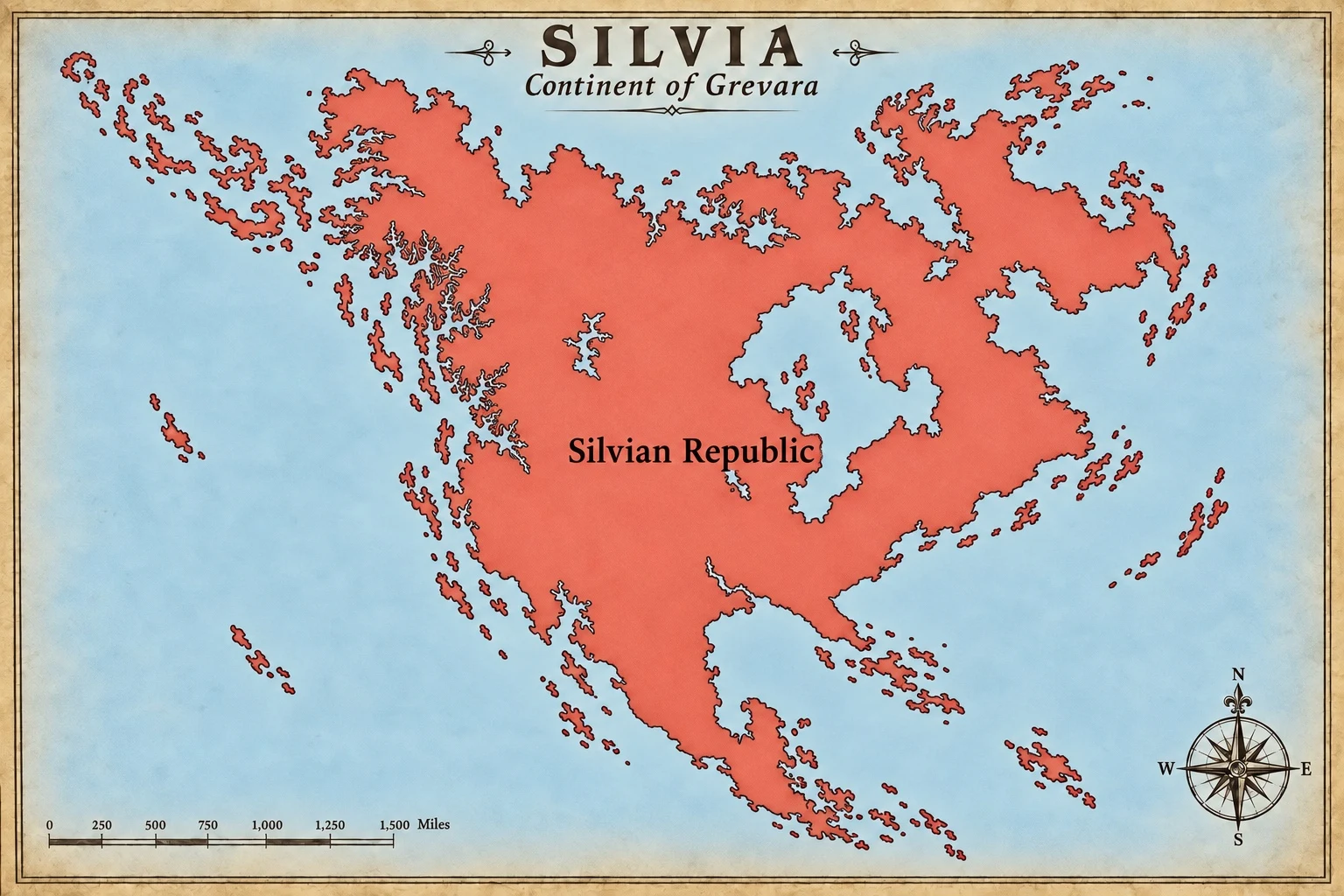
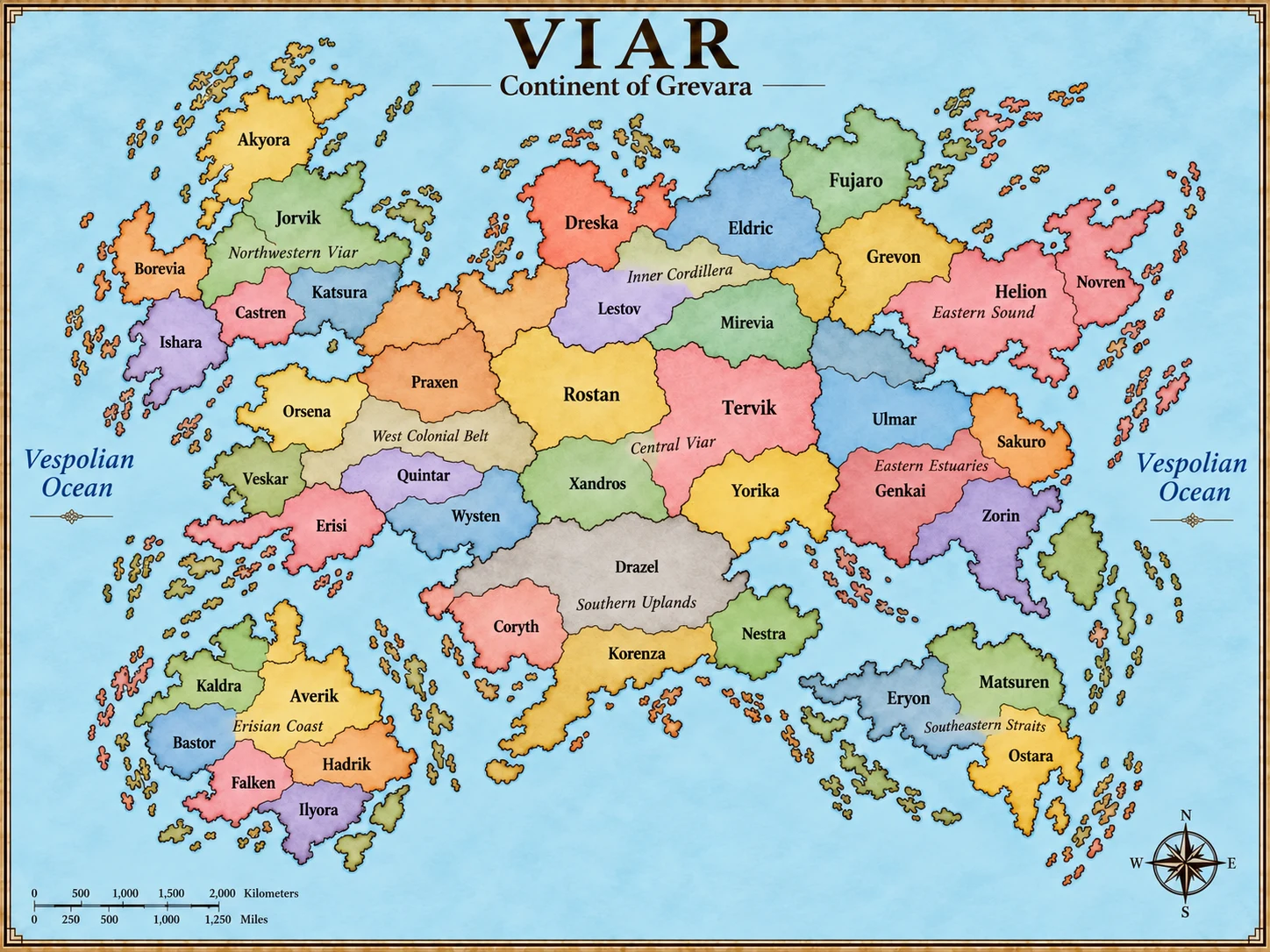
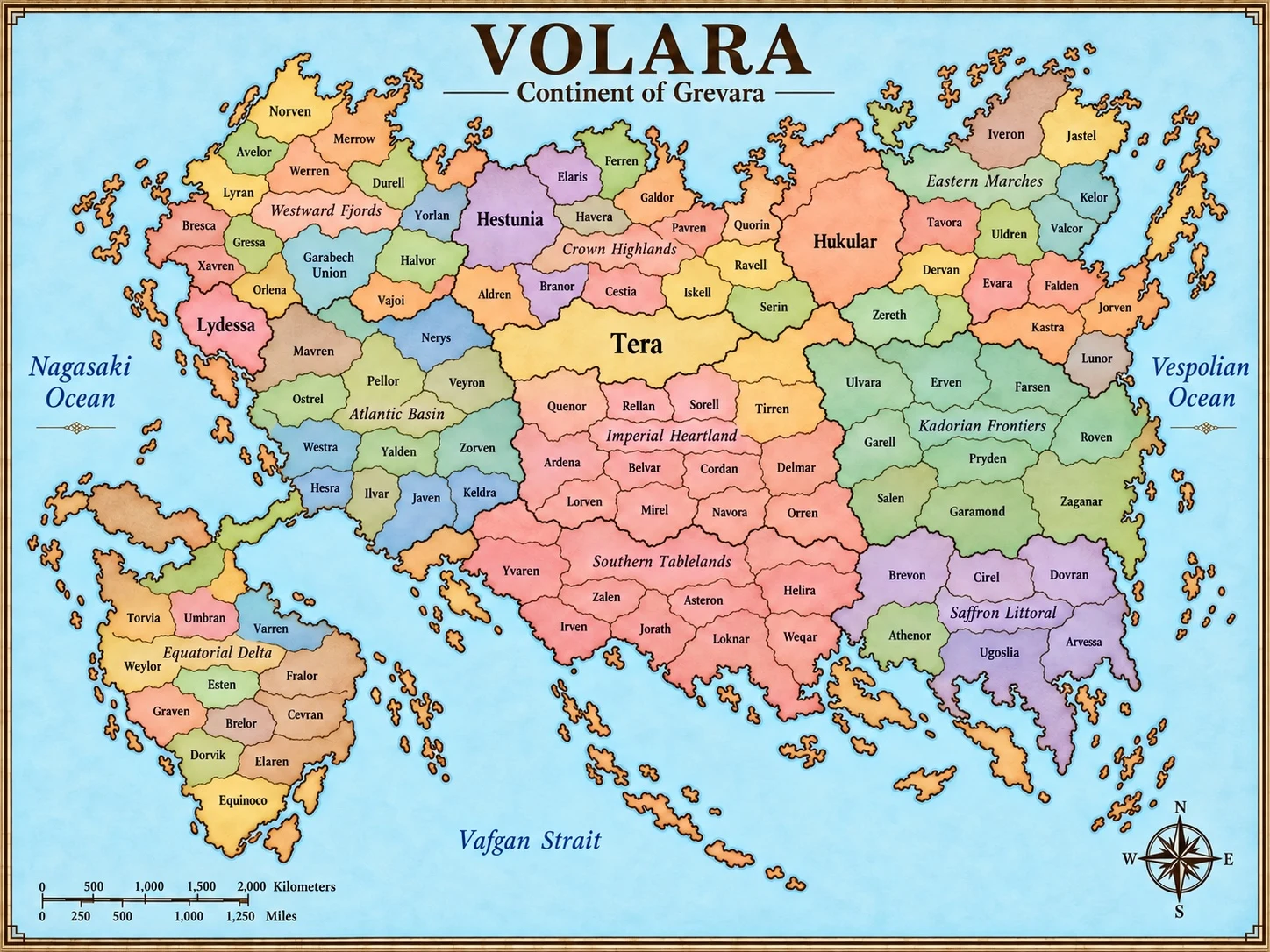
1199–1208: The prewar world
1199 — The year confidence broke
The first year of the crisis did not look like the beginning of a world war to most of the people living through it. Harvests were bought, ships were chartered, and families crossed borders to visit relatives. In Hestunia, parliamentary arguments still centered on taxes and employment. In Hukular, workers welcomed contracts that reopened workshops and promised regular wages. Ravell's merchants complained about customs delays with the irritation of people expecting the delays eventually to end. What changed during 1199 was the meaning governments assigned to these ordinary events. A railway improvement became a possible invasion route. A grain loan became a political alliance. An army exercise became evidence of intentions that no foreign delegation could reliably inspect.
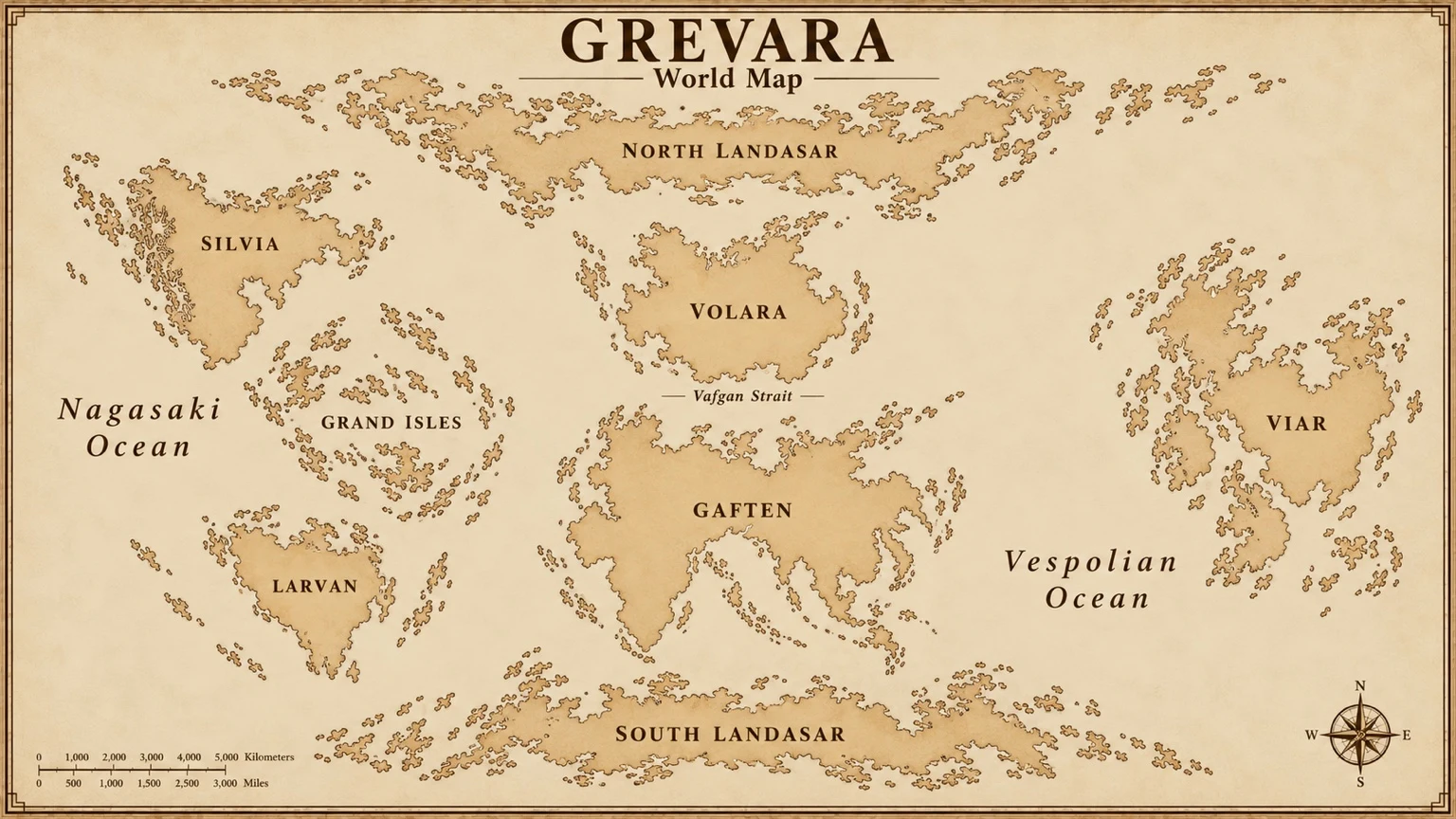
The rivalry also had a geographic complication that political speeches frequently concealed. Hestunia and Hukular did not share a frontier. Between their centers of power lay independent countries whose governments possessed interests of their own. Hestunia could denounce Hukular's expansion, but it could not send an army east merely by ordering one to march. Hukular could portray Hestunia as an encircling enemy, but the intervening states had neither a common foreign policy nor a unified military command. Much of the next decade would be spent turning this fragmented political landscape into competing systems of access, credit, and obligation. In 1199, those systems barely existed.
January 7–24: Hukular finances a permanent expansion
On January 7, Imperial Director Darek Voss promulgated the National Renewal Appropriation under the Emperor’s authority. The title resembled a parliamentary measure, but Hukular’s subjects had no competitive national legislature capable of rejecting the imperial decision. Its public explanation combined employment, infrastructure, and national security. Hukular's government would purchase machinery, improve freight handling, expand technical schools, and modernize the armed forces. These were not separate undertakings. New machine tools could manufacture agricultural equipment or gun components; railway workshops could repair commercial wagons or military trains. The appropriation's political strength came from making military expansion useful to people who had no particular enthusiasm for war. Provincial officials wanted construction spending. Industrialists wanted guaranteed orders. Skilled workers wanted an end to irregular employment.
The decisive provision concerned duration. Instead of requiring the military to compete for every major purchase in each annual budget, the measure authorized commitments extending across several years. Factories could borrow against future government payments. Officers could plan successive training intakes. Contractors could purchase land beside existing works. A later imperial directive could still reverse the policy, but reversal would now mean compensation claims, closed shops, and dismissed workers. Militarization acquired a constituency before the government announced a foreign objective.
Marshal Ilyan Rauk, chief of the General Staff, supported this arrangement because his army's weakness was unevenness. Some formations possessed adequate rifles but insufficient communications equipment; others could mobilize men more quickly than transport could deliver their ammunition. Rauk sought a force that could expand in an orderly sequence, not merely a larger ceremonial establishment. The first contracts therefore included field telephones, engineering stores, replacement barrels, and standardized spare parts. Foreign newspapers paid greater attention to the visible artillery orders. That emphasis allowed Hukular to present foreign concern as an exaggerated reaction to a few weapons while the less conspicuous foundations of sustained mobilization advanced.
February 3–19: Hestunia begins counting the consequences
First Minister Mara Vey's government, acting under Hestunia’s hereditary Crown and answerable for supply to Parliament, initially resisted calls for an immediate matching appropriation. Hestunia could not know how much of Hukular's announced program would actually be delivered, and an extravagant response might turn a manageable rivalry into a financial emergency. On February 3, Vey instead authorized a joint economic and military inquiry. Its members were asked to examine production capacity, railway access, and the time required to move a defensive force beyond Hestunia's borders. The inquiry's narrow mandate was politically useful: the government could claim vigilance without admitting that its existing planning was inadequate.
The first findings were uncomfortable. Hestunian officials had often discussed the eastern balance as though sympathetic governments automatically constituted a defensive barrier. They discovered that sympathy did not guarantee railway wagons, fuel, interpreters, medical facilities, or permission to unload ammunition. An army traveling through several jurisdictions would require agreements over accidents, customs charges, compensation, and command of station approaches. A friendly government might approve transit in principle yet deny the specific schedules that made deployment possible. Hestunia's diplomatic influence was more substantial than its ability to fulfill a distant military promise.
Foreign Secretary Oren Tal drew a political conclusion from these technical observations. If smaller states doubted that Hestunia could help them, they would accommodate Hukular even while privately fearing it. Hestunia therefore needed to demonstrate reliability before demanding alignment. Tal favored commercial guarantees and consultation mechanisms because these could produce tangible benefits without forcing an immediate choice between blocs. His critics called this indecisive. In practice, it established the method by which Hestunia would begin extending influence eastward: credit first, procedures second, and military commitments only after the costs became harder to ignore.
March 11–28: The Ravell customs dispute
Ravell became the first testing ground. On March 11, Hukular's customs authorities began applying additional inspections to selected Ravell shipments. The published explanation concerned inaccurate declarations and inconsistent certification. Ravell's prime minister, Sera Danic, governing within its constitutional monarchy, accepted that individual consignments could require inspection but objected to a practice that concentrated delays on politically sensitive categories. Agricultural goods deteriorated while officials argued over forms. Small exporters could not afford to leave wagons idle. Hukular's larger importers, better able to carry temporary losses, acquired bargaining power over Ravell suppliers.
The dispute was effective precisely because it remained below the threshold of a clear international emergency. No territory had been occupied. No formal embargo had been proclaimed. Hukular could release selected shipments and point to them as proof that ordinary trade continued. Ravell's cabinet split over its response. Commercial ministers proposed a temporary technical settlement; others warned that accepting unilateral certification requirements would allow Hukular to determine which Ravell firms could survive. Danic avoided a rupture by requesting a bilateral review while quietly asking Hestunia whether alternative credit might be available.
Hestunia did not immediately issue the requested guarantee. Its treasury needed to know who would bear the loss if grain prices fell or deliveries failed. That delay became a lesson for Ravell's diplomats. Political goodwill traveled faster than approved money. Hukular's negotiators used the interval to offer expedited inspections to merchants willing to sign longer supply contracts. A customs problem began reshaping commercial loyalties before either government called it a strategic crisis. Ravell remained independent, but the cost of maintaining independent choices had become visible to farmers, warehouse owners, and lenders.
April 5–22: Transparency is proposed and narrowed
Hestunia suggested an exchange of military observers in early April. The proposal was modest: advance notice of major exercises, designated viewing areas, and a small number of visiting officers. It offered a way for both governments to test the other's claims without undertaking a full arms conference. Hukular accepted discussion of ceremonial visits but rejected access to workshops and mobilization facilities. Its foreign ministry argued that no sovereign state was required to disclose industrial secrets merely because another government disliked its budget.
That objection contained a real difficulty. Observation could establish that soldiers had performed a particular exercise; it could not prove how many additional formations a state intended to raise. A visiting delegation might see equipment assembled for display while missing deficiencies elsewhere. Hestunia's own officers were reluctant to expose communications procedures or reserve arrangements. Both sides wanted reassurance from the other without furnishing information that could become useful in war. Negotiations settled on a limited exchange of public schedules, a measure substantial enough to announce and too weak to resolve the underlying uncertainty.
In Ravell, the failure strengthened those who favored preparing for several possible outcomes. Danic authorized a survey of bridge condition and civilian transport capacity, keeping it under the public works ministry. The arrangement avoided the appearance of mobilization but created rival files: military planners wanted confidential assessments, while local authorities needed open tenders for repairs. Even precaution generated administrative friction. The crisis was beginning to consume attention long before it consumed large military budgets.
May 9–30: Exercises teach different lessons
Hukular's spring exercises began on May 9. Their most significant feature was coordination between transport offices and field formations. Rauk's staff tested the order in which units would enter loading areas, receive stores, and depart. The exercises exposed delays rather than concealing all of them. Some formations arrived before their assigned supplies; others discovered that the wagons promised on paper were already committed to civilian traffic. The General Staff treated these failures as reasons for extending its authority over the transport system.
Hestunia conducted a separate readiness exercise later that month. Its commanders emphasized defending prepared positions and maintaining communication between neighboring formations. That approach reassured officials who expected any future conflict to begin with a recognizable diplomatic warning. It also revealed an assumption that would become dangerous: a defender could complete essential preparations after the political decision to resist. Hukular was exploring how to reduce the interval between decision and movement. Hestunia was still testing how well its forces functioned after deployment had occurred.
The smaller states watched both exercises through imperfect reports. Pavren sought information about warning times. Havera worried about congestion if foreign troops sought passage. Quorin objected to foreign newspaper maps that shaded its territory as part of an assumed Hestunian defensive route. Those maps were not official commitments, but they affected domestic debate. Citizens could see their own country being converted into a corridor by people who did not govern it. Concern about Hukular did not automatically produce trust in Hestunia.
June 2–25: Military expansion reaches households
On June 2, Hukular announced extended training periods for selected reservists. The measure was limited enough to avoid a general mobilization, but its effects spread beyond the men called up. Employers had to rearrange shifts. Families lost income that military allowances only partly replaced. Party and provincial administrators sought exemptions for skilled trades whose absence threatened existing contracts, including military contracts. The army could not simultaneously remove every trained mechanic from industry and demand faster production from the same factories.
Voss's government resolved some disputes by establishing priority categories. Workers in designated essential employment could receive deferments; other men served longer. The result was politically uneven. A laborer who saw a better-connected neighbor exempted might regard national service as a burden distributed by influence. Military newspapers celebrated sacrifice, while provincial representatives pressed for exceptions in private. Hukular's militarization was rapid, but it was neither effortless nor universally popular. Its durability depended on the government's ability to distribute wages, exemptions, and patriotic recognition while its political police prevented grievances from becoming independent organized opposition. Private anger and petitions for exemptions remained possible; a lawful movement to replace the regime did not.
Hestunia's response was a review of reserve records rather than a comparable extension. Officials found obsolete addresses, medical classifications that had not been updated, and employers unsure which workers were liable for service. Correcting these records was inexpensive compared with purchasing weapons, yet it made future call-ups more credible. Opposition speakers accused Vey of administrative timidity. The war ministry replied that a regiment listed in a book was not the same as a regiment that could assemble. By midsummer, both powers were learning that military strength depended on the accuracy of civilian institutions.
July 6–27: Grain credit becomes diplomacy
Hestunia finally approved a limited guarantee for Ravell's agricultural trade on July 6. It was structured to support specific purchases rather than subsidize Ravell's entire economy. Banks could extend short-term credit against verified shipments, allowing exporters to survive delays at Hukular's frontier while seeking other buyers. The guarantee did not erase transport costs or produce an alternative market overnight. It nevertheless reduced the immediate pressure on Danic to accept every condition offered by Hukular.
The political consequences exceeded the program's initial monetary size. Hestunia had demonstrated that it would spend money to preserve another state's room for maneuver. Ravell's government could cite something more concrete than sympathetic speeches. Hukular interpreted the same transaction as evidence that Hestunia was turning commerce into strategic intrusion. Voss's supporters argued that a state accepting foreign guarantees would eventually accept foreign instructions. The claim ignored Ravell's own motives but appealed to merchants who feared losing accustomed suppliers.
Ravell's farmers were less interested in these abstractions than in payment dates. Some benefited from the new guarantees; others remained tied to merchants with Hukular contracts. Rural politics began dividing along commercial lines. A local dispute over storage charges could now be presented as a dispute over national independence. Danic attempted to prevent that polarization by keeping the program open to qualifying firms rather than rewarding declared political supporters. Her success was partial. Once foreign rivalry entered the price of a harvest, it became difficult to keep it out of village politics.
August 4–23: The first railway conference
Representatives from Hestunia, Havera, Pavren, and Ravell met in August to discuss freight coordination. Quorin sent technical observers while explicitly withholding consent to any foreign troop route. The distinction mattered because no agreement among the other participants could create rights over Quorin's territory. The conference considered customs simplification, wagon accounting, and commercial through-booking. Military subjects were omitted from the formal agenda, although every government understood that better freight coordination might later support military movement.
Engineers complicated the diplomats' optimism. Capacity depended on passing places, repair depots, the strength of bridges, and the availability of trained crews. Even compatible track did not guarantee compatible brakes, loading practices, or operating rules. Nor did a line on a map establish that a continuous, high-capacity service already existed. Participants agreed to exchange selected technical surveys before making promises about schedules. This was a small achievement, but it replaced imagined connectivity with questions that could actually be answered.
Ravell's delegation wanted the agreement described as international economic cooperation. Hukular's press called it a disguised military conference. Hestunia avoided both an explicit denial of strategic interest and an admission that no deployment agreement existed. That ambiguity served immediate diplomacy and damaged long-term understanding. Foreign readers could believe Hestunia had acquired access it did not possess. Ravell's public could mistake technical talks for a guarantee of rescue. The first machinery of cooperation was accompanied by the first dangerous exaggeration of what cooperation meant.
September 8–29: Hukular plans against a possibility
Rauk directed the General Staff to organize neighboring states into planning categories in September. These were working assumptions about access and resistance, not a treaty map. Ravell received particular attention because of its frontier with Hukular and its growing financial connection to Hestunia. Staff officers were asked to examine the consequences of a hostile Ravell, a compliant Ravell, and a Ravell whose government lost control during a crisis. No invasion order followed. Nevertheless, institutions were now being paid to imagine how independence might be overridden.
The distinction between contingency planning and intention became increasingly difficult for outsiders to assess. A competent army prepared for possibilities that its government might never choose. Yet detailed plans could also make an aggressive policy seem easier to adopt. They identified obstacles, assigned solutions, and gave ministers schedules where previously there had been uncertainty. Rauk's staff did not create Voss's political ambitions, but it began converting them into options that could be discussed in practical terms.
Ravell meanwhile restricted the publication of certain bridge surveys. Danic's cabinet argued that an independent state had a right to protect sensitive infrastructure information. Hukular complained that secrecy contradicted Ravell's insistence on purely commercial intentions. Each government now used the other's caution as evidence of hostility. Measures adopted because confidence had declined were themselves accelerating the decline.
October 10–31: The price of a defense loan
Hestunia opened subscriptions for a limited defense loan in October. Its stated purpose was to improve reserves, communications, and transport readiness. Vey resisted proposals to match every Hukular announcement with an equivalent purchase. Instead, the cabinet prioritized repairing the gaps identified earlier in the year. The decision made military sense but was difficult to advertise. New artillery could be photographed; accurate inventories and repaired telephone equipment could not easily anchor a triumphant newspaper illustration.
The loan also linked public savings to expectations about national danger. Subscribers ranged from wealthy institutions to households buying small certificates. Some regarded the purchase as patriotic duty; others simply wanted a dependable return. Opposition deputies asked whether the government had created fear to borrow cheaply. Supporters asked whether critics preferred dependence on a militarizing rival. The narrowing space between those accusations reduced the possibility of discussing defense expenditure as an ordinary budget question.
Across Volara, banks began asking more detailed questions about where borrowers operated and which borders their goods crossed. No general financial panic occurred. The change was subtler: political risk entered calculations that had previously emphasized harvest quality, machinery, and sales. A factory with dependable customers could face higher borrowing costs if its transport route seemed vulnerable. Military rivalry was altering civilian investment before any general arms race had been declared.
November 3–21: The first Hestunian assurance
On November 3, Hestunia’s Crown government announced that coercive changes to Ravell's independence would be a matter of grave concern and immediate consultation. Tal deliberately avoided an automatic commitment to war. The cabinet had neither parliamentary authority nor the transit arrangements needed to promise a prompt expeditionary response. The declaration nonetheless moved Hestunia beyond commercial assistance. It attached national prestige to Ravell's continued freedom of decision.
Danic welcomed the statement while requesting private clarification. Would consultation include weapons, money, diplomatic action, or troops? Hestunia answered that measures would depend on circumstances. Ravell's critics saw the weakness immediately: the assurance identified a concern without specifying a remedy. Its defenders argued that a limited promise from a functioning government was more valuable than an extravagant one that could not be honored. Both assessments contained truth, and the tension between them would persist throughout the decade.
Hukular rejected any implication that its relations with Ravell required Hestunian supervision. Voss used the declaration to justify continued expansion, asserting that foreign interference made preparation necessary. This completed a political circuit. Hukular's militarization had helped produce Hestunia's concern; Hestunia's concern was now cited as a reason for further militarization. Each government could describe its own latest action as a response to the other, obscuring the cumulative change.
December 1–31: Neutrality and distance
The Silvian Republic treated the dispute as a reason to strengthen commercial resilience and consular reporting. Lord Elian Sorell's administration requested assessments of shipping exposure and foreign debts but made no military commitment to either side. Silvian neutrality was a policy with active administrative requirements: ports had to apply consistent rules, officials had to distinguish private business from state commitments, and diplomats had to avoid language that could be mistaken for an alliance. Public sympathy for a foreign state did not bind the republic to fight for it.
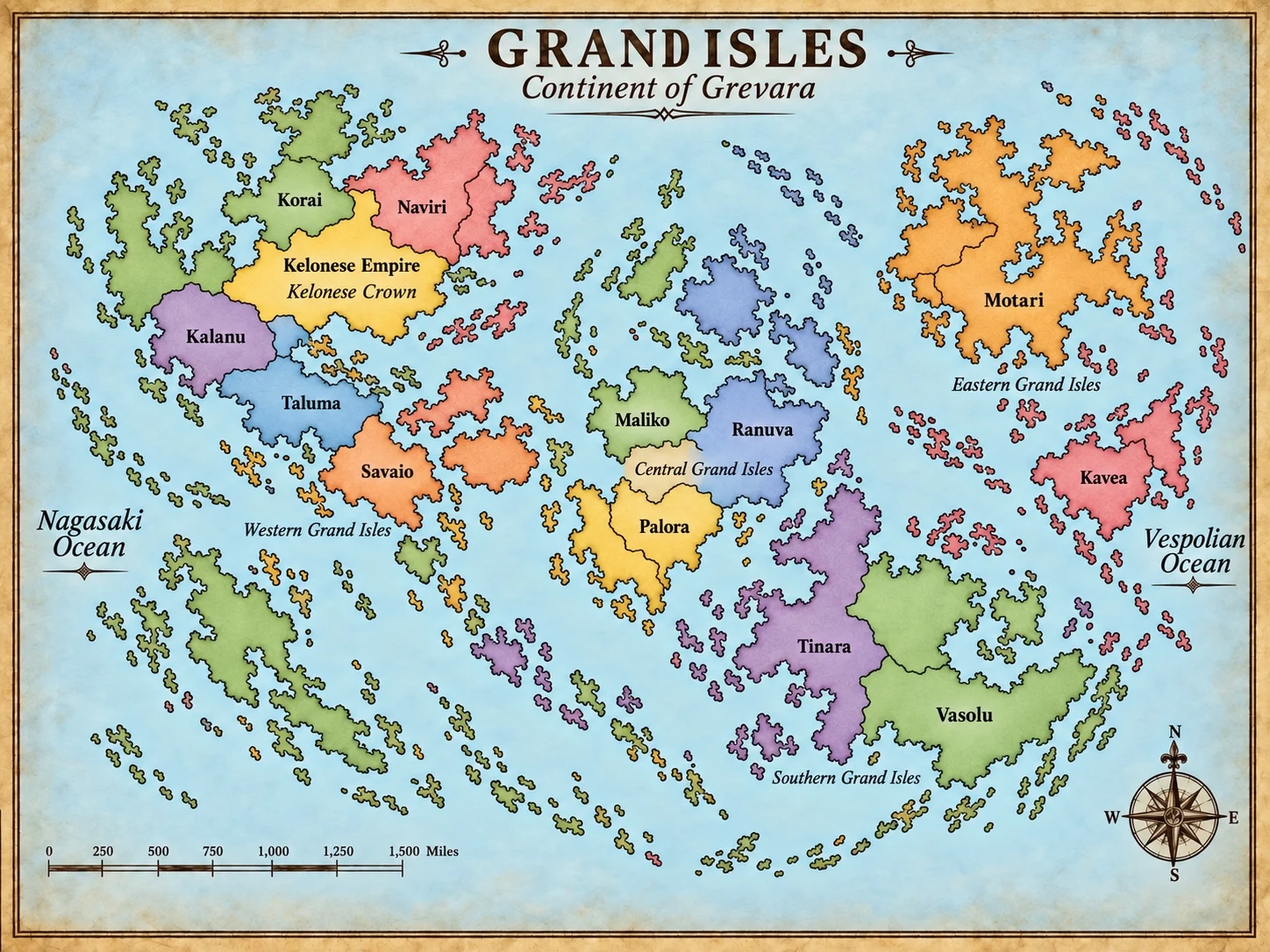
In the Grand Isles, the Kelonese Empire's naval leadership watched the continental rivalry for its implications for procurement and shipping. Admiral Taren Seko argued for improved repair capacity and better surveys of maritime supply needs. These were early institutional interests, not a decision to attack Silvia. The bombing of Kandar Harbor remained twenty-four years in the future. No participant in the 1199 debates possessed knowledge of that event, and Silvian officials had no reason to treat every Kelonese commercial visit as evidence of an already settled war plan.
Larvan's trading governments and the many states of Gaften and Viar likewise responded unevenly. Some exporters saw opportunity in new orders. Some treasuries worried that competing borrowers would raise the cost of capital. Most governments had not chosen a side. By December 31, there was still no global coalition war, no general mobilization, and no invaded Ravell. The change was structural: governments had begun building institutions around the possibility that relations would worsen. Those institutions would survive individual conciliatory speeches. The coming crisis now had budgets, files, employees, and people whose careers depended on taking it seriously.
1200 — The struggle over access
By the beginning of 1200, the question facing Volara's governments was no longer whether Hukular intended to maintain a large military establishment. Contracts had been signed, reserve obligations extended, and transport offices drawn into army planning. The remaining uncertainty concerned purpose. Hukular's official explanation was defensive independence. Hestunia saw the beginnings of an instrument for compelling its neighbors. Ravell had to conduct daily business while deciding which explanation would be more dangerous to believe. A mistaken judgment in either direction carried costs: premature confrontation could ruin commerce, while excessive accommodation could make resistance impossible later.
For Hestunia, the year brought an unwelcome distinction between having friends and possessing a defensible system of cooperation. Havera and Pavren were increasingly receptive to consultation. Ravell wanted assistance. Yet Quorin controlled an important intervening route and would not consent to becoming an appendage of Hestunian strategy. Farther south, Branor, Cestia, and Iskell presented a chain of separate political obstacles. Their eventual Axis alignment was not written on every government paper in 1200, but the interests that would draw them toward Hukular and the Teran Empire were already taking form. No amount of rhetorical solidarity could eliminate that geography.
January 8–26: Vey's cabinet confronts the corridor problem
First Minister Mara Vey received the railway inquiry's consolidated findings on January 8. The document distinguished three matters that earlier discussions had often confused: commercial capacity, legal access, and military control. A railway might carry ordinary freight efficiently while lacking space for concentrated troop movements. A government might authorize military transit but retain the right to suspend it. Even unrestricted passage would not solve the problem of feeding units after they reached Ravell. Hestunia could not defend a distant partner with an opening delivery followed by an uncertain sequence of supplies.
The inquiry examined two broad overland possibilities. The northern approach depended on cooperation through Havera and Pavren and then on access across Quorin. A southern alternative would require arrangements with Branor, Cestia, and Iskell. Neither was a continuous military corridor waiting to be activated. Each contained missing agreements, disputed priorities, and places where commercial traffic already consumed most available capacity. Officials were instructed to stop presenting these possibilities as equivalent to an established line of communication. This apparently minor correction changed the cabinet's understanding of the time available in a crisis.
Vey authorized Foreign Secretary Oren Tal to seek limited consultation agreements while the war ministry prepared a separate estimate of what Ravell could do for itself. The separation was deliberate. If every request for military data implied an immediate alliance, smaller states would refuse to answer. If every diplomatic reassurance assumed Hestunian troops could arrive, ministers would be promising more than they could deliver. The cabinet adopted a cautious working principle: strengthen the prospective defender first, then determine which external assistance could reach it under adverse conditions. That principle would improve Ravell's resilience without resolving its strategic isolation.
February 4–24: Quorin bargains over its independence
Quorin's government answered the northern transit proposals on February 4. It accepted further commercial discussions and rejected any agreement that would give foreign military authorities priority over its transport system. The refusal was not simply dictated from Hukular. Quorin's federal interests included merchants dependent on eastern trade, local governments concerned about requisition, and political factions unwilling to let Hestunia decide when an emergency existed. A treaty that appeared protective in Ravell could look like an invitation to invasion in Quorin.
Hukular took advantage of these concerns without initially demanding formal allegiance. Its negotiators offered preferential treatment for qualifying Quorin goods and promised stable purchases if Quorin maintained an independent transit policy. The language was carefully chosen. Independence meant freedom from Hestunian military passage, while dependence on Hukular's market was described as mutually beneficial commerce. Quorin's critics recognized the asymmetry but struggled to offer an alternative that would preserve the same immediate revenue. A strategic choice entered domestic politics disguised as a choice about reliable customers.
Hestunia declined to bid without limit for Quorin's cooperation. The treasury feared establishing a precedent under which every transit country could threaten refusal to obtain a larger subsidy. Tal also understood that paid consent might disappear when the risk of retaliation increased. A government willing to sell access during peace might close the route during war. February ended with a small commercial concession and no military agreement. Ravell's diplomats began asking whether Hestunian planning treated their country's survival as a requirement or merely as one interest to be balanced against expenditure elsewhere.
March 6–29: Ravell inventories the ordinary state
Sera Danic's government ordered a national readiness inventory on March 6. The work began with civilian systems: medical beds, municipal water supplies, grain storage, bridge repair materials, and the locations of workshops able to maintain heavy vehicles. Ravell's military leadership wanted secrecy. Local officials wanted enough information to justify spending to councils and taxpayers. Danic permitted publication of broad categories while withholding detailed vulnerabilities. The compromise was imperfect, but it prevented the entire program from disappearing into a military office that lacked the staff to administer it.
The survey showed why a small state's defense could not be reduced to its army's size. A damaged bridge might interrupt food distribution as well as troop movement. A hospital crowded with ordinary seasonal illness could not instantly absorb military casualties. Evacuating a frontier district required knowing where people would go, who would feed them, and how families separated at stations would find one another. Ravell possessed no experience of administering every one of those problems simultaneously. Planning therefore concentrated on procedures that could be practiced in peacetime without announcing that war was imminent.
On March 21, the cabinet approved pilot civil-defense exercises in selected districts. Schools tested temporary shelter arrangements; municipal clerks rehearsed replacement identity records; physicians compiled lists of equipment that could be moved. Participation varied. Some residents resented the disruption, while others demanded broader protection. Danic refused to describe the exercises as proof that Ravell was safe. Their value lay in exposing what was missing. Hestunian observers later found that this willingness to discover weaknesses contrasted with Hukular's growing pressure to report readiness as a measure of political loyalty.
April 2–20: Hukular standardizes its army and its reporting
Hukular's spring military directives concentrated on standardization. Units were instructed to distinguish equipment physically available from equipment promised under contracts. Depots were assigned clearer responsibilities for repair and replacement. The program responded to genuine failures found during the previous year's exercises, and it initially produced more accurate figures. Rauk's staff could identify shortages that had previously been concealed inside broad statements of readiness. Standardization also allowed the government to place larger orders with selected manufacturers, reducing variety while increasing the influence of firms favored by the center.
The political apparatus complicated the reform. Provincial officials wanted their districts to appear efficient. Party supervisors treated missed targets as possible evidence of disloyalty rather than ordinary production difficulty. A factory manager could satisfy one inspector by reporting completed components and mislead another who assumed those components formed finished weapons. Rauk pressed for physical verification, but he could not remove the political incentives that made optimistic reporting attractive. Hukular's institutions were becoming better organized and less candid at the same time.
The burden fell unevenly on workers. Preferred industrial districts gained orders and housing projects; less favored communities supplied labor under increasingly restrictive service requirements. Residents classified as politically suspect faced reduced access to skilled positions and fewer means of appealing discriminatory treatment. Militarization was therefore not merely a transfer of money into defense. It extended the regime's power to decide whose work counted as service and whose objections counted as sabotage. Foreign assessments that described Hukular only through output figures missed the coercive structure producing those figures.
May 10–28: The Teran Empire enters the calculation
The Teran Empire opened discussions with Hukular over machinery purchases and commercial settlement in May. The talks did not create a combined military command. They revealed a convergence of interests between two authoritarian powers with different governing traditions. Hukular sought faster access to industrial inputs and recognition that its expansion was legitimate. The Teran court sought influence over the central Volaran balance and an opportunity to reduce Hestunia's freedom of action. Each intended to use the other without becoming subordinate to it.
Teran officials also watched neighboring states whose eventual alignment would place them in the Axis coalition. Their immediate instruments were credit, transport contracts, court connections, and the attraction of a large nearby market. This was not a seamless imperial bloc. Smaller governments bargained for exceptions and favorable terms. Some feared Hukular's methods even while depending on Teran commerce. The emerging relationship worked because it allowed cooperation without requiring public agreement on every ideological question. A common interest in limiting Hestunia mattered more than a common constitutional identity.
Hestunia's cabinet debated whether to issue a formal protest. Tal advised against protesting commercial talks for which Hestunia demanded equivalent freedom. Instead, he instructed diplomats to determine whether the agreements included exclusive access, military delivery preferences, or restrictions on third-party trade. The distinction prevented a rhetorical confrontation but made the diplomatic task harder. The most consequential clause in a procurement contract could be a delivery priority, not an announcement of friendship. Hestunia needed people who could read schedules and financial guarantees as carefully as speeches.
June 3–25: The Hestunian supply debate
The midyear defense estimates brought the crisis openly into Hestunia's domestic politics. Military advocates sought funds for communications, stockpiles, and additional technical instruction. Representatives from districts awaiting civilian improvements asked why roads and clinics should be delayed to prepare for a conflict beyond Hestunia's frontier. Vey answered that preparation was less expensive than improvisation after a disaster, but she could not supply a date on which the danger would become acute. That uncertainty made every allocation vulnerable to both accusations: too much spending for an imagined war, or too little for a predictable one.
The Crown supported a program of measured readiness without giving the ministry unlimited authority. The distinction reflected the story's early Hestunian balance between monarchy and representative supply, not an assumption that every detailed provision recorded in 1580 already existed unchanged. Royal endorsement could strengthen a ministry's case; it could not manufacture the workshops, trained instructors, or tax receipts required to execute the program. The political argument ended in a narrower appropriation than the army requested and a stronger requirement to report actual deliveries.
One practical result was an expansion of technical training. Hestunia needed signalers, transport supervisors, mechanics, and medical personnel who could operate within larger formations. Training these specialists took longer than purchasing a batch of standard equipment. The first additional classes therefore represented a commitment whose military effect would emerge only gradually. Students entering them in 1200 did not necessarily expect to fight. Many regarded the instruction as a path to civilian employment. The armed forces and the civilian economy were beginning to compete for, and jointly produce, the same skills.
July 5–23: Neutral Silvia sets commercial boundaries
In Silvia, Lord Elian Sorell's administration reviewed foreign transactions that might be mistaken for public commitments. The republic's size made it a valuable potential supplier and customer, but foreign merchants did not speak for its government. A sale by a Silvian company was not an assurance that Silvian forces would protect the purchaser. Likewise, a foreign government borrowing in Silvian markets did not acquire a right to military assistance. Officials required clearer distinctions in public statements so that private commercial enthusiasm would not become an accidental diplomatic promise.
The policy generated opposition from several directions. Merchants disliked restrictions that might frighten customers. Supporters of Hestunia argued that equal treatment ignored the difference between a state seeking security and one building coercive power. Other citizens opposed involvement of any kind, including commercial exposure that might later be used to demand intervention. The administration defended neutrality as a decision about state action, not a command that every citizen feel the same way about foreign affairs. Newspapers remained free to take sides in argument while the republic remained outside the emerging blocs.
Silvian port officials also reviewed routine inspection and recordkeeping. Their concern included fraud, unsafe cargo, and the possibility that competing foreign representatives would make incompatible claims about the same vessel. No Silvian combat deployment followed. No belligerent received a special right to base forces on Silvian territory. The republic's eventual appearance in the Allied roster must not erase this prolonged period of nonparticipation. In 1200, Silvia was preserving options and protecting ordinary commerce, not conducting an undeclared war against Hukular or the Kelonese Empire.
August 7–30: Repair yards become a Grand Isles question
Kelonese naval planners used August budget discussions to argue that readiness depended on repair capacity as much as on the number of ships launched. A vessel awaiting an unavailable replacement part could contribute little to a distant crisis. Admiral Taren Seko pressed for better stock control, expanded engineering instruction, and arrangements that would keep commercial repair facilities available during an emergency. Civilian shipping interests objected to open-ended military priority over workshops on which their own schedules depended.
The dispute exposed a basic tension in an island power. Merchant shipping and the navy shared skilled labor, harbor space, and suppliers, yet they did not always benefit from the same investment. A facility optimized for a large naval vessel might be expensive and inconvenient for ordinary trade. A policy intended to increase national resilience could divert resources away from the very merchant fleet that carried imports. The Kelonese government therefore approved surveys and limited preparatory spending while postponing the most contentious requisition provisions.
Neighboring Grand Isles governments watched these discussions through their own interests. Kalanu and Taluma worried about commercial dependence. Naviri's diplomats sought reassurance that an expanded Kelonese establishment would not become a pretext for supervising adjacent waters. Neutral Korai had reasons to avoid both confrontation and submission. The later Allied and Axis alignments did not mean that every harbor dispute in 1200 was already a war operation. These were early arguments over who would set the terms of maritime security, and which states would be expected to accept those terms without an equal voice.
September 9–27: Neutral brokers and the cost of ambiguity
Paraku's merchant government offered a convenient venue for discussing insurance and shipping documentation in September. Its neutrality and commercial institutions made it useful to parties unwilling to meet under a rival's political sponsorship. The gathering did not attempt to resolve Volara's strategic dispute. It addressed more limited questions: proof of ownership, responsibility for delayed cargo, and the handling of conflicting inspection demands. Such matters lacked the drama of an arms conference but affected whether commerce could continue amid worsening suspicion.
Representatives from Mareka and Aroven supported clearer procedures while avoiding military undertakings. Their eventual Allied affiliation did not require immediate belligerency or a declaration that every current trade dispute was a test of coalition loyalty. Other maritime governments valued the same procedures for reasons that would not lead them into either coalition. The conference illustrated how states could cooperate on a practical problem while diverging sharply on the political question behind it.
Its weakness was enforcement. A government determined to delay cargo could invoke safety, customs, or documentary concerns without openly repudiating the agreed rules. Merchants therefore continued pricing the risk of interference into contracts. Smaller firms paid disproportionately because they lacked reserve capital and access to several shipping routes. The appearance of continued trade concealed a redistribution of power toward companies able to withstand disruption. Those companies, in turn, acquired greater influence over the officials who depended on them for reliable supply.
October 1–24: The Ravell consultation protocol
Hestunia and Ravell completed a limited consultation protocol on October 1. Havera and Pavren accepted associated diplomatic notification arrangements, while reserving decisions about any military use of their territory. The agreement provided named channels for urgent messages, a procedure for requesting economic assistance, and regular meetings on transport and supply. It did not authorize Hestunian troops to cross Quorin or create an automatic declaration of war. Its immediate value was to reduce the chance that a request would be lost among offices during a crisis.
Danic faced criticism for accepting an agreement so limited. Her defense was practical: a named official obliged to respond was better than an unspecified government expected to feel concern. Ravell also secured cooperation on technical training and purchasing, giving its own institutions more capacity to act. The monarchy's public role emphasized national continuity, while the cabinet took responsibility for the actual commitments. This helped prevent Hukular's claim that Danic was privately disposing of the country's independence from becoming the only account heard abroad.
Hukular denounced the protocol as another step toward encirclement. Voss's administration highlighted every reference to emergency consultation and ignored the restrictions on military access. Its propaganda presented a potential future alliance as if it were already an operational system surrounding Hukular. Hestunian newspapers sometimes committed the opposite error, celebrating the arrangement as a decisive strategic success. In both countries, political language outran the document. The resulting discrepancy would matter when publics later expected governments to honor promises more extensive than those governments had actually made.
November 6–26: Information becomes a contested resource
The autumn brought an increase in disputes over military information. Railway employees were asked about unusual traffic; foreign commercial visitors sought factory specifications; consulates requested details about reserve notices. Much of this activity was ordinary observation rather than an elaborate clandestine operation. The difficulty was that ordinary information became militarily useful when assembled. A production advertisement, a freight schedule, and a local notice of extended training could together reveal more than any one official intended to disclose.
Hukular responded with tighter restrictions and security investigations. These measures also gave officials a means to conceal failed targets. A missing delivery could be described as a secret rather than a shortage. Hestunia chose a narrower approach, restricting particular operational information while permitting public debate about expenditure. That policy produced embarrassing disclosures and accusations of carelessness. It also allowed criticism to identify procurement failures before they were tested in war. Openness had costs, but secrecy did not eliminate the underlying mistakes.
Ravell confronted the hardest balance. Its small size made local knowledge difficult to compartmentalize: the people repairing a bridge often knew the people guarding it. Broad censorship risked frightening investors and damaging confidence in the government. Danic therefore emphasized penalties for specific unauthorized disclosures instead of declaring all frontier discussion forbidden. The policy could not prevent every leak. It preserved a distinction between reporting a public concern and supplying a foreign power with restricted plans, a distinction Hukular's security machinery increasingly refused to recognize.
December 4–31: A wider world of separate calculations
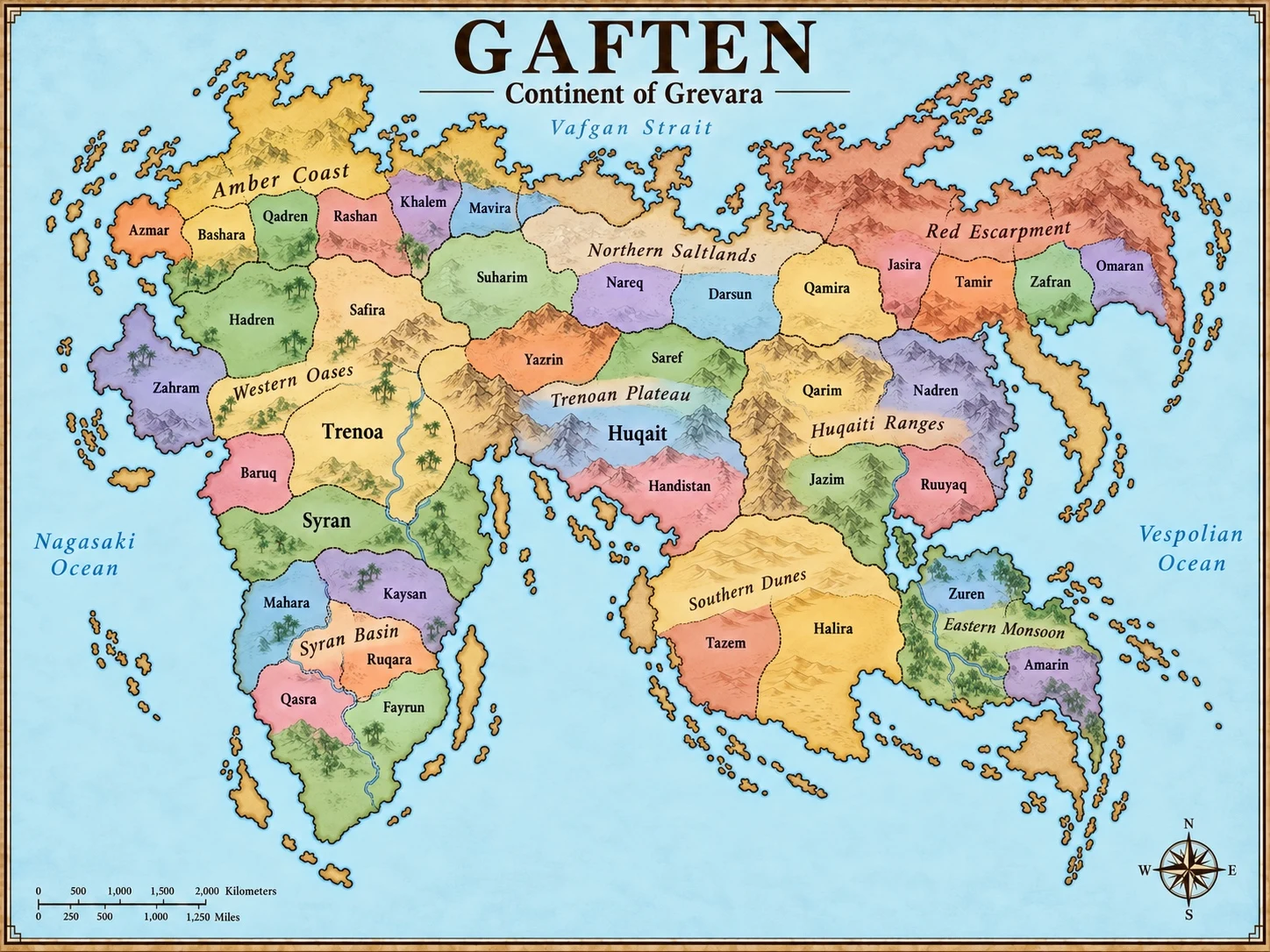
The year's final commercial reviews showed that the Volaran rivalry was beginning to affect distant decisions without yet producing a worldwide arms race. In Gaften, Trenoan officials examined the implications for trade across the Vafgan Strait. Huqait's government considered how disruptions in machinery imports would affect public works. Syran's exporters sought customers less vulnerable to a single continental interruption. These eventual Allied states did not act as one cabinet. Their reasons for concern were distinct, and their resources were not interchangeable.
In Viar, Erisia and Praxen assessed credit exposure, while Fujaro's officials monitored the relationship between procurement and shipping. Akyora's public debate included the argument that distant military contracts could bring prosperity without political entanglement. Other governments reached different conclusions. Kaldra and Rostan, eventual Axis members, had commercial reasons to preserve access to buyers associated with the emerging authoritarian powers. The roster describes where those states would align, but in 1200 the process operated through specific bargains rather than a single universal summons.
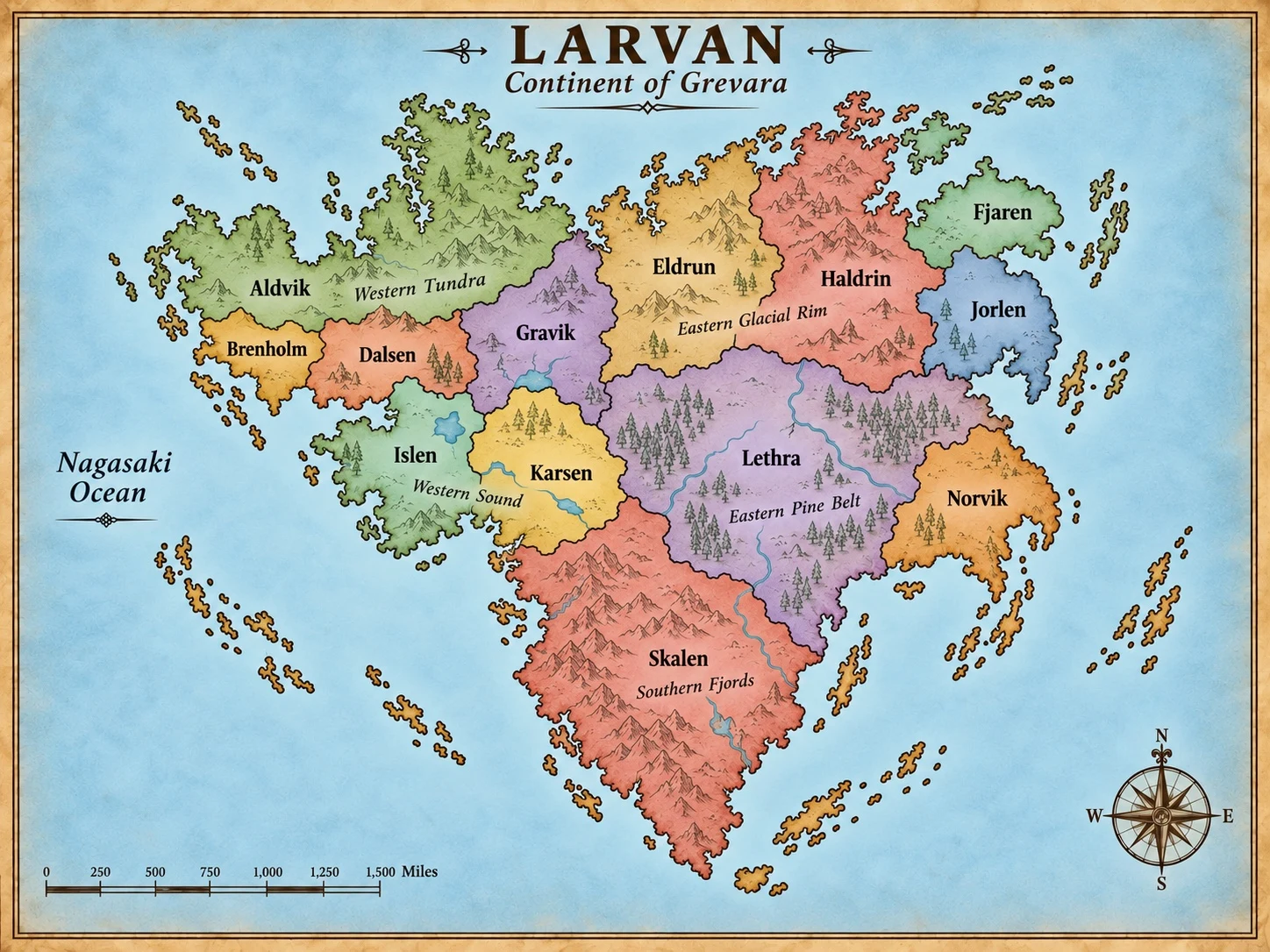
Larvan's states likewise balanced economic opportunity against vulnerability. Aldvik and Brenholm had an interest in reliable trade, while neutral Lethra and Islen sought room to maintain relations across the growing divide. No government could assume that neutrality would protect every shipment from disruption. Nor did concern about disruption automatically justify joining a military bloc. This uncertainty helped keep the crisis geographically limited even as its economic consequences widened.
By December 31, Hestunia had acquired better consultation procedures and a clearer understanding of its limitations. Ravell had begun strengthening the civilian systems on which defense would depend. Hukular had improved military organization while extending political coercion into production and reporting. The Teran Empire had entered the strategic calculation more visibly. Silvia remained neutral. The central question for the next year was no longer whether governments would prepare, but whether the institutions they were building would leave them able to change direction when preparation itself began driving the crisis.
1201 — Factories, loyalties, and promises
The crisis entered its third year through construction sites. Workshops were extended, storehouses surveyed, training establishments enlarged, and contracts renegotiated to account for deliveries that could no longer be treated as ordinary purchases. Governments still described these decisions as reversible. In a narrow legal sense, many were. In practice, each new factory building created workers, lenders, officials, and local businesses with an interest in keeping the program alive. Military preparation was becoming embedded in civilian prosperity. A conciliatory foreign policy would soon have to answer a domestic question: what would happen to the people employed by fear?
The change was most pronounced in Hukular, where imperial authority and political screening gave the government powerful means of directing resources. Hestunia's response remained less centralized, slower, and more exposed to public dispute. Ravell occupied the uncomfortable middle ground. Its government wanted greater defensive capacity but could neither finance a miniature great-power army nor rely on immediate foreign rescue. Around those three states, the future coalition divide developed through choices that were often smaller than an alliance treaty and more durable than a speech.
January 9–28: Hukular's second industrial schedule
On January 9, Imperial Director Darek Voss circulated a second industrial schedule under the Emperor's authority. The first expansion had concentrated on placing orders and restoring capacity. The new schedule addressed how factories would maintain output over several years. It assigned priorities for machine tools, electrical equipment, freight capacity, and specialized labor. Firms receiving favored status gained access to supplies but accepted closer supervision. Their managers were expected to report progress through both economic and political channels, increasing the number of officials able to interfere with a production decision.
Marshal Ilyan Rauk sought fewer types of equipment and more dependable reserves. His staff argued that an army carrying several incompatible systems created its own shortages even when aggregate inventories looked impressive. The proposal threatened manufacturers whose existing designs might lose official approval. Some responded with technical arguments; others appealed through court and Party patrons. Standardization became a contest over political access. The final schedule reduced certain varieties while preserving exceptions that the army had not requested.
The exceptions were revealing. Hukular's dictatorship could compel labor and suppress criticism, but it could not eliminate bargaining within the ruling system. A provincial patron could protect an inefficient plant if closing it would damage his standing. A favored supplier could promise improvements that were not yet technically demonstrated. Rauk obtained a larger and more coherent program, yet its published certainty exceeded its practical reliability. Foreign observers who assumed that dictatorship meant frictionless execution misunderstood the source of both Hukular's strength and its future failures.
February 5–22: Hestunia builds a training economy
Hestunia's first expanded technical courses produced a problem their advocates had anticipated but underestimated. Graduates with valuable mechanical and communications skills attracted civilian employers willing to pay more than military service offered. Vey's cabinet rejected a broad prohibition on leaving technical employment. It instead funded service agreements for selected trainees and increased allowances for occupations judged difficult to replace. The arrangement was more expensive than simply ordering graduates to remain, but it reduced the risk that training would become publicly identified with involuntary confinement to a profession.
Industrial representatives requested similar support. A firm accepting a long military contract wanted assurance that the state would not remove its most experienced workers through reserve call-ups. Military officers wanted assurance that companies would not label every useful employee indispensable. The compromise required named occupations and periodic review rather than blanket exemptions. Local disputes continued, but the policy made the government's priorities more visible. A workshop could contest a decision instead of relying entirely on private influence.
The year's expanded instruction also changed the social composition of military work. Rural recruits with limited experience of machinery entered courses alongside urban apprentices. Clerks learned military inventory systems; civilian nurses joined reserve medical instruction; transport workers practiced communicating across departmental boundaries. These were not dramatic scenes of national mobilization. They were evenings in classrooms, supervised repairs, and examinations that people sometimes failed. Their strategic importance lay in producing skills that could not be summoned instantly after a declaration of war.
March 3–24: Ravell's six-depot argument
Ravell's defense ministry proposed six regional supply depots in March. The plan did not guarantee that six large new facilities could immediately be built. Each depot would have a defined service area and separate arrangements for food, medical stores, repair materials, and military equipment. Danic's finance officials objected to constructing all six at once. Concentrating expenditure might leave the government with impressive buildings and insufficient money to maintain their contents.
The cabinet authorized three permanent conversions of existing facilities and three smaller dispersed arrangements using leased space. This reduced construction costs while creating difficulties of security and accounting. Military officers disliked supplies divided among civilian buildings. Municipal officials preferred the arrangement because it preserved ordinary employment and avoided turning entire neighborhoods into military compounds. Danic accepted the administrative burden as the price of building a system Ravell could afford.
The depot debate also exposed conflicting assumptions about the future battlefield. Some officers expected a lengthy warning period in which reserves could be moved away from the frontier. Others warned that the first rail disruption might occur before a formal declaration. The cabinet required duplicate inventories and plans for relocating selected stores. Those measures did not make the system immune to attack. They reduced dependence on the survival of any one office or warehouse. Ravell was gradually converting the idea of national resistance into a set of tasks that ordinary officials could perform.
April 8–29: The station stoppage in Havera
A labor dispute in Havera interrupted freight handling during April and unexpectedly tested the consultation arrangements. Workers at a major interchange stopped handling overtime after negotiations over wages and safety failed. The stoppage was local and economic in origin. Foreign reporting quickly gave it strategic meaning. Hukular's press described it as evidence that the states associated with Hestunia could not maintain reliable transport. Some Hestunian commentators accused the workers of undermining regional security, although no evidence established foreign direction of the dispute.
Havera's government refused to treat an ordinary labor disagreement as military sabotage. It arranged mediation and temporary routing changes while demanding that employers disclose staffing and accident records. That approach delayed a full return to service but prevented an immediate political escalation. Hestunia's transport officials learned how little spare capacity existed elsewhere. A route that looked redundant on a schematic diagram might already be full, unsuitable for heavy loads, or dependent on crews unavailable at short notice.
The stoppage ended on April 29 with a wage adjustment and a revised safety procedure. Its strategic effect endured. The next round of transport discussions included staffing resilience and dispute resolution, subjects military planners had previously treated as civilian details. For Havera, the episode reinforced a central concern: cooperation with Hestunia must not mean surrendering the right to govern its own workers. For Hestunia, it demonstrated that dependable access required a functioning political relationship, not merely permission printed in a treaty.
May 6–27: Quorin chooses preferential supply
Quorin signed a preferential industrial supply agreement with Hukular on May 6. The arrangement reserved specified commercial capacity for contracted deliveries and established a joint procedure for resolving payment disputes. It did not publicly authorize the movement of combat units. Nevertheless, it drew transport offices, manufacturers, and financial institutions into repeated cooperation with Hukular. Officials who once encountered one another only in occasional negotiations now worked through standing channels.
Hestunia protested clauses that could disadvantage third-country freight during periods of congestion. Quorin replied that commercial preference did not amount to a hostile act. The answer was legally narrower than the strategic concern. A line consistently occupied by favored contracts would be less available for urgent aid to Ravell, whether or not any formal prohibition existed. Hukular could reduce Hestunia's options without announcing a military closure. That advantage was particularly useful because it did not require Quorin's public to endorse war.
Ravell attempted to secure exceptions for food and medical shipments. The negotiations produced limited concessions, but their practical meaning depended on how officials classified cargo. Machine parts useful to civilian hospitals might also serve military vehicles. Timber could be an ordinary export or material for field defenses. The boundary between civilian and military commerce became a place where political discretion operated. Danic's government increasingly understood that access could disappear through a sequence of administrative decisions long before an enemy soldier crossed the frontier.
June 11–30: The arsenal fire
An industrial fire at a Hukular assembly works on June 11 killed twenty-three workers and injured dozens more. The incident did not destroy the national armaments program. Its importance lay in how the state handled evidence. Local managers initially attributed the fire to careless storage. A Party investigator suggested deliberate sabotage before the technical inquiry had established a cause. Workers who had previously complained about overcrowded work areas were questioned as possible sources of disaffection rather than immediately treated as witnesses to unsafe conditions.
Rauk's inspectors wanted accurate information because similar practices existed at other facilities. They found that accelerated deliveries had encouraged managers to move materials into spaces not designed for them. Responsibility extended beyond a single worker or shift supervisor. Production targets, transport delays, and inadequate separation of hazardous processes had combined. The report recommended changes that would temporarily reduce output. Political officials resisted publishing findings that contradicted the image of disciplined expansion.
The compromise corrected some procedures while leaving the public explanation deliberately vague. Families received payments subject to official certification, and the press celebrated the dead as servants of national renewal. Some relatives welcomed assistance; others resented the transformation of an avoidable workplace disaster into a patriotic ceremony. Abroad, incomplete reporting encouraged speculation that losses were much greater than they were. Secrecy thus failed in both directions: it denied Hukular's public a candid account and denied foreign governments a reliable measure of the program's actual condition.
July 2–25: Competing communisms, different alignments
Diplomatic exchanges involving Garamond and Zaganar complicated any attempt to describe the emerging divide as a simple conflict between forms of government. Both would be identified in the later constitutional reference through communist systems, yet Garamond belonged to the Allied roster and Zaganar to the Axis. Their security interests and regional calculations did not require them to choose the same partners. The manuscript treats that divergence as a political fact rather than forcing either state into an ideologically convenient camp.
Garamond's representatives explored commercial and diplomatic cooperation with governments resisting coercive expansion. Their interest did not amount to adopting Hestunia's monarchy or endorsing every Allied state's domestic institutions. Zaganar's contacts with the powers moving toward the Axis likewise concerned strategic opportunity and influence. Rival political narratives could make each government claim to embody the more legitimate version of a common ideological tradition while pursuing incompatible foreign policies.
Hestunia's own ministers disagreed about the implications. Some feared association with Garamond would weaken support among conservative constituencies. Tal argued that a coalition capable of resisting a major continental power could not be organized as a club of identical constitutions. The practical question was whether partners could honor limited commitments despite their differences. That principle would eventually make the Allied coalition broad enough to include monarchies, republics, direct democracies, sultanates, and a communist one-party state. In 1201, accepting it remained controversial rather than inevitable.
August 5–26: Aircraft as instruments of observation
Hestunian military trials in August examined the usefulness of aircraft for observation and message delivery. The trials belonged to an industrial setting; the Grevaran date does not imply medieval technology. Aircraft could reveal movement beyond the view of ground observers, but the machines, crews, maintenance arrangements, and weather limits prevented commanders from treating them as a complete substitute for other intelligence. A successful demonstration over a prepared field did not establish reliable service under operational conditions.
The most difficult problem was turning observation into action. A crew might see a concentration of vehicles yet deliver its report too late for a headquarters to respond. Descriptions could be mistaken, maps imprecise, and communication equipment unreliable. The war ministry therefore paired flying trials with exercises in processing reports. The object was to reduce delay between noticing something and deciding what it meant. Purchasing aircraft without building that system would have produced an expensive collection of isolated observations.
Hukular followed similar developments and advertised them more aggressively. Its propaganda emphasized speed and reach, suggesting that technical superiority could overcome geography and hesitation. Rauk's staff was more cautious in its internal demands. It wanted serviceable machines, replacement components, and trained ground crews. The difference between public spectacle and operational capacity remained large in both countries. Neither possessed a magical ability to see every enemy movement, and neither could base a sound campaign on the assumption that aviation had eliminated uncertainty.
September 7–28: Gaften watches the strait
Trenoan and Huqaiti officials met in September to discuss trade disruptions affecting access to Volaran markets. The meetings addressed customs handling, documentary recognition, and the vulnerability of firms relying on a single buyer. They did not establish a common military command or erase differences between a hereditary sultanate and a constitutional emirate. Cooperation rested on specific economic interests and concern that great-power rivalry might allow stronger states to dictate terms to smaller trading partners.
Syran and Handistan followed the discussions through their own representatives. Their participation broadened the conversation without creating a continent-wide position. Gaften contained governments moving toward both future coalitions and others that would remain neutral. Azmar, Khalem, and several northern states had reasons to preserve profitable relationships with the emerging Axis powers. A transport agreement on one shore could therefore affect negotiations on the other without any government issuing an overt threat.
The Vafgan Strait's significance lay in this combination of proximity and divided authority. No single declaration by a coastal ruler could reliably settle the conduct of every ship, port, or neighboring state. Officials considered what a political emergency might do to insurance, credit, and cargo inspection before they considered a formal closure. For civilians, the earliest effects would be dearer goods and less predictable employment. For military planners, the same disturbances could alter the timing of supplies. The crisis was connecting commerce and strategy through channels that remained largely invisible on a map of national borders.
October 4–22: Ravell asks for a stronger undertaking
On October 4, Danic formally requested that Hestunia clarify what assistance would follow an attack on Ravell. The consultation protocol had improved communications but left the central uncertainty unresolved. A government deciding whether to resist coercion needed to know whether promised support included material deliveries, financial assistance, or a commitment to fight. Danic did not demand that Hestunia solve every transport problem before answering. She demanded that political language cease implying solutions that had not been obtained.
Vey's cabinet divided. Military ministers feared that a strong undertaking without access would create an obligation impossible to honor promptly. Other ministers warned that continued ambiguity would encourage Hukular to believe Ravell could be isolated at acceptable cost. The Crown's advisers were concerned with credibility: a monarchy that publicly associated its prestige with another state's independence could not indefinitely hide behind procedural consultation. None of these concerns yielded an inexpensive answer.
The October reply strengthened material assistance but postponed an automatic military guarantee. Hestunia agreed to prepare specified categories of equipment for purchase and training support, subject to delivery arrangements, while promising further talks on a political undertaking. Ravell gained a useful program and another delay. Danic accepted it because rejecting assistance would not create a better alternative. Her private position hardened. Future negotiations would need to address actual resistance, not merely the maintenance of friendly relations during peace.
November 1–23: Political pressure without a border crossing
Hukular responded to the strengthening Hestunian relationship by increasing diplomatic and economic pressure on Ravell. Official statements accused Danic's government of allowing foreign influence to endanger regional stability. Favored commercial organizations repeated the charge in less formal language. Ravell firms with Hukular customers were encouraged to demand a more accommodating policy from their own cabinet. The purpose was to make resistance appear expensive and accommodation appear sensible before military force became necessary.
Ravell's domestic debate was real, not simply a contest between patriots and foreign agents. Merchants fearing bankruptcy had legitimate interests. Families with relatives across the frontier had reasons to oppose escalation. Critics could question Danic's judgment without supporting annexation. Hukular's pressure was most effective when it attached itself to such existing concerns. Danic's government therefore avoided treating every opponent of its policy as disloyal, although more aggressive supporters urged prosecutions and broad restrictions.
On November 23, the cabinet published a statement distinguishing commercial accommodation from the surrender of sovereign decisions. Ravell would negotiate inspection rules and payment disputes; it would not allow a neighboring power to decide which states it could consult. The statement did not end disagreement at home. It gave that disagreement a clearer boundary. The coming confrontation would concern the right to choose policy as well as the immediate terms of trade. Hukular's leaders increasingly treated that distinction itself as an obstacle to be removed.
December 3–31: The cost of stopping
Year-end financial reviews revealed a development that neither camp could easily reverse. Hukular's military contracts now supported a chain of dependent firms, workers, and provincial accounts. Canceling the program would expose debts and employment losses as well as require a political explanation. Hestunia's smaller expansion had likewise created commitments extending beyond one budget. Ravell's depot and training programs required maintenance spending that could not be dismissed as a one-time emergency measure. Preparation was acquiring a recurring cost.
The Silvian Republic observed these developments without joining either military grouping. Its government continued to separate private trade from public military obligations. Discussion of foreign danger did not become authorization for covert combat or a foreign base. Some Silvian commentators saw the buildup as an argument for intervention; others saw it as proof that continental commitments would become impossible to escape. The state remained neutral, and the later Kandar Harbor attack had not yet occurred to provide a different political circumstance.
Viaran and Larvan governments ended the year with their own divided assessments. New contracts could support employment, but dependence on military demand risked tying local prosperity to a worsening international climate. Neutral states hoped rules and commercial balance would preserve their freedom. Emerging coalition partners increasingly doubted that rules alone would restrain coercion. No worldwide military mobilization followed. What had widened was the constituency for preparation.
At the close of 1201, the question of a settlement had become more difficult because peace would require more than a reassuring declaration. Governments would have to explain how factories would work, debts would be repaid, and partners would remain secure if expansion slowed. Hukular had not invaded Ravell. Hestunia had not solved access. The two facts coexisted with a third: every additional year of preparation made a future confrontation more capable of sustaining itself once it began.
1202 — The settlement that almost existed
The fourth year of the crisis opened with an argument about what could still be stopped. Hukular's expansion had produced factories, contracts, and a military establishment whose routine expenses would continue even if no new units were authorized. Hestunia's response had created commitments of its own. Ravell had spent money it could not easily replace without obtaining the protection it believed that expenditure should make possible. Each government could describe the costs of continuing. None could confidently explain how to stop without leaving itself exposed to decisions taken elsewhere.
The resulting negotiations were not merely a ceremony preceding inevitable war. Commercial officials, some military administrators, parliamentary critics in Hestunia, and representatives of smaller states believed that practical limits might still restrain the rivalry. Their proposals concentrated on measures that could be observed: the announcement of exercises, the duration of reserve service, inspection of designated installations, and the separation of civilian transport from unannounced military concentration. The challenge was to make an agreement specific enough to matter without requiring every participant to surrender information it considered essential to its security.
January 12–31: A proposal with numbers behind it
Hestunian foreign secretary Oren Tal circulated the first draft on January 12. It proposed advance notification of major exercises and reciprocal reporting of selected military expenditures. The figures were to be grouped by function rather than published as complete national accounts. Tal hoped that this limited approach would allow governments to compare the direction of preparation without demanding an inventory that Hukular was almost certain to reject.
First Minister Mara Vey supported the proposal while warning her cabinet that publication would expose some Hestunian uncertainty. Estimates of Hukular's spending were already used to justify appropriations. If the negotiations revealed that those estimates were inconsistent, opponents could accuse the government of financing preparation on inadequate evidence. Vey nevertheless judged that the weakness of current knowledge was an argument for negotiation rather than a reason to avoid it.
In Hukular, Imperial Director Darek Voss referred the draft to military and commercial offices. The initial replies did not all recommend rejection. Some administrators believed predictable exercise schedules could reduce disruption to trade without compromising the state's essential freedom. Marshal Ilyan Rauk's staff objected that expenditure categories could conceal more than they disclosed. A government might report fewer military purchases while using civilian accounts to build facilities available to its army. The criticism was valid enough to require an answer, even when used by officials who disliked the prospect of any meaningful restraint.
February 6–24: Ravell asks who would verify the promises
Ravell's prime minister, Sera Danic, welcomed discussion but challenged the proposal's treatment of smaller states. Notification between Hestunia and Hukular would not protect Ravell if either decided that activities near its frontier fell below the reporting threshold. Nor would a report establish whether an announced exercise had ended. Danic asked for a mechanism through which a state directly affected by a concentration could request clarification and obtain a timely reply.
Her officials also proposed limited observation by mixed delegations at designated sites. They distinguished observation from control: visitors would verify a specified activity rather than acquire authority to inspect any place they chose. Ravell had no interest in creating a legal pretext through which a powerful neighbor could demand indefinite access to its transport and defenses. The distinction would recur through the negotiations because a word such as inspection could describe arrangements with very different consequences for sovereignty.
Hukular objected that small states might use repeated requests to interfere with ordinary readiness. Hestunia resisted a system in which a single unresolved objection could suspend all military activity. The disagreement was substantive. A useful agreement needed consequences for evasion, but a consequence powerful enough to compel compliance might itself become an instrument of coercion. Tal asked the delegations to separate the right to receive information from the power to stop an activity while that information was disputed.
March 9–28: The Paraku consultations
Preliminary meetings opened in neutral Paraku on March 9. The host provided a venue and administrative support without promising to enforce whatever settlement emerged. Marekan and Aroven commercial representatives supplied information on shipping and insurance concerns through parallel consultations. Their presence did not constitute military alignment. Neutral participants wanted a workable reduction in uncertainty, not an obligation to fight if one of the larger states later violated an agreement.
The first meetings made progress on the form of exercise notices. Delegates agreed that a notice should state the affected area, an expected duration, and a means of communicating changes. They also accepted that commercial authorities needed information early enough to plan ordinary traffic. These were modest agreements, but they addressed real costs. Railway companies and merchants had repeatedly lost money because activities described as temporary continued beyond the period for which civilian arrangements had been made.
The more difficult question was what happened when a notice proved misleading. Hukular preferred explanations delivered through diplomatic channels, with no outside judgment. Ravell wanted a neutral record of unresolved disputes. Hestunia proposed publication of a summary after a fixed interval. Each proposal created a different form of pressure. A secret diplomatic exchange could be ignored; a public finding might become a political confrontation the agreement had been intended to prevent.
April 3–25: Inspectors and the sovereignty problem
Ravell offered a pilot arrangement at a limited number of transport and storage facilities, conditional on comparable access elsewhere. Its cabinet debated the offer at length. Military officers worried that observers would learn information useful in a future attack. Danic argued that the purpose of reciprocity was to obtain something valuable in return and that refusal to discuss any access would make it easier for Hukular to portray Ravell as concealing an offensive design.
Rauk's representatives proposed a different sequence: inspection of facilities associated with foreign assistance before inspection of Hukular's own military establishments. They described this as a response to the special danger of encirclement. Ravell regarded it as an attempt to turn a general limitation agreement into an investigation of its independent relationships. Tal supported simultaneous implementation, both because the sequence was unequal and because a first inspection followed by endless argument over the next would destroy confidence in the system.
The delegations narrowed some practical questions while leaving the central dispute unresolved. They agreed on advance identification of observers, confidentiality rules, and procedures for correcting factual errors in reports. Those arrangements would have made an agreed inspection easier to conduct. They did not establish who would be inspected first or what a refusal would mean. The paperwork of cooperation advanced further than the political decision to cooperate.
May 7–29: The workers who depended on preparation
In Hestunia, the negotiations produced concern in districts employed by defense contracts. Workers had welcomed the reopening of facilities and feared that a diplomatic success would be followed by cancelled orders. Employers requested guarantees that a reduction in military purchasing would be phased rather than imposed immediately. Vey's government began examining civilian transport and public works that might absorb part of the capacity released by an agreement.
The proposals exposed differences between a factory capable of producing military equipment and one able to sell civilian products profitably. Some machinery could be adapted. Other installations required changes that their owners could not finance without assistance. The government could reduce the insecurity created by dependence on military orders only by accepting costs of its own. Peace was not a free alternative to spending; it required a different pattern of expenditure and a willingness to explain that pattern to taxpayers.
Hukular faced related pressures within a different political system. Provincial officials reported employment dependent on the expansion while assuring the center that production targets would be met. Independent campaigning against government policy was constrained, but petitions, administrative bargaining, and concealed shortfalls still shaped decisions. Voss could order a change more directly than Vey could legislate one. He could not order the economic consequences of that change to disappear.
June 10–30: Quorin refuses the role assigned to it
Quorin's representatives objected to drafts that treated transit as a technical consequence of an agreement between larger states. Its preferential supply relationship with Hukular had already deepened, but its government continued to defend the principle that foreign military movement required its consent. It would not accept an inspection or notification system that converted commercial rail access into an implied right for Hestunia to support Ravell across its territory.
Tal distinguished ordinary trade, transport of military goods, passage by unarmed technical personnel, and the movement of troops. Those categories did not solve the dispute, but they prevented negotiations from proceeding on an assumption that everyone meant the same thing by access. Havera and Pavren were prepared to discuss cooperation in parts of the northern route. Their consent could not bind Quorin, and Quorin's refusal left the most direct projected chain incomplete.
Ravell's delegation understood the implication. Even a successful arms agreement would not provide an immediate physical guarantee of relief. Danic supported the negotiations because reducing the chance of attack was valuable in itself. She also instructed her officials to continue seeking stronger political commitments from Hestunia. Restraint and protection were related objectives, but one could not be substituted for the other merely because it was easier to discuss.
July 4–26: A draft that could have worked
By July, the delegates had produced a draft combining exercise notices, a pilot reciprocal observation scheme, and publication of unresolved factual disputes after consultation. It did not impose a complete limit on national armed strength. It would have reduced the ability to disguise prolonged concentrations as brief exercises and created a record against which assurances could be compared. Several participants believed this was sufficient to justify an initial agreement that might later expand.
The draft included safeguards against treating observers as occupying officials. Their access would be limited in purpose and time; disagreements would be recorded without granting a foreign government independent authority over the site. Ravell considered the distinction essential. Hukular's commercial representatives regarded the predictable procedures as preferable to recurring border disputes whose costs could not be calculated in advance.
Rauk's staff continued to object to reciprocal observation of selected Hukular installations. Voss asked what political advantage the empire would receive for accepting restrictions on its own preparation. The negotiations therefore reached a decision that technical drafting could not resolve. A workable limited agreement existed. Accepting it required the regime to value reduced uncertainty more highly than the freedom to use uncertainty as pressure against its neighbors.
August 8–27: Silvia remains outside the military bargain
Silvian observers followed the consultations through ordinary diplomacy and commercial reporting. The republic did not become a signatory to a military grouping, offer bases to a prospective belligerent, or promise armed enforcement. Its government supported negotiated reductions in disruption because those would benefit navigation and trade. Support for that purpose did not place Silvian forces at the disposal of Hestunia or any other state.
Within Silvia, arguments over foreign risk continued. Some commentators believed a successful continental agreement would confirm the wisdom of remaining outside the rivalry. Others doubted that any document could constrain Hukular. The government's position did not require unanimity among newspapers or merchants. It required a distinction between private opinions about the crisis and public decisions committing the republic to military participation.
Commercial firms sought guidance on contracts whose completion might extend beyond the negotiations. Officials declined to provide a guarantee that peace would endure. They also declined to treat uncertainty as a reason for covert intervention. Defensive planning at home, ordinary commercial activity abroad, and diplomatic concern remained compatible with neutrality. Silvia's eventual entry after Kandar Harbor in 1223 did not make the choices of 1202 preparations for a secret earlier war.
September 2–23: The failure of the compromise
On September 2, Hukular proposed changes that removed the practical reciprocity from the observation scheme while retaining additional scrutiny of Ravell's foreign-supported facilities. Hestunia was willing to revise administrative details but refused to endorse an arrangement that made one participant's security program subject to investigation while leaving another's exempt. Ravell rejected the revised sequence for the same reason it had resisted it in April.
Further discussions produced no common text. On September 23, the consultations adjourned without the principal agreement. Some minor commercial understandings survived, including better procedures for communicating certain transport interruptions. Those were useful, but they did not restrain the military preparation that had brought the delegations together. The distinction mattered: calling the talks completely worthless would conceal real improvements, while presenting those improvements as an arms settlement would conceal the central failure.
Voss blamed foreign attempts to limit Hukular's independent authority. Vey stated that her government remained prepared to accept reciprocal obligations. Danic published the principles Ravell had offered without disclosing military information protected during the discussions. Each statement addressed a domestic audience as well as foreign governments. The possibility of agreement had not vanished because no sensible proposal existed. It had failed because the remaining political choices would not support the proposal the delegates could defend.
October–November: Guarantees return to the agenda
The failure strengthened those in Ravell who believed the country needed a firmer commitment from Hestunia. Danic renewed the request for a defensive guarantee in October. She did not ask Vey to pretend that geography had changed. She asked for a clear statement that an unprovoked invasion would create obligations beyond consultation and material assistance. Without such a commitment, Hukular might conclude that its neighbor could be coerced separately while other governments expressed concern.
Vey's cabinet divided over how much it could promise. Military advisers warned against a guarantee whose immediate fulfillment required routes not under Hestunian control. Supporters answered that the obligation need not mean an army reaching Ravell within days; it could mean joining the war against an aggressor and sustaining resistance through whatever lawful access could be secured. The distinction was ethically and strategically significant, but it would be difficult to communicate to a public likely to hear the word guarantee as a promise of rescue.
Negotiations continued into November with Havera and Pavren consulted about their own possible roles. Neither accepted that a treaty between Hestunia and Ravell automatically committed its troops or railways. Danic accepted the need for separate agreements while fearing that a collection of conditional promises might fail at the moment all were needed. The next year's central diplomatic work was taking shape in the space left by the settlement that had not been signed.
December: A lost opportunity with lasting effects
The year ended without invasion or a worldwide war. Hukular's expansion continued, and Hestunia's appropriations reflected the reduced confidence produced by the talks. Ravell maintained its defensive projects while seeking the undertaking it had not obtained. Other regions observed the outcome through their own concerns: maritime powers considered the vulnerability of trade, Gaften governments watched access and movement near their waters, and Viaran and Larvan administrations weighed programs whose purposes remained predominantly regional.
The failed negotiations left more than disappointment. Governments had learned what information the others valued, which obligations they would accept, and where commercial officials differed from military staffs. Some of that knowledge could support another attempt at agreement. It could also support preparations for a confrontation. An unsuccessful conference did not return its participants to the condition in which they had arrived.
At the close of 1202, peace remained possible, but it would now require governments to reverse expectations hardened by a specific failure. Hestunia could no longer rely on the prospect of imminent reciprocal inspection to justify postponing difficult commitments. Ravell could point to concessions offered and refused. Hukular retained its freedom of action while deepening the suspicion that surrounded it. The crisis had survived an opportunity to become less dangerous, and the practical consequences of that choice would shape the next year.
1203 — The guarantee and its limits
January 7–29: What Hestunia could promise
The failure of the Paraku consultations made the question of Ravell's protection harder to postpone. Prime Minister Sera Danic had offered limited reciprocal observation and accepted discussions of restraint without obtaining an agreement. She now asked Hestunia to define what would happen if negotiation failed more completely and Hukular used force. A promise of consultation could bring ministers together after an invasion. It could not by itself give the threatened government reason to expect that their meeting would produce a military response.
First Minister Mara Vey convened a cabinet review on January 7. Its starting point was the geography every previous discussion had encountered. Hestunia and Hukular did not share a border. Havera and Pavren could cooperate with part of a projected northern route, but Quorin controlled the continuation. Southern alternatives through Branor, Cestia, and Iskell involved states with their own interests and increasingly close relationships to the powers Hestunia was trying to restrain. An agreement could create an obligation to act. It could not create access by changing the words on a map.
Military advisers therefore distinguished an undertaking to enter a conflict from an undertaking to deliver immediate relief. Vey insisted that any guarantee published by her government must preserve that distinction. She would not authorize language whose ordinary meaning promised Ravell troops that Hestunia had no practical means of supplying on the required timetable. Danic accepted the need for honesty but warned that an undertaking qualified beyond recognition might deter no one.
February 3–25: The trigger
The first draft defined the central trigger as an armed invasion of Ravell intended to compel political submission or seize territory without Ravell having initiated hostilities. The wording was debated closely. Hukular had already portrayed foreign advice and economic arrangements as hostile acts. If the guarantee could be nullified whenever the aggressor claimed to feel threatened, it would offer little protection. If it covered every frontier incident without investigation, it could draw Hestunia into a war caused by misjudgment or a local commander.
The negotiators separated minor incidents from sustained state action. They also established consultation procedures intended to operate before an emergency became irreversible. Ravell would communicate significant changes in its military arrangements and avoid presenting Hestunia with obligations created through secret commitments to third parties. Hestunia would not use those provisions to claim general control over Ravell's government. Danic regarded that boundary as indispensable: protection purchased by surrendering independent decision-making would reproduce the danger it was intended to prevent.
Oren Tal worked to make the undertaking clear enough for publication while reserving technical discussions for authorized officials. He knew that an agreement understood differently by the two governments would become most dangerous during the very crisis it was intended to manage. The draft therefore identified obligations and consultation rights without pretending to predict every circumstance in which they would be exercised.
March 6–27: Ravell debates the price
In Ravell, supporters of the guarantee argued that it would make Hukular reckon with a wider war. Opponents feared it would confirm the imperial accusation that Ravell was becoming a forward position for Hestunian policy. Danic faced the uncomfortable fact that neither argument could be proved in advance. Deterrence meant influencing a decision that would remain partly concealed within Hukular's ruling institutions. A treaty might restrain those institutions or furnish them with another justification for preparation.
Commercial organizations asked whether the agreement would trigger preferential treatment for Hestunian goods or restrict Ravell's existing trade. Danic refused to make economic exclusivity a condition of defense. Her country depended on commerce that did not fit neatly within a future coalition map. The government's purpose was to preserve the ability to make those choices independently, not to replace one external dependency with another under a more reassuring name.
Military officers asked a different question: what assistance could actually arrive before a war? The answers concerned training, equipment, maintenance, communication, and limited advisory work rather than the permanent stationing of a Hestunian field army. Ravell would remain responsible for its own defense. The guarantee would connect that defense to a larger political commitment while the practical capacity to fulfill it developed through separate arrangements.
April 9–30: Parliamentary money and royal authority
Vey's government brought the proposed undertaking into Hestunia's constitutional processes under the Crown, with Parliament considering the expenditure and political responsibilities it would create. The wartime Parliament comprised a 320-member Commons and a 96-member Crown Council, with military supply originating in the Commons. Its substance concerned whether a government could accept a potentially expensive obligation while leaving the public uncertain about what immediate military success would look like.
Critics asked what Hestunia would do if Ravell were attacked and every useful transit state refused cooperation. Ministers answered that the guarantee committed the state to resist aggression, not to violate any particular neutral territory. The precise response would depend on the conflict and available lawful routes. That answer was necessary, but it also exposed the undertaking's practical uncertainty. The government could promise that an aggressor would face a larger war more confidently than it could promise that Ravell's capital would be saved.
Supporters argued that refusing to act because access was difficult would itself have consequences. Hukular might learn that intervening states could isolate a target not only physically but politically. The debate therefore concerned competing risks rather than a choice between danger and safety. Vey secured support for the undertaking and its initial material commitments by acknowledging the limits instead of presenting them as problems already solved.
May 16: The defensive guarantee
The Hestunia–Ravell defensive guarantee was concluded on May 16, 1203. Hestunia undertook to join resistance to a qualifying invasion of Ravell and to provide agreed assistance, while both governments accepted consultation and notification obligations intended to prevent the commitment from being manipulated through undisclosed actions. The guarantee did not authorize Hestunia to govern Ravell or allow Ravell to dictate the conduct of Hestunian forces.
Its military annex provided for a limited advisory presence, training exchanges, and compatible procedures for specified equipment and communications. It established no permanent Hestunian field army inside Ravell. It also granted no right to cross Quorin or any other state without that state's agreement. The absence of such a right was not an accidental omission. It recorded a political fact that the negotiators had been unable to change.
Danic announced the agreement as a means of making the consequences of aggression clearer. Vey described it as a defensive obligation consistent with continued negotiation. Neither declaration could control Hukular's interpretation. The treaty altered the calculation by making a war against Ravell more likely to involve Hestunia. It did not settle whether that possibility would deter an invasion or encourage the aggressor to prepare for the wider conflict in advance.
June 4–26: Havera and Pavren decide for themselves
Havera and Pavren negotiated associated arrangements during June. These concerned supply coordination, communication, training access, and the use of facilities under their own authority. Each government insisted that a treaty signed elsewhere could not automatically make its territory available for unlimited military movement. They were sympathetic to Ravell's vulnerability and increasingly concerned about Hukular. They also had populations, budgets, and frontier risks of their own.
The resulting protocols made cooperation more practical without creating a single army or abolishing national consent. Officials began comparing timetables and identifying which facilities could support expanded traffic. They found limitations that diplomatic summaries had tended to hide: insufficient storage, incompatible administrative procedures, uncertain capacity during the harvest, and expenses that had not yet been assigned to anyone's budget. Agreement to cooperate was the beginning of solving those problems, not proof that they had been solved.
Pavren's representatives warned that concentration farther east would expose their country to retaliation before assistance could arrive in equal strength. Havera's officials raised similar concerns about becoming a permanent staging area. These warnings did not invalidate the protocols. They demonstrated why the emerging defensive system would remain a coalition of unequal risks rather than a chain of obedient states serving Hestunian strategy.
July 8–29: Quorin narrows the corridor
Quorin responded to the guarantee by tightening its interpretation of permitted transit. Commercial contracts remained valid in principle, but cargo associated with military assistance faced additional documentation and inspection requirements. Applications involving organized foreign military personnel were treated separately and could be refused. The government argued that these measures protected its sovereignty rather than served Hukular's interests. In practice, the restrictions also increased the value to Hukular of Quorin's cooperation.
Hestunia protested delays affecting supplies intended for Ravell. Quorin replied that a bilateral guarantee created no duties for a third country. On that narrow point, it was correct. The dispute concerned how far routine administration was being used to accomplish a political restriction without openly declaring one. Officials could delay a consignment through repeated requests for clarification while insisting that no general prohibition existed.
Danic's government began examining greater domestic stocks and alternative commercial arrangements. Those measures reduced some exposure but could not replace an open military route. Ravell could purchase goods through more than one intermediary; it could not disguise the movement of a large relief army as ordinary trade. The guarantee's political significance grew alongside the practical obstacles to fulfilling the expectations it created.
August 2–23: Hukular answers the treaty
Voss presented the guarantee as evidence that Hukular faced a coordinated foreign design. Rauk's staff used it to support additional planning against a wider conflict. Some of those plans addressed a real change: Hestunia had accepted an obligation it had not previously held. The regime's public account went further, treating Ravell's defensive arrangements as proof that its neighbor was preparing aggression under outside direction.
The distinction between evidence and interpretation narrowed in the imperial information system. Reports on the actual advisory presence were combined with speculation about what might follow. A future possibility became part of the justification for current expansion. Officials who questioned the interpretation risked appearing unwilling to prepare against a threat already endorsed by the political leadership. The process did not require every report to be fabricated; selective emphasis could make limited facts sustain much larger conclusions.
Hukular announced additional exercises and reviewed reserve readiness. The measures stopped short of invasion. They were designed partly to demonstrate that the guarantee would not restrict the empire's freedom of action. Ravell had obtained a stronger promise from Hestunia and immediately faced a more intense argument over whether that promise made it safer. The answer would remain contested because security now depended on decisions being made in several states rather than on the treaty alone.
September 5–27: Advisers, mechanics, and the limits of assistance
The first expanded advisory work under the agreement began in September. Its scale remained limited. Instructors and technical personnel worked with Ravell organizations responsible for maintenance, medical preparation, communications, and training. They were not an occupying headquarters or a hidden Hestunian army. Their usefulness depended on the ability of Ravell's own institutions to retain and apply what was learned.
The practical work exposed how difficult standardization could become. Equipment supplied by different firms required different parts. A training procedure appropriate to one establishment assumed facilities another did not possess. Officers disagreed about which changes were essential and which would create permanent dependence on foreign supply. Danic's government wanted assistance that strengthened national capacity rather than an arrangement in which every future repair required another outside contract.
Ravell therefore retained authority over its establishments and selected which recommendations to implement. The resulting compromises sometimes reduced efficiency. They also preserved the political purpose of the relationship. A defense system that functioned only by displacing Ravell's own decision-makers would have contradicted the independence the guarantee claimed to protect. The tension between practical integration and sovereign control would continue through the years before invasion.
October 6–28: Neutrality in Silvia and the Grand Isles
The Silvian Republic received news of the guarantee as a development in a foreign crisis. Its government neither joined the undertaking nor offered military enforcement. Commercial firms continued examining contracts across national lines, subject to domestic rules and ordinary risk. The state maintained its distinction between protecting Silvian interests and accepting responsibility for a continental alliance's military objectives.
Kelonese naval circles drew their own conclusions from the events in Volara. Admiral Taren Seko continued arguing for the ability to sustain naval operations and protect imperial interests in the Grand Isles. His proposals competed with other demands on resources and did not yet constitute a war against Silvia. Neighboring island governments watched the growth of maritime capacity with concern while attempting to preserve trade and their own freedom of action.
No event in October made Silvia a covert participant in the emerging coalition. Debate, observation, and domestic defense preparation remained compatible with neutrality. The republic's later place on the Allied roster must not be projected backward as a secret decision already made. Its government in 1203 was responding to the risks it could identify then, without knowledge of the Kandar attack twenty years in the future.
November 3–25: A system of promises, not a single command
By November, officials were beginning to speak of a defensive grouping around Hestunia and Ravell. The phrase described a real accumulation of agreements, but it could mislead. Havera and Pavren had accepted specific responsibilities, not dissolved their armed forces into a common command. Other sympathetic states were still deciding how far to cooperate. Some eventual Allies remained outside the arrangements altogether.
Tal attempted to establish regular consultation so that national decisions would not surprise the other participants. The meetings proved useful precisely because they revealed disagreement. Governments differed over costs, intelligence, publicity, and the circumstances in which preparations should be accelerated. A record of those differences gave negotiators a basis for further work. Suppressing them to present a seamless alliance would have left the problems to emerge during an emergency.
Danic continued pressing for concrete assistance while defending the political significance of what had been achieved. Her position was neither that the guarantee solved Ravell's security nor that its limitations made it meaningless. It changed the potential consequences of invasion and improved some forms of preparation. It also left the country exposed to a first attack that might advance faster than its partners could provide relief.
December: Deterrence without certainty
At the end of 1203, the crisis possessed a new institutional shape. A future invasion of Ravell would no longer confront only the arrangements that existed within Ravell. Hestunia had undertaken a defined obligation, and associated cooperation was becoming more practical. Hukular had responded by preparing more explicitly for the possibility of a wider war. Quorin's restrictions ensured that the central access problem remained unresolved.
Across the other regions, governments continued distinct programs driven by local concerns as well as observation of Volara. There was still no world war and no synchronized global mobilization. The significance of the year's agreements lay in how they could connect separate decisions once a crisis began. A foreign attack might trigger obligations, obligations might trigger movement requests, and refusals of movement might force new military choices whose consequences extended beyond the original frontier.
The guarantee did not make war inevitable. It could still serve its intended purpose by making aggression too costly to attempt. But it also made the next crisis a test of promises whose credibility depended on their eventual fulfillment. Ravell had gained a commitment it believed necessary. Hestunia had accepted a responsibility it could not exercise without difficulty. Hukular would spend the following years deciding whether that difficulty offered a reason for restraint or an opportunity to strike.
1204 — Pressure without invasion
January–February: The frontier becomes an administrative weapon
Hukular's response to the defensive guarantee developed first through measures that did not require an army to cross Ravell's frontier. Customs officials requested new certificates, revised the categories under which consignments could be inspected, and held cargo whose declared purpose they disputed. Each intervention could be presented as a particular administrative question. Taken together, they made commerce less predictable and increased the cost of Ravell's decision to seek protection elsewhere.
Prime Minister Sera Danic's government had difficulty demonstrating the full pattern. A rejected document could be corrected. A delayed shipment could eventually move. A complaint about one official could receive an apparently reasonable answer from another. Traders therefore experienced a succession of problems that did not always appear severe when examined individually. The pressure worked partly because it forced the targeted country to spend time proving a cumulative effect while those affected needed immediate remedies.
Ilena Rost, a Ravell customs administrator, began compiling records that distinguished ordinary errors from new requirements repeatedly applied to particular classes of trade. Her work depended on cooperation from merchants reluctant to disclose information they considered commercially sensitive. Some feared that a formal complaint would make future consignments more vulnerable. Others wanted the government to act before a broader confrontation became unavoidable. The resulting record was incomplete, but it gave Danic's officials a clearer account of what had changed.
Hukular denied that the measures formed a political campaign. Imperial Director Darek Voss described the controversy as proof that foreign-supported interests expected exemption from ordinary sovereign regulation. His argument contained a principle Ravell itself defended: a state had authority over its own customs. The dispute concerned the use of that authority to punish another government's independent choices. Because the measures remained short of invasion, they also fell outside the guarantee's clearest military trigger.
March 5–26: The relief that credit could provide
Hestunia offered assistance intended to reduce Ravell's exposure to the disruption. The initial measures concerned credit, alternative commercial purchasing, and temporary arrangements for goods held up by the new procedures. They were useful to some firms and inaccessible to others. A large exporter with records accepted by a lender could obtain support more easily than a small trader whose losses were difficult to document. The crisis began altering the distribution of economic security inside Ravell as well as between states.
First Minister Mara Vey resisted demands to guarantee every private loss. An unlimited commitment would expose Hestunia's finances to commercial decisions its government did not control. It could also encourage businesses to take risks on the assumption that foreign taxpayers would absorb the consequences. Ministers developed eligibility rules and required evidence of the connection between claimed losses and the new restrictions. Those safeguards made the program more defensible while delaying help to people whose problems were immediate.
Danic accepted the arrangement without presenting it as a complete solution. Credit could help a company survive delayed payment. It could not necessarily replace a customer, reopen a route, or preserve a perishable consignment indefinitely. Her government began distinguishing emergency assistance from structural adaptation. The first reduced the immediate damage. The second would determine whether Hukular could continue obtaining political influence through repeated interruption of the same dependencies.
April–May: Exercises as a message
During April, Hukular increased military activity in areas whose relevance to Ravell was difficult to conceal. The exercises were announced as routine training. Some aspects were ordinary preparation; others demonstrated capacities the empire wanted neighboring governments to notice. The distinction was not visible in every movement. A train carrying troops could be part of a scheduled exercise, a readiness test, or preparation that might later be extended into something else.
Ravell responded with observation and limited adjustments rather than full mobilization. Reservists received requests to verify information, medical establishments reviewed stocks, and officials examined how civilian traffic could be maintained during an emergency. Each measure risked being interpreted by Hukular as another indication of hostile intent. Danic nevertheless rejected the idea that the country should avoid all defensive preparation simply because the stronger neighbor might criticize it.
Hestunia's advisory personnel helped review procedures within the limits of their agreement. Their presence did not turn Ravell into the location of a Hestunian field army. The distinction mattered because imperial commentary increasingly treated technical cooperation as an operational concentration. Reports on a small number of instructors appeared beside speculation about formations that did not exist. The resulting account could be used to justify additional Hukular preparation without demonstrating that the alleged immediate threat was real.
In May, Oren Tal requested fuller information about the exercises' duration and the restoration of ordinary traffic afterward. Hukular provided assurances while refusing the kind of reciprocal observation discussed in 1202. The response preserved diplomatic communication without reducing the central uncertainty. Foreign governments could read the notice. They could not reliably establish whether the activity ended when the notice said it would.
June 7–28: The railway dispute in Quorin
Quorin introduced further restrictions on consignments associated with foreign military establishments. Its officials argued that a shipment's commercial ownership did not determine its military significance. Ravell and Hestunia agreed with that principle in limited circumstances but disputed how broadly it was being applied. Equipment useful in civilian transport could also support an army; declaring every such item suspect would make ordinary commerce subject to a military transit rule.
The controversy exposed how much depended on classification. A repair part might be sold by a civilian firm, shipped to a civilian depot, and later used in equipment temporarily assigned to military work. Quorin requested information that the exporter might not possess about the item's ultimate use. Further requests could then justify continued delay. The procedure did not require a formal prohibition to make a transaction impractical.
Havera and Pavren pressed for predictable rules because congestion and uncertainty affected traffic through their own facilities. They did not acquire the right to overrule Quorin by suffering from its decisions. Negotiations therefore combined technical proposals with political bargaining. Quorin's closer commercial relationship with Hukular made the concessions it sought increasingly difficult for Hestunia to accept without appearing to purchase the reduction of pressure being applied on Hukular's behalf.
No general transit agreement emerged. Some consignments were released after individual settlements, and others were redirected where actual alternatives existed. Military planners could not count those exceptions as a dependable wartime route. The difference between a transaction eventually completed and a corridor reliably available became another recurring source of misleading optimism in assessments of Ravell's security.
July: The household cost of preparedness
Inside Ravell, the government's defensive expenditures and commercial difficulties began meeting in household budgets. Businesses exposed to delayed trade reduced hours or postponed investment. Public work associated with depots and transport employed some of the same people who had lost work elsewhere, but not always in the same districts or occupations. A worker could hear that national employment remained stable while personally experiencing a change that made family life less secure.
Danic's government faced demands to direct more spending toward immediate relief. Military advisers argued that delaying preparation would make future losses greater. The cabinet attempted to preserve essential projects while changing their sequence and financing. Decisions described nationally as adjustments could determine whether a town's building work continued, whether an apprentice completed training, or whether a family had to relocate. The crisis was no longer confined to foreign ministries and army staffs.
Rost's customs records helped identify patterns but also revealed how unevenly policy affected the country. Firms with alternative markets could adapt. Others depended on relationships built over generations. Asking them to diversify was easier than finding customers able to buy the same goods at a viable price. The government's commitment to independence therefore required a willingness to bear and distribute costs, not merely a declaration that it would resist foreign pressure.
Hestunia faced parallel disputes over defense spending and assistance. Vey defended the guarantee while insisting that preserving public consent required visible accounting. The government could not indefinitely justify every appropriation by invoking secret estimates. Publishing too much information, however, could disclose vulnerabilities or expose the conditions under which partners were willing to cooperate. Democratic scrutiny and military preparation created tensions that had to be managed rather than dismissed as a choice between patriotism and disloyalty.
August 13–September 4: The detained consignment
The year's most publicized confrontation began on August 13, when Hukular authorities detained a Ravell commercial consignment and its accompanying personnel during a documentation dispute. The cargo had entered Hukular under an existing contract. Ravell maintained that the required papers had been supplied; imperial officials alleged an inaccurate description of its intended use. The case became important because it combined financial loss with the continued restriction of individuals who had expected an ordinary commercial journey.
Danic sought their release through diplomatic channels while resisting demands at home to treat the incident as an act of war. Hestunia supported the request and examined what assistance its agreements required. The defensive guarantee did not oblige an automatic military response to every detention. Its consultation provisions nevertheless ensured that Hukular could not assume Ravell would address the dispute without political support.
The personnel were released in stages, and a settlement concerning the consignment was reached by September 4 without establishing the original allegation in the form Hukular had publicly suggested. The incident ended without a border crossing or exchange of fire. Its political effect outlasted its immediate resolution. Ravell's public saw evidence that ordinary work abroad could become a means of coercion. Hukular's official press represented the settlement as proof that firm regulation had forced foreign compliance.
The episode also demonstrated the limits of confrontation below the threshold of war. Hukular could impose costs without openly invoking the guarantee. Ravell could obtain support without allowing the incident to dictate a military escalation. Neither outcome made the larger relationship stable. Repeated use of such measures would continue reducing the space in which the governments could interpret one another's actions generously.
September–October: The Teran calculation
The Teran Empire watched the dispute with interests distinct from Hukular's. It wanted influence in central Volara and saw value in relationships with states controlling alternative approaches. It did not regard its role as simply providing whatever the northern empire requested. Imperial officials considered commercial agreements, procurement relationships, and political cooperation that could increase Tera's own bargaining position.
Branor, Cestia, and Iskell consequently became more important to discussions of the southern access problem. Their governments were not interchangeable sections of a road between Hestunia and Ravell. Each possessed territory and interests whose use required a decision. Increasing ties to the Teran and Hukular systems made the route less promising to Hestunia, but no single agreement by one state could automatically close or open the whole chain.
Tal continued examining alternatives while warning against the assumption that more planning would eventually discover a route free of politics. The map's obstacles were not merely engineering problems. A road could be improved only to end at a frontier whose government denied passage. The likely need to fight a broader war if Ravell were invaded was becoming clearer precisely because immediate relief remained so difficult.
November: Silvia and the commerce of a divided region
Silvian businesses received inquiries associated with the expanding continental programs. Some concerned goods with ordinary civilian uses, others equipment more clearly connected to military preparation. The republic's authorities applied domestic rules without converting private contracts into a state alliance. Officials reminded firms that commercial opportunity did not carry a government promise to enforce a foreign military objective.
Debate inside Silvia reflected the profits and risks. Merchants wanted predictable treatment. Critics feared dependence on markets shaped by coercion and preparation. Supporters of restraint argued that the republic should preserve its capacity to speak with multiple governments rather than accept the obligations of a rivalry it did not control. None of these arguments required that the entire public agree about which foreign power was more responsible for the crisis.
Silvia remained neutral. It offered no covert combat force, foreign military base, or alliance commitment to the emerging blocs. Domestic defense remained a matter of protecting its own territory and navigation. The future bombing of Kandar Harbor did not yet determine its decisions, and its later Allied membership did not make ordinary trade in 1204 an act of earlier participation in the war.
December: The limits of resistance short of war
By December, Ravell had withstood another year without abandoning its guarantee or accepting foreign supervision of its government. That was an important result. It had paid for it through disruption, greater dependence on assistance, and the diversion of resources toward preparation. Hukular had failed to obtain the political submission it sought, but it had learned that sustained pressure could impose costs while avoiding the clearest military consequences of the defensive arrangement.
Hestunia had demonstrated support through diplomacy, finance, and technical cooperation. It had also discovered how often those measures required choices the guarantee's public language did not explain. A policy of resisting coercion needed an account of which costs the government would assume, what evidence would justify action, and how it would avoid being drawn into escalation by every administrative dispute. Those questions remained open even where immediate cases had been settled.
The wider world continued observing a regional crisis becoming more institutionalized. Separate naval and military programs developed in other regions, but the global arms race associated with the invasion of 1208 had not yet begun in its full wartime form. The year's significance lay in the narrowing effectiveness of measures short of force. Hukular had not invaded. Ravell had not yielded. Both governments ended the year with reasons to doubt that repeating the same methods would produce a different political result.
1205 — The economies of alignment
January–February: Contracts that outlasted the crisis
The opening discussions of 1205 concerned delivery dates extending into years no government could confidently predict. A machine ordered now might not be installed until a later budget. A railway improvement could become useful only after work in another country was completed. Preparation was therefore creating commitments based on assumptions about future cooperation. Governments were no longer deciding solely what equipment they needed. They were deciding which foreign relationships their future capacity would depend upon.
Hukular's procurement offices favored agreements that linked suppliers to recurring orders rather than isolated purchases. Imperial Director Darek Voss defended the approach as a means of ensuring national reliability. It also gave the state influence over firms and districts whose prosperity increasingly depended on official approval. A supplier could benefit from predictable demand while becoming less able to refuse new conditions attached to the next contract.
Hestunia faced a similar problem through a less centralized process. Manufacturers wanted long commitments before expanding facilities, while Parliament wanted assurance that those commitments would not prevent a later reduction in expenditure. First Minister Mara Vey's government used staged contracts and review provisions where possible. They limited some risk but did not remove the consequences of encouraging businesses to invest on the expectation of continued military demand.
For Ravell, the difficulty was sharper because its resources were smaller and its vulnerability more immediate. Prime Minister Sera Danic could not maintain independence by purchasing every item her military advisers considered desirable. Her cabinet had to decide which capacities should be domestic, which could depend on partners, and which deficiencies the country would have to accept. The choices were political as well as technical: dependence could provide access to better equipment while creating another point at which foreign decisions determined Ravell's options.
March 3–24: The Havera–Pavren purchasing discussions
Hestunia, Havera, and Pavren examined coordinated purchasing in March. The purpose was to reduce incompatible requirements and improve the availability of selected supplies. It did not create a single military budget. Each government retained responsibility for what it ordered and paid for, and each wanted the economic benefits of procurement to reach its own firms and workers.
The discussions exposed disagreements hidden by the general appeal of cooperation. A common specification might favor the manufacturing methods of one country and require expensive changes in another. A larger combined order could reduce the unit price while concentrating the work where capacity already existed. Smaller participants worried that efficiency would become a reason for making their own establishments permanently dependent on the larger state's industry.
Officials developed limited common requirements rather than a universal standard. The result was less dramatic than the language of an integrated defensive system suggested, but more likely to survive domestic scrutiny. It created practical improvements without requiring governments to accept every recommendation from Hestunian specialists. Cooperation grew through particular purchases whose results could be examined rather than through a declaration that national differences had ceased to matter.
April: Ravell's repair workshops
Danic's government placed greater emphasis on the ability to maintain what it already possessed. New equipment attracted attention, but a shortage of parts or trained mechanics could make it unavailable at the moment it was needed. Workshops associated with the depot program begun earlier in the decade received additional resources. Their work served civilian as well as military transport, which made the investment useful even if the immediate crisis eased.
The projects encountered mundane limits. Skilled workers were already employed, machinery deliveries were uncertain, and a larger building did not create a trained staff. Apprenticeships and technical instruction required time. Foreign advisers could explain a procedure without ensuring that the institution teaching it would receive a stable budget after they left. The government's most valuable gains were therefore sometimes the least visible: better records, fewer incompatible purchases, and a clearer account of which repairs could actually be performed locally.
Ilena Rost's customs office supplied information about delays affecting replacement parts. The connection between her work and military readiness had become increasingly direct. A component held at a frontier could immobilize equipment far from the border, and the resulting shortage might be misreported as a failure by the workshop responsible for maintenance. Better information helped assign responsibility correctly. It could not compel the foreign authority causing the delay to release the item.
May–June: Quorin's preferential market
Quorin extended preferential commercial arrangements with Hukular during May. The agreements concerned recurring supply and access to favored contracts. They strengthened the economic constituency for cooperation with the empire without announcing that Quorin had surrendered its independent foreign policy. Officials continued rejecting the suggestion that a commercial agreement automatically constituted a military alliance.
The distinction had practical value but could also obscure the direction of change. Firms benefiting from Hukular contracts became more attentive to the political consequences of offending their customers. Transport authorities adjusted their plans to expected flows of goods. Credit arrangements made some transactions easier than comparable business associated with Ravell or Hestunia. The accumulating preferences could shape national choices even in the absence of a treaty explicitly requiring those choices.
Hestunian foreign secretary Oren Tal sought assurances that ordinary commercial access would remain available. Quorin supplied them in general terms while retaining discretion over particular military-related consignments. The familiar gap between a declared principle and its administration persisted. Hestunia could identify the pattern more clearly than in earlier years; it still lacked a means of changing it without concessions the government considered damaging.
Ravell adjusted purchases and stocks where possible. These measures reduced some vulnerabilities while increasing costs and lengthening delivery times. A policy described as diversification could mean paying more for the same item or holding resources unused because a replacement might later become unobtainable. Independence acquired a visible financial premium. Danic's government accepted that premium in selected areas rather than allowing every budget decision to be governed by the cheapest offer under present conditions.
July: The Teran commercial system
The Teran Empire pursued agreements across central and southern Volara that strengthened its own influence. Its interests overlapped with Hukular's without becoming identical to them. Teran officials wanted reliable supplies and political cooperation, but they also wanted recognition that the empire possessed priorities beyond serving the northern rivalry. Coordination between the two powers remained a negotiation rather than the operation of a unified state.
Branor, Cestia, and Iskell expanded particular relationships with the imperial systems. The effects on Hestunia's planning were substantial because those countries appeared in projected southern approaches to Ravell. Their closer ties did not turn every road into a military route already assigned to an Axis army. They did make voluntary cooperation with Hestunia less likely where it conflicted with the partners now providing contracts, credit, and political support.
Tal warned against describing the entire region as a fixed enemy bloc before its governments had made every relevant decision. Prematurely treating them as enemies might remove remaining incentives for restraint. He also warned against the opposite mistake of assuming that the absence of a public alliance left their choices unaffected by economic dependence. Policy had to recognize a developing alignment without pretending that all its eventual consequences had already occurred.
August: The Grand Isles and naval expenditure
In the Grand Isles, Kelonese naval planners continued emphasizing repair capacity, trained crews, and the ability to sustain operations beyond a short deployment. Admiral Taren Seko argued that the usefulness of a ship depended on the organizations supporting it after departure. The principle competed with the political attraction of new hulls whose completion could be celebrated more easily than an expanded training establishment or a better repair schedule.
Neighboring governments followed these programs with concern. Naviri, Kalanu, and Taluma had their own security interests, while Motari and Kavea considered the implications for movement among the island groups. Their responses remained varied. Purchasing equipment, improving local facilities, seeking diplomatic assurances, and discussing cooperation were different decisions with different costs. The region had not yet entered the fighting that would begin in 1210.
Commercial and military uses of maritime infrastructure overlapped. A repaired quay could support trade and make future naval activity easier. That dual use did not prove that every civilian improvement concealed an agreed war plan. It did make national governments more sensitive to who financed construction, who controlled access, and what obligations accompanied favorable terms. The same broad questions of dependence being debated in Volara appeared in the islands through a different geography.
September: Silvia refuses an exclusive arrangement
Silvian officials reviewed proposals that would have linked commercial advantages to closer alignment with one of the developing foreign groupings. The government rejected military obligations and exclusive commitments that would compromise its neutral position. It could regulate trade and defend navigation without promising to join a continental conflict or make its facilities available to a prospective belligerent.
Some Silvian firms considered the decision unnecessarily restrictive. They argued that governments abroad were using large contracts to shape markets and that remaining outside preferential arrangements could mean losing business. Other commercial interests valued the freedom to deal with several states. Neutrality therefore did not align perfectly with a single domestic economic interest. It required the government to choose a policy for the republic rather than simply follow whichever firms expected the largest immediate orders.
Domestic defense discussions continued independently. The government could examine the condition of its own maritime establishments while remaining outside the foreign guarantees. No Silvian combat force, covert advisory campaign for a belligerent, or foreign military base emerged from the commercial debates of 1205. The republic's neutrality remained an actual constraint on state action, not a public description concealing an earlier decision to fight.
October: Gaften, Viar, and Larvan make separate choices
Gaften's governments watched changes in Volara partly through their implications for movement near the Vafgan Strait and the security of regional commerce. Trenoa and Huqait discussed supply and transport questions with partners while considering their own military needs. Ruuyaq and neighboring states made different assessments. None could assume that the policies of a large northern empire represented a common interest shared by the entire continent.
In Viar, procurement decisions reflected rivalries and distances that were not simply extensions of the Hestunia–Hukular dispute. The future Allied and Axis roster identified alignments that would emerge through the war, but it did not mean every government had already accepted a binding worldwide commitment. Some officials viewed Volara as a warning; others saw commercial opportunity or a reason to preserve room for maneuver.
Larvan's maritime and transport concerns likewise produced limited projects rather than a general mobilization. Administrators had to decide how much to spend on facilities that might support defense while continuing to serve ordinary communities. The year's wider significance was the spread of attention to preparedness. That was not yet the global arms race unleashed by the 1208 invasion. Regional decisions were becoming easier to connect, but the event that would connect many of them had not occurred.
November: The accountants of security
As budgets were prepared, finance officials attempted to distinguish recurring costs from exceptional appropriations. A depot needed staff and maintenance after it opened. Equipment purchased through foreign credit generated payments after delivery. A training program required instructors every year if it was to remain useful. Governments that celebrated the completion of a project without funding its continued operation could possess an impressive inventory and a declining ability to use it.
Vey's cabinet faced criticism from both advocates of further preparation and those seeking restraint. Danic confronted a sharper version of the same problem with fewer resources. In Hukular, officials worked within a system that rewarded reports of fulfilled targets while making failure politically dangerous. The institutional differences affected how weaknesses were described. They did not eliminate weaknesses or make financial claims equivalent to functioning capacity.
Some commercial officials continued seeking opportunities for accommodation. Reduced frontier disruption would benefit businesses on both sides, and technical agreements could settle particular grievances. Such contacts did not reverse the broader alignment, but they prevented the history from becoming a simple progression in which every relationship deteriorated at the same speed. Governments were preparing for conflict while many of their subjects continued needing the ordinary cooperation that made peace profitable.
December: Alignment becomes expensive to reverse
At the end of 1205, the emerging groupings were increasingly supported by arrangements that could survive a change in diplomatic language. Suppliers expected orders, lenders expected repayment, officers expected training relationships to continue, and communities depended on work created by preparation. A conciliatory declaration could alter the atmosphere. It could not immediately dissolve the network of interests built around the expectation of continued rivalry.
Hukular had still not invaded Ravell. Hestunia's guarantee remained untested by its central contingency. Quorin retained control of its own territory, and the southern access problem remained unresolved. Silvia remained neutral. The world had not become a single mobilized battlefield. Those facts were essential to understanding the year's limits as well as its significance.
What changed was the price of choosing a different course. Governments now had more to explain if they reduced preparation and more practical obligations encouraging them to continue. Ravell's resistance to pressure rested on a deeper connection to Hestunia, while Hukular's influence over its partners increasingly involved expectations of material benefit. The next phase of the crisis would turn from building those capacities toward determining how quickly they could be placed in motion.
1206 — The machinery of mobilization
January 8–30: From establishments to available forces
The military programs of the preceding years had produced an impressive accumulation of equipment, facilities, and nominal manpower. During 1206, governments increasingly asked a different question: how much of that capacity could be made available together, and how quickly? An army listed in a budget was not necessarily an army that could leave its districts, receive supplies, and operate under coherent command. Testing the transition would expose weaknesses that the expansion's public accounts had often concealed.
In Hukular, Marshal Ilyan Rauk ordered a review of reserve records and the obligations of institutions supporting mobilization. Military offices compared names with actual addresses, examined the condition of stored equipment, and identified the civilian services on which movement depended. The work was politically sensitive because an honest review could reveal that earlier reports overstated readiness. Officials who had claimed complete compliance now had an incentive to explain discrepancies without admitting that the original claim had been unreliable.
Imperial Director Darek Voss demanded visible results. Rauk's staff sought sufficient accuracy to make planning useful. Those demands could reinforce each other where inspection corrected a weakness, or conflict where pressure for a favorable result encouraged another misleading return. Hukular's centralized authority accelerated some decisions while making the disclosure of unwelcome information dangerous. It could order a review across many districts; it could not ensure that every district would tell the same kind of truth.
February: Ravell checks the names
Ravell's government undertook its own reserve review. Officials found people who had moved without records being updated, workers assigned simultaneously to military and essential civilian duties, and men whose health had changed since their last examination. None of these findings meant the reserve system was fictitious. They meant that a living population could not be represented indefinitely by a list prepared under earlier conditions.
Prime Minister Sera Danic authorized changes intended to reduce conflicting claims on personnel. Railway workers, mechanics, medical staff, and public administrators could be more valuable maintaining essential services than joining the first available military formation. Exemptions and assignments created resentment because they appeared to distribute danger unequally. The government had to explain that keeping an army supplied and a population alive required decisions more complicated than sending every eligible person to the same kind of service.
The review also reached households. Families were asked to correct information they had previously considered routine. Employers wanted to know how much notice they would receive if workers were called. Local officials needed instructions for dependents who would lose income during a mobilization. Preparation became more credible by addressing those questions. It also made the possibility of war more present in ordinary life without a single battle having occurred.
March 4–27: Hestunia rehearses movement
Hestunian exercises in March examined the coordination of transport, supply, and command within territory where the government possessed authority or explicit permission. They did not create a right to enter Quorin or the southern transit states. First Minister Mara Vey insisted that public accounts distinguish readiness to move from access to the intended destination. Otherwise, a successful domestic exercise could encourage the false belief that Ravell's relief problem had been solved.
The exercises exposed delays associated with loading, documentation, changing instructions, and the unequal readiness of supporting organizations. Some units performed well while services assigned to assist them were still trying to reconcile conflicting schedules. Officers accustomed to discussing movement in terms of departure dates had to consider the condition in which a formation arrived and what supplies would arrive with it. A timetable completed on paper could conceal an army separated from the means of remaining effective.
The review produced practical changes rather than a claim that every weakness had been eliminated. Training appointments were adjusted, responsibilities clarified, and additional expenditure requested for identified limitations. Parliamentary critics asked why such shortcomings had persisted after years of appropriations. Ministers answered that exercises were partly intended to reveal them. The credibility of that answer depended on whether the government could demonstrate improvement rather than use the same explanation for recurring failures.
April–May: The civilian railway problem
The most difficult transport questions concerned systems that could not be turned wholly military without damaging the country supporting the army. Food, fuel, workers, mail, and commercial goods still needed to move. A mobilization that displaced too much ordinary traffic might weaken production and civilian confidence before the resulting forces entered combat. Military and civil officials therefore argued over priorities that could not all be satisfied simultaneously.
Havera and Pavren participated in planning for facilities under their control. They required assurances about compensation, responsibility for damage, and the restoration of normal services after an exercise or emergency. Their agreements did not make them mere departments of Hestunian administration. A government lending facilities remained accountable to the communities whose work was interrupted by their use.
Quorin declined to provide the continuation on which optimistic versions of the northern route depended. It permitted particular commercial transactions while reserving its authority over military-related movement. Hestunia's planners increasingly prepared alternatives that involved delay, partial assistance, or operations on other fronts if a war began. Those alternatives could impose costs on an aggressor. They could not guarantee that Ravell would receive relief before an invasion reached its principal centers.
Danic understood the distinction and continued demanding clarity about it. An adviser describing Hestunia's available strength could make the guarantee sound more immediately protective than a transport officer describing access. Ravell needed both accounts. Its government could not make responsible decisions about mobilization if its allies supplied only the reassuring half of the problem.
June 6–29: Medical preparation and the public meaning of war
Ravell reviewed hospital capacity, medical stores, and the potential movement of casualties in June. The work required information from civilian institutions whose ordinary patients would not disappear during a military emergency. Designating a building for wartime use did not provide trained staff or establish where its existing occupants would go. Officials had to distinguish space from a functioning medical service.
The discussion introduced future wartime medical officer Dr. Lena Oric into the government's practical consultations. At this stage, her concern was preparation: records, treatment capacity, and the consequences of moving sick or injured people through an overburdened transport system. Her later service after the invasion would build on that work without making the earlier consultations an admission that war was certain.
Publication of limited preparations caused anxiety. Opponents accused the government of making conflict seem inevitable. Danic replied that refusing to plan would not prevent casualties if another state attacked. The dispute illustrated a recurring political difficulty: preparation could be necessary because war was possible while also making the public feel that its government expected war. The government had to preserve room for diplomacy without concealing the obligations it would face if diplomacy failed.
July: Hukular's extended readiness
Hukular held selected formations at elevated readiness for longer periods during the summer. The measures tested administrative capacity and made the available force less dependent on a complete emergency recall. They also imposed costs on families, employers, and transport services. Those costs could be obscured in official announcements but remained visible in petitions, delayed work, and the burden placed on local administrations.
Foreign observers had difficulty separating a readiness measure from the early stage of offensive preparation. The same stored supplies and maintained personnel could support an exercise, deterrence, or a future attack. The failure of reciprocal observation in 1202 continued to matter. Governments possessed more reports than before but still lacked a trusted means of establishing the purpose and expected end of activities they considered threatening.
Voss used that uncertainty in public arguments. He described foreign concern as interference with Hukular's sovereign right to defend itself. Hestunia and Ravell did not dispute the existence of that right. They disputed the conclusion that every activity undertaken in its name must therefore be harmless to neighbors. The argument repeated familiar principles while the practical capacity to turn pressure into force continued growing.
August–September: The advisory controversy
Hukular renewed its allegations concerning foreign personnel in Ravell. The actual advisory presence remained limited and did not constitute a Hestunian field army. Imperial commentary increasingly treated the difference as irrelevant, arguing that the advisers were preparing institutions through which larger forces might later operate. A potential future capability was used to portray a present arrangement as an immediate threat.
Danic offered clarification of the advisers' functions without accepting Hukular's right to approve their presence. The distinction was deliberate. A state could explain a foreign relationship in the interest of reducing suspicion while retaining authority to decide whether that relationship should exist. If clarification became a precedent for permission, Ravell would have conceded the independent choice the guarantee was intended to protect.
Oren Tal supported a renewed discussion of reciprocal measures. Hukular's response again emphasized inspection of Ravell first. The old disagreement now operated in a more dangerous setting because the armies capable of acting on it were larger and more practiced. An unresolved issue that had once concerned limited programs was becoming a dispute over systems designed to function at short notice.
October: Neutral observers and imperfect information
Neutral governments received competing descriptions of the crisis. Some offered diplomatic channels through which particular allegations could be discussed. Their usefulness depended on the parties' willingness to accept information that did not support their preferred account. A mediator could convey a proposal or record a response; it could not make reciprocity acceptable to a government that considered freedom from scrutiny part of its advantage.
Silvia continued to assess developments without joining the military arrangements. Its officials followed trade, navigation, and foreign policy through normal reporting. The republic maintained its neutrality and declined commitments that would make its forces or facilities part of either side's preparations against the other. Domestic opinions remained divided, but the state's actions did not include hidden combat participation or a foreign offensive base.
The distinction between knowledge and intervention was important. A neutral government could understand that one state was applying coercive pressure without accepting an obligation to fight that state. It could also prepare its own defenses without converting preparation into a declaration of belligerency. Silvia's eventual entry after the 1223 Kandar attack lay far beyond the decisions being made in 1206.
November: Other regions test their assumptions
Grand Isles governments studied their own movement and maintenance problems as Kelonese naval programs developed. Gaften administrations considered how military demands might compete with trade near important maritime connections. Viaran states reviewed readiness in relation to their regional rivalries, and Larvan governments weighed the expense of maintaining facilities useful for defense. These were separate programs, not yet a unified worldwide mobilization.
The growing exchange of commercial and military information nevertheless made events in one region easier to interpret as warnings for another. A railway dispute in Volara could influence an argument about shipping access elsewhere. A delayed equipment delivery could encourage another government to increase domestic stocks. Such connections spread the habits of preparation before the invasion of 1208 transformed the scale and urgency of the international response.
Not every program accelerated. Some governments postponed spending because the immediate threat appeared distant or the domestic need more pressing. Others preferred diplomatic reassurance to additional equipment. The later coalition roster should not conceal those differences. Future membership in a wartime alliance did not make every prewar government equally committed, equally informed, or equally willing to pay for preparation.
December: The narrowing interval
At the end of 1206, Hukular possessed a more practiced system for turning resources into available force. Hestunia and its partners had improved parts of their own preparation while clarifying the limits of access. Ravell knew more about what it could sustain and about the assistance it could realistically expect. That knowledge made some decisions better founded. It did not make the strategic problem less severe.
The governments had also created expectations about speed. Once a formation could be prepared more quickly, officials feared that delaying their own decisions might allow an opponent to gain an irreversible advantage. Faster mobilization could support deterrence, but it could also reduce the time ministers believed available for examining a warning or negotiating a settlement. Preparation was changing the political timetable as well as the military one.
War had not begun. The parties still exchanged messages, commerce continued despite difficulties, and no decision made peace impossible in a literal sense. Yet the systems now available would make a future crisis harder to contain through delay alone. The following year would bring Hukular's demands into sharper form and force Ravell to decide how much of its sovereignty could be negotiated without surrendering the independence for which it had prepared.
1207 — The last year before invasion
January 10–31: A proposal to supervise a neighbor
Hukular opened 1207 by seeking a settlement that would transform its complaints about Ravell into a continuing right of supervision. The initial proposal called for a frontier commission to investigate disputes involving transport, customs, and military preparation. Its stated purpose was to reduce uncertainty. Its proposed composition and authority would give Hukular a dominant position in deciding whether Ravell's explanations were satisfactory.
Prime Minister Sera Danic did not reject a commission in principle. Her government had repeatedly offered discussion of particular allegations and reciprocal observation under defined rules. It objected to an arrangement in which the more powerful party would investigate the weaker one, control the practical judgment, and determine when supervision could end. That would make Ravell's independence conditional on a foreign government's continuing approval.
Danic's officials proposed balanced representation, neutral participation, and limits on the subjects and duration of any inquiry. Those provisions addressed the difference between settling a dispute and establishing a supervisory regime. Hukular treated them as attempts to evade the central concern. Imperial Director Darek Voss argued that the threat to Hukular justified special authority over the arrangements supposedly creating it. The argument made the commission less a means of resolving a disagreement than a demand that Ravell accept Hukular's description of the disagreement in advance.
February: The advisers become the issue
The controversy increasingly centered on foreign military advisers in Ravell. Their presence followed the limited arrangements established with Hestunia and did not amount to the stationing of a Hestunian field army. Hukular nevertheless demanded greater information about their work and linked the commission proposal to their withdrawal. The demand would remove practical assistance while establishing a precedent that Ravell required foreign permission for such cooperation.
First Minister Mara Vey's government supported clarification of the advisory role but refused to accept a unilateral right of approval for Hukular. Oren Tal proposed that comparable questions about military relationships and preparations be examined together. The proposal again raised the issue on which earlier negotiations had failed: whether obligations would apply reciprocally or serve primarily to constrain one party.
Ravell's military officers warned that abrupt withdrawal would disrupt training and maintenance programs. Danic regarded that practical cost as secondary to the constitutional issue. If the government dismissed lawful advisers because a neighboring power demanded it, the next dispute could concern procurement, appointments, or diplomatic relationships. The pressure would have obtained a mechanism for reproducing itself after the immediate issue had been resolved.
March 6–27: Hestunia renews the guarantee
Hestunia reaffirmed its defensive undertaking in March. The statement was intended to reduce any impression that continuing access problems had emptied the guarantee of political meaning. It did not promise that a relief army could reach Ravell immediately. Vey's government had become more familiar with the obstacles since 1203, not less. It could commit to resistance against invasion while acknowledging that the first military response might occur elsewhere than the point of attack.
The announcement produced criticism from opposing directions. Some Hestunian voices wanted a more explicit demonstration of military commitment. Others argued that the country was approaching a war whose immediate purpose it might be unable to achieve. Vey replied that the absence of an easy relief route did not make the consequences of abandoning the guarantee disappear. If promises could be nullified whenever an aggressor arranged to make assistance difficult, they would provide little protection to any threatened partner.
Danic welcomed the renewed statement while asking for continued practical preparation. She had no interest in a guarantee so emotionally satisfying that its limitations went unexamined. Ravell's plans had to assume that its own forces would bear the initial attack if one came. That assumption shaped reserves, stores, medical arrangements, and decisions about what civil functions might need to continue from another location in an emergency.
April–May: Families and factories wait
The prolonged crisis created a particular kind of uncertainty for Ravell's population. Businesses could not indefinitely postpone investment, families could not suspend ordinary decisions, and farms still required seasonal work. Yet almost every commitment acquired a possible military consequence. A worker leaving for a new job might need to update reserve records. A warehouse lease might be affected by emergency planning. A delivery delayed by foreign inspection could disrupt a workshop needed for both civilian and defensive work.
Ilena Rost's office continued documenting commercial interference while distinguishing it from ordinary mistakes. The work mattered because exaggerated complaints could weaken the government's position as readily as ignored genuine ones. Danic wanted evidence that could withstand examination by neutral observers. A policy resisting coercion required credibility outside the circle of states already sympathetic to Ravell.
Hukular's own economic preparation also carried costs. The regime could suppress independent political opposition more effectively than it could prevent shortages, conflicting production demands, or the exhaustion of particular establishments. Officials sought additional resources while assuring superiors that targets remained achievable. Marshal Ilyan Rauk's staff needed reliable information on readiness, and every incentive to present success made that information harder to obtain.
Commercial interests on both sides continued pressing for settlements of particular disputes. Their efforts did not prove that national policy was becoming conciliatory. They demonstrated that trade and preparation existed together, and that many people still had material reasons to prefer a stable peace. The eventual invasion would therefore represent a decision made despite substantial costs, not the inevitable behavior of societies that had already ceased benefiting from normal relations.
June 4–25: Another neutral approach
Neutral intermediaries explored whether a limited agreement could separate the commission issue from the demand to remove advisers. One proposal would examine specified frontier allegations under balanced procedures while postponing broader questions of military cooperation. The arrangement offered neither government everything it wanted. It could have reduced the immediate dispute without requiring Ravell to accept foreign supervision of its entire security policy.
Danic authorized further discussion. Vey's government indicated support for a genuinely reciprocal process. Hukular representatives asked whether the commission could require temporary measures before the inquiry was completed. Ravell accepted that particular agreed precautions might be discussed. It refused a general power allowing the commission's dominant party to order restrictions first and investigate the justification afterward.
The renewed approach failed to bridge that difference. The failure was important because it showed that the parties had not exhausted every possible formula through lack of imagination. They had reached a conflict over authority. Hukular wanted an arrangement capable of compelling changes it could not obtain through ordinary negotiation. Ravell wanted a mechanism that would settle allegations without giving its neighbor control over the conditions of national independence.
July 17: The demands become public
On July 17, Hukular publicly demanded the withdrawal of designated foreign military advisers and acceptance of a frontier commission on terms giving the empire a dominant role. The publication changed the diplomacy. Issues previously subject to revisions in private now became tests of credibility before domestic audiences. Voss had made acceptance part of the regime's account of what national security required.
Danic rejected the demand in its proposed form while restating Ravell's willingness to examine concrete allegations. Her statement distinguished negotiation from compliance with a predetermined result. Ravell would not refuse every discussion because it feared appearing weak, but neither would it treat the mere existence of a demand as proof that the demand had to be satisfied to preserve peace.
Hestunia supported that position. Its response did not require endorsement of every Ravell administrative decision. It required recognition that a threatened state could not preserve independent government if a stronger neighbor possessed an indefinite right to approve its foreign relationships. Tal continued seeking a formula for talks, partly because diplomatic communication remained useful even when agreement appeared remote.
August: The military meaning of a diplomatic failure
Rauk's staff reviewed the possibilities created by the continuing dispute. Plans considered the chance that coercion would produce concessions and the chance that an invasion would bring Hestunia and other states into war. The existence of those plans did not itself prove that an order to attack had been issued. It did mean the regime possessed increasingly developed options for turning political failure into military action.
Some Hukular officials warned that a campaign against Ravell might produce a longer and wider conflict than its advocates expected. The defensive guarantee mattered even without an immediate relief route because it could make the invasion the opening of a broader war. Commercial disruption, occupation responsibilities, and the response of other powers also required consideration. Voss heard arguments about these costs alongside the military case for acting before the opposing system became stronger.
In Ravell, defensive preparation proceeded under the same uncertainty. Mobilizing too early would impose costs and might be cited as evidence of hostile intent. Waiting too long could leave essential measures incomplete if the threat became an attack. Danic's cabinet authorized selected preparations while avoiding a claim that it could identify the precise date or form of Hukular's next decision. Readiness improved through actions that could still be justified without declaring an emergency whose duration no one knew.
September 14–30: Quorin removes another ambiguity
Quorin tightened its restrictions on military-associated transit again in September. On September 14, its government clarified that prior commercial permissions could not be interpreted as advance consent for organized foreign military movement during a crisis. The statement did not close every trade route. It removed any defensible basis for treating those routes as a ready-made corridor for Hestunian relief.
Havera and Pavren continued cooperating within the limits of their agreements, but their territory did not connect Hestunia directly to Ravell without further political obstacles. Southern alternatives remained constrained by Branor, Cestia, and Iskell. Military planning therefore had to confront the possibility that assistance to Ravell would be expressed partly through a broader conflict rather than a rapid arrival inside the threatened state.
The clarification strengthened Hukular's confidence that Ravell could be isolated during the first phase of a war. It did not prove that Hestunia would remain neutral or that other states would refuse involvement. Isolation in the opening campaign and immunity from a larger war were different propositions. The danger lay in a political leadership treating the first as sufficient reason to discount the second.
October: Silvia preserves its distance
The Silvian Republic followed the public demands and the renewed negotiations without joining the defensive guarantee or the imperial grouping. Its diplomatic concern did not become authority for military participation. The government continued to protect its own interests through domestic regulation, observation, and ordinary foreign relations, while refusing arrangements that would make its facilities or forces part of the developing continental confrontation.
Private debate remained active. Some Silvians feared the consequences of Hukular aggression; others emphasized the danger of becoming bound to commitments over which the republic had little control. Trade connected Silvian firms with states taking different positions. Neutrality did not require all those relationships or opinions to disappear. It required that the government remain outside the conflict's military obligations.
There was no covert Silvian war, no Allied operational base on Silvian territory, and no decision that secretly anticipated the republic's later belligerency. Its neutrality would survive the invasion of Ravell and the widening world war until the Kelonese bombing of Kandar Harbor on June 8, 1223. The events of 1207 belong to the earlier period in which remaining outside the war was still the republic's actual policy.
November: The final drafts of the year
Diplomatic exchanges continued during November around a revised inspection proposal. Ravell offered simultaneous examination of specified activities with mixed delegations and neutral participation. Hukular continued seeking an arrangement beginning with access inside Ravell and leaving reciprocity conditional on later decisions. The disagreement repeated earlier patterns, but the consequences had grown because both governments now possessed more developed military preparations.
Tal urged officials to preserve the record of offers and refusals accurately. A future dispute over responsibility would depend partly on whether the documents showed a willingness to accept equivalent obligations. Danic also wanted the record for her own government. Continuing to negotiate should not become an endless performance in which concessions were offered merely to demonstrate patience without any realistic prospect of agreement.
No settlement emerged. The parties nevertheless left channels open, and discussions would resume in the following March. Their continuation mattered because the transition to invasion was still a political choice. Diplomatic failure made that choice more likely within Hukular's leadership, but it did not make the invasion a natural event outside anyone's responsibility.
December: Peace with the machinery of war beside it
By December, Ravell's ministries were reviewing plans for records, medical services, reserves, and the continuity of government during an emergency. Those plans did not mean that officials expected every threatened institution to fall. They reflected the obligation to prepare for losses a small state could not exclude from its calculations. Dr. Lena Oric's medical consultations now concerned the connection between available treatment and transport that might itself be disrupted.
Hestunia prepared for possible decisions under the guarantee while maintaining that Hukular could still choose a negotiated outcome. Vey had not abandoned the commitment, and Tal had not solved the access problem. Hukular continued its readiness measures and the argument that Ravell's independent arrangements justified intervention. Quorin and the southern transit states preserved the control over their territory that made the impending crisis more than a bilateral matter.
The year ended before the final ultimatum and before any invasion. That boundary matters. Families entered the new year without knowing that May 14 would become the beginning of a world war. Ministers still had choices, commercial relationships still functioned, and neutral governments still hoped the confrontation could be contained. The machinery of war was available beside the remaining machinery of negotiation. In 1208, Hukular would choose to put the former into motion.
1208 — The invasion of Ravell
January–February: A continent prepared for the wrong timetable
By January 1208, Hukular's military expansion had passed from a conspicuous policy into a permanent system. Factories worked against multiyear orders; reserve districts maintained current registers; railway officers attended military conferences as a routine duty. The regime's assurances that preparation served peace had become less persuasive with each renewal of compulsory service. Imperial Director Darek Voss still described the buildup as a response to foreign interference. Marshal Ilyan Rauk's staff now possessed the means to give that explanation an offensive consequence.
The preceding years had given the crisis a durable structure. Reciprocal arms talks failed in September 1202, and Hestunia concluded its limited defensive guarantee to Ravell on May 16, 1203. Customs pressure, preferential contracts, and readiness programs then deepened the division without resolving access. Quorin progressively restricted military transit associated with the guarantee. In July 1207, Hukular publicly demanded that Ravell withdraw designated foreign military advisers and accept a frontier commission dominated by the empire. Ravell offered balanced procedures instead. The year ended without agreement, leaving a stronger defensive relationship, a more capable Hukular army, and an unresolved dispute over who would control Ravell's independent decisions.
Ravell's prime minister, Sera Danic, entered the year attempting to preserve independence without provoking an attack her army could not defeat alone. Mobilization would disrupt the planting season and might furnish Hukular with a pretext. Delaying mobilization risked leaving reserve formations scattered when the frontier closed. On January 18, her cabinet authorized concealed preparatory measures: railway leave was curtailed, medical stores redistributed, and reservists asked to confirm their addresses. The measures improved readiness but could not remain invisible in a country where military and civilian transport shared stations.
Hestunia faced a different timing problem. Its guarantee was stronger than the assurances of 1199, but geography had not changed. A Hestunian army could not march directly into Hukular. The shortest practical approaches to Ravell crossed states increasingly hostile to Hestunia. Havera and Pavren offered cooperation; Quorin denied the necessary continuation. The southern alternatives through Branor, Cestia, and Iskell were no more dependable. First Minister Mara Vey could promise resistance to aggression more readily than she could promise immediate relief of the country first attacked.
March 4–April 21: The frontier commission fails
Negotiations resumed on March 4 under a proposal for reciprocal inspection. Ravell offered access to disputed customs posts if Hukular accepted comparable scrutiny of nearby military preparations. Hukular demanded that inspections begin inside Ravell before any decision about reciprocity. Accepting that sequence would allow Hukular to collect information and then declare the experiment unsatisfactory. Danic therefore offered simultaneous visits by mixed delegations, including neutral observers. Voss rejected the arrangement as outside interference in a bilateral matter.
The negotiations were not wholly theatrical. Some Hukular commercial officials feared that invasion would destroy profitable relationships and produce a wider conflict. Ravell's exporters pressed Danic to find language that would let both sides claim a concession. The final compromise draft would have suspended selected exercises while inspectors reviewed specific allegations. Rauk opposed any suspension that exposed his preparations without securing Ravell's political submission. Imperial authorization went to the more coercive course.
On April 21, Hukular withdrew its delegation. Its public explanation accused Ravell of concealing a foreign offensive base. No Hestunian field army was stationed in Ravell. The allegation converted a defensive relationship and small advisory presence into an imagined imminent attack. In Hukular, censorship prevented a sustained public challenge to that transformation. In Ravell, the failed talks triggered the release of emergency funds that Danic had hoped not to use.
May 8–13: The ultimatum
Hukular delivered its ultimatum on May 8. Ravell was ordered to dismiss designated security officials, admit Hukular inspection detachments to strategic transport facilities, and suspend its military agreements with Hestunia. The proposed inspection detachments would have authority to remain until Hukular certified compliance. There was no independent mechanism for compelling their departure. Acceptance would leave Ravell nominally sovereign while placing its capacity to resist under foreign supervision.
Danic convened the cabinet, parliamentary leaders, and Crown representatives. They disagreed about how long resistance could last but found no majority for accepting the ultimatum intact. On May 11, Ravell offered immediate neutral inspection and arbitration of documented frontier incidents. Hestunia endorsed the counterproposal and warned that an invasion would activate its guarantee. Quorin announced restrictions on military freight, preventing any assumption that a diplomatic warning could quickly become an army on Ravell's western approaches.
On May 13, Ravell ordered general mobilization. The order came late enough that some formations would assemble under attack. It came early enough to preserve parts of the army that otherwise would have been taken in barracks. Families queued outside municipal offices for allowances and travel documents. Railway workers separated evacuation trains from reserve movements with whatever flexibility remained. The last ordinary passenger services crossed the Hukular frontier under inspection and did not return on their normal schedules.
May 14–21: The first week
Hukular invaded before dawn on May 14, 1208. Artillery struck frontier positions and transport approaches while aircraft attacked selected communications sites. The opening bombardment was concentrated rather than omnipotent. Some telephone circuits failed; others survived because Ravell had installed alternate links. Several border units received their first reliable notice from retreating police rather than headquarters. The invasion's decisive initial advantage was the combination of surprise at particular points, prepared transport, and a government willing to initiate violence without further negotiation.
Rauk committed three main operational groupings along Ravell's eastern frontier. Their objectives were to disorganize mobilization, seize the principal railway intersections, and prevent an orderly withdrawal toward Serin. Motorized detachments advanced quickly where roads remained clear, but much of the army still depended on rail supply and slower transport. Broken bridges and abandoned vehicles created delays that propaganda reports omitted. Ravell's resistance was uneven: some isolated posts surrendered, while others held long enough for reserve units to escape encirclement.
On May 16, Danic's government rejected Hukular's claim that its forces were conducting a temporary security intervention. Ravell was at war and requested the assistance promised by its partners. Hestunia demanded withdrawal and began mobilizing the formations intended for eastern operations. When the withdrawal deadline expired, Hestunia declared war on Hukular on May 20. The declaration fulfilled a political obligation; it did not instantly remove the hostile territory between Hestunian forces and Ravell.
Civilian losses mounted through displacement as well as bombardment. Municipal hospitals received wounded soldiers alongside people injured in station crushes and road accidents. Some farmers remained to protect livestock, believing the fighting would pass quickly. Others fled after rumors that proved false, only to find their return road under actual attack. Danic instructed officials to preserve identity and property records wherever possible. Those records would later determine whether displaced families could claim wages, land, pensions, or even recognition of relatives missing in the retreat.
May 22–June 30: War spreads through the corridors
Quorin entered the war on Hukular's side on May 22, converting restrictions on transit into military cooperation. Havera and Pavren declared war against the attacking combination that same day and authorized Hestunian deployment within their territory. Their consent opened a western defensive system, but Ravell remained beyond the hostile Quorin corridor. Serin entered against Hukular on May 25 after fighting and border incursions made its own security inseparable from Ravell's survival.
The Battle of the Three Junctions, fought from June 2 to June 18, determined the first campaign's direction. The name refers to three Ravell railway intersections. Ravell held the westernmost junction long enough to withdraw hospital trains and a portion of its ammunition reserves. Hukular captured the other two, separating formations that had expected to mobilize on a continuous rail network. The result was a major operational defeat without the complete destruction Rauk had sought.
Ravell's command abandoned the attempt to defend every district equally. Units with intact transport withdrew toward the southern route into Serin, while smaller formations covered crossings and dispersed stores. Local officials interpreted withdrawal orders differently. Some evacuated early and were accused of panic; others waited for written confirmation and were trapped. Danic refused a proposal to announce that every retreat was temporary. Such assurances would have encouraged civilians to stay in places the army could no longer protect.
June 24–29: The last hospital trains
The retreat after the Three Junctions battle exposed a problem the mobilization plans had treated too neatly. A hospital train was supposed to move from a functioning collection point to a receiving facility along an assigned route. In late June, collection points shifted, routes closed, and the receiving hospitals acquired wounded faster than they could discharge them. Medical officials had to decide whether a train should wait for patients still approaching or leave before the track became unusable. Neither choice protected everyone.
Ravell medical officer Dr. Lena Oric, a commander of one such evacuation unit, organized three successive departures between June 24 and June 27. Her immediate dispute was with a transport officer who wanted to combine patients and military stores in order to save scarce train paths. Oric argued that mixing urgent surgical cases with cargo awaiting unloading would delay treatment at the destination. The eventual compromise separated the most critical patients and permitted less urgent cases to travel in a later mixed movement. It was a limited solution to a shortage, not a universally applicable procedure.
The first departure reached its assigned reception area. The second was diverted after damage farther along the route, forcing receiving officials to improvise treatment in buildings not prepared for that number of patients. The third left with incomplete manifests because clerks were still trying to identify soldiers separated from their units. For families, the missing paperwork could be as consequential as the diversion itself. A survivor might spend months untraced because the record of the journey remained at a station later occupied by Hukular.
On June 28, Danic's cabinet ordered duplicate patient lists to be sent through a separate administrative channel wherever circumstances allowed. The decision did not create reliable communications where none existed. It acknowledged that moving a person and preserving evidence of that person's survival were separate tasks. Clerks, nurses, and railway workers all became responsible for parts of the same chain. An apparently small omission could later affect a pension, a marriage record, or a family's decision to leave the country.
The episode also changed relations between the army and municipal hospitals. Local doctors objected to being told that the arrival of military patients automatically displaced every civilian case. Soldiers wounded at the frontier required care, but so did women in labor, injured railway workers, and children whose ordinary treatment had been interrupted. The government authorized emergency use of additional public buildings and sought voluntary civilian assistance. Where resources remained insufficient, officials had to record what they could not provide instead of hiding the shortfall behind a nominal hospital capacity.
These evacuations preserved lives and a portion of Ravell's medical establishment. They also demonstrated why its defeat could not be measured only by formations lost or territory occupied. The retreat scattered professional networks and records that had taken years to build. When the exile administration later attempted to reconstruct the nation's civilian condition, it depended on people like Oric and on lists carried out by clerks whose names never appeared in military communiqués. The survival of the state began to mean the survival of information as well as armed force.
July 3–August 31: A regional war becomes a global arms race
The Garabech Union, Lydessa, and Vajoi entered the conflict on the Allied side on July 3, declaring war on Hukular and Quorin. Their immediate contributions differed. Garabech organized industrial orders and expeditionary preparation. Lydessa provided maritime support and a western diplomatic center. Vajoi's position made the security of the central approaches especially urgent. None of these governments could simply transfer its entire army to Ravell, and their entry did not mean that every eventual Allied nation had become a belligerent.
The invasion nevertheless transformed procurement worldwide. Governments that had previously postponed major contracts now sought aircraft engines, communications equipment, artillery, ammunition, and shipping at the same time. Prices rose, delivery queues lengthened, and exporters demanded guarantees. The global arms race emerged from this collision of national programs. It extended beyond the states already fighting. Neutral governments bought defensive equipment, while future coalition members sought capacity they hoped would deter attack or improve their position when they entered.
The Teran Empire entered against Hestunia, Garabech, and Vajoi on August 18, presenting the western coalition's mobilization as a threat to the central Volaran order. Branor, Cestia, and Iskell followed as active Axis belligerents on August 19. The war now possessed connected but distinct fronts. Hestunia had to guard its approaches through neighboring territory; Garabech and Vajoi faced pressure from the central system; Ravell continued fighting for survival. An Allied commander could no longer assume that concentrating everything against Hukular would leave the rest of Volara quiet.
September 1–October 12: The fall of Ravell's capital
Hukular resumed its main offensive in early September after repairing transport routes and accumulating supplies. On September 19, its forces occupied Ravell's capital. Ravessa was the kingdom's administrative and royal capital. Danic's cabinet and the Crown had departed before the final closure, first moving within Ravell and then separating to preserve continuity. Danic ultimately reached Hestunia by a staged military air evacuation; the principal surviving field formations withdrew into Serin.
The evacuation preserved a government but left accusations that its leaders had abandoned the population. Danic addressed those accusations by refusing to declare the occupied country politically extinguished. Ravell's exile administration would maintain records, support the surviving army, and contest Hukular's attempt to install compliant authorities. It possessed little direct power over occupied districts. Its legitimacy depended on continued recognition and practical assistance, not simply the possession of a seal.
Hukular divided military occupation from political supervision on paper, then allowed the two to overlap. Officers wanted working railways and regular food deliveries. Security officials demanded arrests, loyalty classifications, and the removal of suspected opponents. Requisitions burdened civilians even where fighting had ended. Collective punishments and discriminatory measures were abuses committed by the occupier, not legitimate consequences of Ravell's resistance. By October 12, organized conventional resistance inside most of Ravell had contracted sharply, but fugitives, hidden stores, and surviving municipal networks prevented occupation from becoming secure consent.
November–December: No short victory
Hukular had won territory and failed to end the war. Hestunia remained in the field; Serin sheltered Ravell's survivors; the western Allies were converting economic strength into sustained military programs. Ravell's fall discredited Vey's handling of the guarantee even among people who accepted that geography had constrained her. She resigned in December. Tomas Arven formed a broader wartime ministry, retaining Oren Tal in foreign affairs to preserve diplomatic continuity. The change of government did not undo Hestunia's commitments.
Silvia remained neutral. It issued rules distinguishing ordinary private commerce from public military support, applied port restrictions without offering belligerent bases, and permitted humanitarian activity under neutral supervision. Its eventual Allied membership did not authorize an early intervention. The Lord of the Republic did not send forces to rescue Ravell, and no covert Silvian army entered the war under another flag.
At year's end, the Kelonese Empire was expanding preparations but had not yet entered this chronology as an active belligerent. Gaften, Viar, Larvan, and the ocean states were experiencing the procurement shock and choosing among cooperation, preparation, and continued neutrality. The world war had begun with an invasion in northern Volara. Its first global effect was a rush to acquire the means of fighting before the widening conflict decided who could still buy them.
Dated reference timeline
| Date | Development |
|---|---|
| January 7, 1199 | Hukular promulgates the National Renewal Appropriation and begins sustaining a permanent expansion. |
| February 3, 1199 | Hestunia’s economic and military inquiry begins examining the consequences. |
| March–November 1199 | Customs disputes, inspection refusals, exercises, credit, and limited assurances deepen tension. |
| October 1, 1200 | The Ravell consultation protocol formalizes contact without an automatic war guarantee or transit right. |
| May 6, 1201 | Quorin chooses preferential supply cooperation with Hukular. |
| June 11, 1201 | A Hukular arsenal fire exposes the political danger of honest reporting. |
| October 4, 1201 | Ravell asks for stronger protection but receives material and training support only. |
| March 9, 1202 | Paraku arms-limitation consultations begin. |
| July 1202 | A limited reciprocal observation and notification draft offers a practical opportunity for restraint. |
| September 23, 1202 | The principal agreement fails over reciprocity, authority, and implementation. |
| May 16, 1203 | Hestunia concludes the limited defensive guarantee to Ravell. |
| June–September 1203 | Associated protocols and advisory work develop; Quorin restricts transit and no field army is placed in Ravell. |
| January–July 1204 | Customs pressure, credit relief, exercises, and transit disputes test the guarantee below the invasion threshold. |
| August 13–September 4, 1204 | A detained Ravell consignment and accompanying personnel produce a diplomatic crisis, settled without war. |
| 1205 | Long contracts, coordinated purchasing, repair capacity, preferential markets, and imperial relationships make alignment harder to reverse. |
| January–March 1206 | Reserve reviews and movement exercises distinguish nominal strength from available force. |
| June–September 1206 | Medical planning, extended readiness, and the advisory dispute make the crisis more immediate. |
| January–June 1207 | Hukular seeks a dominant frontier commission; Ravell offers balanced procedures and neutral participation. |
| July 17, 1207 | Hukular publicly demands withdrawal of designated foreign advisers and acceptance of its commission terms. |
| September 14, 1207 | Quorin clarifies that commercial permissions confer no advance right of military passage. |
| March 4–April 21, 1208 | The final commission negotiations fail. |
| May 8–13, 1208 | Hukular issues an ultimatum; Ravell offers neutral inspection and rejects supervision of its independence. |
| May 14, 1208 | Hukular invades Ravell; the world war begins. |
| May 20–25, 1208 | Hestunia, Havera, Pavren, Quorin, and Serin enter according to their respective decisions and alignments. |
| July 3, 1208 | Garabech Union, Lydessa, and Vajoi join the active war against Hukular and Quorin. |
| August 18–19, 1208 | Teran Empire, Branor, Cestia, and Iskell enter as Axis belligerents. |
| September 19, 1208 | Ravell’s capital falls; Danic’s government survives in exile and forces continue in Serin. |
| December 1208 | Tomas Arven replaces Mara Vey; the conflict and worldwide preparation have outgrown the initial invasion. |
| June 8, 1223 — later fixed boundary | Kelonese bombing of Kandar Harbor ends Silvian neutrality; this event lies outside the narrated decade. |
People and institutions
| Person or institution | Role in the opening decade |
|---|---|
| Mara Vey | Hestunian first minister, serving under the Crown and accountable for public expenditure; replaced in December 1208. |
| Oren Tal | Hestunian foreign secretary, pursuing reciprocal restraint and practical cooperation. |
| Darek Voss | Hukular Imperial Director, exercising authority within the imperial dictatorship. |
| Ilyan Rauk | Hukular marshal and military planner; expansion develops into invasion capacity. |
| Sera Danic | Ravell prime minister, defending independence within a constitutional monarchy and later leading the exile government. |
| Elian Sorell | Silvian Lord in the early chapters; the republic remains neutral. |
| Taren Seko | Kelonese admiral developing maritime capacity; no attack on Silvia occurs during this volume. |
| Ilena Rost | Ravell customs administrator whose records expose the practical effects of coercive trade restrictions. |
| Dr. Lena Oric | Ravell medical figure; preparation in 1206–1207 precedes her service during the 1208 invasion. |
| Tomas Arven | successor to Vey at the end of 1208. |
Havera, Pavren, Quorin, Branor, Cestia, and Iskell make sovereign decisions affecting access. Their territory is not a transport facility owned by the larger powers. Neutral governments retain their own policies, and ordinary commercial activity does not itself establish belligerency.
Sources and scope
- Seven supplied Grevara maps, reproduced below without modification.
- Grevara_Allied_and_Axis_Alliances(1) (1).txt: eventual national alignments.
- Grevara_All_232_Nations_Complete_Government_and_Constitutional_Reference(2).txt: national identities and institutional context, explicitly dated to a 1580 baseline.
- Your instructions establishing tension in 1199, invasion and the global arms race in 1208, the war’s eventual 1235 conclusion, and Silvia’s neutrality until the June 8, 1223 Kandar attack.
This volume supplies ten substantive annual chapters. It does not count later-war chapters, maps, source notes, lists, or the national roster toward its requested tens of thousands of words.
Map atlas
The original supplied maps. The map colors distinguish political territories rather than coalitions.
Grevara — world map
Volara
Silvia
Grand Isles
Gaften
Viar
Larvan
Eventual national alignment reference
88 Allied, 107 Axis, and 37 neutral or non-belligerent nations. Eventual alignment does not assign an earlier date of military participation.
| Nation | Eventual wartime alignment |
|---|---|
| Hestunia | Allied |
| Garabech Union | Allied |
| Teran Empire | Axis |
| Hukular | Axis |
| Trenoa | Allied |
| Huqait | Allied |
| Ruuyaq | Axis |
| Erisia | Allied |
| Fujaro | Allied |
| Kelonese Empire | Axis |
| Aldvik | Allied |
| Paraku | Neutral / Non-Belligerent |
| Lydessa | Allied |
| Vajoi | Allied |
| Equinoco | Allied |
| Weqar | Allied |
| Zaganar | Axis |
| Garamond | Allied |
| Athenor | Allied |
| Ugoslia | Allied |
| Loknar | Allied |
| Brelor | Allied |
| Syran | Allied |
| Handistan | Allied |
| Azmar | Axis |
| Khalem | Axis |
| Bashara | Allied |
| Akyora | Allied |
| Borevia | Allied |
| Castren | Allied |
| Sakuro | Allied |
| Genkai | Allied |
| Kaldra | Axis |
| Praxen | Allied |
| Kalanu | Allied |
| Naviri | Allied |
| Motari | Allied |
| Brenholm | Allied |
| Norvik | Allied |
| Skalen | Allied |
| Mareka | Allied |
| Kairuna | Allied |
| Aroven | Allied |
| Maruva | Allied |
| Avelor | Allied |
| Bresca | Allied |
| Corven | Allied |
| Durell | Allied |
| Elaris | Allied |
| Ferren | Allied |
| Galdor | Allied |
| Havera | Allied |
| Iveron | Allied |
| Jastel | Allied |
| Kelor | Allied |
| Lyran | Allied |
| Merrow | Allied |
| Norven | Allied |
| Orlena | Allied |
| Qadren | Axis |
| Suharim | Allied |
| Nareq | Axis |
| Jasira | Allied |
| Tamir | Allied |
| Rashan | Axis |
| Dreska | Allied |
| Eldric | Allied |
| Grevon | Allied |
| Helion | Allied |
| Ishara | Allied |
| Jorvik | Neutral / Non-Belligerent |
| Katsura | Neutral / Non-Belligerent |
| Lestov | Neutral / Non-Belligerent |
| Mirevia | Neutral / Non-Belligerent |
| Taluma | Allied |
| Korai | Neutral / Non-Belligerent |
| Dalsen | Allied |
| Eldrun | Allied |
| Talakai | Allied |
| Koranu | Neutral / Non-Belligerent |
| Navaroa | Axis |
| Belaku | Allied |
| Cerava | Allied |
| Dorakai | Neutral / Non-Belligerent |
| Pavren | Allied |
| Quorin | Axis |
| Ravell | Allied |
| Serin | Allied |
| Tavora | Allied |
| Uldren | Allied |
| Valcor | Allied |
| Werren | Axis |
| Xavren | Axis |
| Yorlan | Allied |
| Zereth | Axis |
| Aldren | Allied |
| Branor | Axis |
| Cestia | Axis |
| Dervan | Allied |
| Evara | Allied |
| Falden | Allied |
| Gressa | Axis |
| Halvor | Allied |
| Iskell | Axis |
| Jorven | Axis |
| Kastra | Axis |
| Lunor | Allied |
| Mavren | Axis |
| Nerys | Axis |
| Ostrel | Axis |
| Pellor | Axis |
| Quenor | Axis |
| Rellan | Axis |
| Sorell | Axis |
| Tirren | Axis |
| Ulvara | Axis |
| Mavira | Axis |
| Darsun | Axis |
| Qamira | Axis |
| Zafran | Allied |
| Omaran | Allied |
| Hadren | Axis |
| Safira | Allied |
| Yazrin | Axis |
| Qarim | Allied |
| Nadren | Axis |
| Zahram | Axis |
| Baruq | Axis |
| Saref | Axis |
| Jazim | Axis |
| Mahara | Axis |
| Kaysan | Axis |
| Novren | Axis |
| Orsena | Axis |
| Quintar | Axis |
| Rostan | Axis |
| Tervik | Axis |
| Ulmar | Axis |
| Veskar | Axis |
| Wysten | Axis |
| Xandros | Axis |
| Yorika | Axis |
| Zorin | Axis |
| Averik | Axis |
| Bastor | Axis |
| Coryth | Axis |
| Drazel | Axis |
| Eryon | Axis |
| Maliko | Axis |
| Savaio | Neutral / Non-Belligerent |
| Ranuva | Allied |
| Palora | Neutral / Non-Belligerent |
| Kavea | Allied |
| Fjaren | Allied |
| Gravik | Neutral / Non-Belligerent |
| Haldrin | Neutral / Non-Belligerent |
| Islen | Neutral / Non-Belligerent |
| Jorlen | Neutral / Non-Belligerent |
| Karsen | Neutral / Non-Belligerent |
| Salavai | Neutral / Non-Belligerent |
| Morakai | Neutral / Non-Belligerent |
| Velanu | Neutral / Non-Belligerent |
| Tamakoa | Neutral / Non-Belligerent |
| Elanu | Allied |
| Faravai | Neutral / Non-Belligerent |
| Galora | Neutral / Non-Belligerent |
| Veyron | Axis |
| Westra | Axis |
| Yalden | Axis |
| Zorven | Axis |
| Ardena | Axis |
| Belvar | Axis |
| Cordan | Axis |
| Delmar | Axis |
| Erven | Axis |
| Farsen | Axis |
| Garell | Axis |
| Hesra | Axis |
| Ilvar | Axis |
| Javen | Axis |
| Keldra | Axis |
| Lorven | Axis |
| Mirel | Axis |
| Navora | Axis |
| Orren | Axis |
| Pryden | Axis |
| Roven | Axis |
| Salen | Axis |
| Torvia | Axis |
| Umbran | Axis |
| Varren | Axis |
| Weylor | Axis |
| Yvaren | Axis |
| Zalen | Axis |
| Asteron | Axis |
| Brevon | Axis |
| Cirel | Axis |
| Dovran | Axis |
| Esten | Axis |
| Fralor | Axis |
| Graven | Axis |
| Helira | Axis |
| Irven | Axis |
| Jorath | Axis |
| Arvessa | Axis |
| Cevran | Axis |
| Dorvik | Axis |
| Elaren | Axis |
| Ruqara | Axis |
| Tazem | Axis |
| Halira | Neutral / Non-Belligerent |
| Zuren | Axis |
| Amarin | Neutral / Non-Belligerent |
| Qasra | Axis |
| Fayrun | Axis |
| Falken | Neutral / Non-Belligerent |
| Hadrik | Neutral / Non-Belligerent |
| Ilyora | Neutral / Non-Belligerent |
| Korenza | Neutral / Non-Belligerent |
| Matsuren | Neutral / Non-Belligerent |
| Nestra | Neutral / Non-Belligerent |
| Ostara | Neutral / Non-Belligerent |
| Tinara | Allied |
| Vasolu | Neutral / Non-Belligerent |
| Lethra | Neutral / Non-Belligerent |
| Naloa | Neutral / Non-Belligerent |
| Soravai | Neutral / Non-Belligerent |
| Ivara | Neutral / Non-Belligerent |
| Kalora | Allied |
| Lorakai | Neutral / Non-Belligerent |
| Tavanu | Neutral / Non-Belligerent |
| Silvian Republic | Allied |
Original illustrations for this source record
Original archive artwork and captions are preserved. Dates, labels and claims printed within inherited images belong to the previous edition; the revised text governs the current history.