Erisia
Erisia is a nation of Viar. Its eventual alignment in the Second World War was allied.
Government in 1580
The government in 1580 was a federal pure republic.
Identity, names, and founding memory. Erisia, also known as Erisi, is a federal pure republic headed by President Leona Daris in 1580. The republic stands in Viar's West Colonial Belt. Unlike most Viar states founded under Hestunian or Trenoan influence, Erisia arose from Teran-founded colonies and a revolution in which Trenoan colonial communities also participated. Seven colonies and their later coordination are fundamental to its constitution. Guvar Erisia's execution and Heva Garmani's unification of rebel cells are commemorated as episodes of the revolutionary struggle; later democratization replaced revolutionary committees with public institutions. In Erisian political speech, "pure republic" means every office derives from a constitutional public mandate and there are no hereditary or reserved corporate seats.
Federal constitution and sovereignty. The Charter of the Seven Communities vests sovereignty in citizens and distributes it among a federal government, seven founding states, and autonomous municipalities. The states may reorganize counties but cannot secede unilaterally. Federal authority covers defense, external affairs, currency, interstate commerce, constitutional rights, and national elections. Education, local health, and ordinary property rules belong primarily to states within national minimum standards. The Constitution is supreme law. A state may bring a federal competence challenge directly in the Supreme Civic Court; it cannot respond by treating a federal court order as optional.
President and elections. The President and Deputy President run on a joint ticket for a six-year term, with no more than two elected terms. National voters rank candidates. If no ticket receives a first-choice majority, the least-supported tickets are eliminated and their ballots transfer until one receives a majority of continuing votes. The Electoral Commission audits and publishes transfers by precinct, including spoiled ballots and turnout, so a winner cannot simply claim a mandate from undisclosed software. The President appoints a Cabinet subject to confirmation by the upper chamber, represents the republic abroad, and is Commander-in-Chief within war-powers limits. The Deputy President succeeds for the remainder on death, resignation, removal, or permanent incapacity.
Legislative chambers. The People's House contains 210 members elected every three years in proportional multimember districts. The State Chamber has forty-two members, six elected in each founding state for six years, with half the seats renewed every three years. Both chambers must pass identical text on ordinary laws. The House originates spending and tax bills; the State Chamber approves federal-state transfers and treaties; neither can adopt an ordinary law alone. A joint conference resolves disagreements. If it fails on an ordinary bill, the bill lapses rather than giving the executive unilateral legislative power. No colonial founding lineage, revolutionary family, or veteran association has a guaranteed seat.
Parties, campaigning, and election management. The Electoral Commission has nine members serving nine-year staggered terms: three nominated by the judiciary, three by the seven state election boards acting together, and three by the People's House with a two-thirds vote. The Supreme Civic Court confirms eligibility. Parties may form freely and access equal public broadcasting windows; coalition agreements are disclosed before a government vote. Civil servants cannot use ration or benefit rolls for campaigning. Ballot challenges go first to an independent panel and then to the Court. Elections can be postponed in a physically inaccessible district for at most thirty days; a national cancellation requires a constitutional amendment, which cannot be passed by an emergency decree.
State and city government. Each founding state elects a governor and state assembly; two states share a metropolitan water authority created by treaty and supervised by both assemblies. States manage courts of first instance, schools, licensing, and internal roads. Municipal councils are elected directly and choose or elect a mayor under their state charter. National funding for a state is calculated from population, need, and infrastructure cost; it cannot be withdrawn for supporting an opposition party. The Seven Communities Commission mediates inter-state issues but cannot issue binding criminal orders. Changing a state's constitutional powers needs the consent of its assembly and the national amendment procedure.
Courts and rights. The Supreme Civic Court has eleven justices serving a single fifteen-year term, selected in staggered thirds by the President, House, and State Chamber from a professional shortlist and confirmed by a supermajority of the two chambers in joint sitting. Ordinary appellate courts are divided into three circuits. The Constitution protects equal citizenship, worship, free political organization, speech, unionization, lawful protest, due process, and access to public records. A court can issue an immediate release order against unlawful detention by any federal or state agency. Historical affiliation with a former colonial regime is not itself a crime; individual conduct must be proved under law.
Legislation and amendment. Members, the Cabinet, and petitions signed by one percent of registered voters across at least four states may introduce a bill. A public text and cost note precede committee hearings; both chambers vote; the President signs or returns the bill within twenty days. A returned ordinary bill passes over a veto with three-fifths in each chamber. Constitutional amendments need two-thirds of each chamber and popular ratification in five of seven states plus a national majority. The equal vote and abolition of hereditary public office clauses require approval in all seven states. This double test prevents one populous state or a coalition of small states acting alone from changing the republic's foundational bargain.
Budget, oversight, and civil administration. The Treasury prepares an annual budget. The House votes line items, the State Chamber may amend the grants schedule, and an independent Auditor-General follows spending down to municipal contracts. If supply fails, existing salaries and basic services continue at prior levels for ninety days. A Public Service Commission hires career staff by examination, while ministers select political advisers from published lists. The Inspector of the Republic receives protected whistleblower reports and can refer senior corruption cases to a Special Prosecutor without seeking the President's permission.
Armed forces and foreign affairs. The President directs the armed forces through a civilian Defense Minister; service chiefs command operations. The State Chamber must consent to basing permanent national units on land owned by a founding state, with an invasion exception subject to rapid review. A declaration of war needs majorities in both chambers; immediate repulsion is authorized for thirty days. Intelligence searches of domestic political organizations require a warrant specifying a criminal or security predicate, not merely a history of anticolonial activism. Major foreign treaties need constitutional ratification. Erisia's Teran and Trenoan historical connections do not confer special modern rights over its institutions.
Removal, emergency, and political fault lines. The House impeaches a President by three-fifths for grave crimes or constitutional abuse; the State Chamber removes by two-thirds after a public hearing presided over by the Court's Chief Justice. A verified citizen petition from eight percent of the electorate across five states may compel a recall ballot, requiring a national majority and a majority in at least four states to remove. The Deputy President succeeds. A disaster emergency lasts twenty-one days without legislative renewal; the Supreme Civic Court can review it at once. Erisia's core argument is how a state formed from seven different colonial experiences stays a single, equal republic without allowing national executive power to revive colonial-style command.
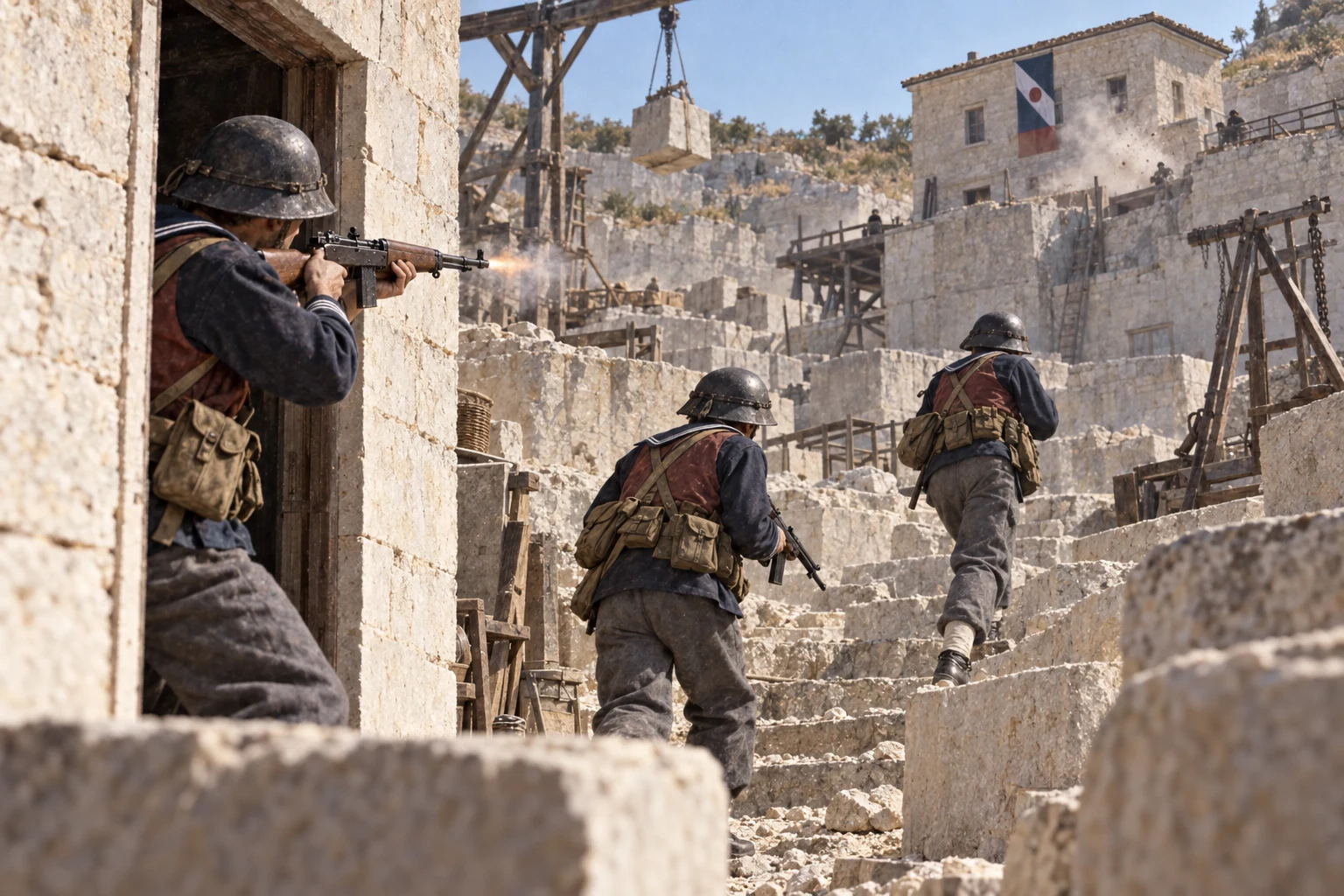
Original illustrations for this source record
Original archive artwork and captions are preserved. Dates, labels and claims printed within inherited images belong to the previous edition; the revised text governs the current history.