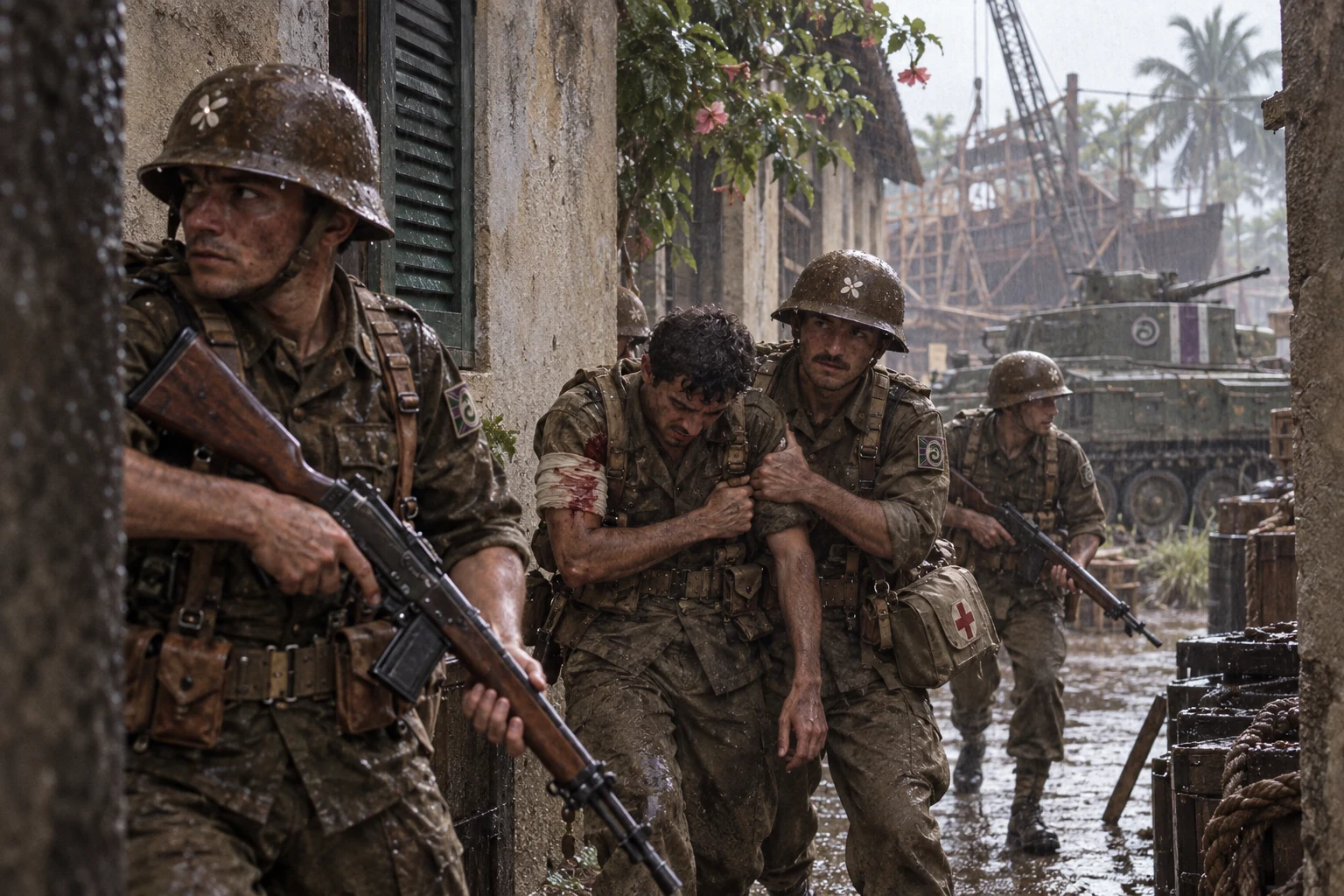
The Kelonese homeland landings
July 16–August 12, 1235 · Kelonese mainland, western Grand Isles · Silvian marine and army formations with Allied support against Kelonese homeland forces
The last national stronghold
The assault on the Kelonese homeland began July 16, after years in which Silvian forces had learned amphibious warfare through severe losses across the Grand Isles. Kaisora, the capital on the mainland's southern coastal side, remained beyond the opening objectives. Major General Mara Isen's Silvian 2nd Marine Division formed part of the assault force, including Brigadier Alen Corv's 4th Marine Brigade. Sergeant Tavin Orrel and Corporal Eda Sorn served in the brigade's 2nd Battalion, C Company, the unit that would later reach the imperial palace. Army formations followed under Lieutenant General Nera Vell, while Admiral Oren Vask coordinated principal maritime support. Kelonese General Taren Mori commanded the threatened coastal district, reporting through the homeland command. General Hideo Saren retained responsibility for the capital defense farther ahead.
The first landings struck the coastal district of Aro Bay at 06:20. The name identified a local Kelonese place, not a new island or neutral possession. Years of practice improved coordination without making the shoreline safe. Orrel's company landed beside a damaged boatyard and lost eleven men in the first hour. Sorn helped carry ammunition and wounded soldiers through a gap between overturned fishing vessels, recognizing the confusion from earlier campaigns while lacking any power to prevent every loss. A landing craft struck wreckage and blocked a planned unloading point, forcing following boats to divert. Naval beach personnel established a replacement reception area before the delay became general. The movement showed experience expressed through recovery from failure rather than a flawless execution of the original schedule.
The boatyard district
Corv's brigade entered the boatyard workshops by noon and encountered defenders in the workers' housing beyond them. Kelonese Lieutenant Colonel Renji Sato held the district with the 41st Coastal Regiment. His soldiers included veterans returned from the island campaigns and recruits whose training had been shortened as the empire's position deteriorated. The mixture produced uneven resistance: some posts fought effectively while others lost cohesion after their officers were killed. Sato maintained contact with Mori and organized a counterattack on July 17. It recovered several houses and briefly separated C Company from the adjoining marine position. Orrel withdrew one section to restore the connection, abandoning a damaged workshop that had cost lives to take. Corv endorsed the decision after reviewing the local situation.
Army reinforcements began moving through the beachhead on July 18. Their arrival created competition for roads, casualty facilities, and unloading space already used by the marines. Vell and Isen established a shared movement headquarters while retaining separate formation commands. The arrangement prevented the army's greater mass from automatically displacing urgent marine requirements. Engineer Colonel Irena Tal inspected the coastal road and found damage beneath a surface that appeared usable. Heavy traffic was restricted until repairs strengthened it, slowing the advance but avoiding a collapse that would have interrupted the whole district. Soldiers waiting inland complained that the veterans had reached the homeland only to stand still. Their frustration was real, though the apparent delay preserved the route on which their next movement depended.
The first inland town
The Allies attacked the inland town of Merako on July 23. Army infantry advanced through its western approaches while marines secured the coastal connection. Mori committed his nearest reserve and held the town center for five days. Civilians sheltered in schools and municipal buildings, some fearing Allied troops because imperial broadcasts had described surrender as certain death. Civil interpreter Nara Kelm accompanied an Allied medical party and persuaded residents of one school shelter to permit evacuation of wounded children. Her success depended on a local teacher who confirmed the message and volunteered to accompany the first group. The evacuation did not end fear throughout the town; it created one verified example that surviving residents could assess against what they had been told.
Sato withdrew from the boatyard district on July 27 to avoid isolation as Merako's defense weakened. Orrel's company advanced through positions it had contested for eleven days and found hastily buried dead from both armies. Sorn helped identify Silvian remains through records and personal effects before the unit moved onward. The work linked the campaign to families far from the homeland being invaded, but it also confronted the marines with enemy dead scarcely older than their newest replacements. Merako fell on July 28 after its remaining defenders surrendered in separate groups. The victory opened an inland route without breaking the whole homeland defense. Saren continued preparing Kaisora, and Emperor Kaien III's government remained committed to resistance despite the worsening position.
A beachhead becomes a campaign
Mori counterattacked on August 3 against the Allied position beyond Merako. His force achieved a local penetration but failed to cut the road to Aro Bay. Vell committed an army reserve while Isen rested depleted marine battalions, resisting demands to use experienced troops for every emergency. The division's veterans were valuable precisely because they could not be replaced immediately. Orrel's company received new men during the pause and trained them within reach of distant firing. Sorn showed one replacement how to read the battalion's casualty and assembly notices, practical knowledge that mattered when familiar officers disappeared. The lesson offered no promise of survival. It gave the newcomer a better chance of finding his own unit amid the administrative disorder that combat repeatedly produced.
Isen's medical staff separated heat illness and ordinary disease from the battle casualty register while still recording their effect on available strength. Several companies entered the next phase below establishment despite receiving replacements for their combat losses. Corv used the actual morning returns when assigning tasks, refusing to treat the brigade's paper strength as proof that every veteran battalion had recovered.
By August 12, the Allies held a sustained homeland lodgment, Merako, and the roads needed to continue the campaign. Allied losses across the opening operation were 14,806 killed, 39,214 wounded, and 1,703 captured. Kelonese losses were 19,672 killed, 42,608 wounded, and 17,419 captured, with wounded prisoners counted once. Civilian deaths attributable to fighting and immediate evacuation numbered 6,184. Kaisora and the Palace of the Dawn Court remained ahead, with months of battle before national capitulation. Orrel and Sorn survived the landings and remained with their company. Nothing raised above Aro Bay substituted for the final scene still to come: the Silvian flag would rise over the imperial palace only on November 21, after the noon ceasefire ended the national war.
Original illustrations for this source record
Original archive artwork and captions are preserved. Dates, labels and claims printed within inherited images belong to the previous edition; the revised text governs the current history.