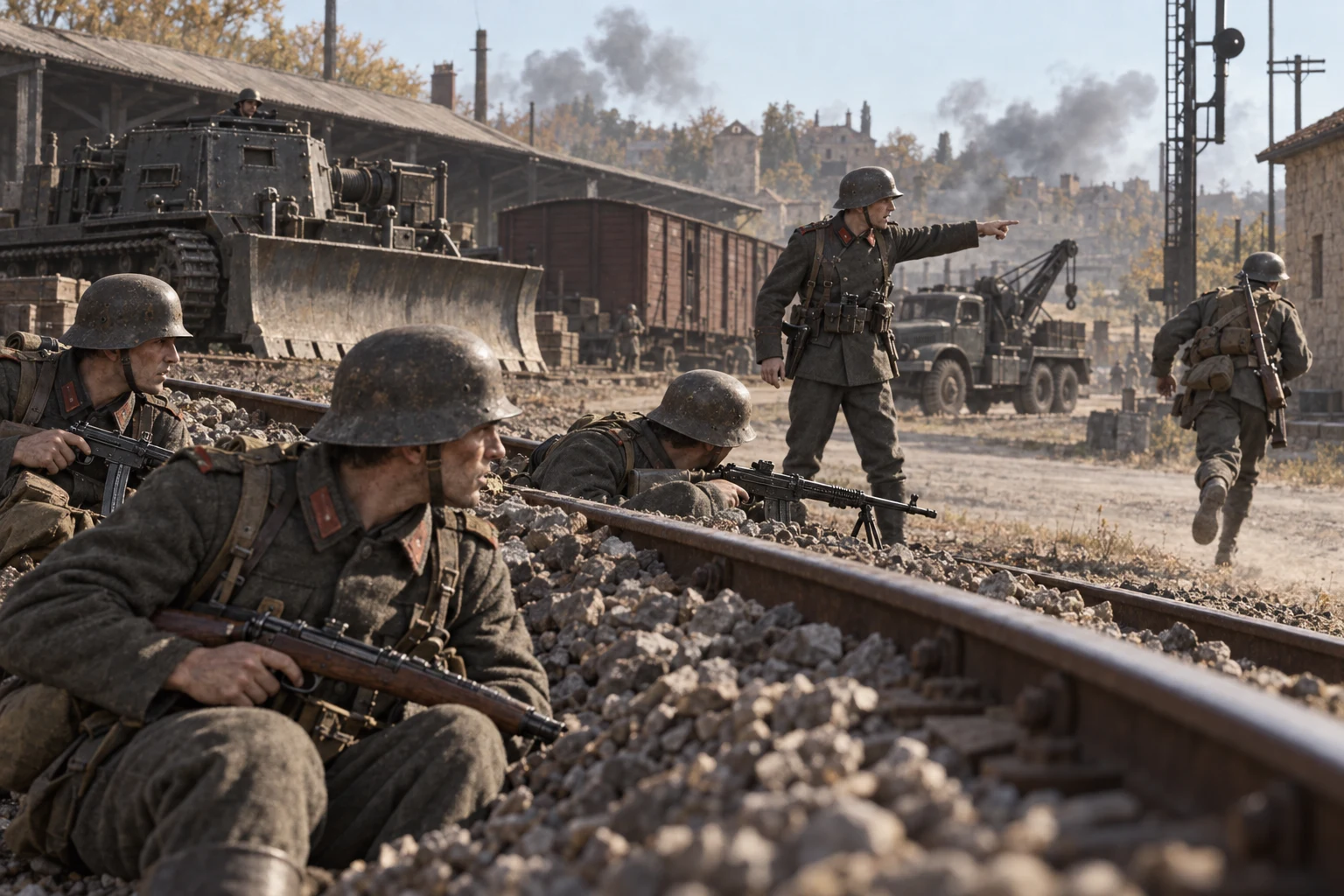
Rostan's last organized front
September 14–October 11, 1234 · Viar, Rostani-held districts of Praxen · Viar Allied and Silvian forces against the Rostani field command
The remaining army
Rostan's final organized campaign began with an army still capable of fighting but increasingly unable to restore its position. Praxen General Dena Kor coordinated her formations with Helion General Mira Alen's expeditionary detachment and Silvian Major General Mara Seln's 56th Division. Alen's force remained in Praxen after its consenting maritime deployment described in the 1230 campaign; Helion's distant homeland was a separate front. Rostani General Varen Kest commanded the opposing army grouping in occupied Praxen. Novren's attached expeditionary troops had arrived through consenting Ulmar and authorized Axis transit across Tervik and Rostan. Novren remained a separate belligerent until November 6, and its national forces were not included in Rostan's October surrender. The September operation targeted Kest's remaining communications district around the Praxen town of Verdan and his field headquarters beyond it.
The attack opened on September 14. Kor's troops advanced through an industrial district whose workers had endured years of occupation and requisition. Captain Lera Dem led her company past warehouses containing dismantled machinery prepared for removal. Several civilian workers offered to identify the equipment's original owners, fearing that retreating troops would destroy it. Dem assigned a guarded record point and continued toward the front. The decision preserved information without allowing her company to become a property investigation team during combat. Behind her, civil liaison officers began inventories that later supported restoration claims. The recovery of machines could not compensate for dead workers, but it gave surviving communities material with which to rebuild after the military occupation ended.
Verdan's station
Kest held the railway station outside Verdan with his 18th Infantry Division under Major General Oren Pell. Allied troops reached its western freight sheds on September 18 and encountered a defense stronger than the preliminary reports suggested. Seln's division lost two company commanders in the first day and halted before committing its reserve. Alen proposed pressure on an adjoining road rather than another direct effort against the sheds. The revised operation opened on September 21 and forced Pell to divide his attention. His troops retained the station but abandoned several outer positions. Kest recognized the danger and sought permission to shorten the army's line. Political authorities initially refused, still describing withdrawal as temporary disorder that determination alone could reverse.
On September 24, a Rostani counterattack recovered the western freight office and captured sixty-nine Silvian soldiers. Among them was medical Lieutenant Nera Voss, unrelated to Hukular's former director. She remained with wounded men after the rest of her detachment withdrew. Pell's medical staff treated the prisoners, although shortages delayed surgery and contributed to several deaths. Voss later testified to both the assistance and its inadequacy. Her account resisted turning surrender into either an uncomplicated rescue or an automatic death sentence. Seln learned of the capture through a recognized medical channel and informed families before the battle ended, reducing uncertainty without pretending that confirmation of life guaranteed eventual safe return.
Authority begins to fail
By September 28, Kest could no longer maintain every section of his line. Units withdrew without synchronized orders, some because neighboring positions had vanished and others because communications failed. Kor and Alen advanced cautiously through abandoned ground, finding rear guards in places reported empty. The caution cost time but avoided several attempts by Pell's troops to inflict losses on an overconfident pursuit. Civilian movement increased as residents tried to leave areas expected to become the next battlefield. Allied commanders established reception routes under their own control and coordinated them with local authorities. Those arrangements remained imperfect; a congested road outside Verdan was struck on October 1, killing ninety-two civilians and seventeen military personnel. The losses entered separate civil and military returns rather than disappearing within an undifferentiated total.
Kest received authority to negotiate military terms on October 4, but several subordinate commanders doubted the message's legitimacy. Rostan's political leadership had issued too many contradictory instructions for a single transmission to settle their obligations. Allied representatives therefore required authenticated national authorization and clear identification of the forces covered. Local ceasefires allowed medical evacuation while negotiations continued, yet fighting persisted where commanders had not accepted or received the instructions. Kor warned her troops against assuming that a white flag seen in one district bound another. The caution preserved the distinction between a local surrender, a negotiating interval, and the national capitulation still being arranged. It also meant soldiers remained exposed after newspapers began predicting that the campaign was effectively over.
The last major clash occurred on October 8 near Kest's field headquarters. A Rostani regiment attempted to withdraw through an area already occupied by Helion troops and fought for several hours before its commander accepted surrender. Alen's forces took 1,846 prisoners, including many wounded. Kest subsequently confirmed the regiment's inclusion in the negotiations and ordered remaining units to cease unauthorized movements. On October 11, Rostan's national capitulation took effect under terms binding its recognized military command. Novren's separate forces continued fighting, and Allied units facing them remained operational. The end of Rostan's organized resistance therefore simplified the Viar campaign without ending it. Prisoner registration, weapons collection, and verification of distant units continued after the formal date.
Kest's surrender staff supplied unit rolls that proved incomplete when Allied teams reached isolated depots. Some men had transferred without updated paperwork, while others had died after the last return. Joint verification teams reconciled the discrepancies over subsequent weeks, separating administrative errors from deliberate concealment. Voss's captured medical group appeared on one of the corrected lists and returned through the prisoner-release system. Her testimony helped identify patients buried during the final retreat, giving families evidence that the initial national capitulation documents could not provide.
Allied losses in the September–October campaign were 8,316 killed, 23,704 wounded, and 1,126 captured. Rostani losses before and during capitulation were 10,982 killed, 27,416 wounded, and 83,219 taken into military custody, with wounded prisoners counted only in custody. The custody figure included formations surrendering under the final terms, not merely men captured in firefights. Civilian deaths attributable to the campaign numbered 3,907. Kor's troops finally entered areas from which their army had been driven years earlier, while Seln prepared forces for continuing operations against remaining opponents. Dem returned to the machinery inventories after her company was relieved. She found workers already arguing over reconstruction priorities, a dispute possible because the army that had removed their equipment had finally ceased to rule their district.
Original illustrations for this source record
Original archive artwork and captions are preserved. Dates, labels and claims printed within inherited images belong to the previous edition; the revised text governs the current history.